
Nine 12 V power supplies, 40–350 W, in sealed enclosures
To keep up with new posts on the blog, I recommend following me on Instagram. I’ll post notifications about all new posts there, and might also write about something interesting from time to time - link to my account
You can also subscribe to updates and new articles on the Telegram channel - https://t.me/KirichBlog
A sealed enclosure doesn’t mean the power supply can operate underwater. It means it can withstand water, unlike ordinary power supplies—a very useful feature for outdoor use.
All the power supplies come in cardboard boxes labeled with the model and basic specifications, such as voltage, power, and ingress protection rating. All the models are rated
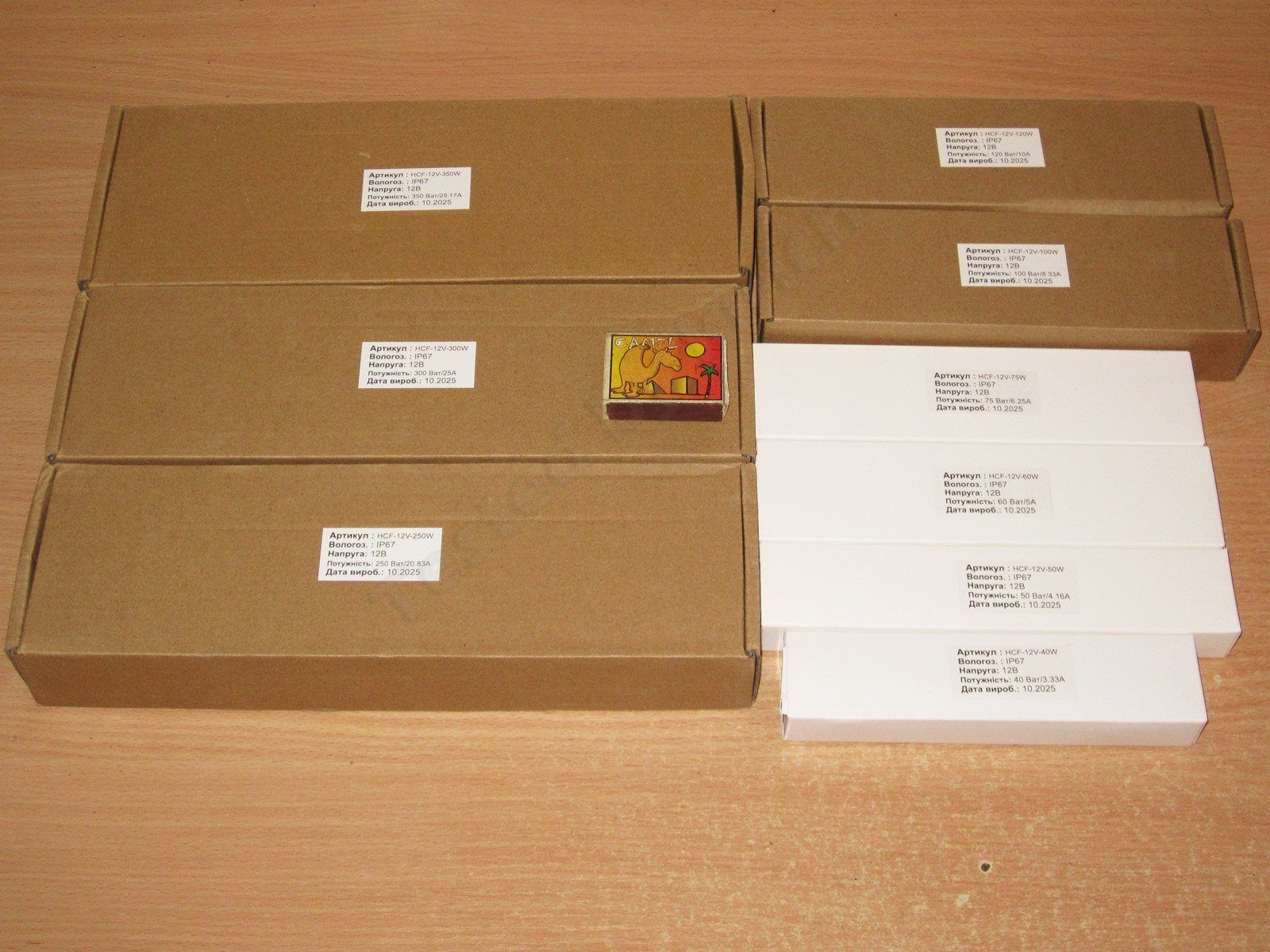
I won't go too deep into the theory, so this review will be relatively short. Also, since the power supplies are not just housed in cases but potted with compound, there won't be any analysis of the components. Still, I'll try to provide some general information based on the tests.
Strictly speaking, this is a review of 6 models, but when I started testing, I didn't know that and tested all 9. I'll explain why at the end.
These power supplies can be roughly divided into two groups. The first includes the 40, 50, 60 and 75 W models; the second, the 100, 120, 250, 300 and 350 W models.
I split them this way because of the case design and a few other minor differences.
I'll start with the lowest-power models and gradually work my way up. I think that's the logical approach :)
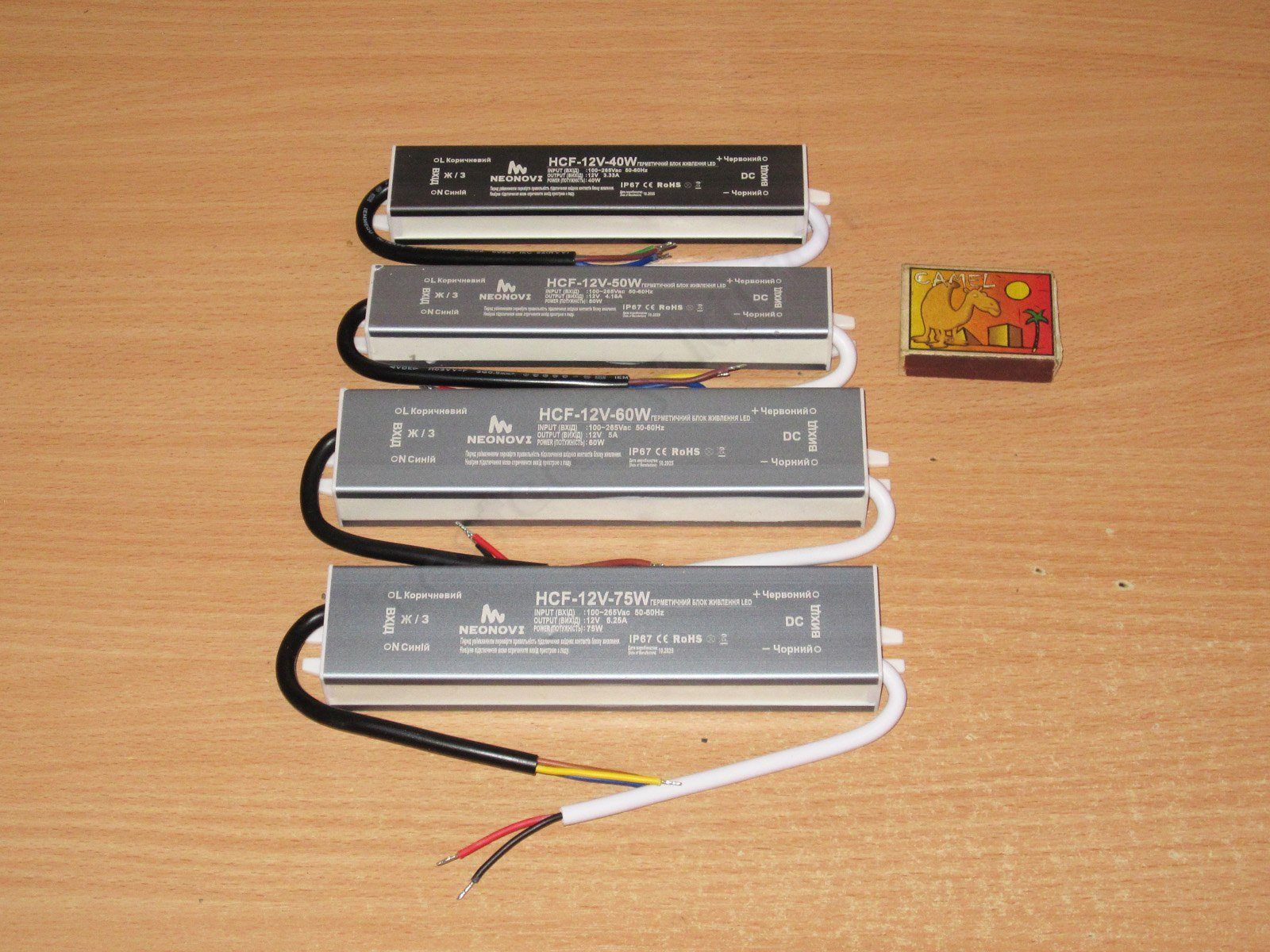
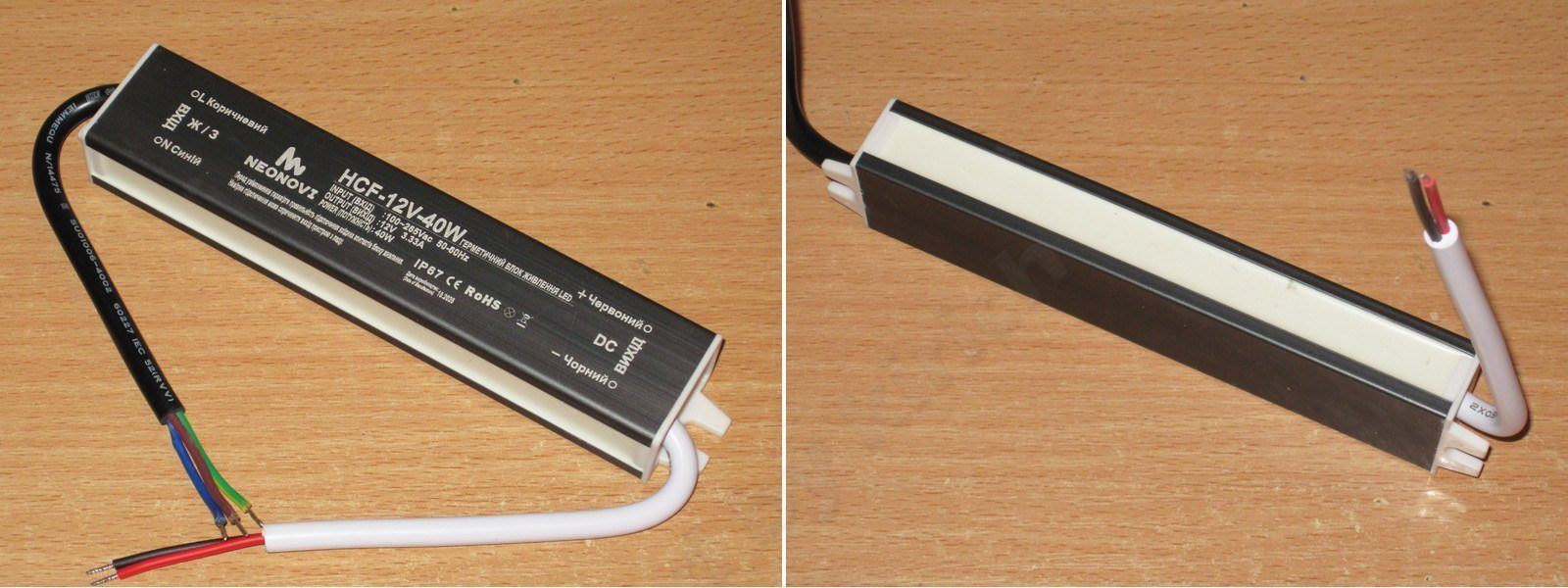
First up is the most compact and lowest-power model, rated at 40 W — link.
Dimensions: length 143/160 mm, width 30 mm, thickness 19 mm
There's a slot on the side of the case where you can see the potting compound. I assume the power components transfer heat only through it and don't make direct contact with the case, though that's fine at low power levels.
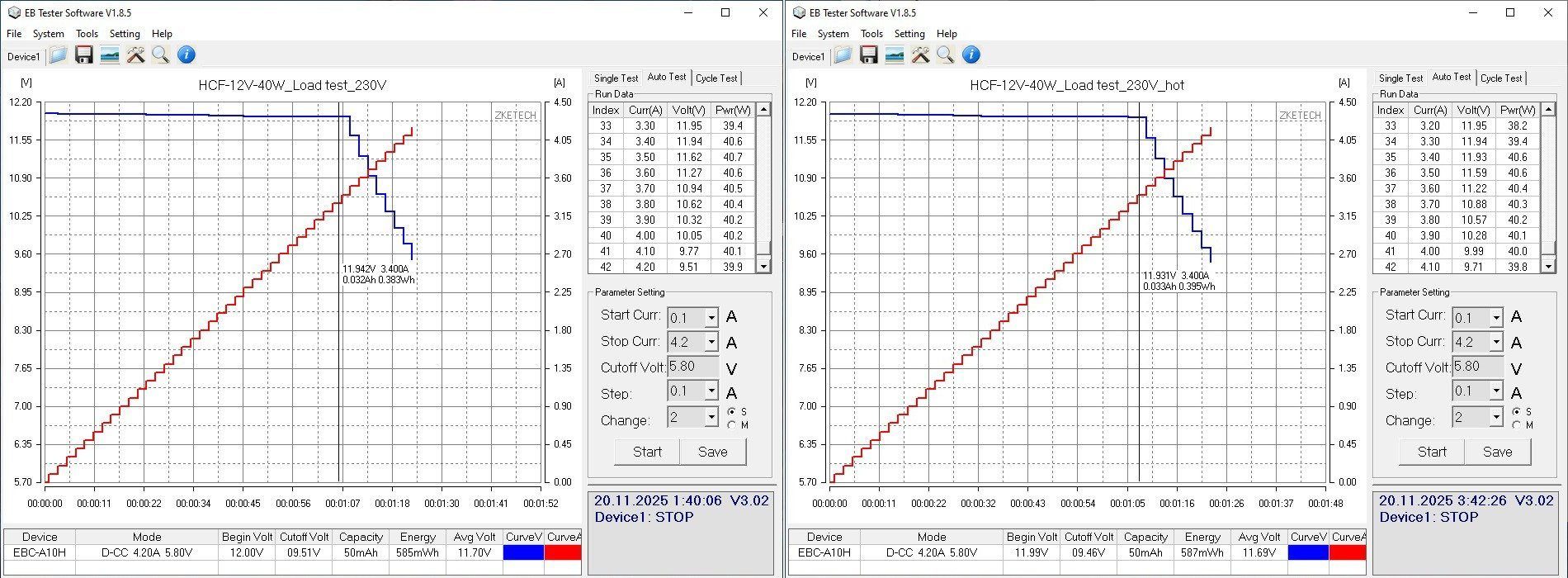
I tested the low-power models using an EBC-A10H electronic load, which makes it easier to plot the graphs.
The rated output current for this model is up to 3.33 A, and the protection is set very close to that limit: it can supply 3.4 A continuously at most, after which the output voltage starts to drop. The protection trip point doesn't depend on temperature.
If the load is stable, such as LED lighting, this protection setting is actually better. But it won't work for loads that may have current surges.
The output voltage has a slight negative dependence on load current, around 50–50 mV, including the voltage drop in the power supply's own cable.
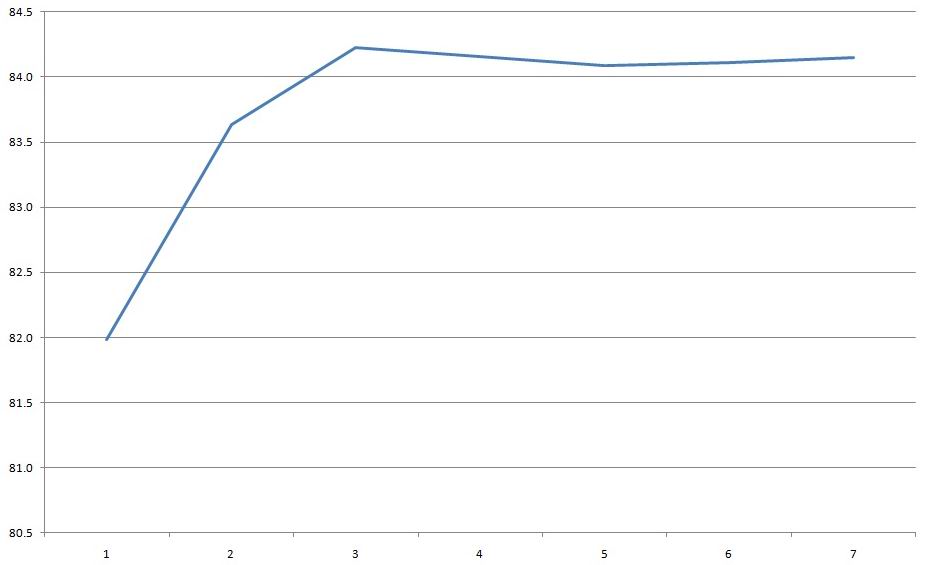
Efficiency was measured at currents from 0.5 to 3.4 A in 0.5 A increments. At the end, the protection forced me to set 3.4 A instead of 3.5 A. Including the drop in the output wires, the result was a little over 84%, which is typical for power supplies with a simple circuit design.
No-load power consumption is about 0.1 W.
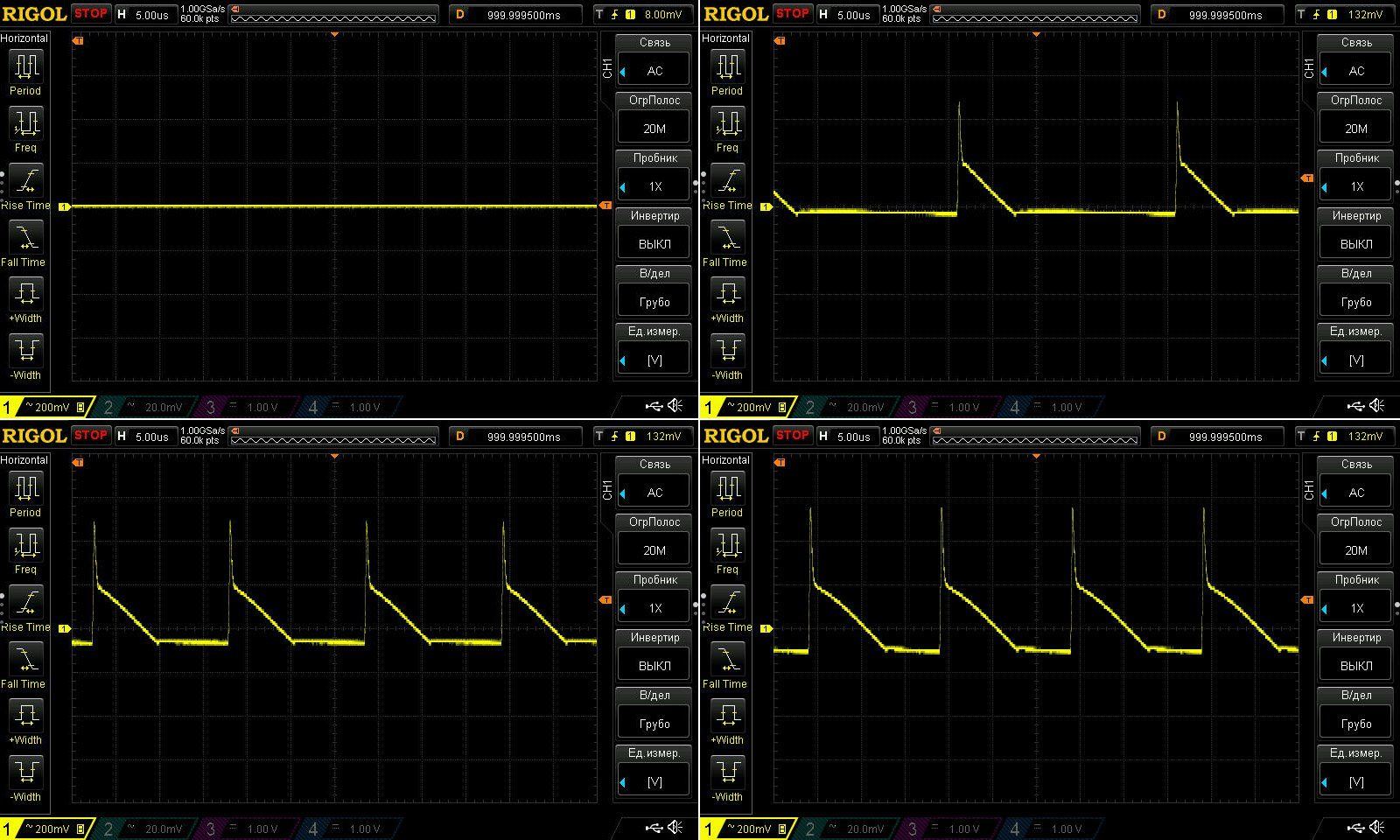
Ripple with no load and at currents of 1, 2 and 3 A.
This is also as expected: the main ripple component at full current is about 300 mV, but there are noticeable spikes, bringing the total to around 650 mV. That's perfectly fine for powering LED strips, but probably not for sensitive devices.
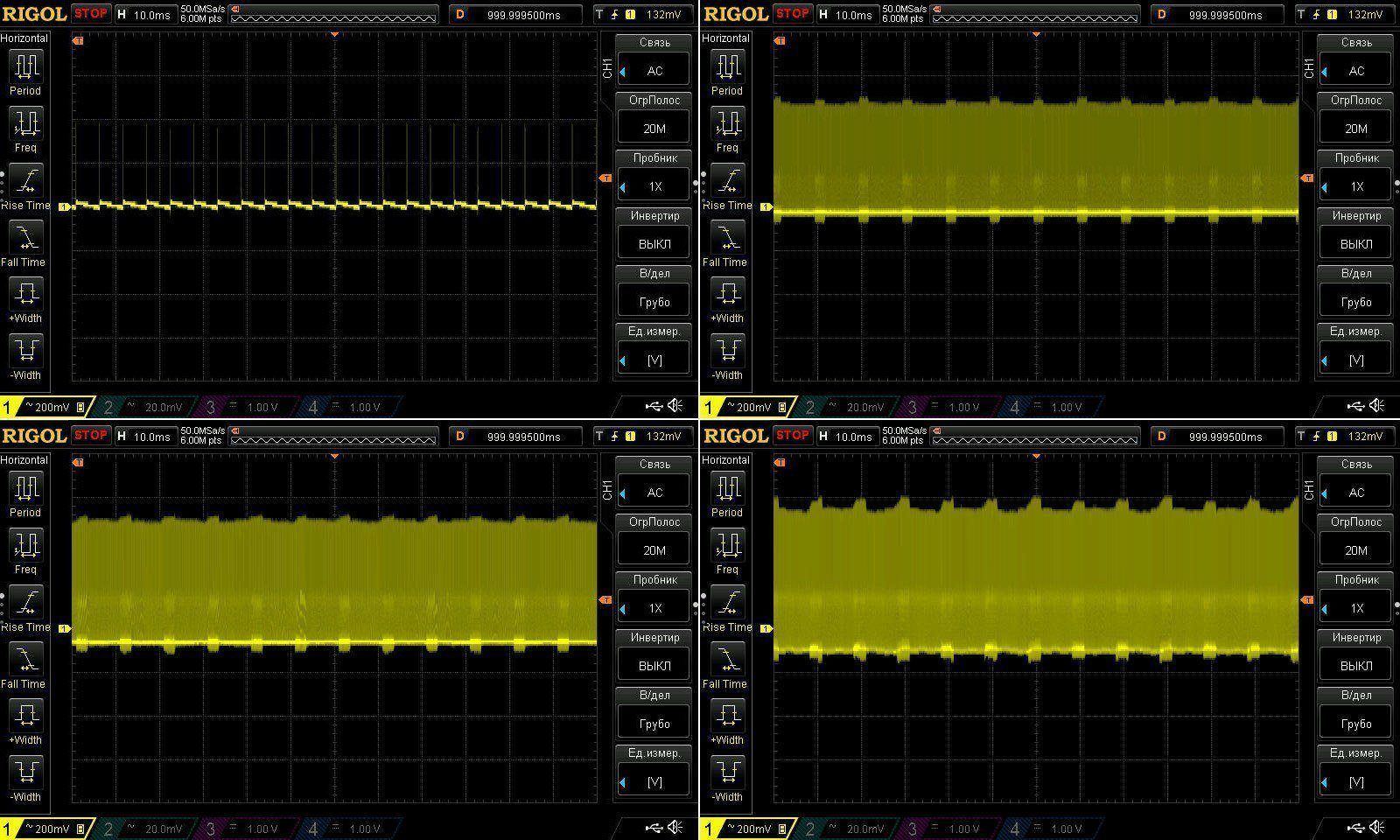
There is some ripple at the mains frequency, but it's within acceptable limits and is mainly noticeable only at maximum power.
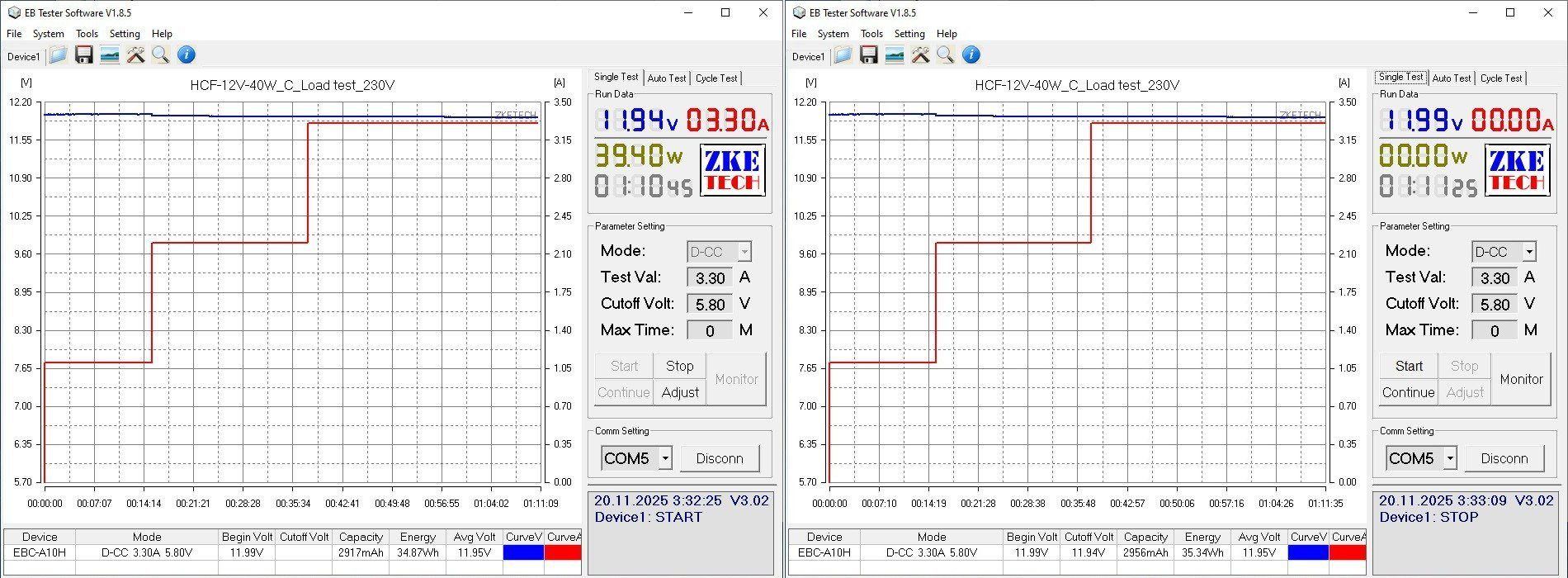
The load test was carried out in three stages, at currents of 1.1, 2.2 and 3.3 A, corresponding to about 33%, 66% and 99% of rated power. The voltage doesn't change as the unit warms up, and its dependence on load is very small—negligible, really. So everything looks great here.
For obvious reasons, with this and the following power supplies I could mostly only measure the case temperature, so the results are indirect.
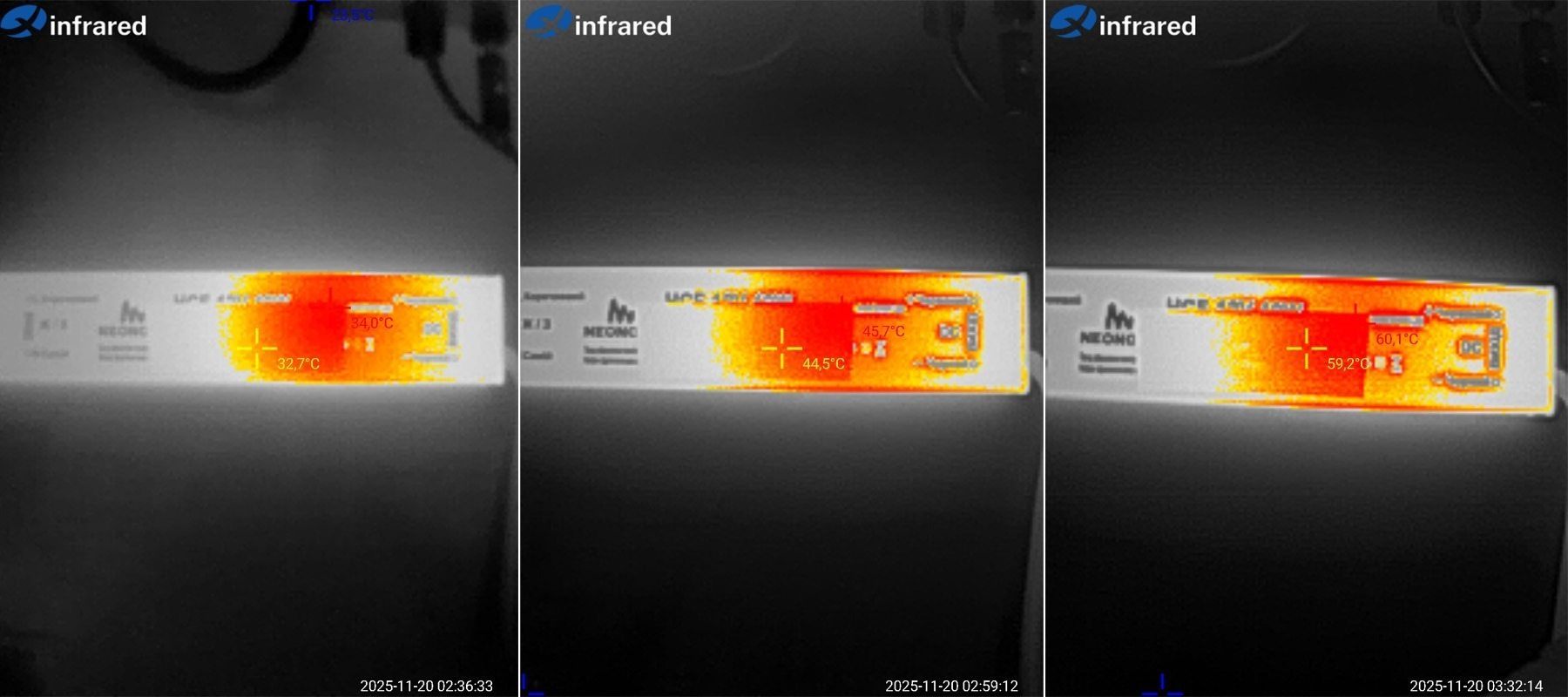
The results are for the same 33%, 66% and 99% power levels. The case got noticeably hot—around 60°C—only at maximum power. And a hot case is actually a good sign: it means heat is being transferred from the components to the surface rather than trapped inside.
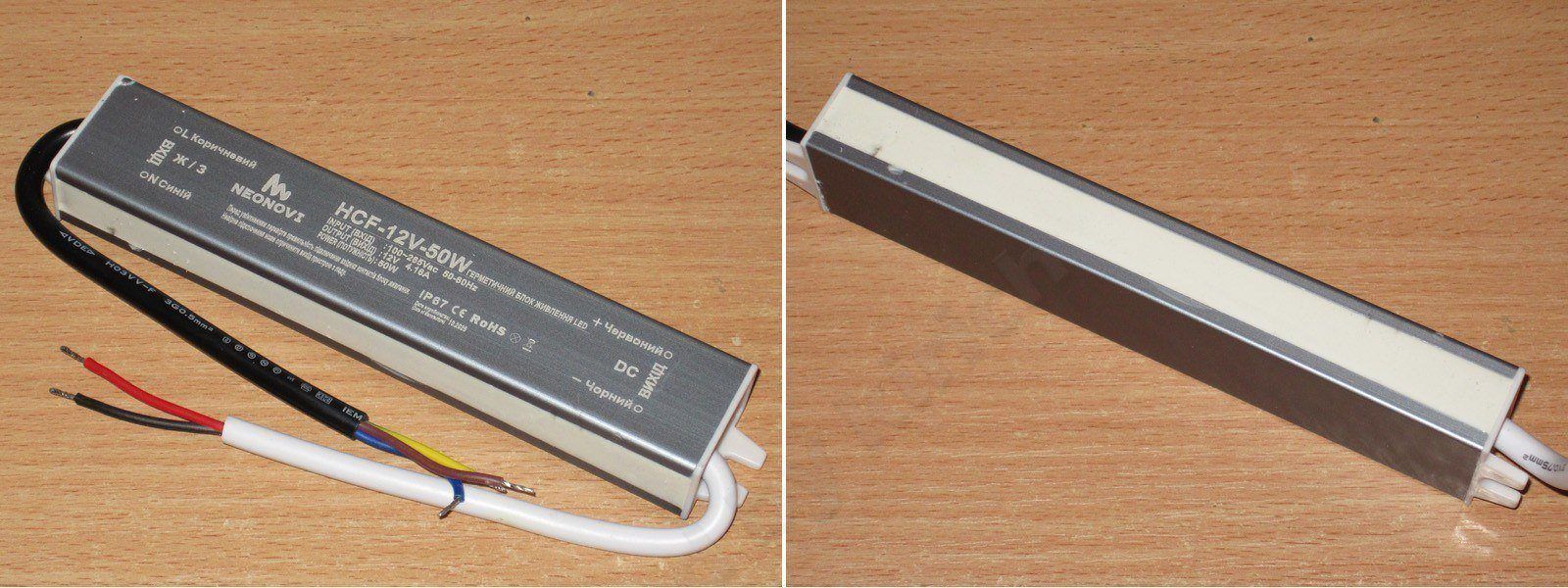
The 50 W model has exactly the same design — link
Dimensions: length 153/170 mm, width 30 mm, thickness 19 mm
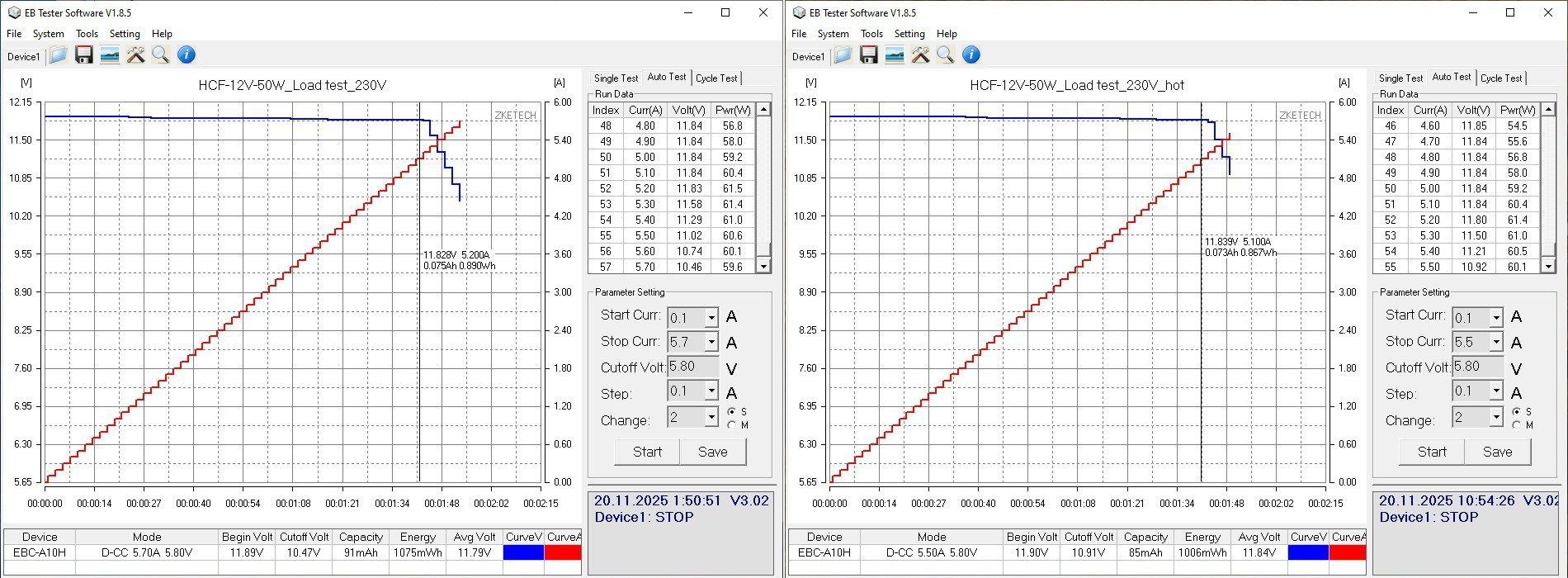
The protection is set to around 5.2–5.3 A. When hot, the current is slightly lower, at 5.1–5.2 A. The voltage drops by about 60 mV under load, most of which is clearly due to the output cable. Just to clarify, I used the four-wire method to measure voltage, but since the power supplies can't be opened, the measurement was taken at the power supply's output cable.
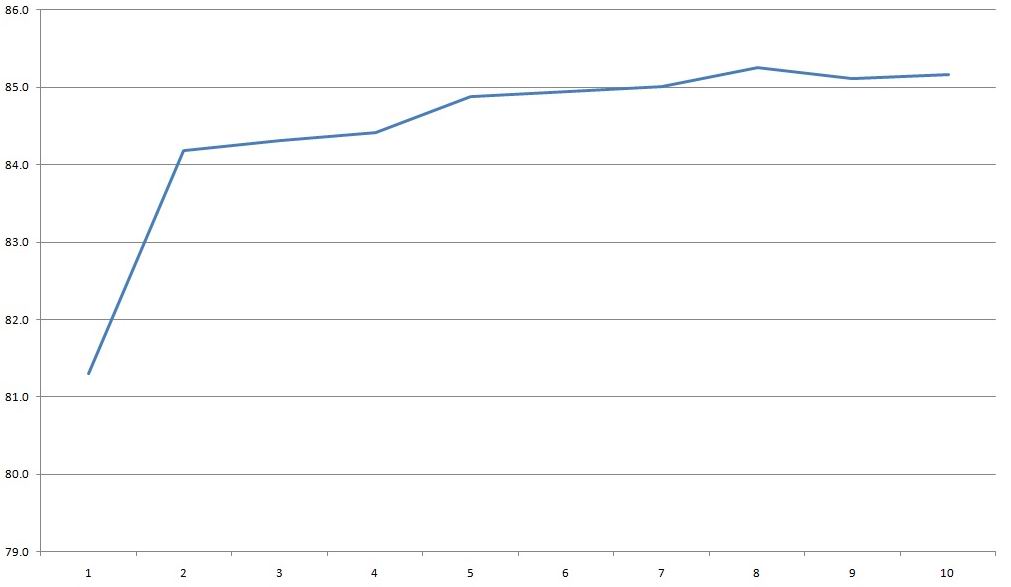
Efficiency at currents from 0.5 to 5 A in 0.5 A increments. The result is slightly better here, at around 85%.
No-load power consumption is about 0.2 W.
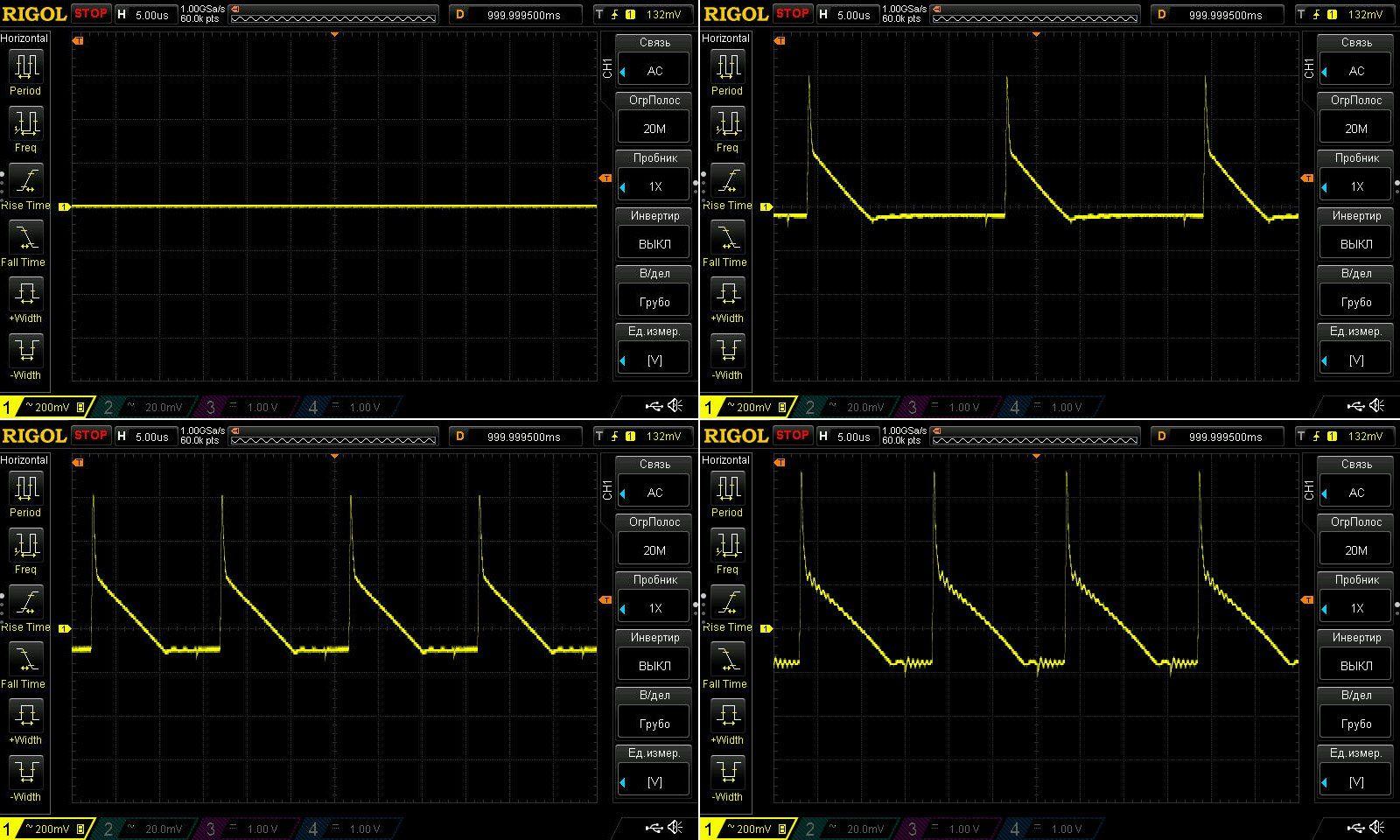
Ripple is roughly proportionally higher than with the previous model. I measured it with no load and at 1.5, 3, and 4.5 A.
At full current, I got around 400 mV for the main ripple and 800 mV peak-to-peak. In my opinion, that's still a bit much, but it all depends on how budget-oriented the power supplies are. For inexpensive units, this is more the rule than the exception.
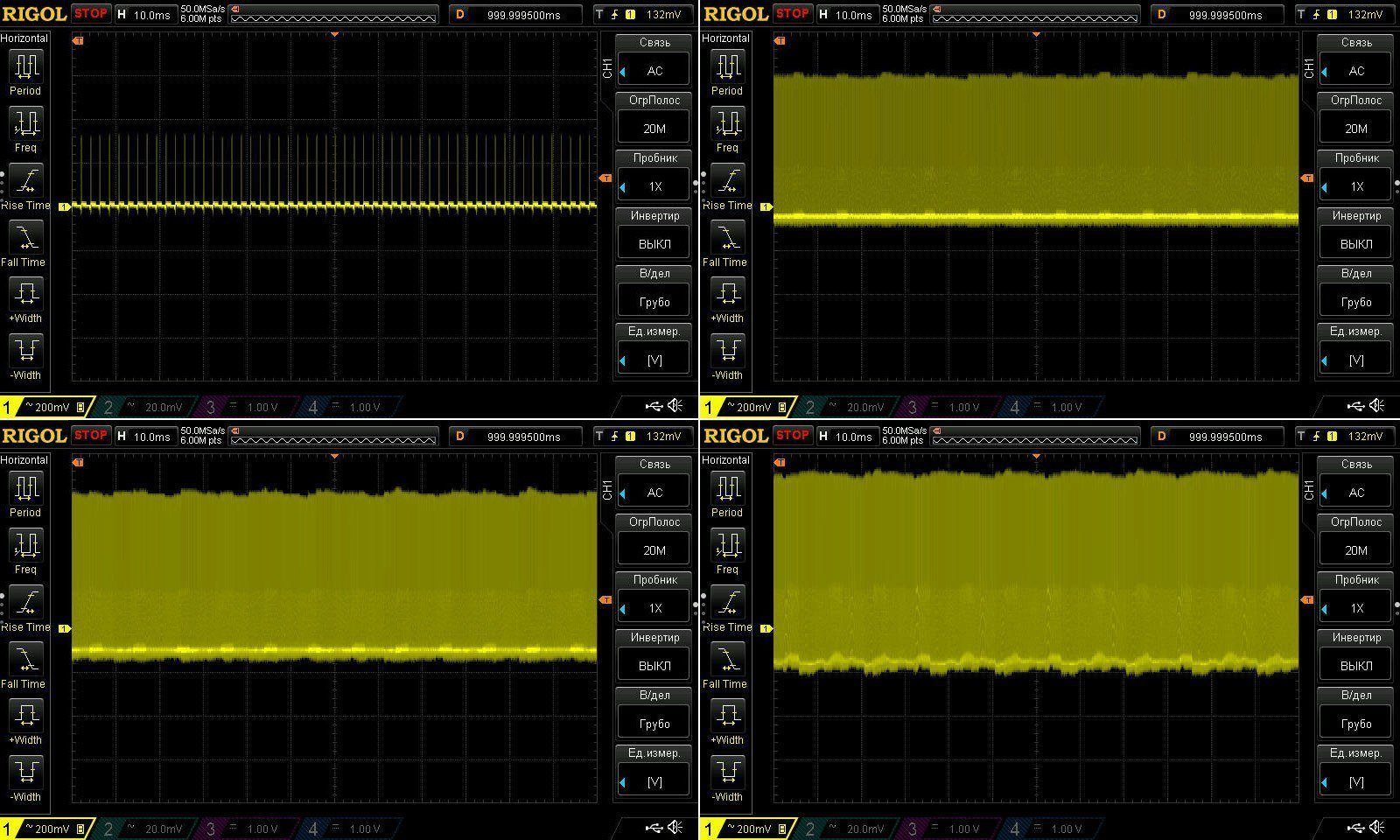
There is some 100 Hz low-frequency ripple, but it's much less pronounced. I assume the input capacitor has a higher capacitance; that could also explain the slightly higher efficiency, by the way.
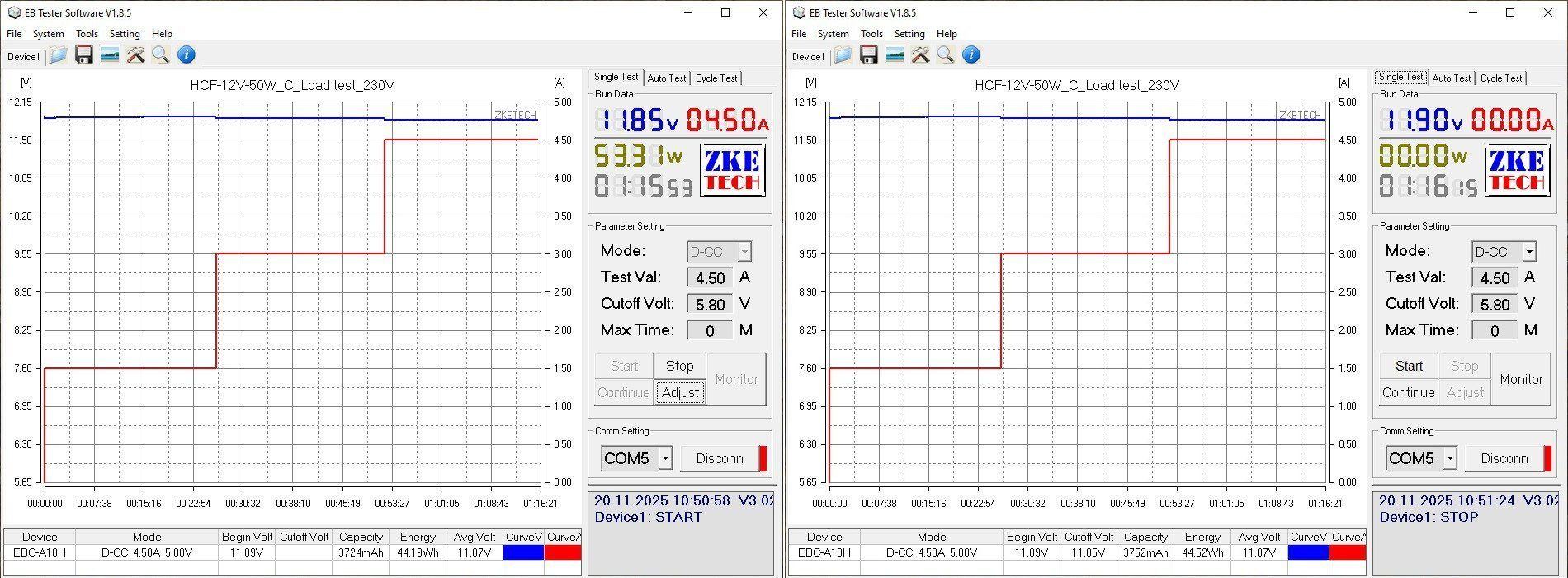
The load test was run at the same current levels: 1.5, 3, and 4.5 A. The voltage rises slightly as the unit warms up, but the change is right at the limit of measurement sensitivity, around 10 mV.
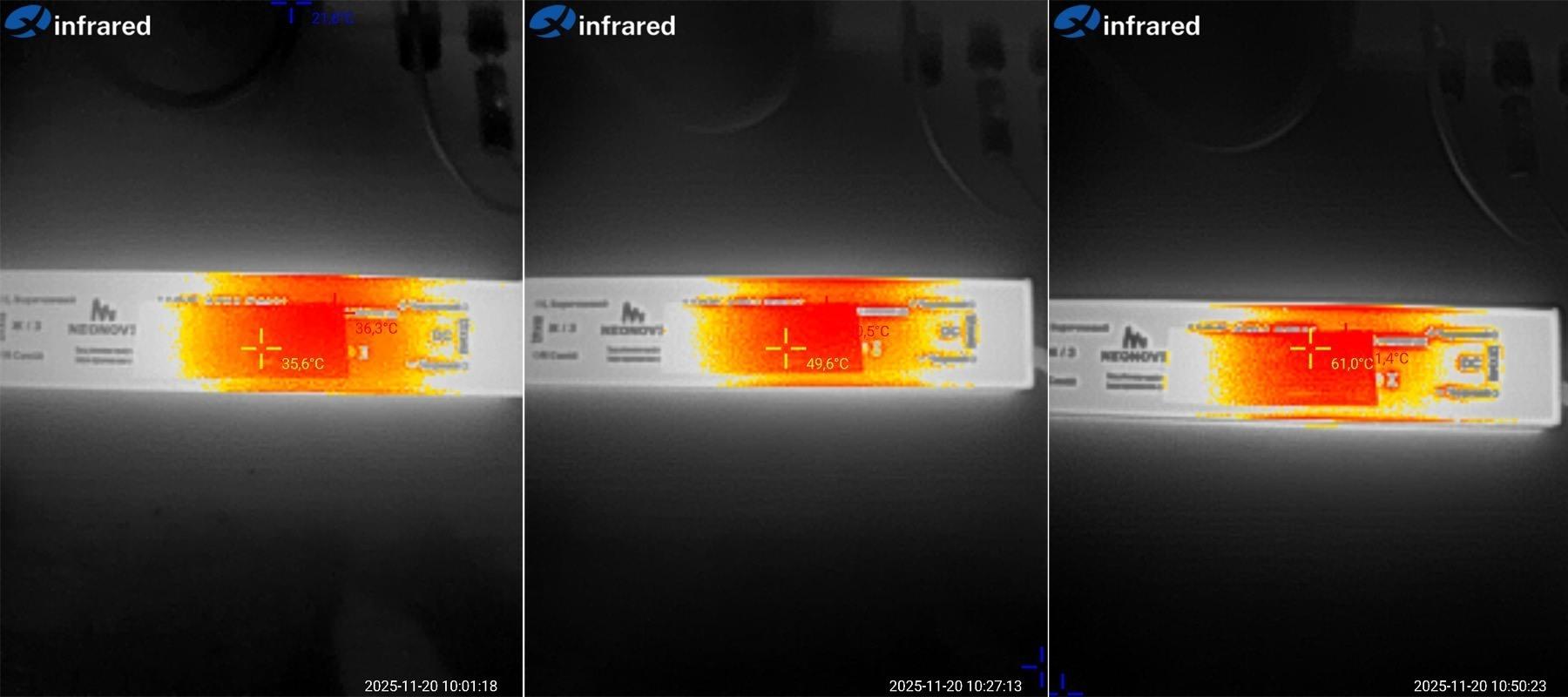
The temperature is almost the same as with the previous model: around 50 degrees at 66% load and 61 degrees at 100% power. That's to be expected: the case is slightly larger, efficiency is slightly higher, and at the higher power we get a comparable temperature.
The 12 V, 60 W model has the same basic case design; the only difference is the size — link.
Dimensions: length 168/185 mm, width 40 mm, thickness 22 mm
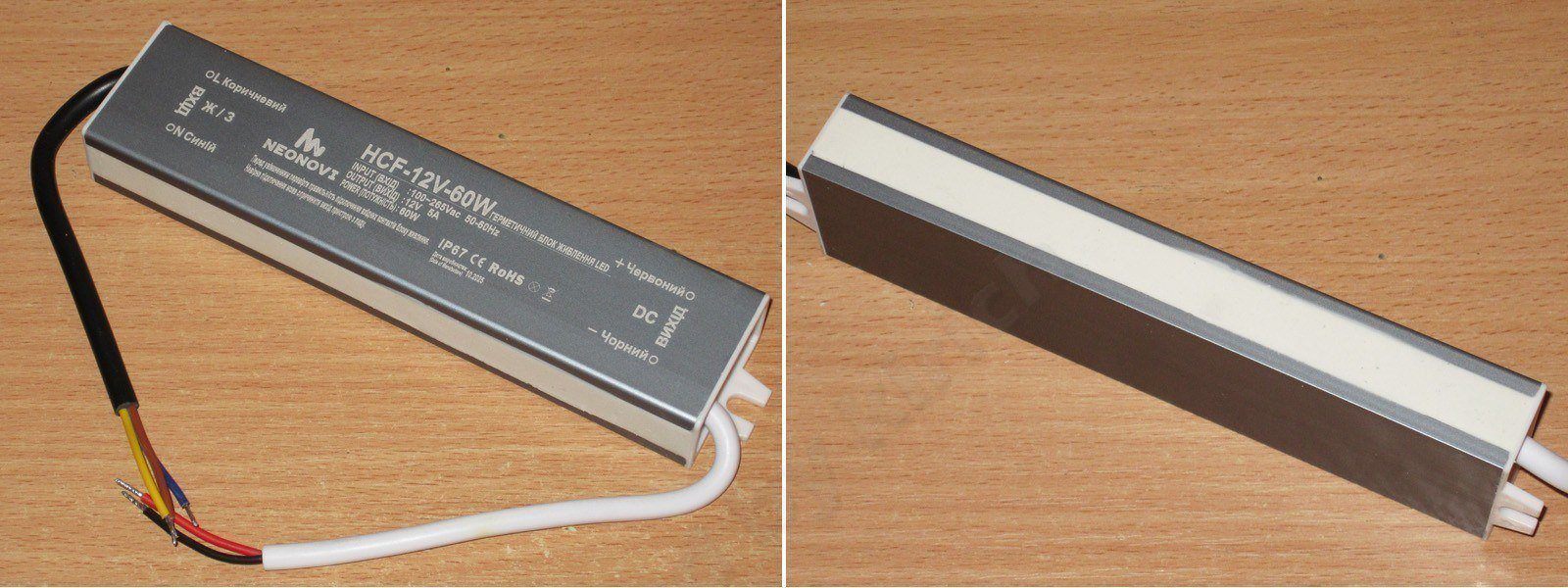
Here, overcurrent protection trips at around 8.2–8.3 A when cold and 8.0–8.1 A when hot. Personally, I don't like that, since it's well above even 50% of the rated power. Sure, for some applications that's a plus, but in my opinion it's unsafe: an unqualified user might buy the power supply and keep piling on the load, thinking, “Well, it works.” The outcome is predictable: either it fails quickly or its service life is drastically shortened.
Under load, the voltage drops by about 110 mV. Neither good nor bad, really—well within the normal range.

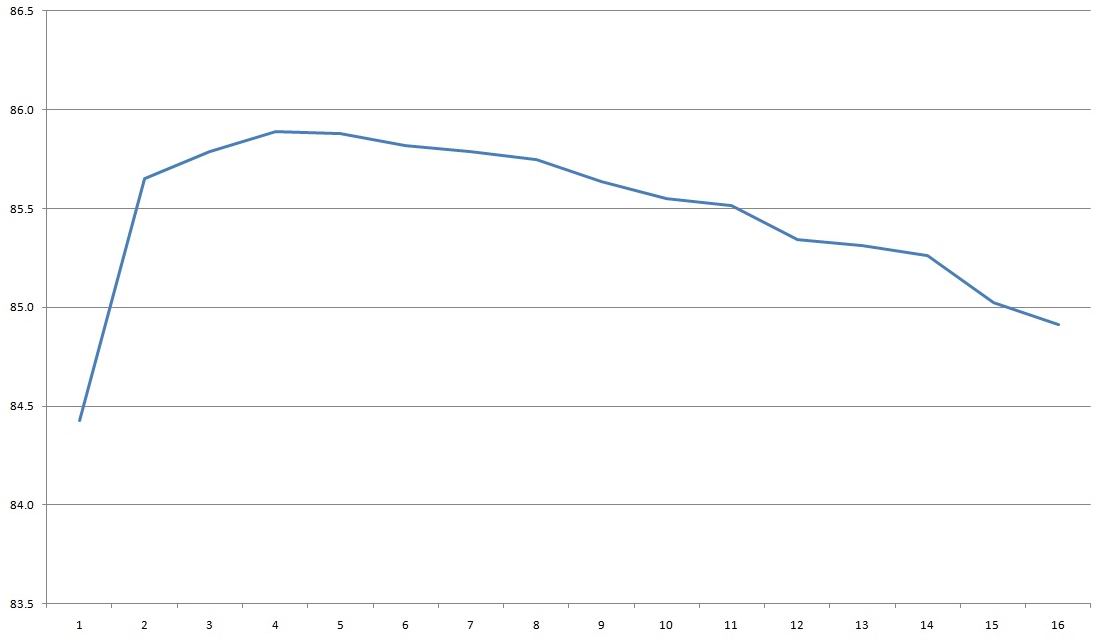
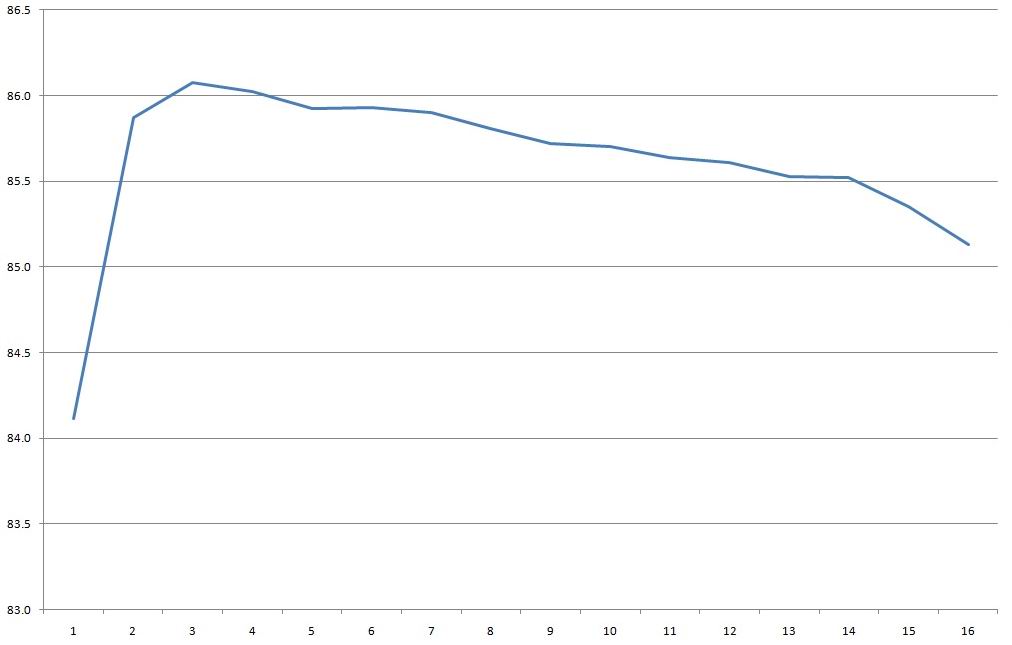
I measured efficiency from 0.5 to 8 A in 0.5 A increments; it came to around 85.5%, slightly higher than the previous model.
No-load power consumption is about 0.1 W.
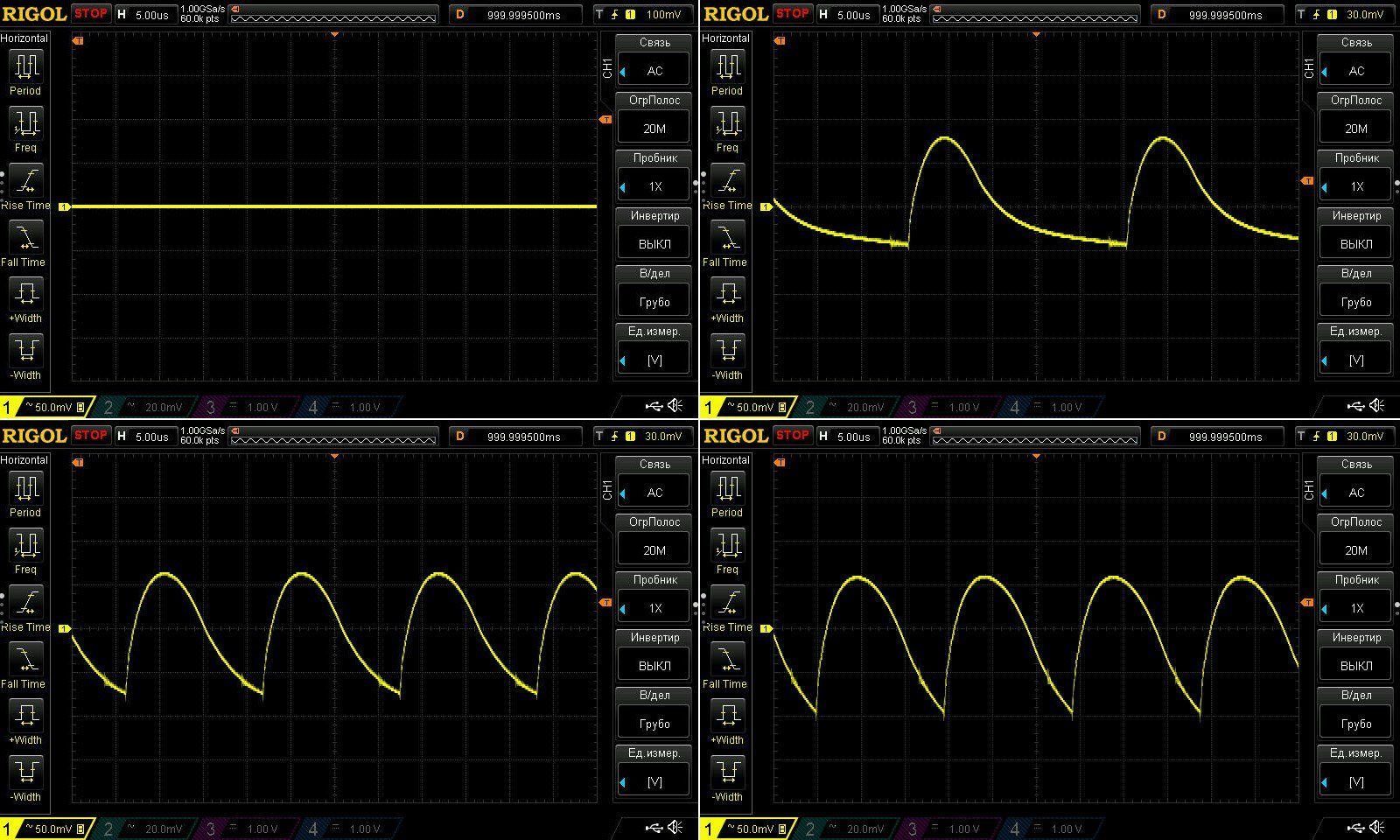
Ripple with no load and at 2, 4, and 6 A.
Here, I can only give it praise: even at 120% load, ripple was around 150 mV, which is perfectly normal and clearly better than on the previous two models. The manufacturer did say that this model has an additional output filter, and that's exactly what we see.
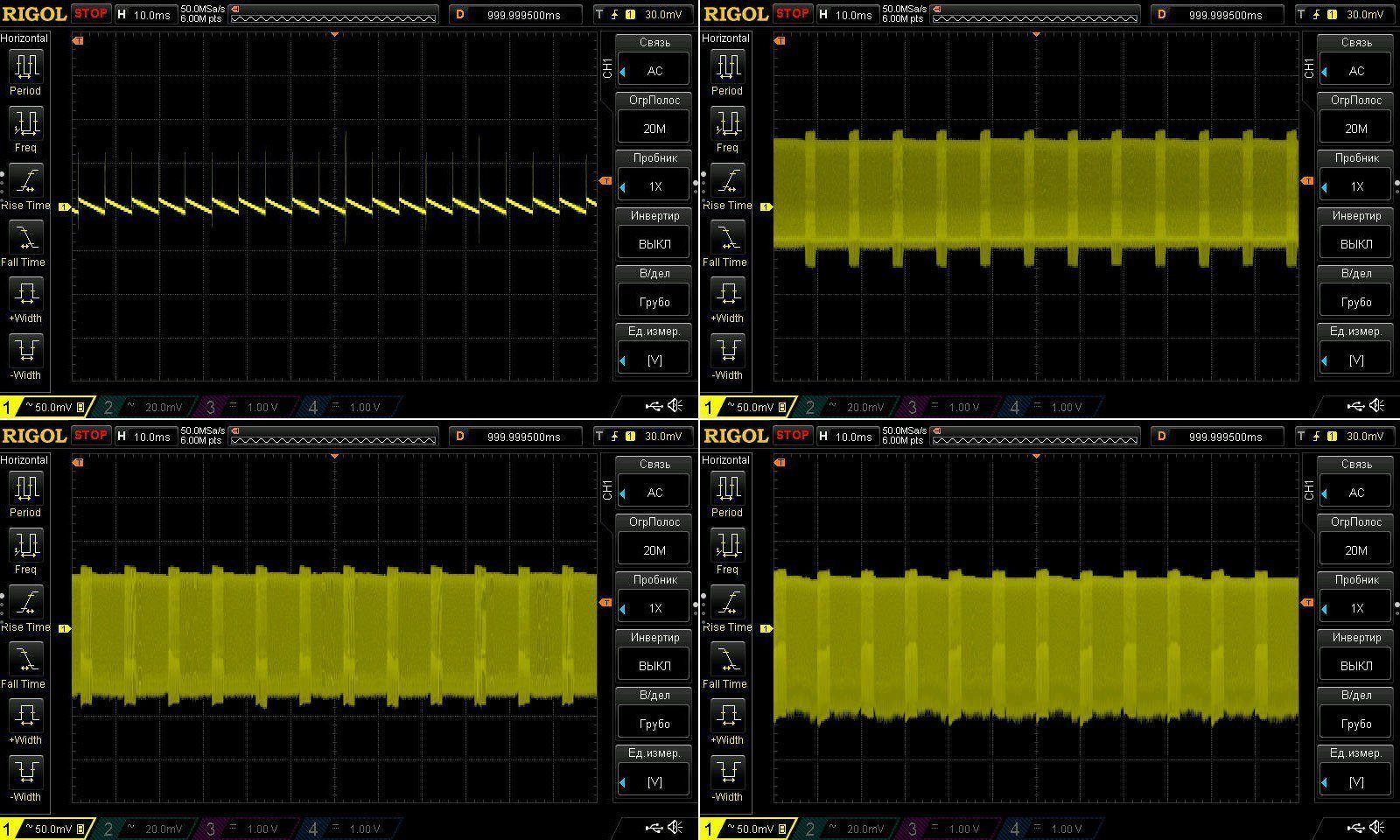
There are small spikes at 100 Hz. They seem perfectly acceptable to me, and they appear regardless of the load.
The load test was also run at 2, 4, and 6 A, so the final stage was at 120% load.
The voltage increases slightly with temperature, but by only around 20 mV, which is very good.
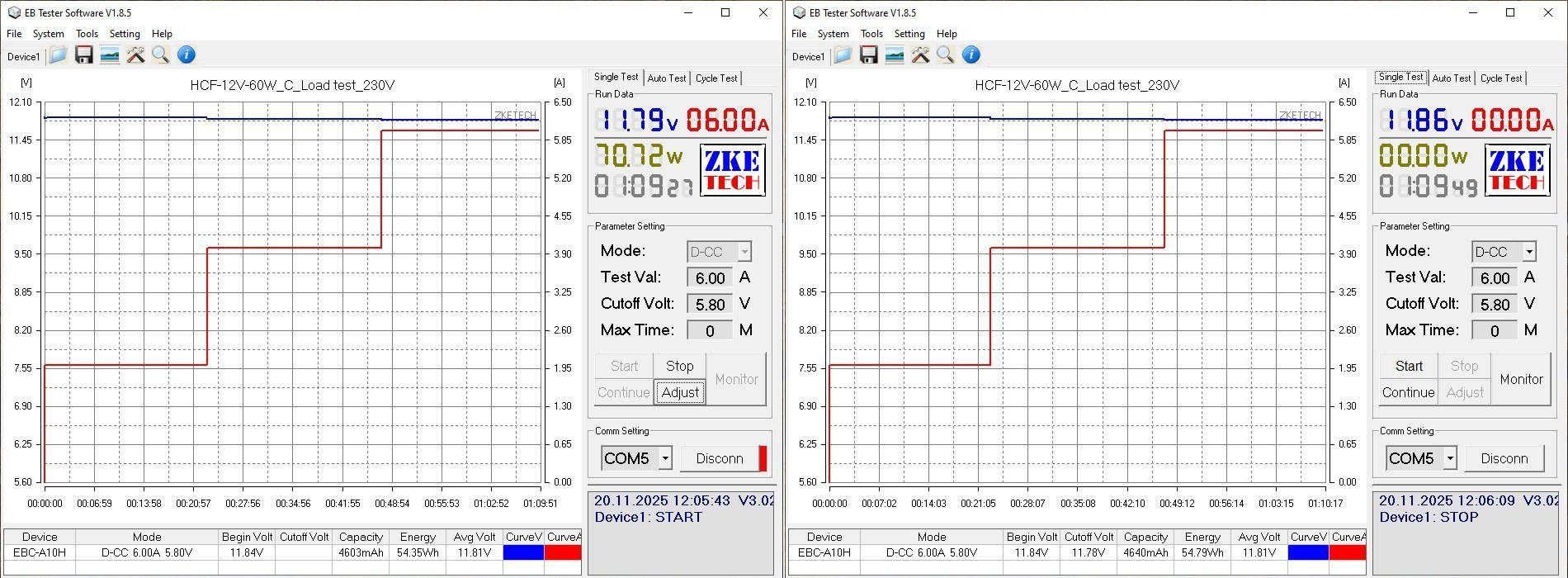
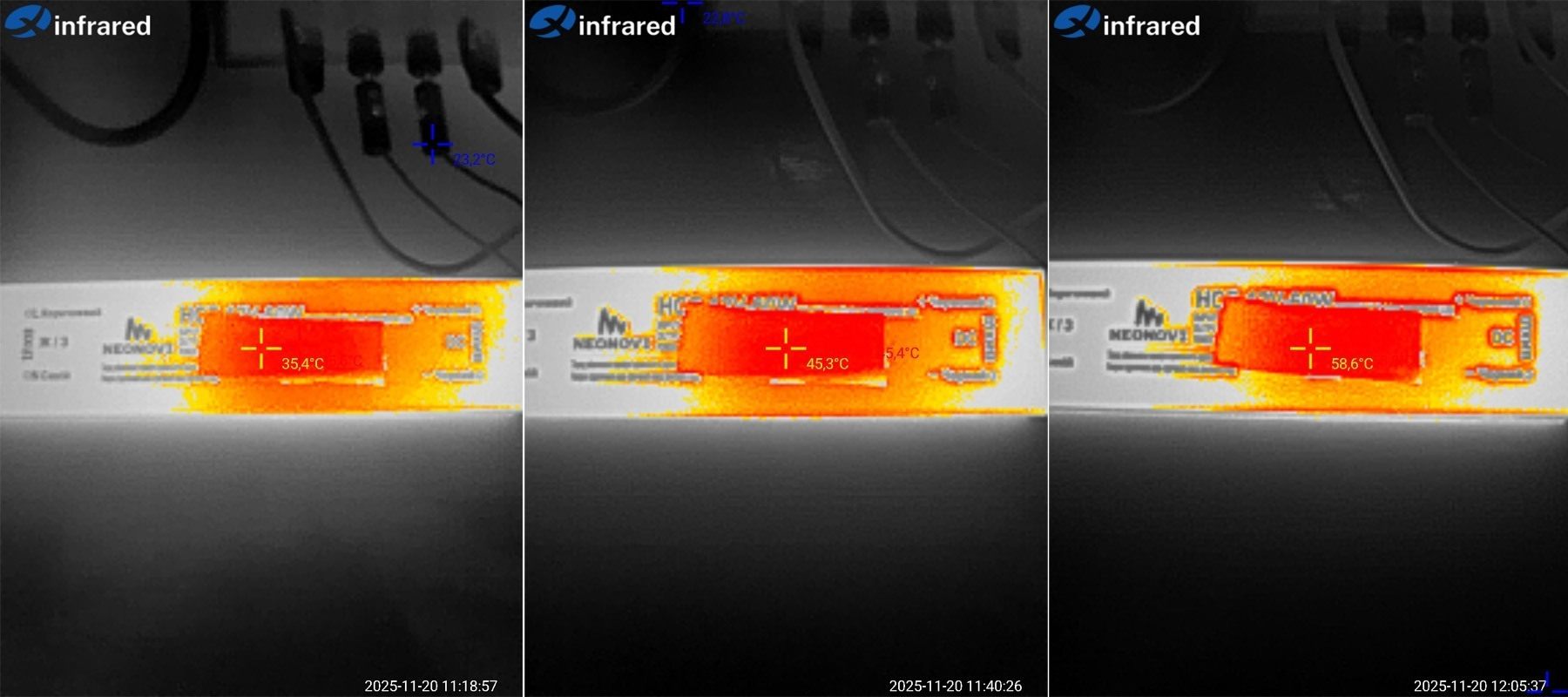
The case temperature was even a little lower than on the previous models: 45 degrees at 4 A and 58.6 at 6 A. It's hard to say what made the difference—poorer heat transfer or the larger case. As they say, it is what it is. I think the power supply should last a long time at a load current of 4.5–5 A.
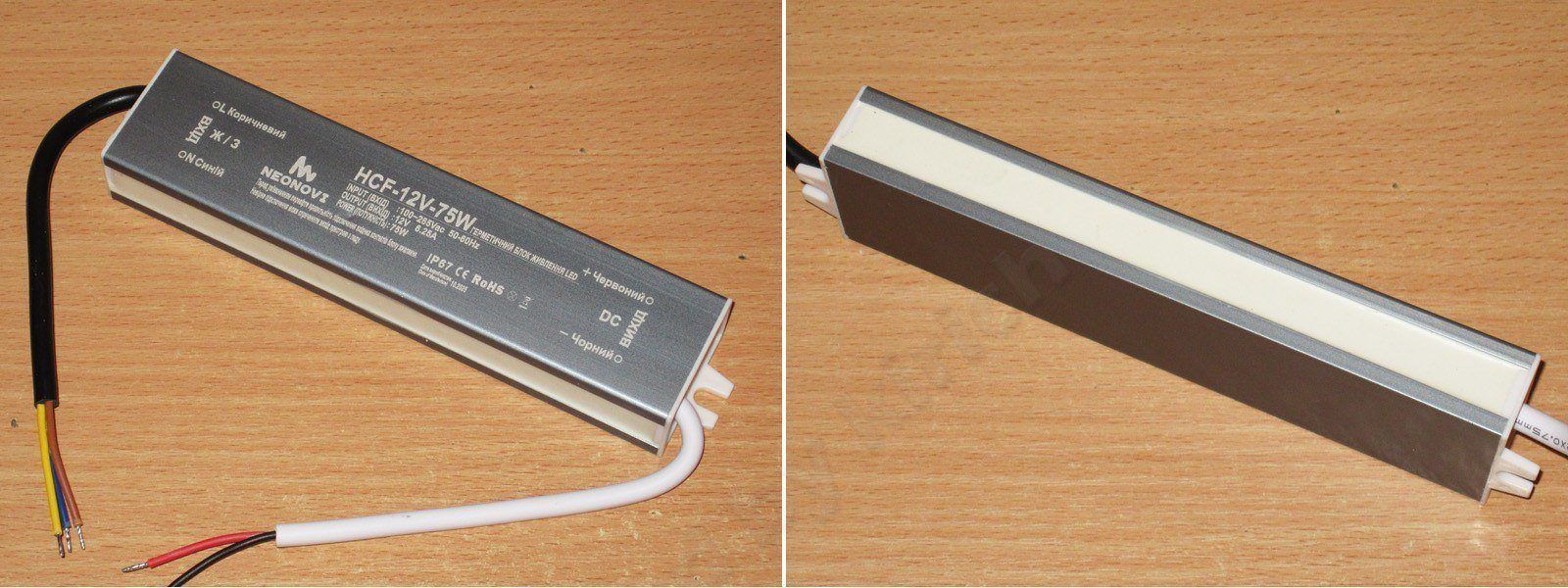
The 12 V, 75 W model looks identical to the previous one apart from the label — link
Dimensions: length 168/185 mm, width 40 mm, thickness 22 mm
Interestingly, the overcurrent protection trips at a slightly lower current than on the previous 60 W model: that one was around 8.3/8.1 A, while this one is 8.0/7.9 A.
At 8 A, the voltage drops by about 100 mV, which is perfectly normal; at the rated current, the difference is even smaller.
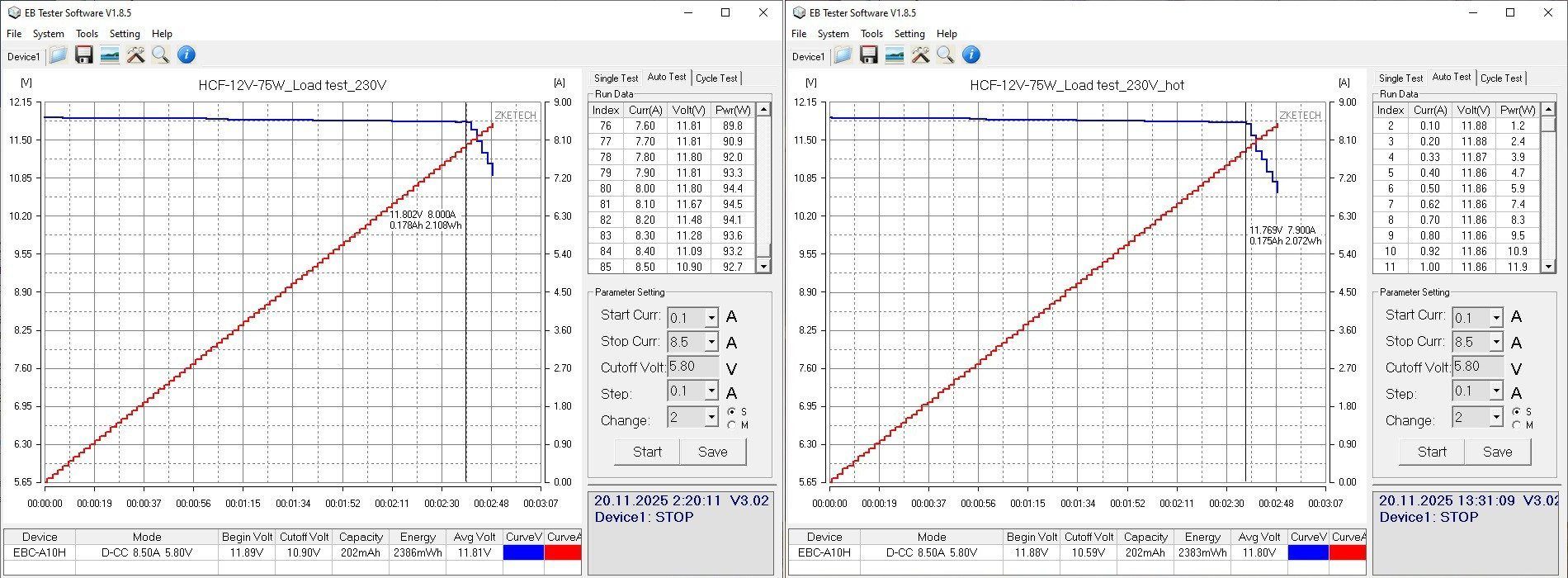
Efficiency from 0.5 to 8 A in 0.5 A increments is essentially the same as on the previous model, a little over 85.5%. The difference is within the measurement error.
No-load power consumption is about 0.1 W.
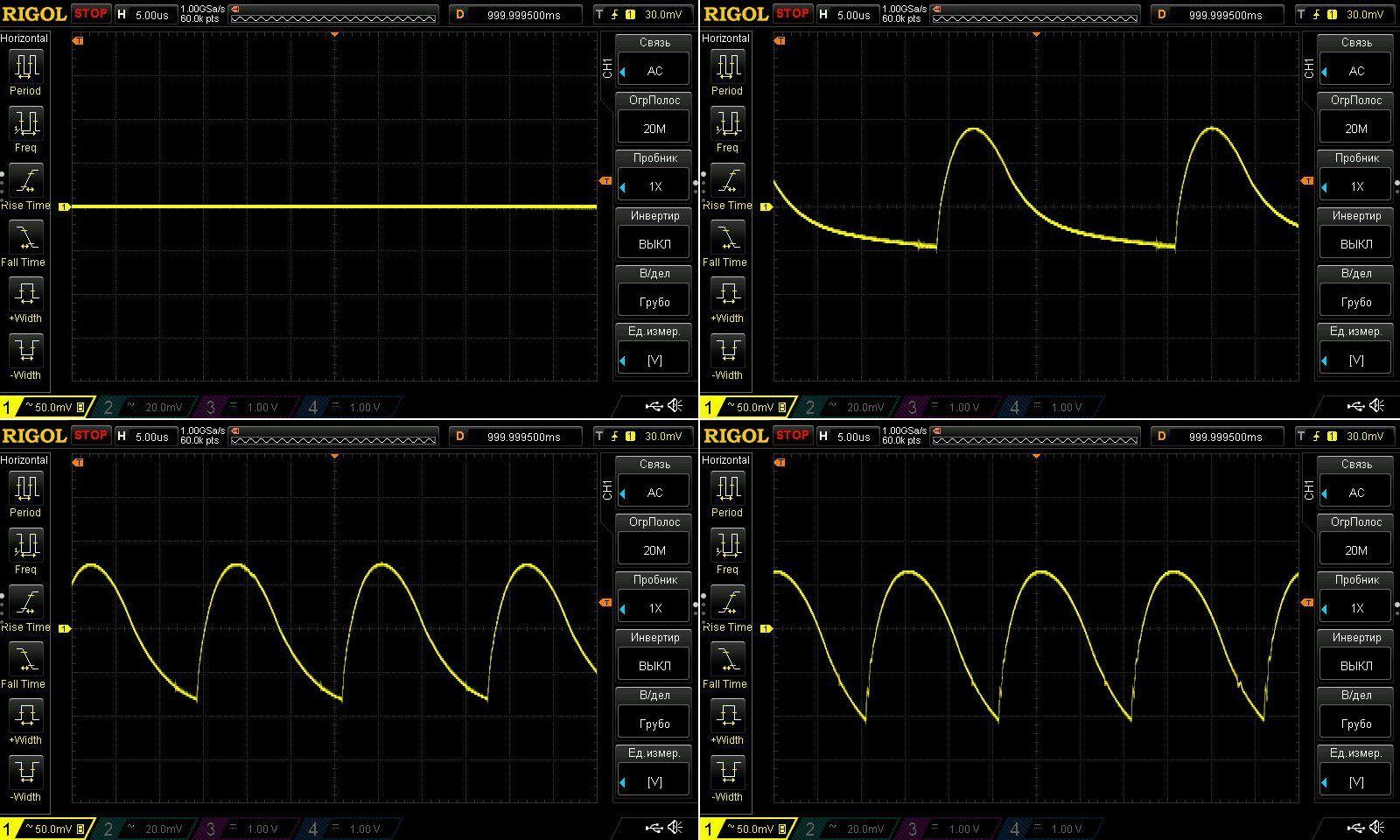
Ripple at no load and at currents of 2, 4, and 6 A is practically identical to the previous model. That one had about 150 mV; this one is closer to 170 mV.
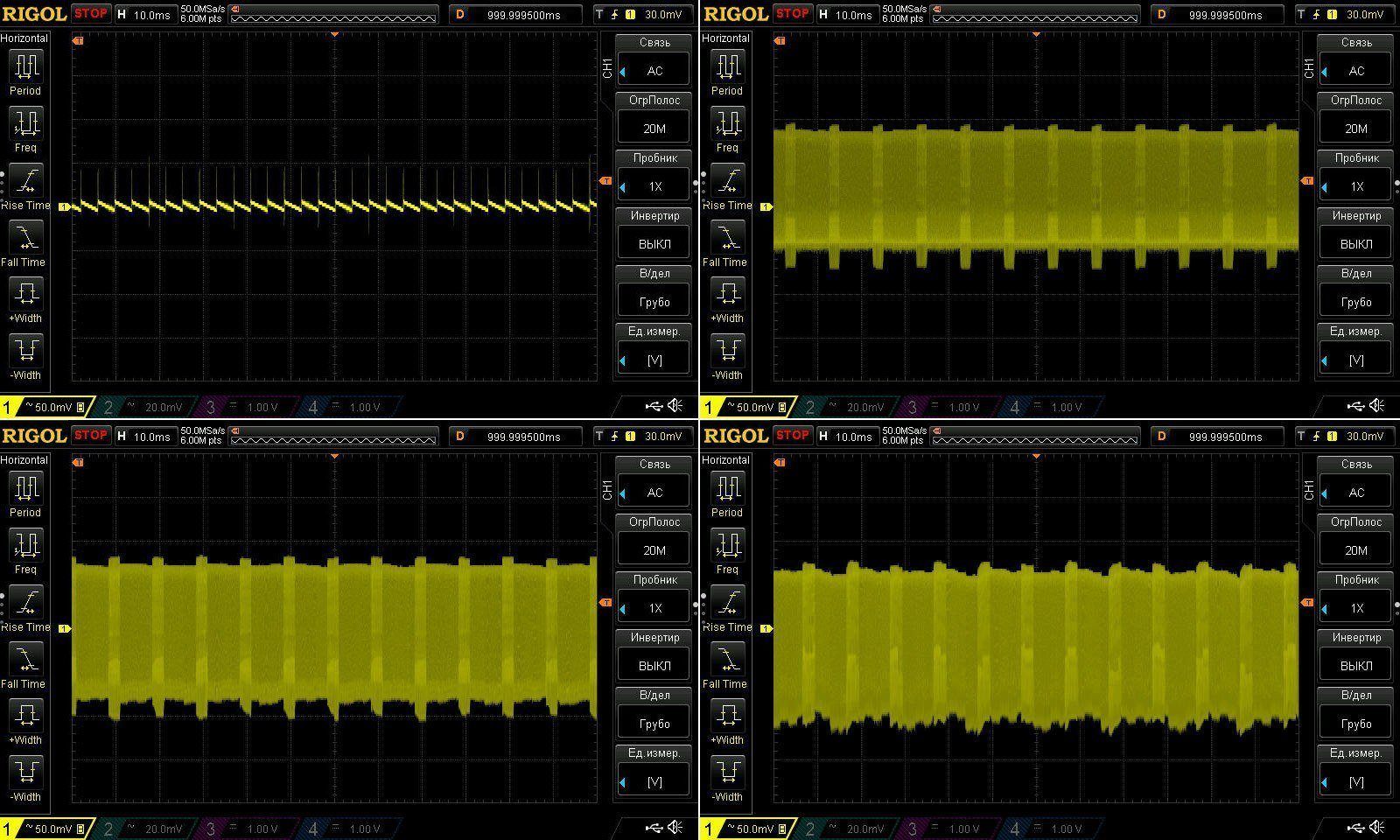
At low frequency, the results are identical to the 60 W model. I have no complaints here either.
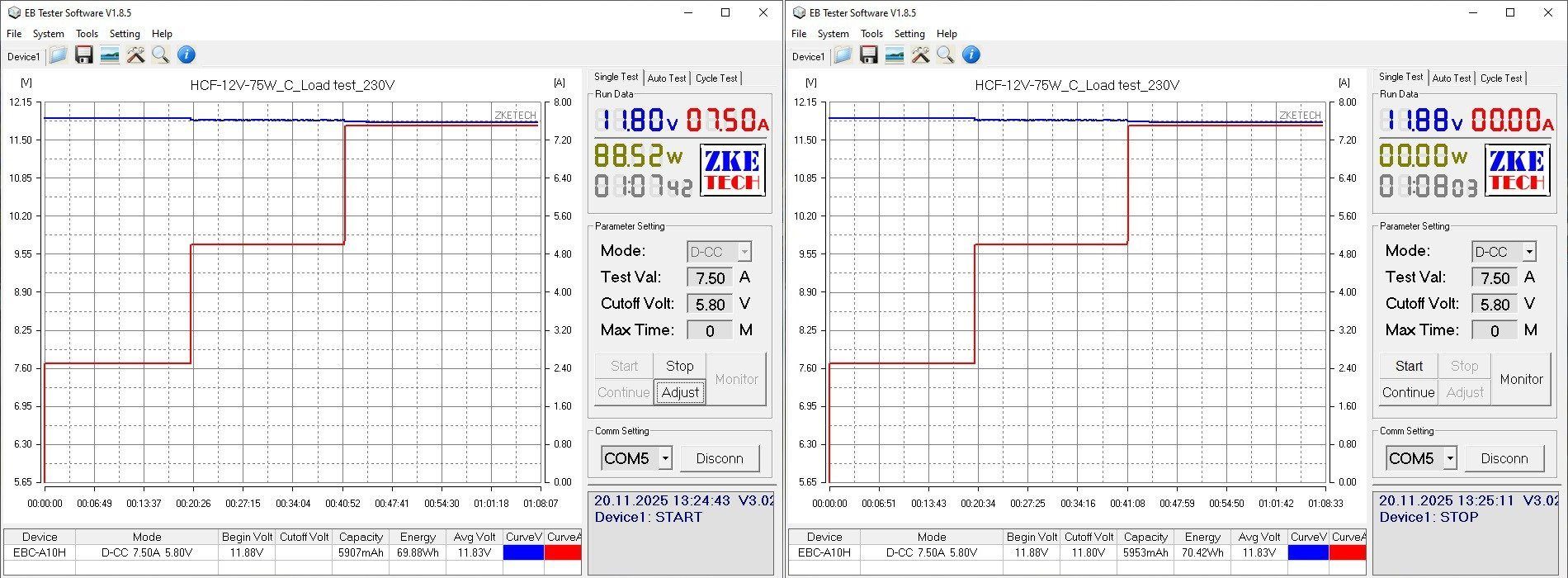
I tested the thermal performance under a heavier load than for the previous model. There, I tested at 2, 4, and 6 A; here, at 2.5, 5, and 7.5 A. But this power supply is rated for more power, even though 7.5 A is still 120% of its rated load. Essentially, I was testing close to the protection trip current, which was about 7.9–8.0 A with the power supply warmed up.
At this point I started to wonder whether I had actually tested ripple on this model at 2, 4, and 6 A, or perhaps at 2.5, 5, and 7.5 A. In any case, it doesn't affect the results; I have no complaints about the ripple either way.
There is no temperature-related voltage change: it was 11.88 V when cold, and I still got 11.88 V at the end.
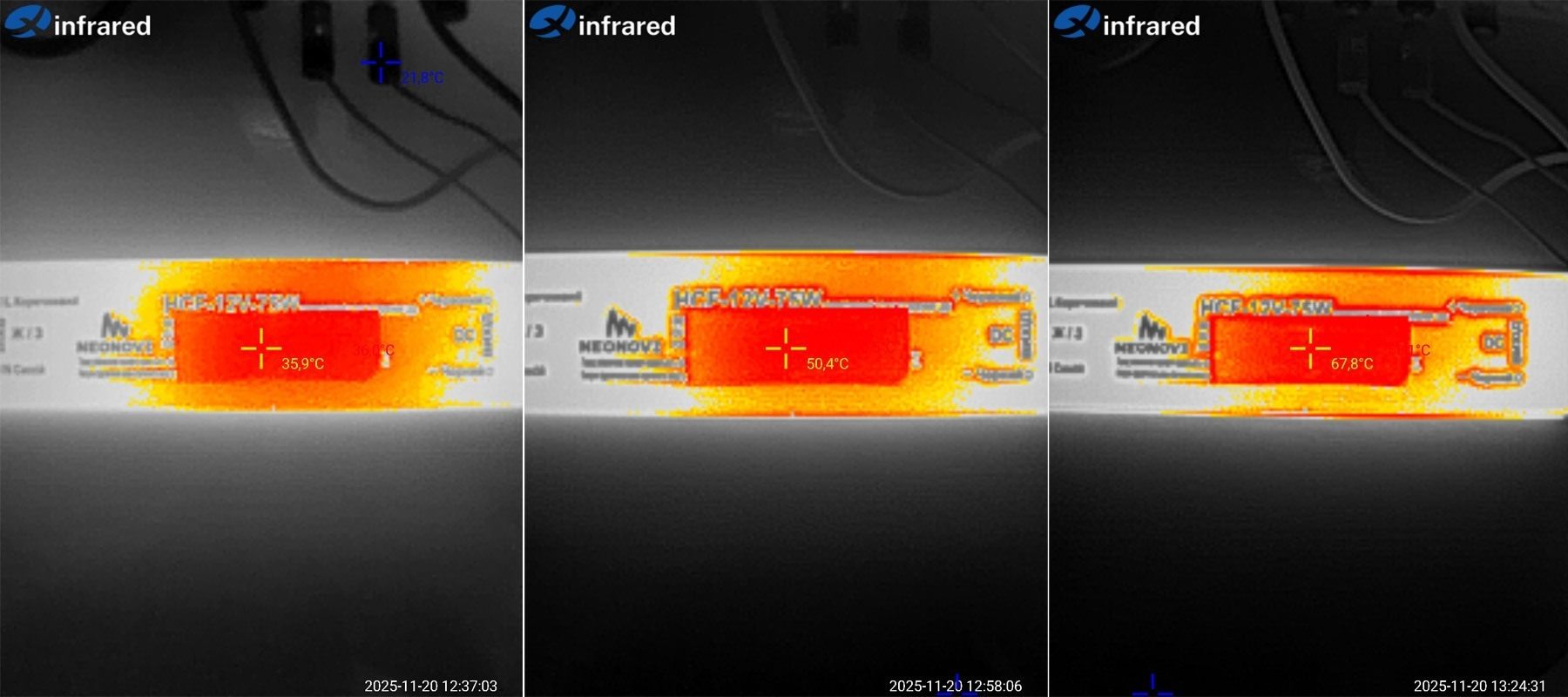
As expected, the case temperature was higher: at loads of 5 and 7.5 A, it reached 50 and 68 degrees, compared with 45/59 degrees at 4 and 6 A on the previous model. In other words, the temperature rose roughly in proportion to the increase in load current.
Since I don't have precise temperature readings for the key components, it's hard to say anything definitive. The case temperature only gives an indirect indication.
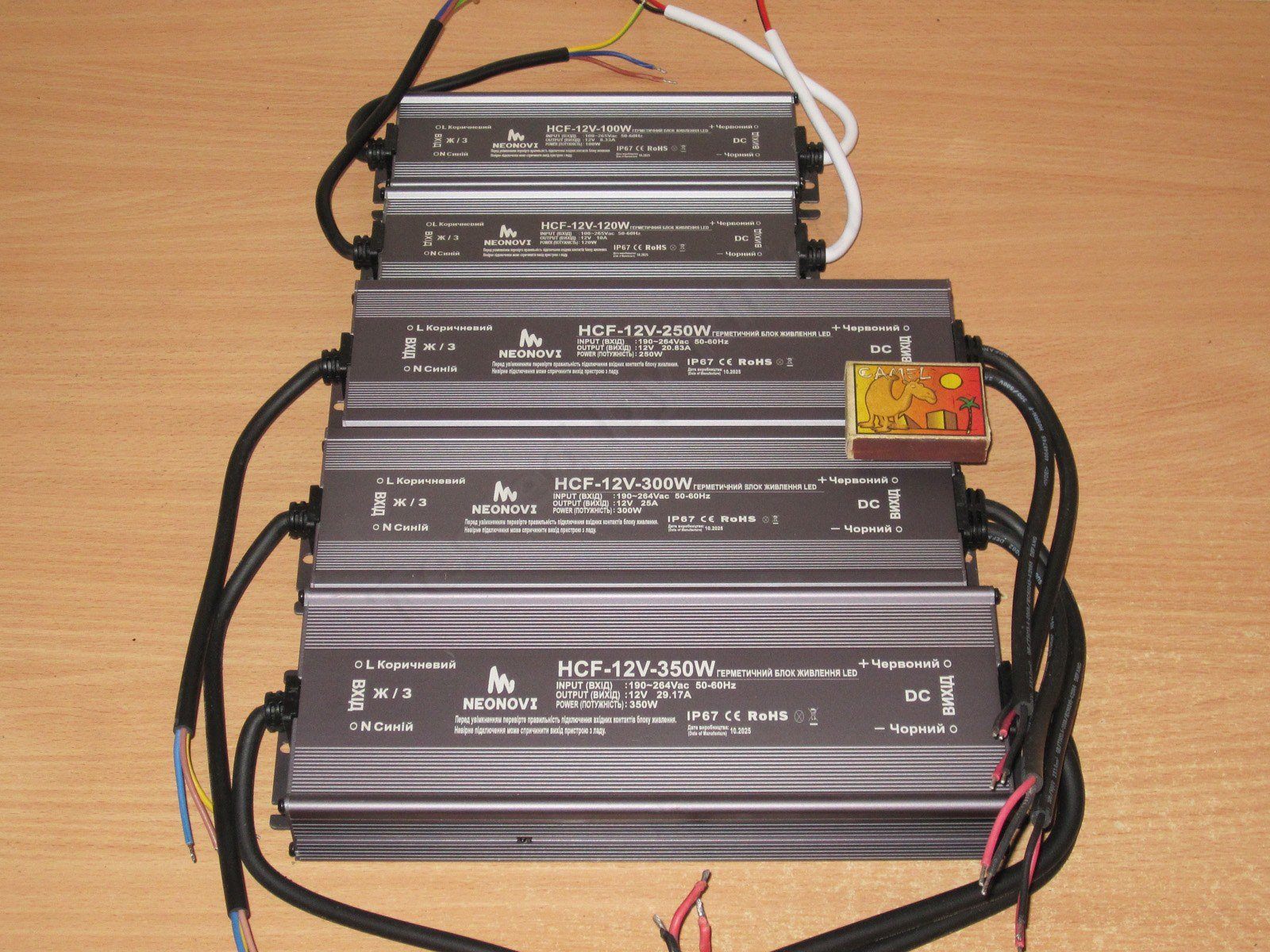
Let's move on to the second part, covering power supplies rated at 100 W and above.
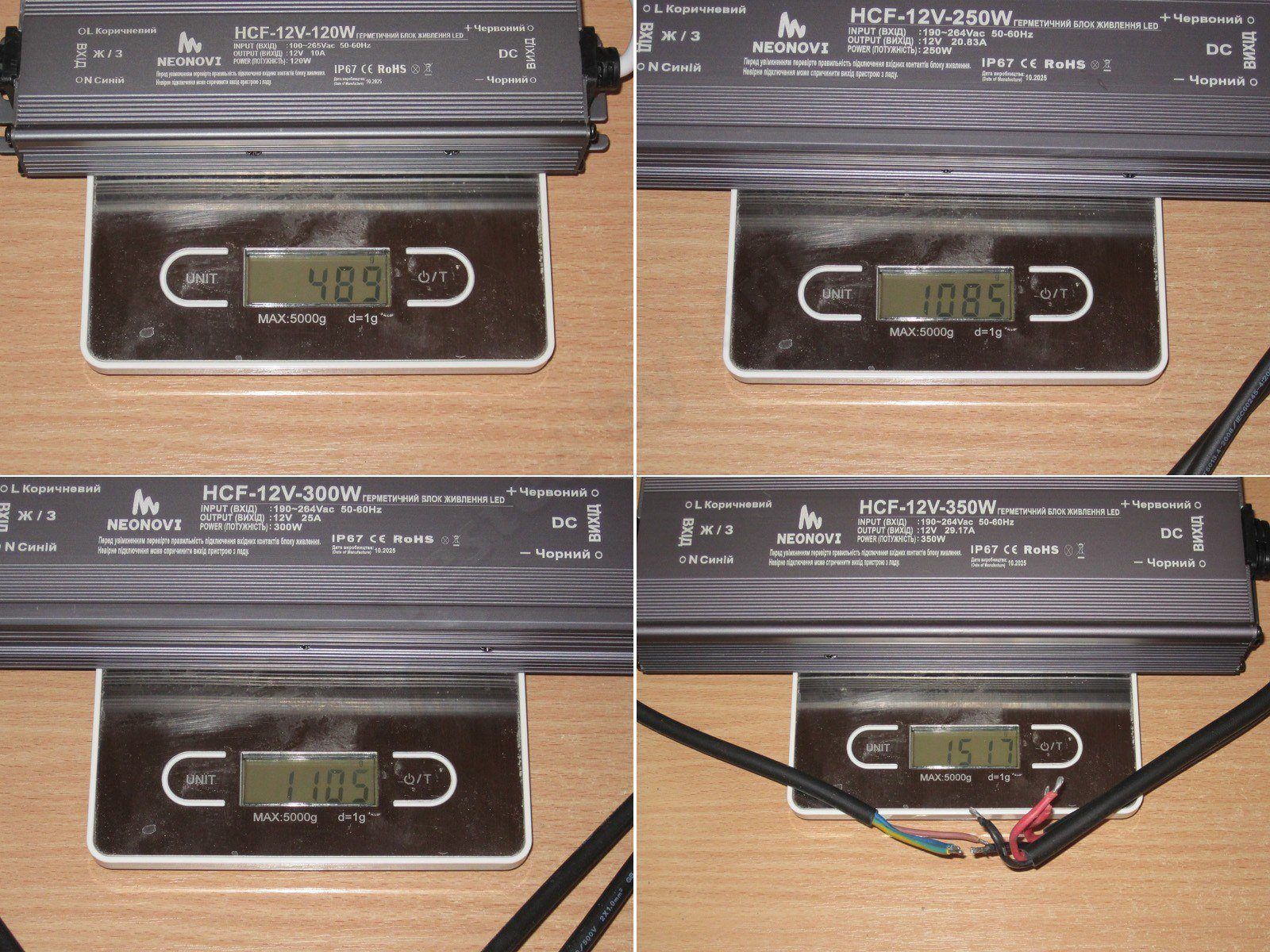
Even while carrying the package home, I thought it felt kind of heavy. When I unpacked it and took a look, the 250, 300, and especially 350 W power supplies felt noticeably hefty, so I couldn't resist weighing them out of curiosity.
And sure enough, the 250 and 300 W models weigh about 1.1 kg, while the 350 W model weighs a full 1.5 kg. Seriously, when you pick up a relatively compact 1.5 kg power supply, it feels like you're holding a brick. I like it :)
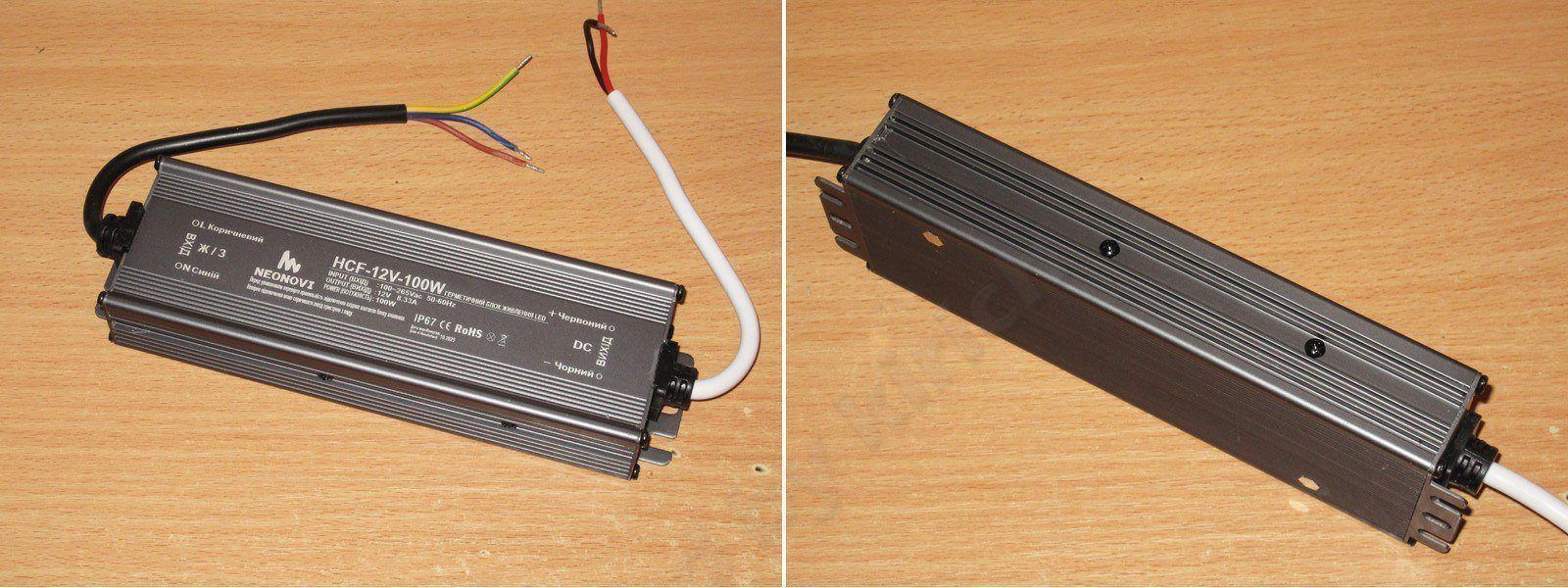
Let's start with the 12 V, 100 W model. The case is noticeably larger, and the power components are clearly screwed to the case on one side — link
Dimensions: length 170/189 mm, width 55 mm, thickness 30 mm
Although the power supply's output current is rated at 8.3 A, my 10 A load wasn't enough to reach the protection trip threshold.
On the other hand, I checked voltage stability. Including the voltage drop in the wire from the power supply, it came to about 100 mV at 10 A, which is excellent in my book.
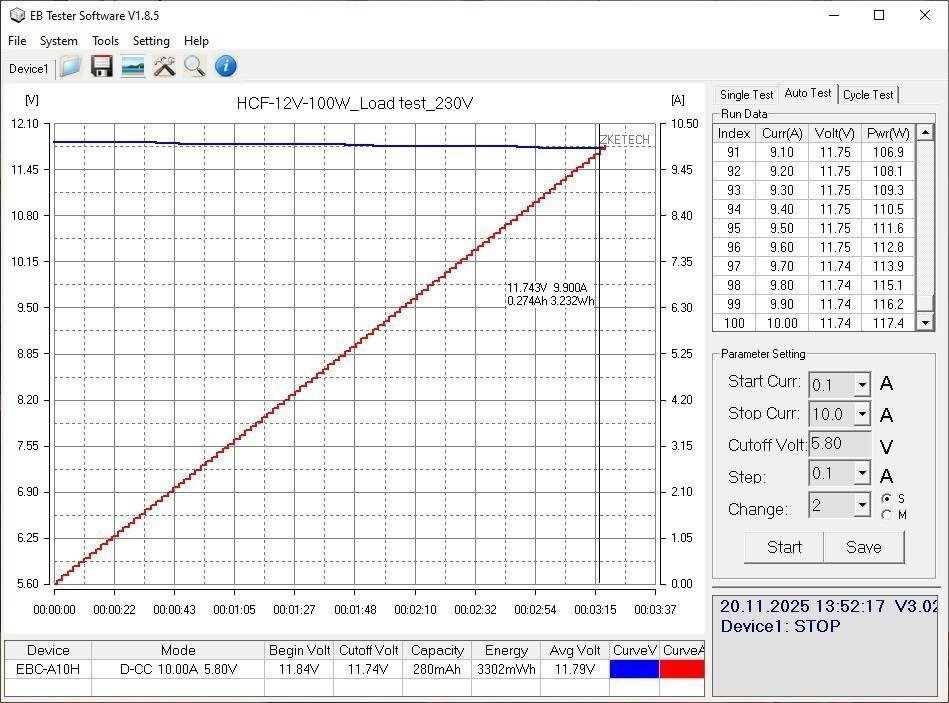
I had to use a different load to check the protection trip current. It was about 10.4 A; the output voltage starts to drop at this point.
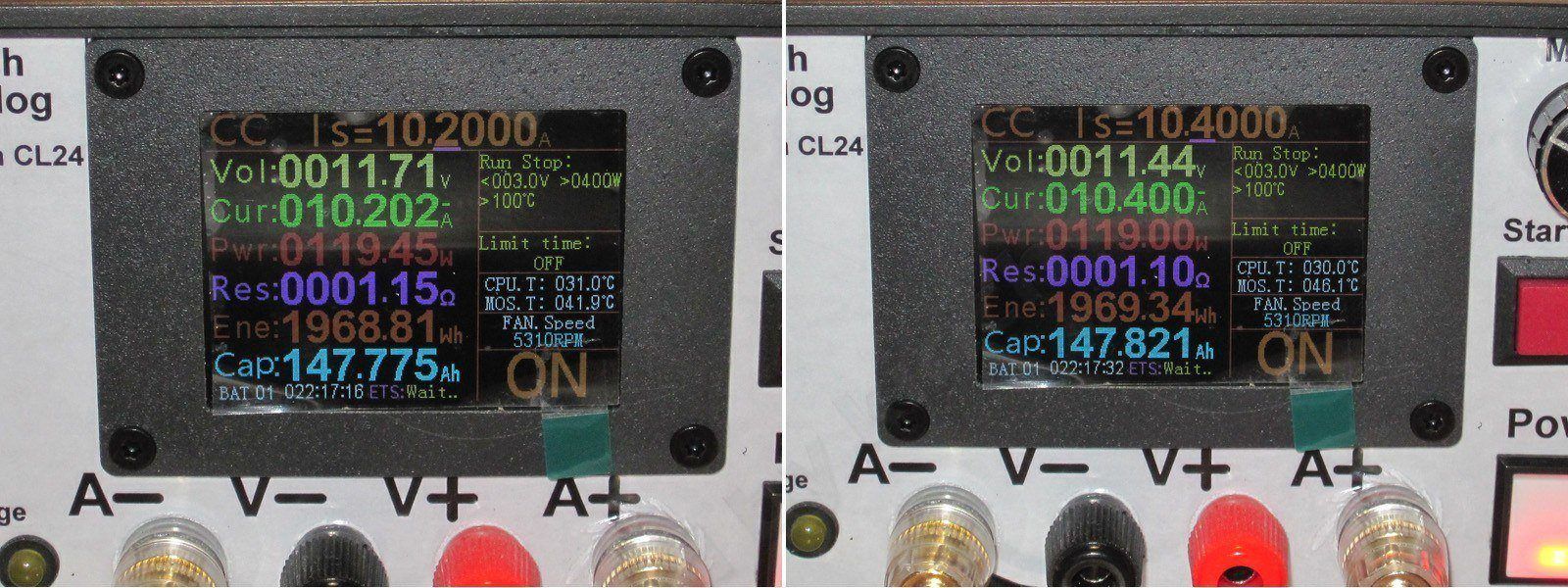
I measured efficiency from 1 to 10 A in 1 A increments and got about 85.5%—an ordinary, typical result, nothing remarkable.
No-load power consumption is about 0.5 W.
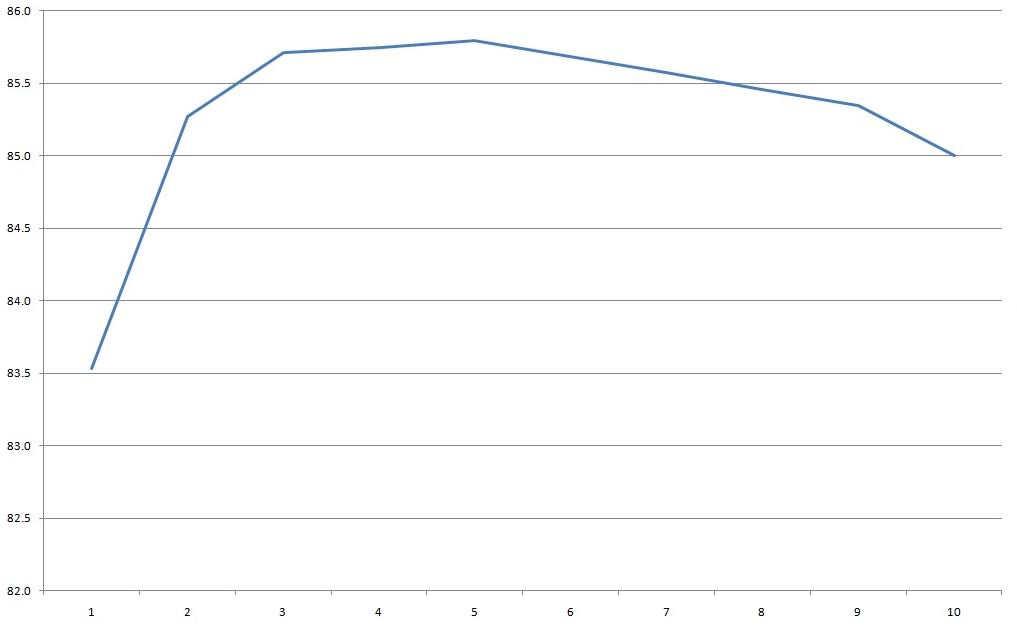
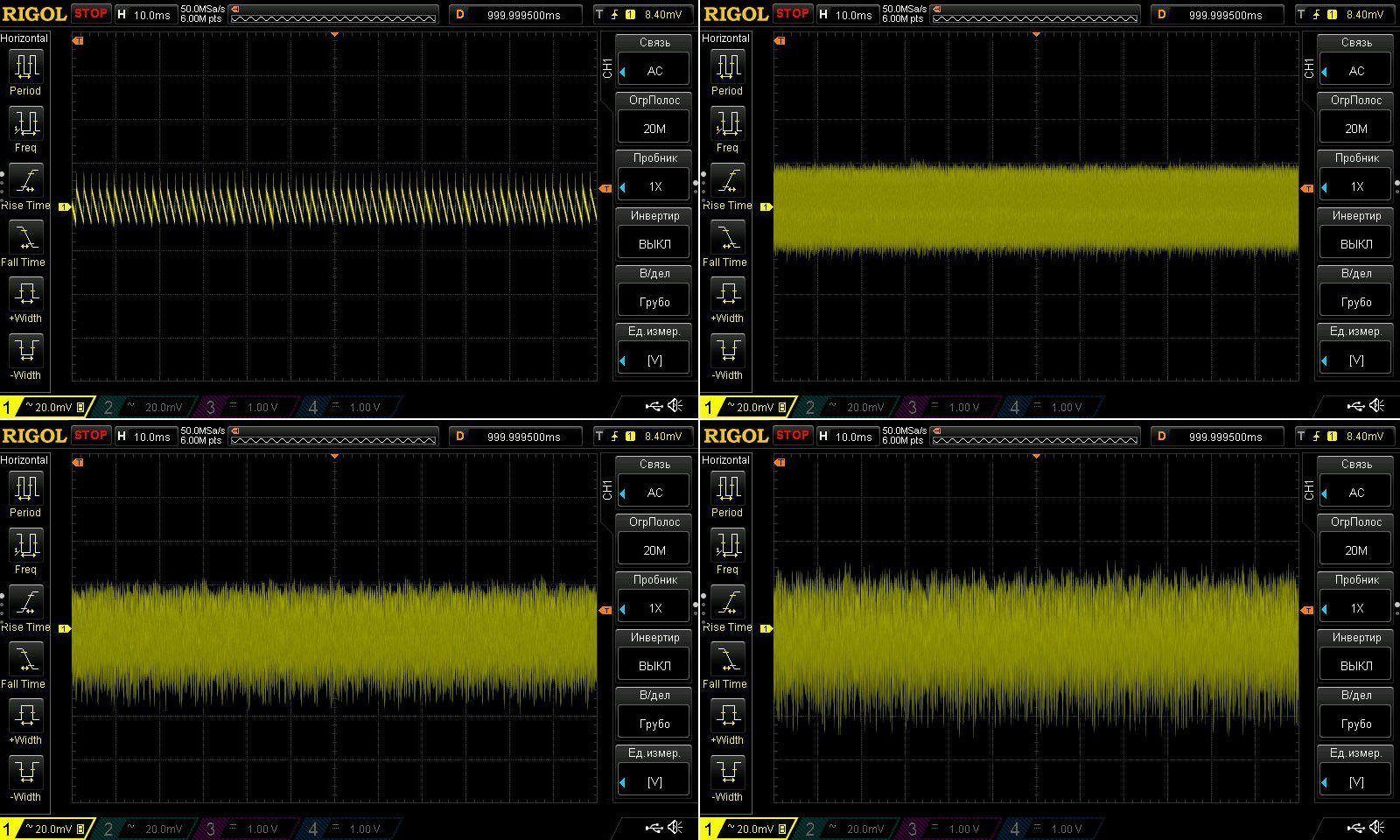
Ripple at no load and at currents of 3, 6, and 9 A.
At 9 A, the peak-to-peak ripple is about 45 mV, which is excellent in my opinion. There's clearly an output filter, so this gets a pass.
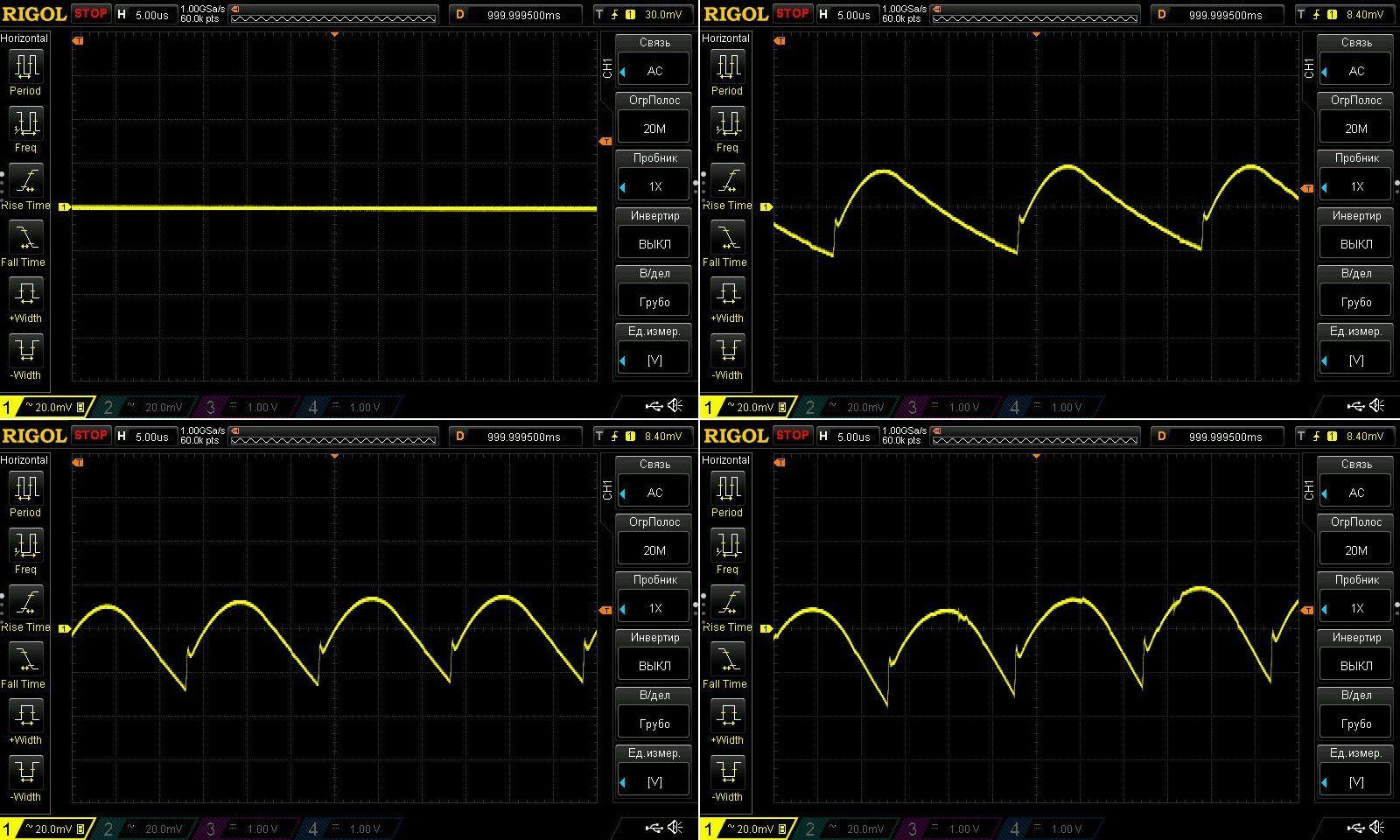
At low frequency, everything is basically fine, but the ripple itself looks a little strange—kind of "spiky." I saw something like this recently, and at the time I suspected it was probably a quirk of the PWM controller's operation.
In any case, this is fine too.
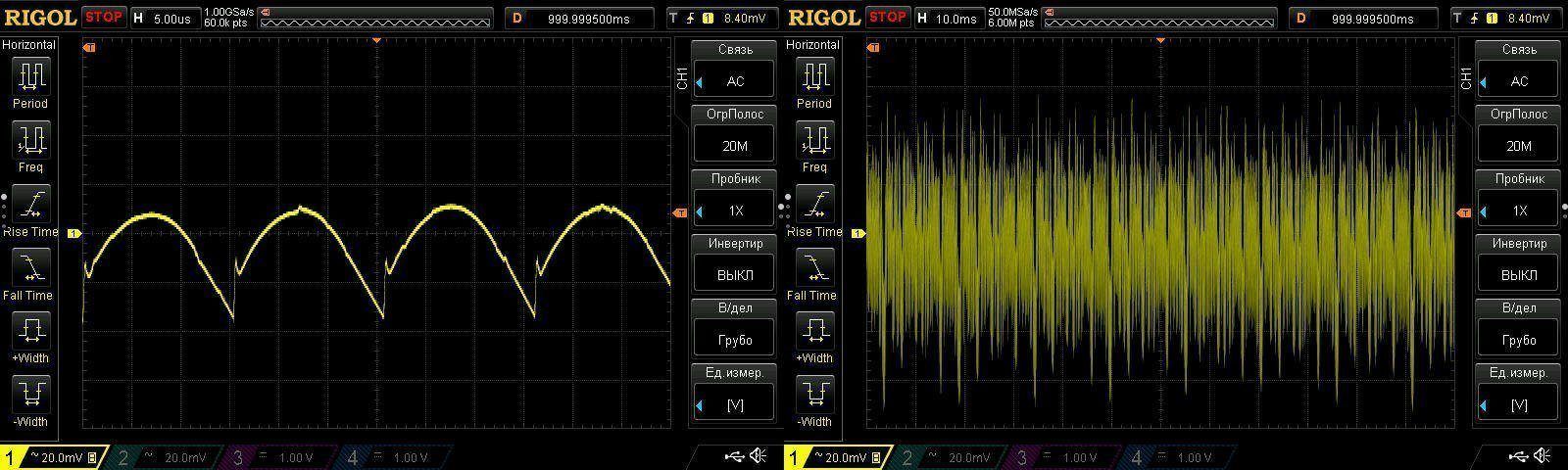
But if I increase the load current to 10 A, the high-frequency ripple stays the same, while the low-frequency ripple gets noticeably worse. Most likely, this is because the overload protection is starting to kick in.
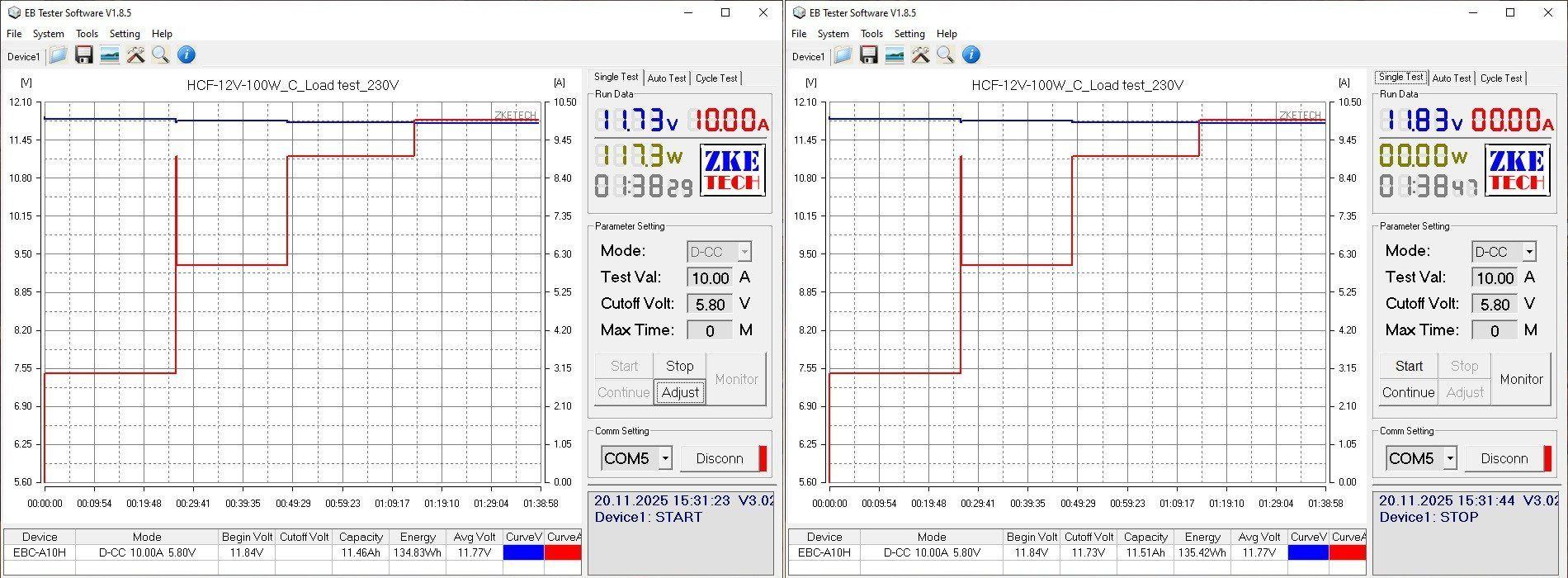
I first tested the thermal performance at 3, 6, and 9 A, then decided to run an additional test at 10 A. For this model, that's about 120% of its rated power.
The voltage change with temperature is almost zero, about 10 mV. Excellent.
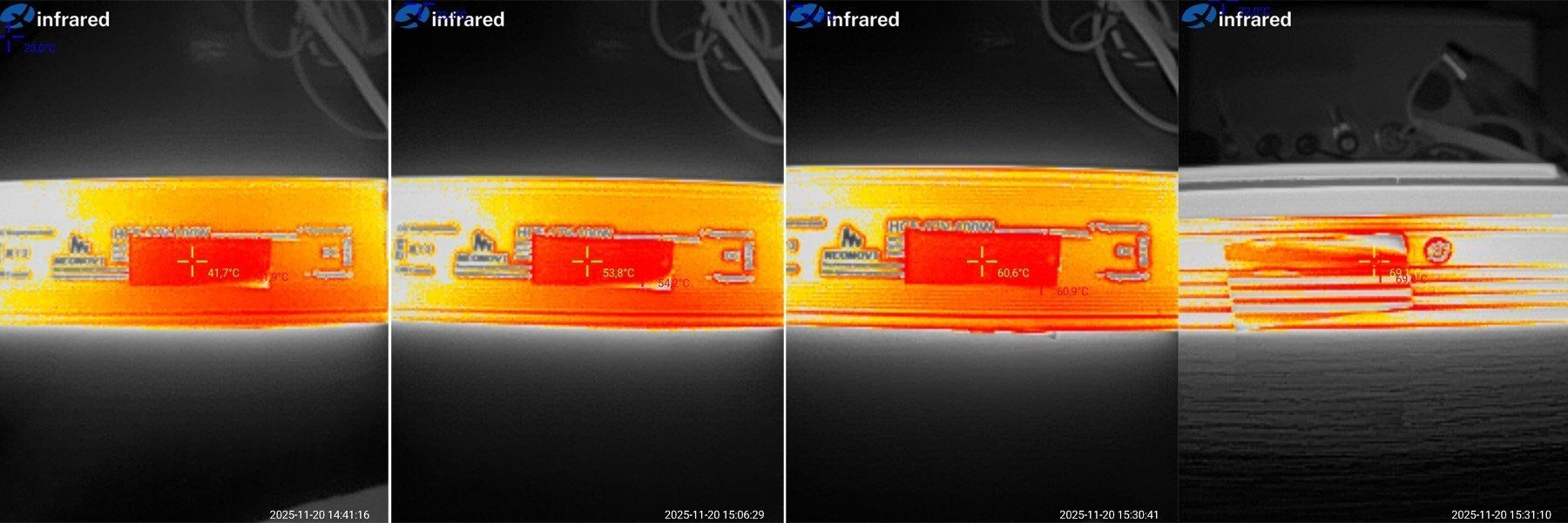
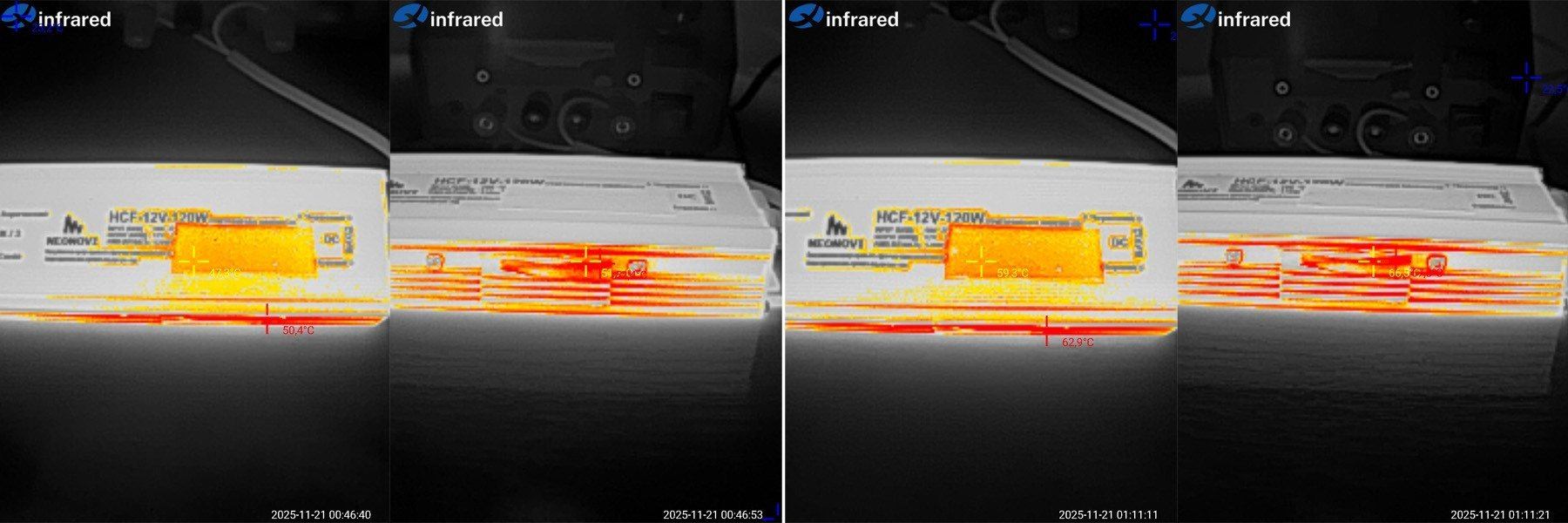
Below are the case temperatures at 6, 9, and 10 A. The last photo shows the temperature of the side facing the power components: about 70 degrees, which I consider perfectly normal. Obviously, the components were running hotter, but I think they were still a long way from critical temperatures, especially since the power supply was operating close to its overcurrent protection threshold.
I forgot to mention right away: since the power supply cases are made of aluminum, I measured the temperature of a small piece of electrical tape stuck to the case, rather than the case itself, to ensure accurate measurements.
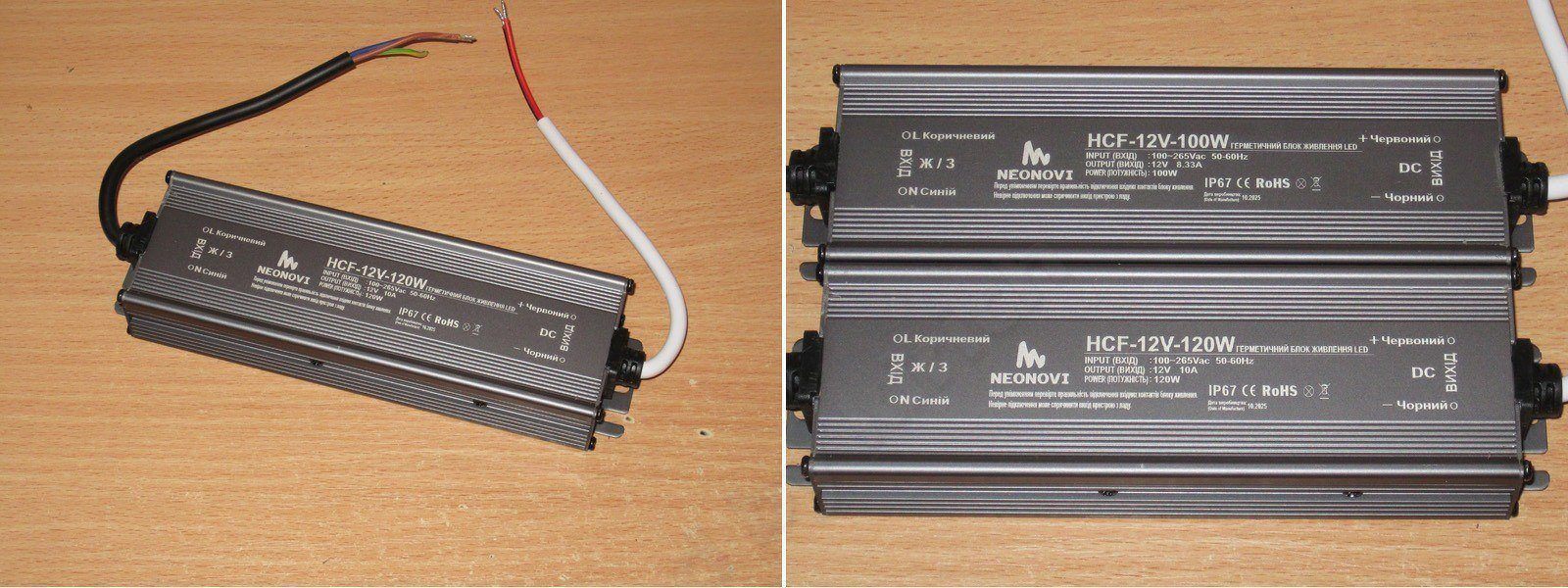
The 12 V, 120 W model is basically the previous one’s twin brother—at least on the outside, that’s for sure: link.
Dimensions: length 170/189 mm, width 55 mm, thickness 30 mm
I think if you covered up the labels, nobody would be able to tell them apart :)
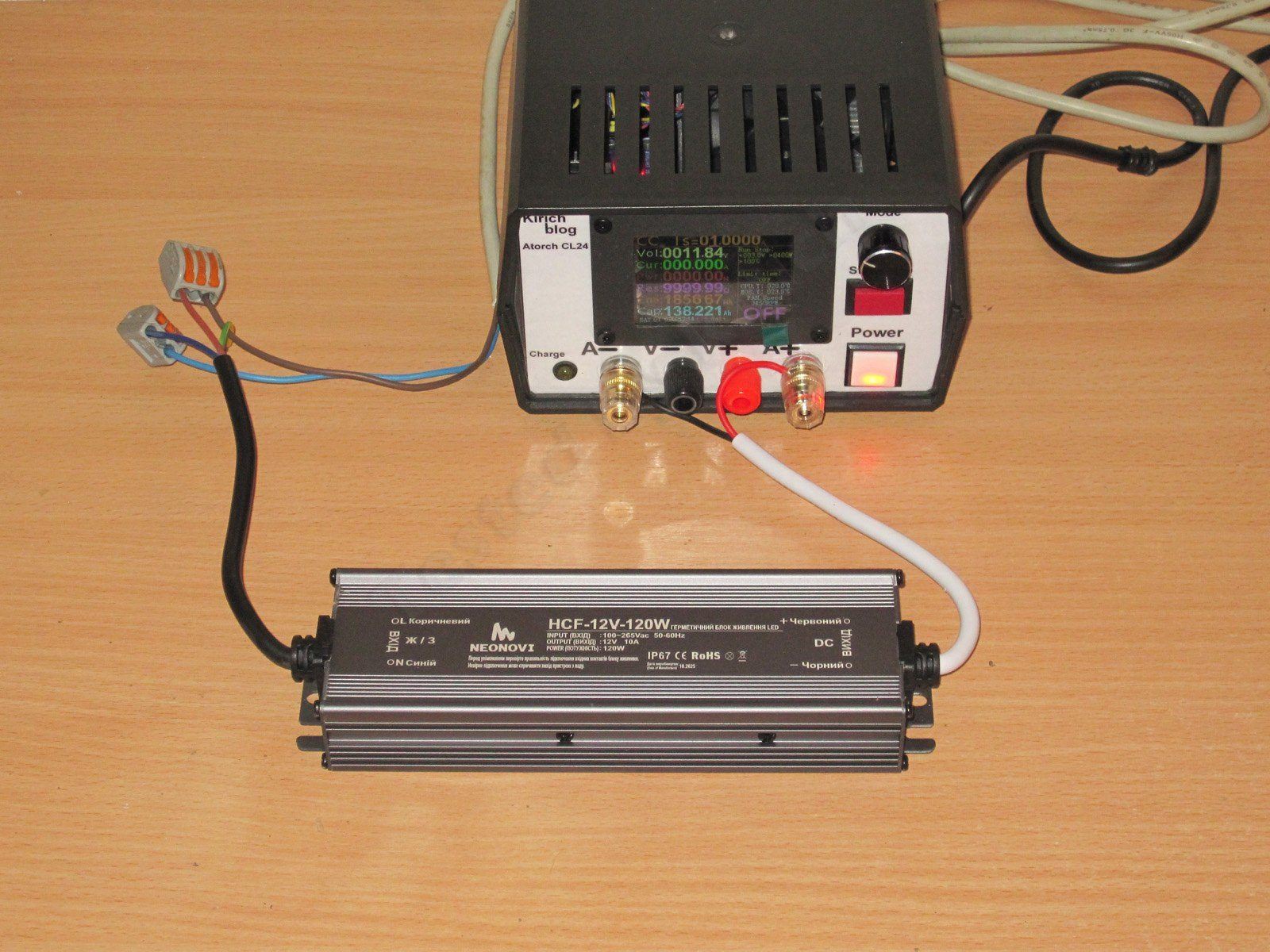
All the tests here were run with an Atorch CL24 electronic load, since the rated current is 10 A, which is the EBC-A10H’s maximum.
The power supply leads were connected directly to the load terminals.
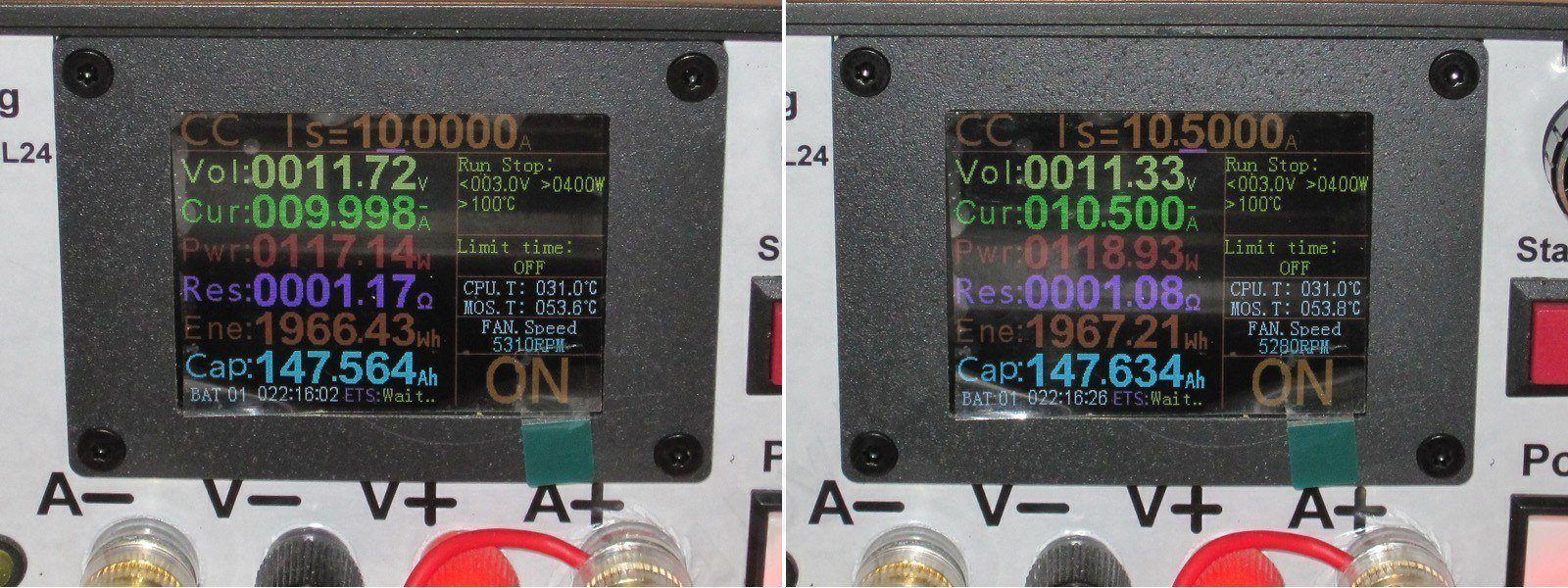
The overcurrent protection threshold is unexpectedly... the same as on the previous model. A 100 mA difference is within measurement error.
For the 100 W model, with an output current of 8.3 A, protection kicking in at 10.4 A is perfectly reasonable. But for a model rated at 10 A, protection at 10.3 A is cutting it a bit too close. That said, if you’re using it for LED lighting, I actually approve: it would be pretty hard to burn out this power supply.
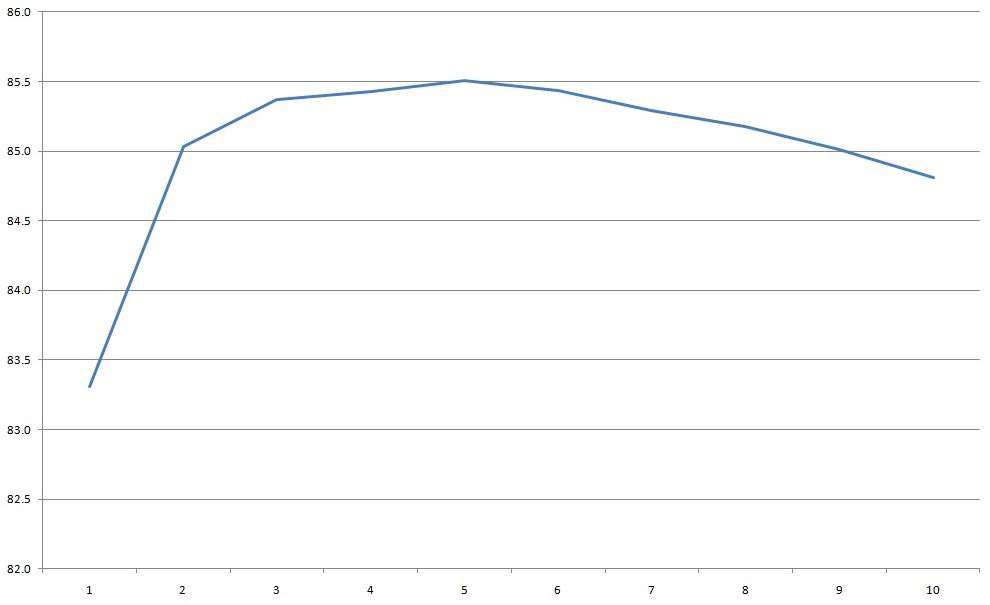
Efficiency at the same 1–10 A load is practically identical to the 100 W model—well, within measurement error, anyway.
No-load power consumption is about 0.5 W.
Ripple with no load and at 3, 6, and 10 A. The results are identical: the 100 W model had 45 mV at 9 A, while this one is closer to 50 mV at 10 A.
But I have no complaints about the ripple on either this or the previous model; it’s all excellent.
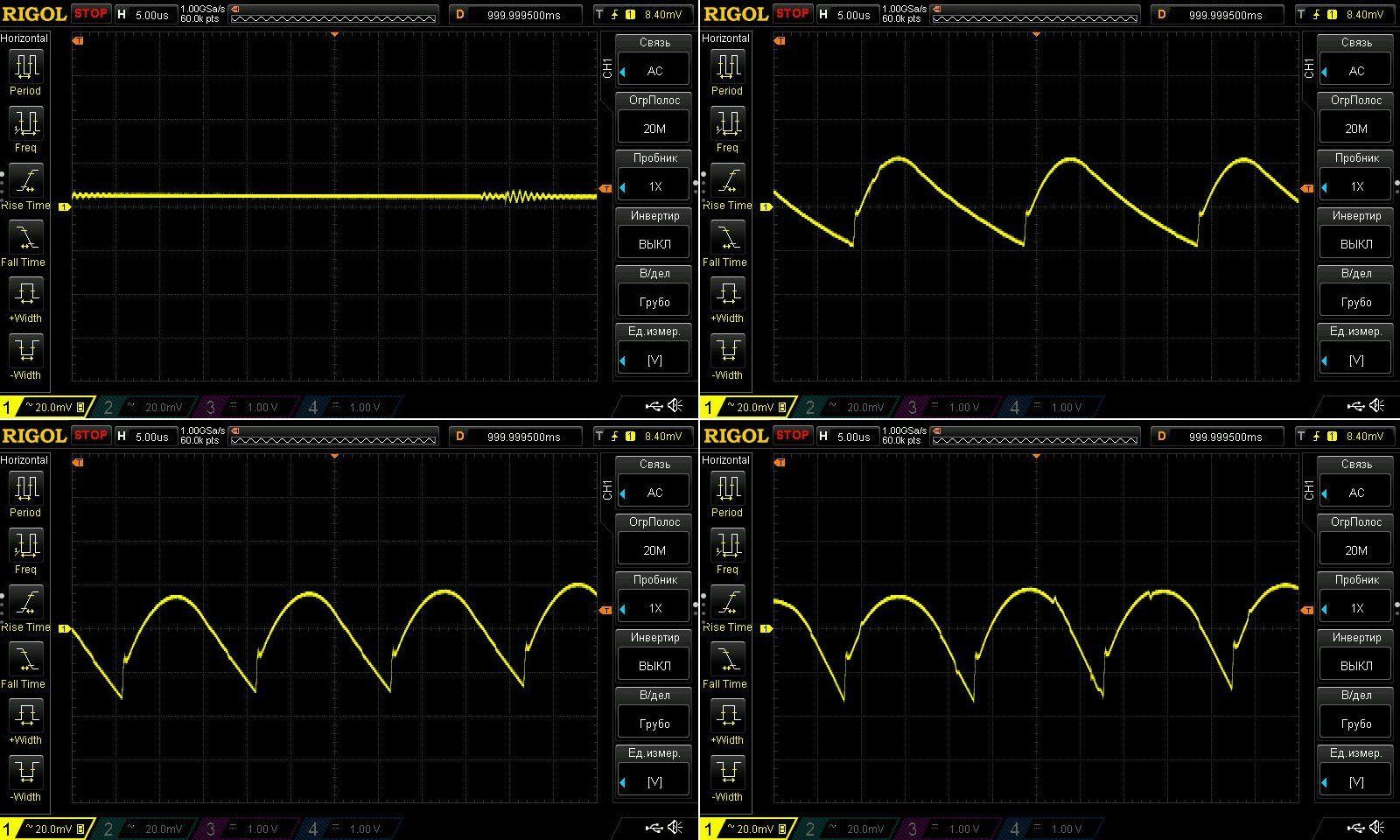
At low frequency, it’s almost fine, but at 10 A the waveform looks pretty scary.
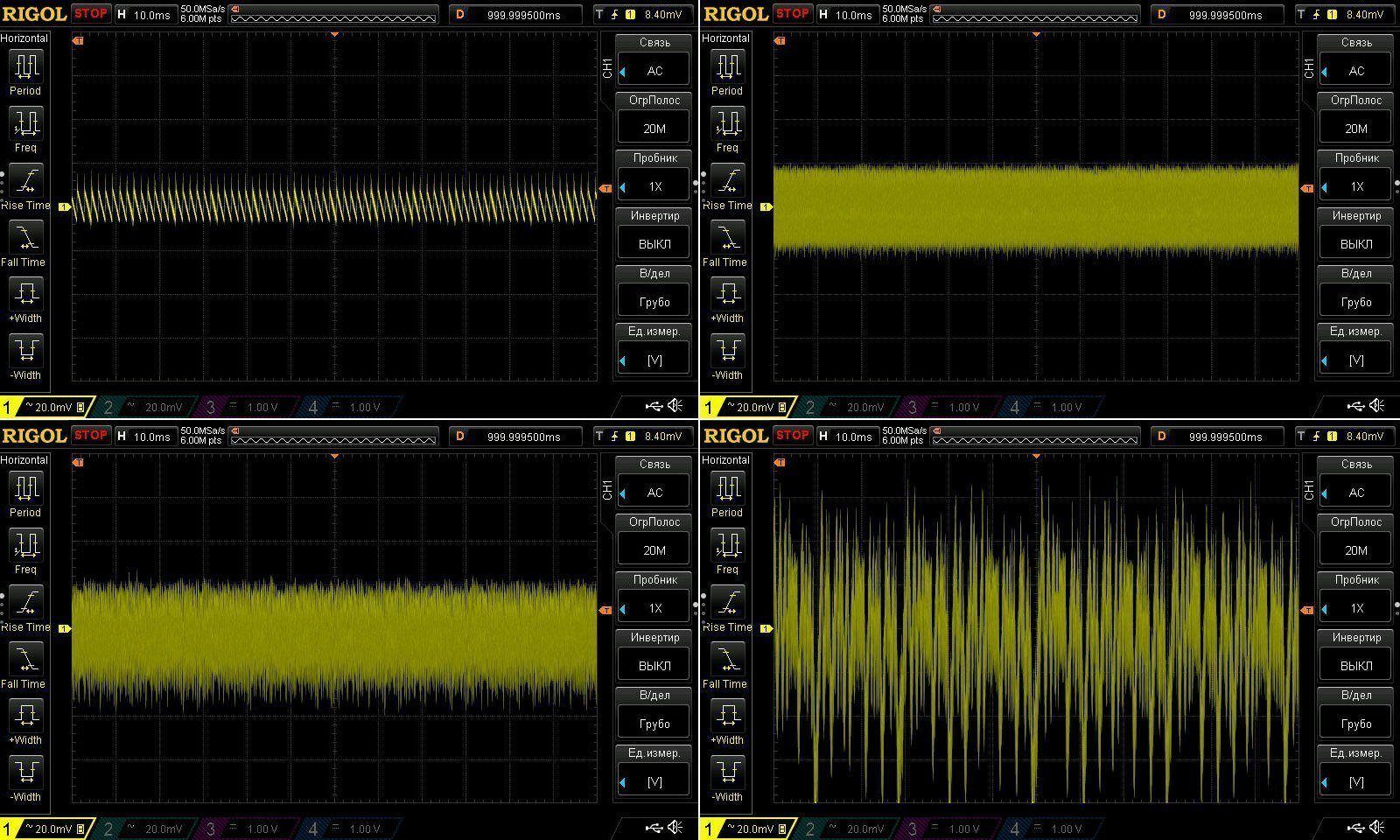
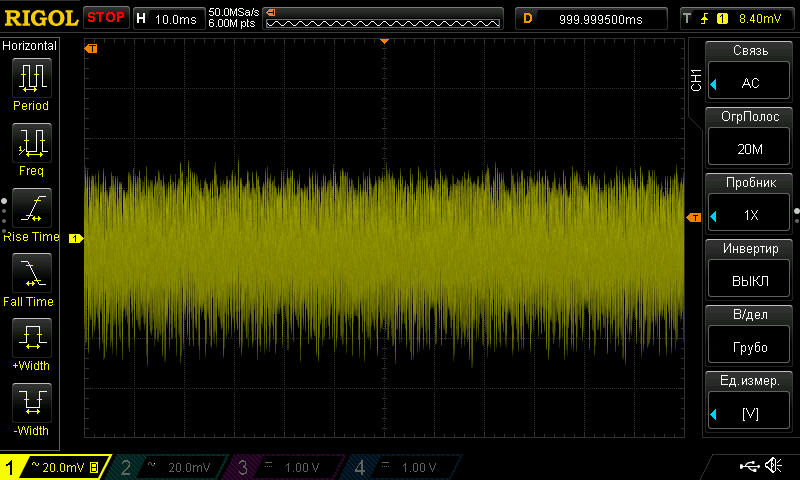
But as soon as I lowered the load current from 10 to 9 A, the ripple magically went back to normal. Magic... Well, no, what the hell am I talking about—this is physics, because as far as I can tell, the only difference between these power supplies is the label :) But I’m getting ahead of myself.
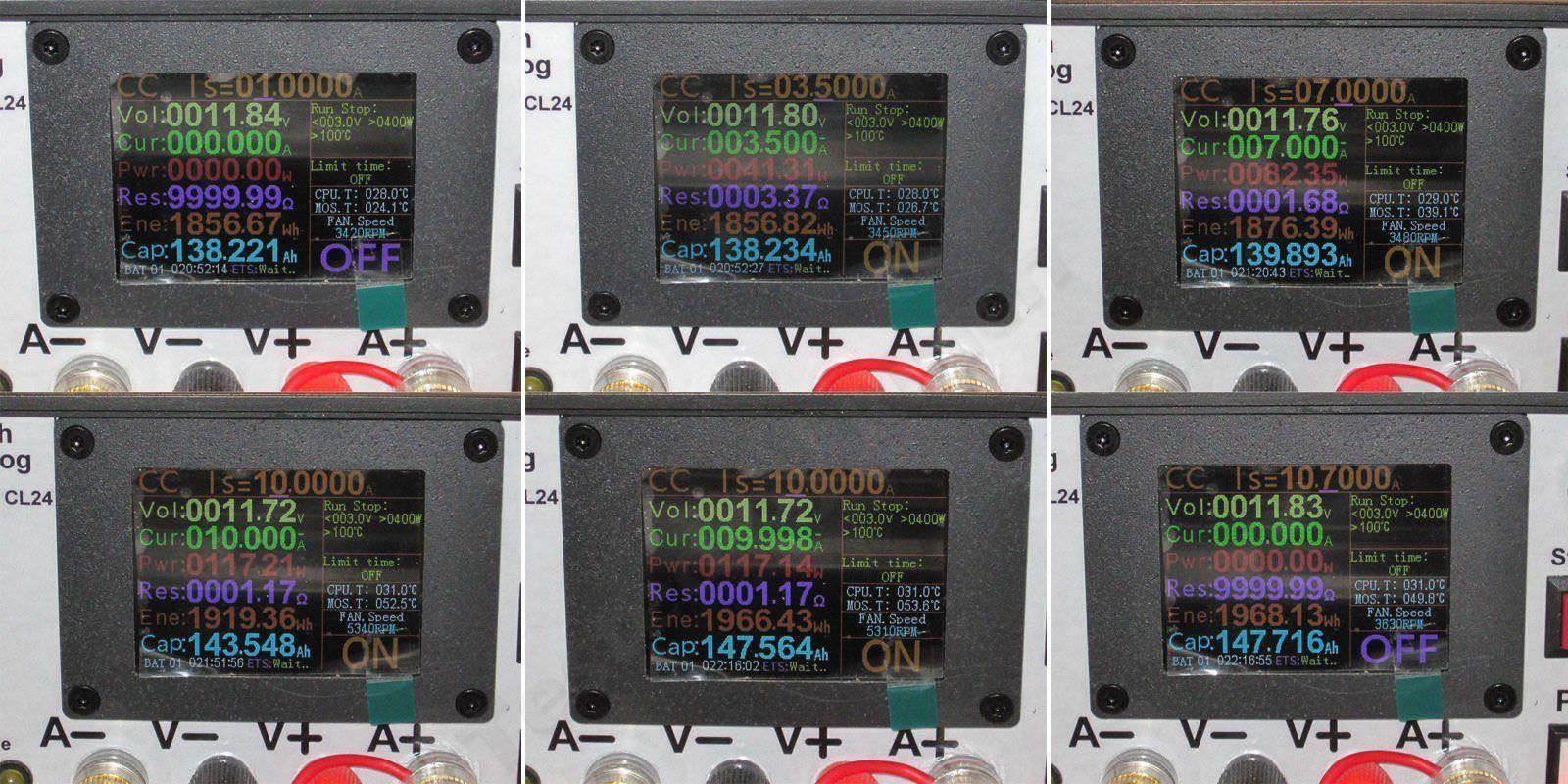
The load tests were run at slightly different levels: 3.5, 7, and 10 A instead of 3, 6, 9, and 10 A. The output voltage behaves just like it does on the 100 W model, dropping by 10 mV. Actually, not just the voltage behavior: both models measured 11.84 and 11.83 V, depending on temperature—in other words, even the output voltage is the same.
Case and side-panel temperatures at 7 and 10 A. At 10 A, I measured 66.5 °C on the side panel; the 100 W model reached 69 °C, but that test was run in four stages, which may have heated the case a little more.
In both cases, though, these seem like honest, fairly well-made power supplies rated at around 100–110 W, or 8.3–9 A.
Now we’re getting to what I consider the more interesting models: 250, 300, and 350 W.
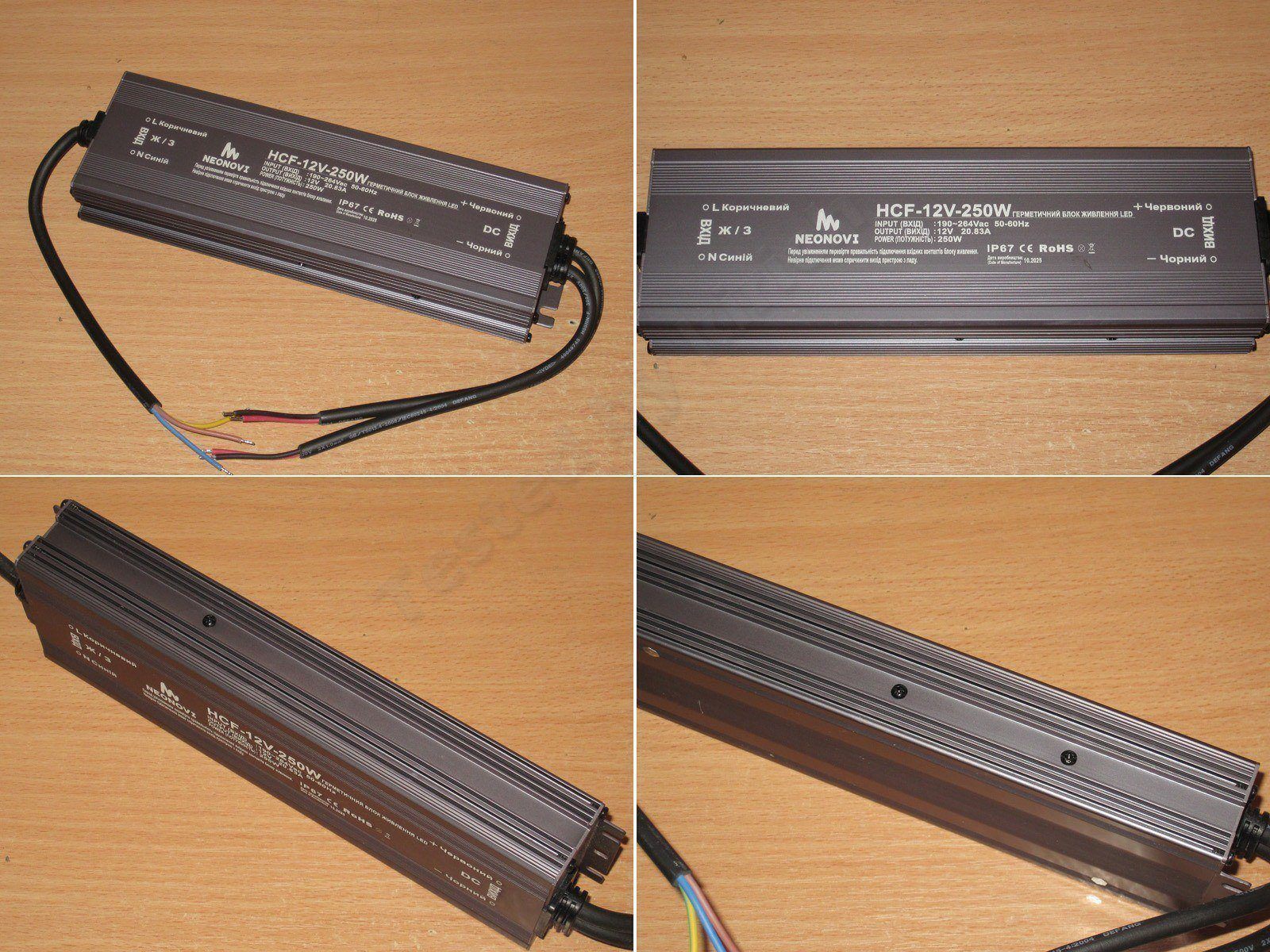
First up is the 12 V, 250 W model: big and heavy, just the way you like them—link.
Dimensions: length 235/254 mm, width 74 mm, thickness 35 mm
The components are screwed to the case on both sides. There’s one screw on the “hot” side and two on the “cold” side. Most likely, it has two transistors and four diode assemblies.
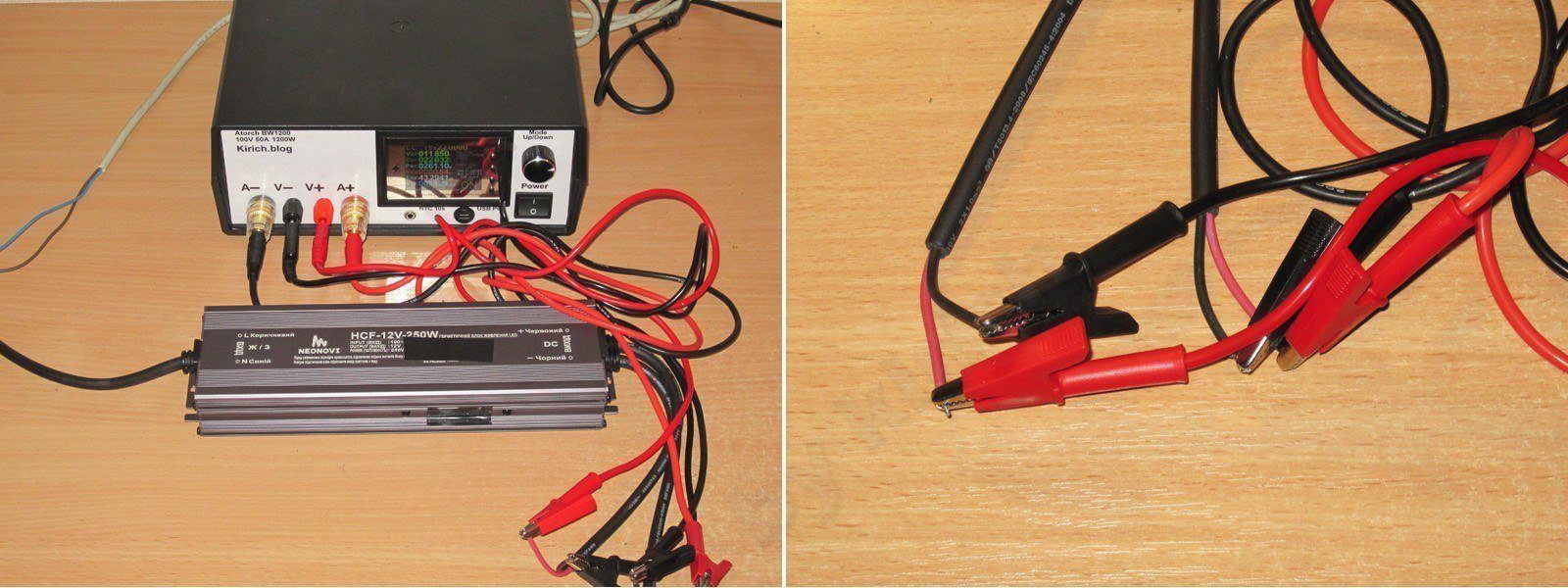
For the main tests, I used a more powerful electronic load, rated for up to 1200 W and 50 A. The higher-power models have two output cables, so to improve measurement accuracy, I used one cable for the load current and the other for voltage sensing. You shouldn't do this during operation; it's better to distribute the load evenly across the outputs or connect these cables in parallel.
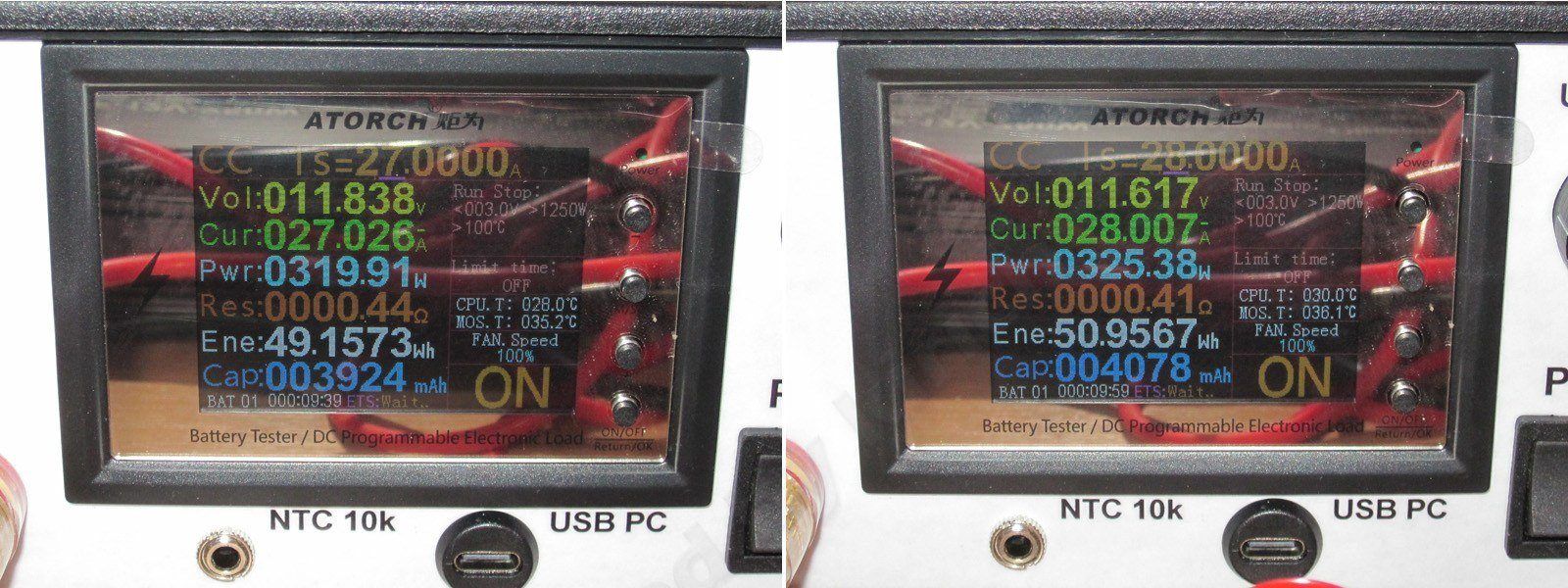
The protection kicks in at around 27–28 A, with the voltage gradually dropping as the load current increases.
I think the protection current is set much too high: 27 A is a lot when the rated current is 22 A. Still, there's a "catch" here too, which I'll get to later.
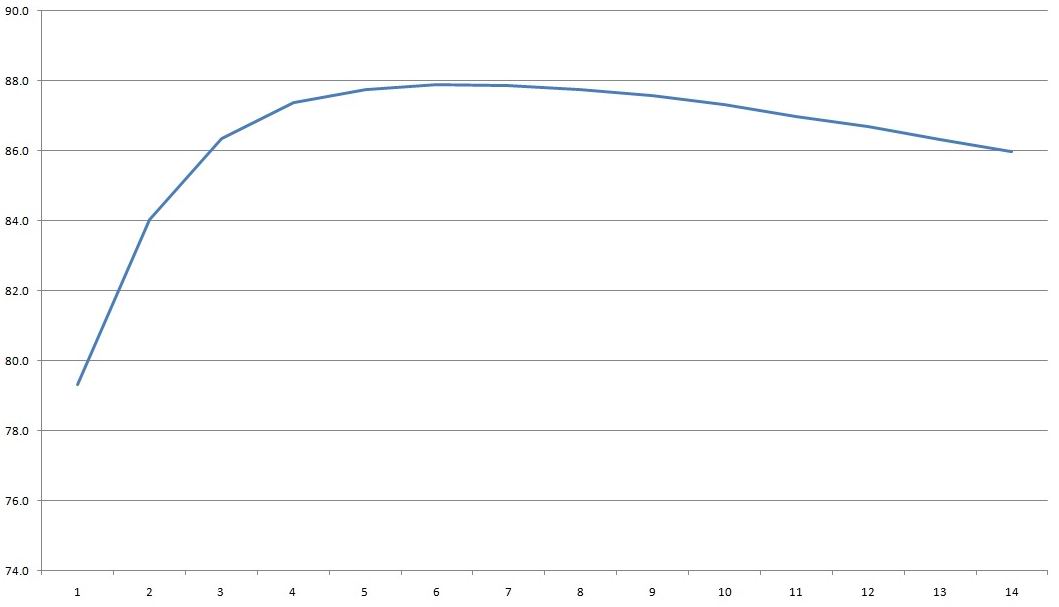
Efficiency was measured from 2 to 28 A in 2 A increments. I have to say, an average of about 87% is pretty good, and at a load of 14–15 A, efficiency is almost 88%.
No-load power consumption is about 0.90 W.
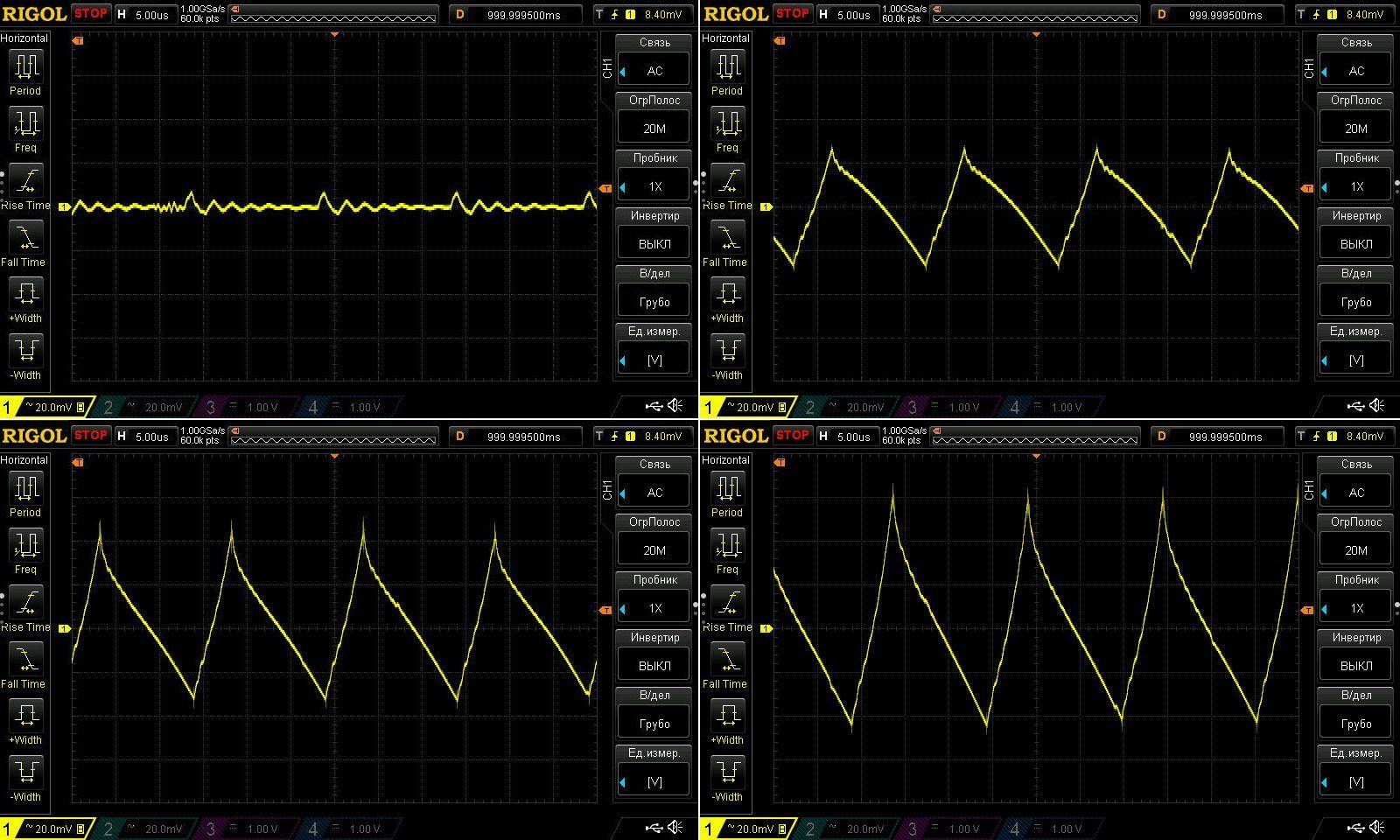
Ripple at no load and at currents of 8, 16, and 22 A, although it would have been more accurate to stop at 21 A.
I wouldn't call it low, but 110 mV at maximum current is less than 1%, so that's an excellent result for a high-power supply. The screenshot also shows no "spikes"; I suspect the output uses polymer capacitors.
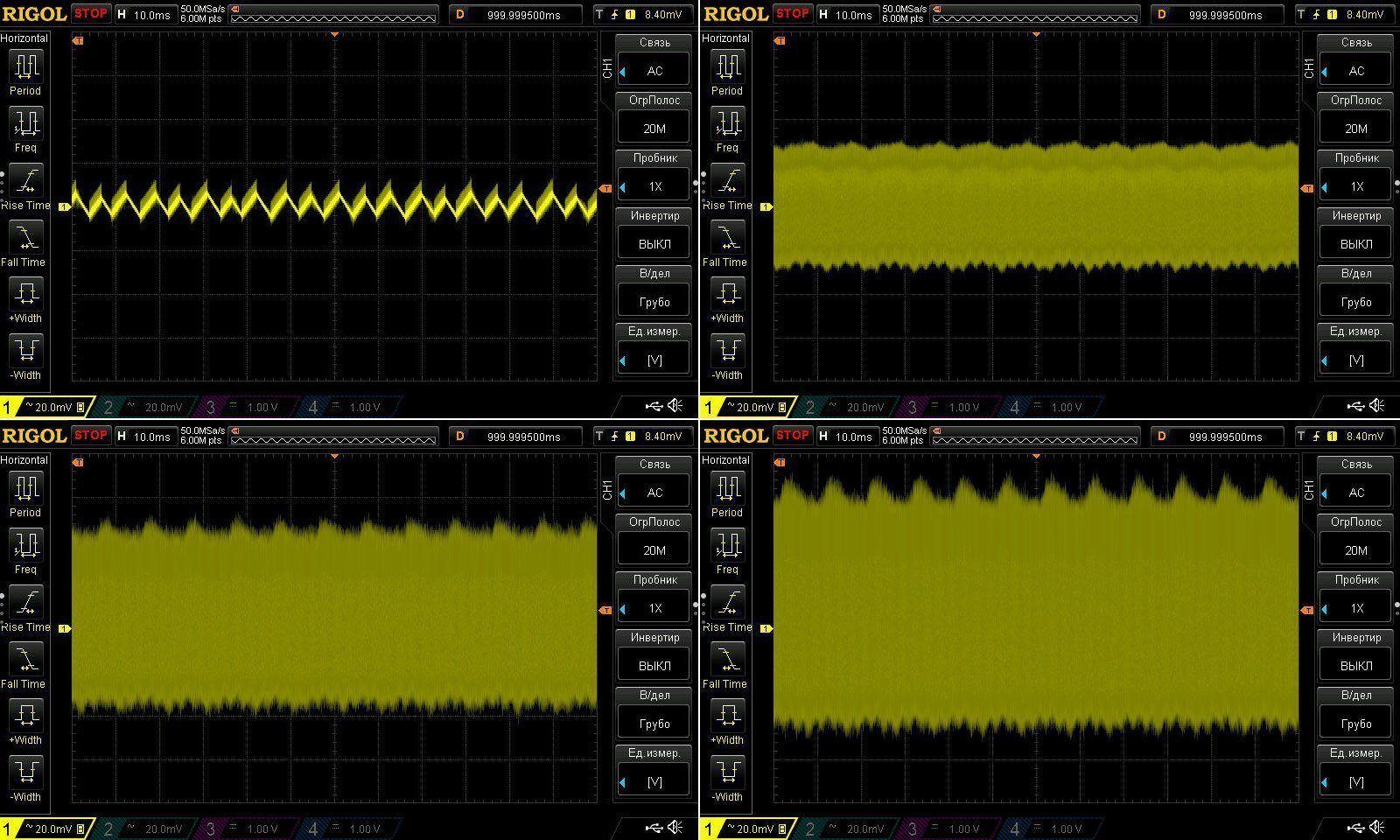
There are some small bumps at the low frequency of 100 Hz, but I have no particular complaints here either. Since they appear in essentially every operating mode, this is more likely a characteristic of the PWM controller than insufficient input capacitance.
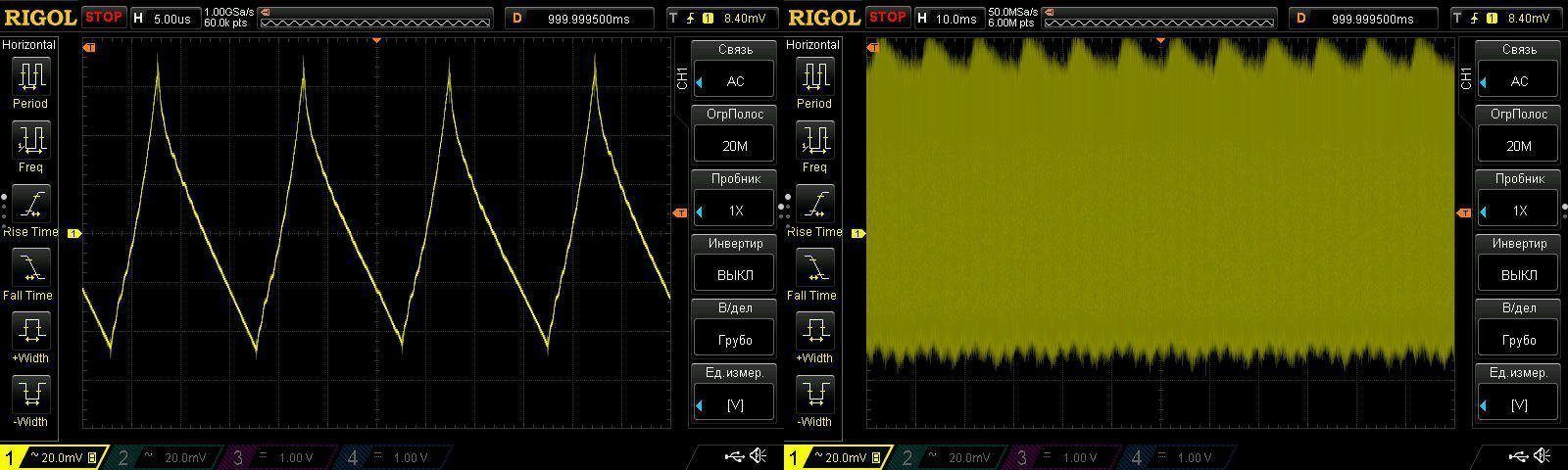
Just out of curiosity, I checked the ripple at 25 A, or 300 W. The high-frequency ripple rose to 120 mV, and the 100 Hz bumps were more pronounced, but overall it's perfectly acceptable.
The warm-up test was run at 7, 14, 21, and 25 A. I didn't notice any voltage change as the unit warmed up. The voltage does vary with load, but 30 mV across the 0–25 A range is a drop in the ocean, in my opinion.
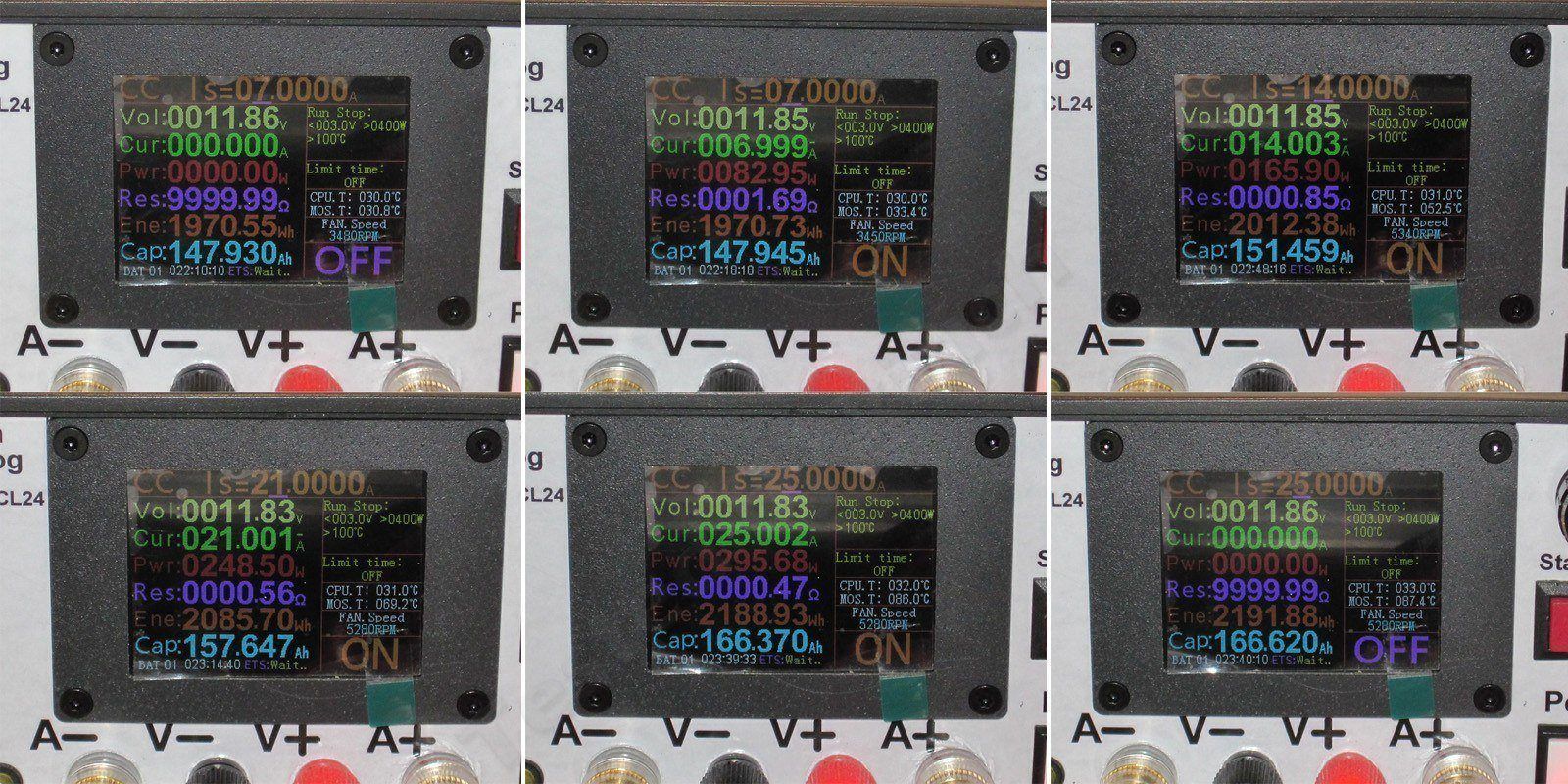
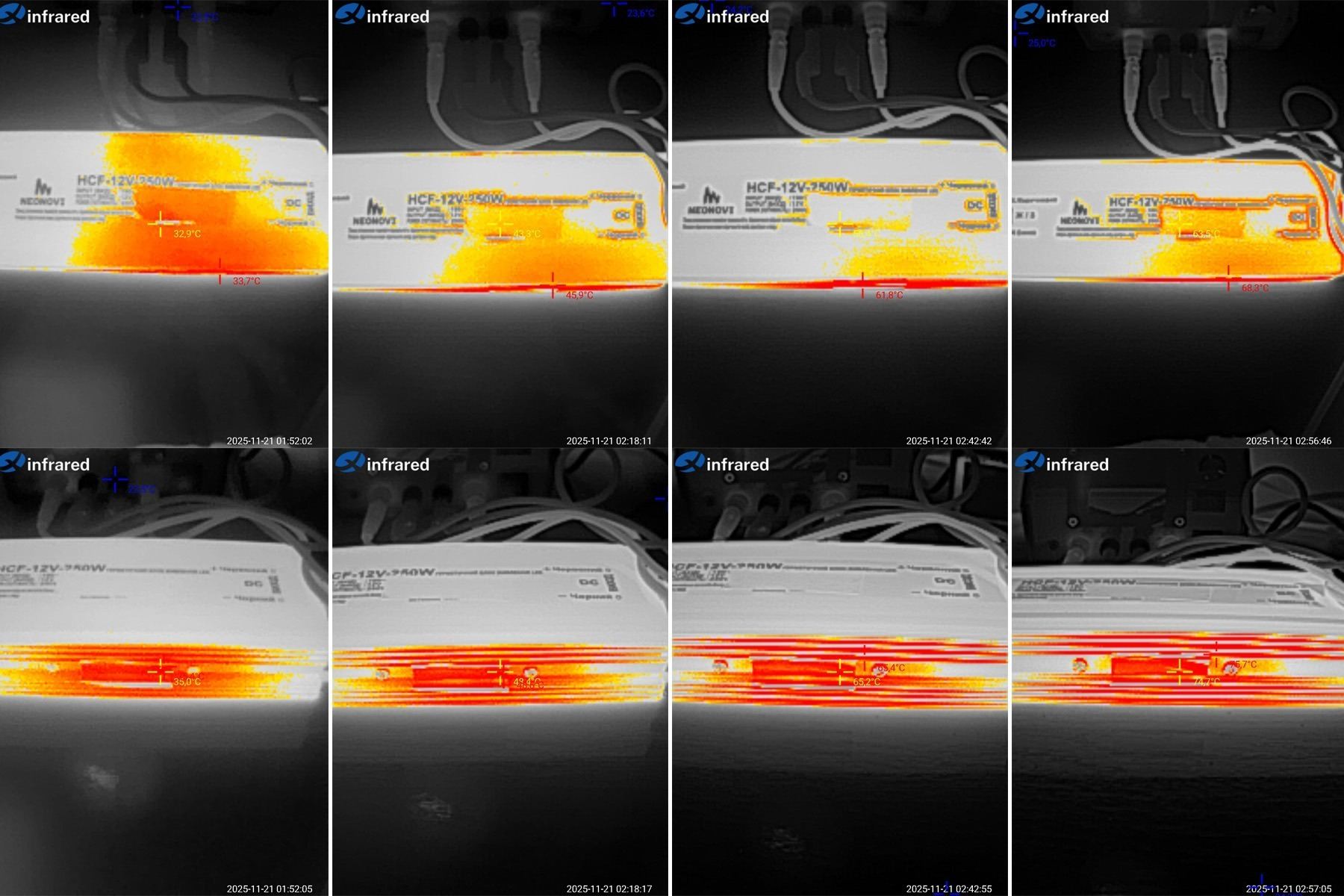
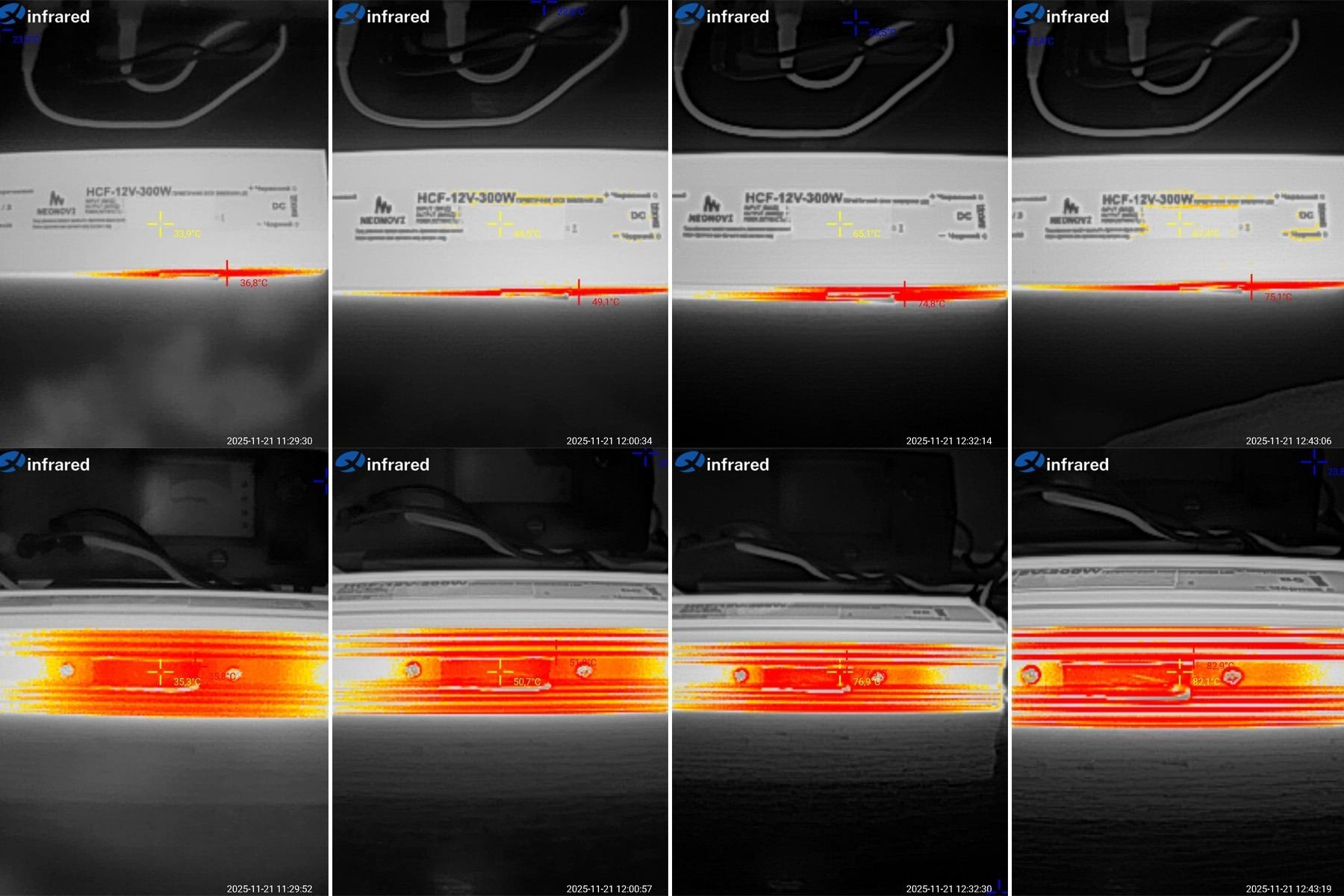
Temperatures at load currents of 7, 14, 21, and 25 A. The top photo shows the top of the case; the lower photos show the side with the diodes.
The top of the case isn't really of interest; the side is much more informative. At 14 A, the side reaches 49°C (43°C on top); at 21 A (maximum power), about 65°C (56°C on top); and at 25 A (about 120% load), 75°C (63°C on top). I suspect that at 25 A, the diodes were around 100°C when the side reached 75°C, which is perfectly acceptable.
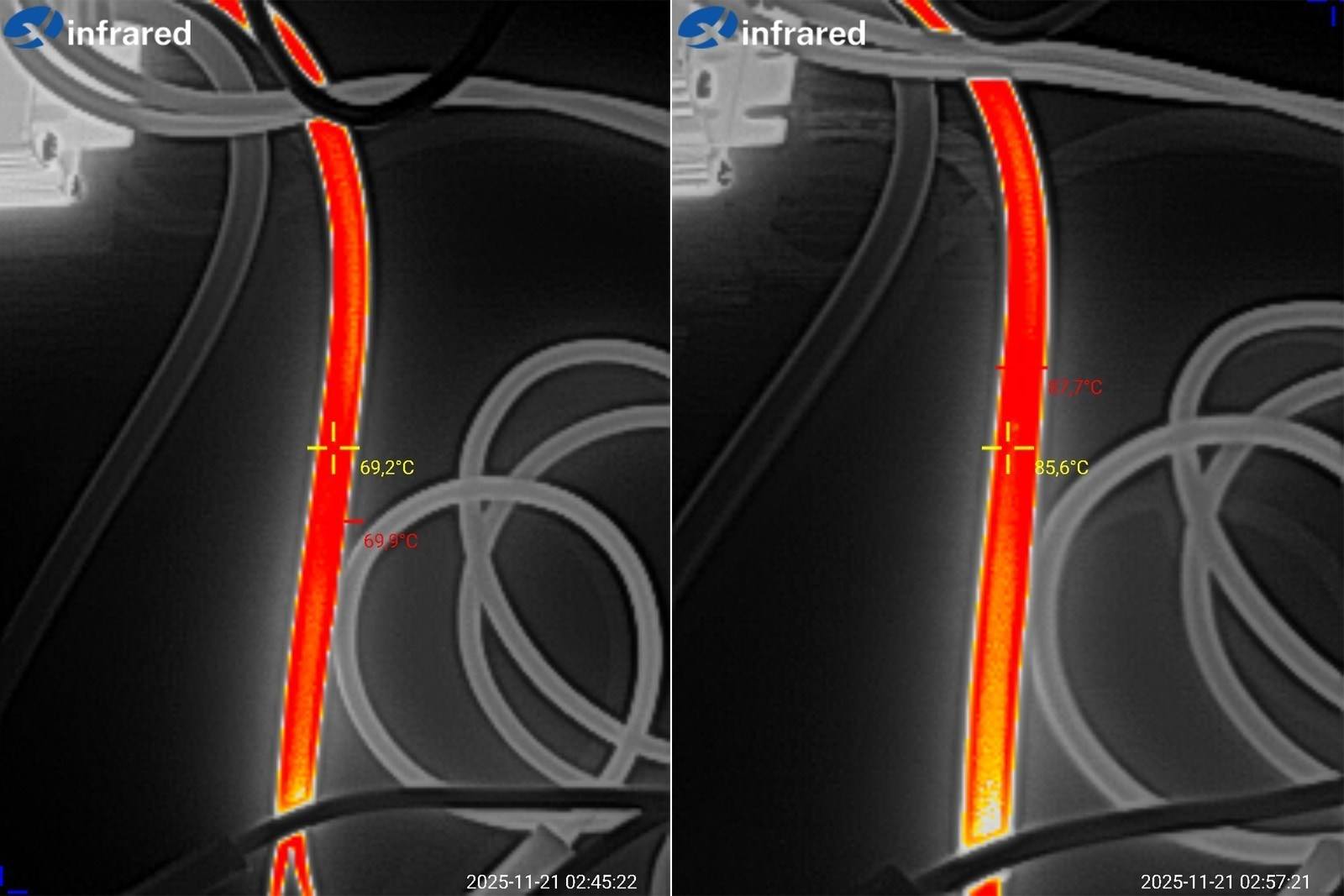
And here's why the load needs to be distributed across the outputs. I ran the load through just one output, and that cable reached 70°C at 21 A. At 25 A, it was already almost 90°C, which is dangerous.
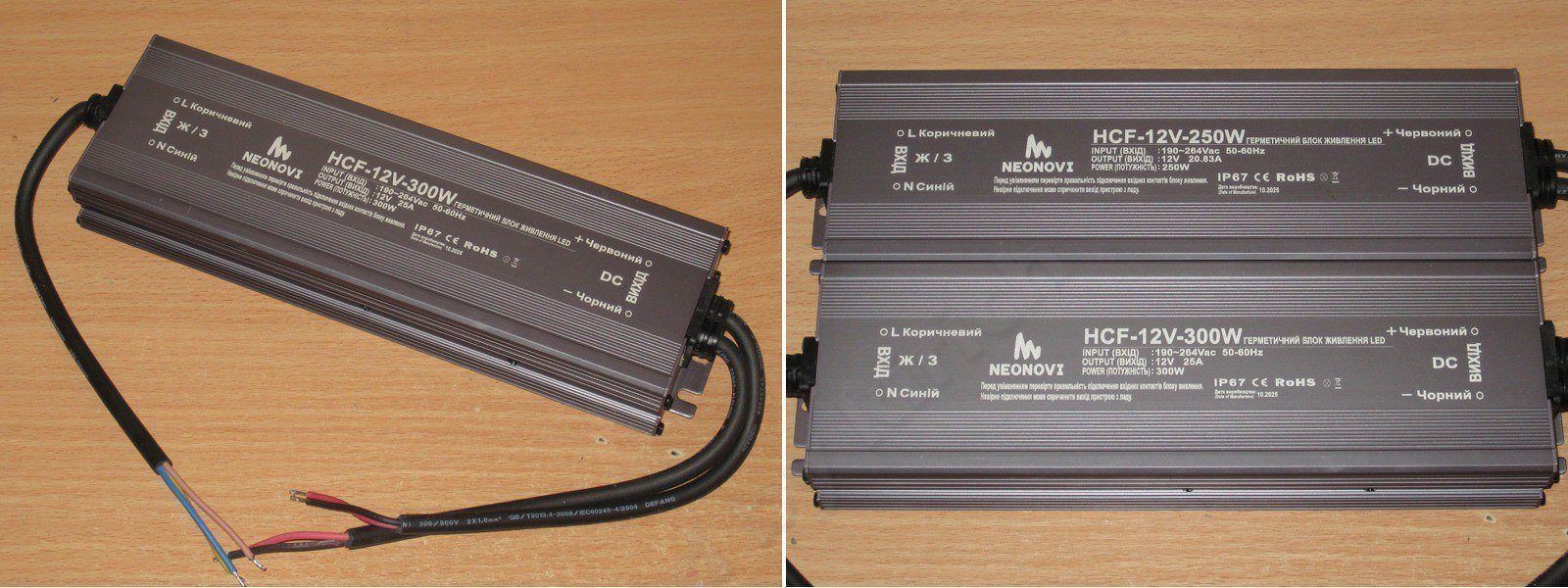
The second model, 12 V, 300 W — link
Dimensions: length 235/254 mm, width 74 mm, thickness 35 mm
As with the 100/120 W models, it feels like they're identical twins.
The test of the protection threshold confirms my impression: here too, the protection kicks in at 27–28 A. If the current is increased further, the voltage simply drops gradually, reaching about 10.65 V at 29 A.
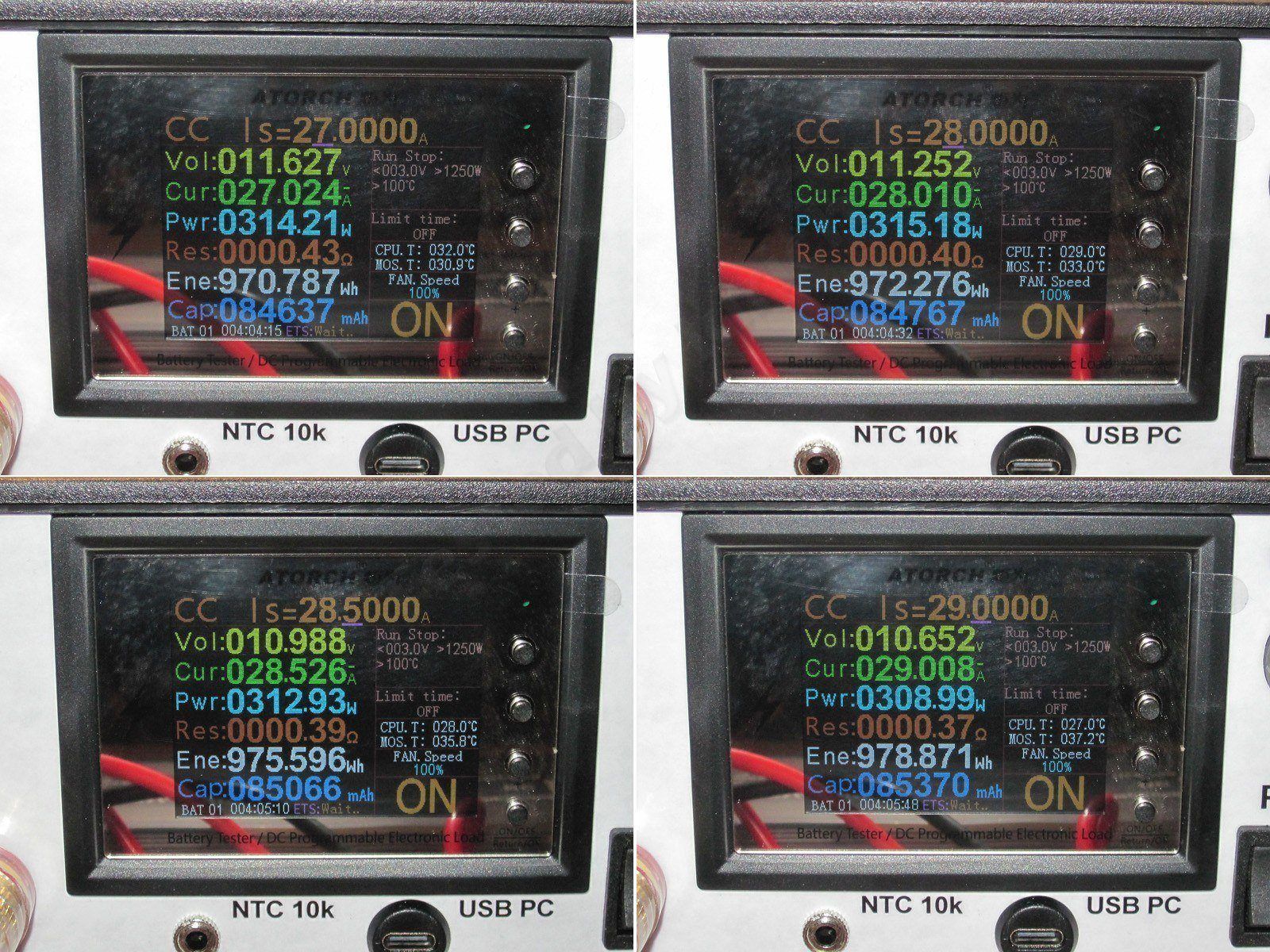
Efficiency was measured over the same 2–28 A range, again in 2 A increments, and the results were exactly the same as for the 250 W model.
No-load power consumption is about 0.9 W.
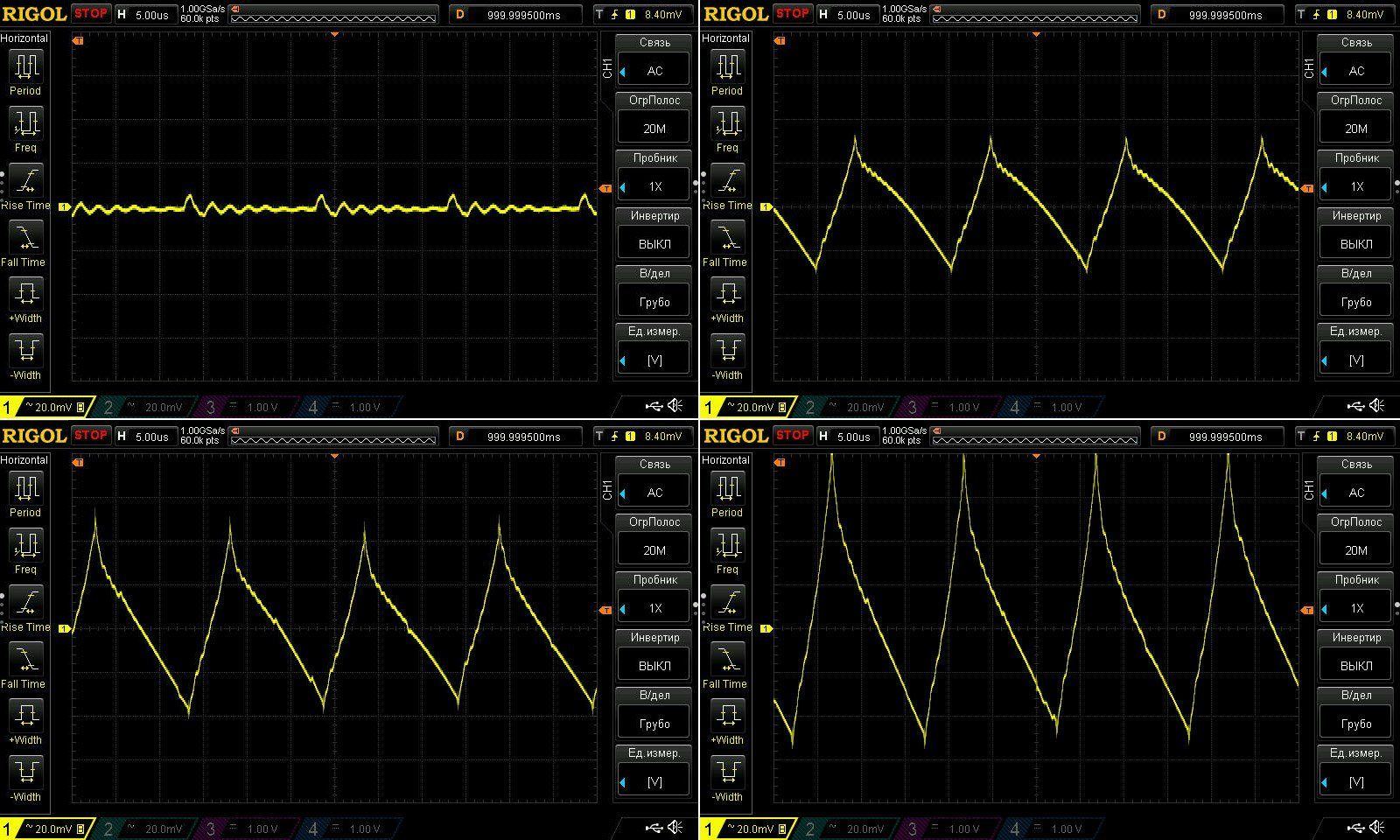
Ripple at no load and at currents of 8, 16, and 25 A. At 25 A, I measured about 130 mV; the 250 W model produced 120 mV under the same conditions. That's well within the margin of error, especially since the measurements were taken after the cable, not directly at the board output.
The conclusion is the same: ripple like this is perfectly normal, and even a good result, for a power supply of this rating.
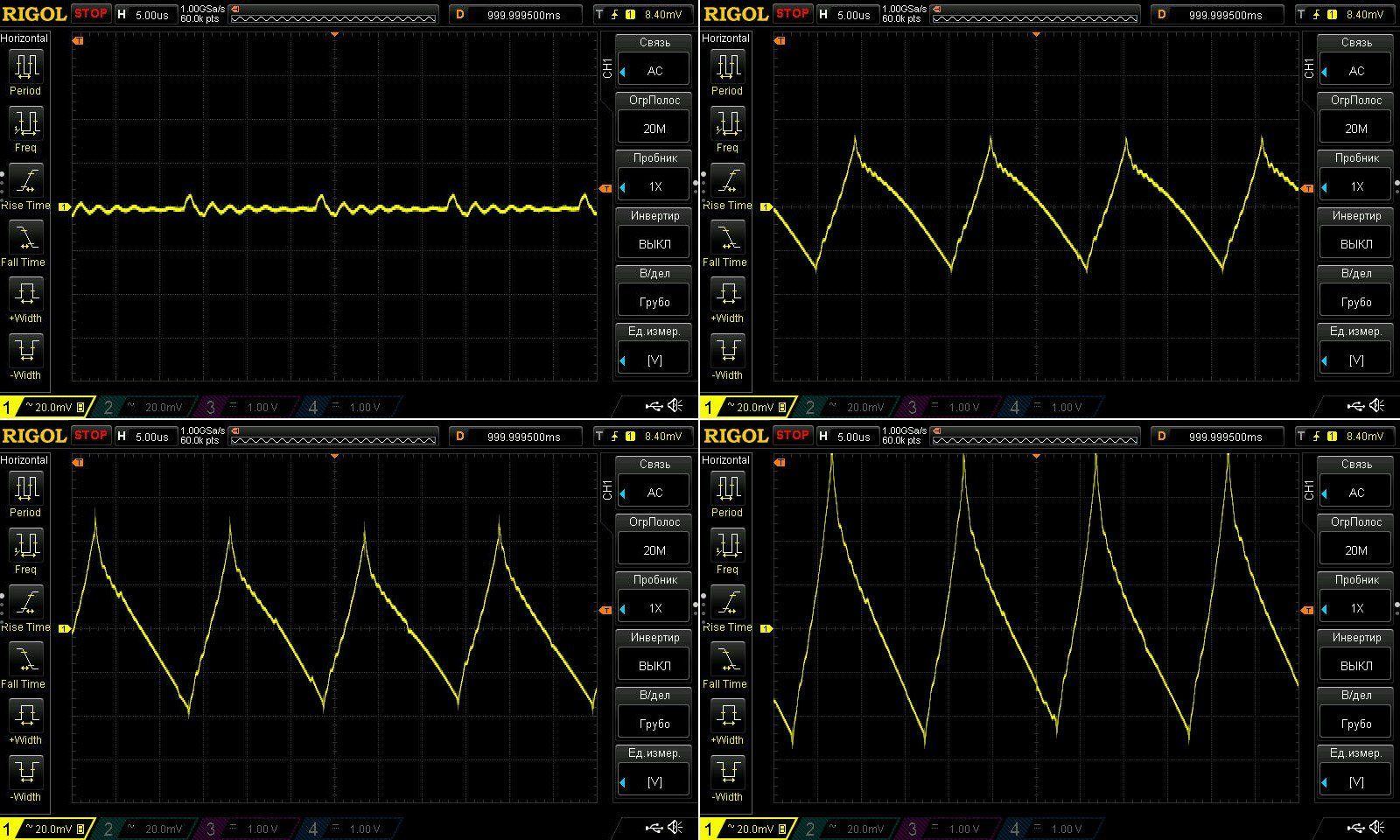
At low frequencies, it's identical to the 250 W model and just as free of issues.
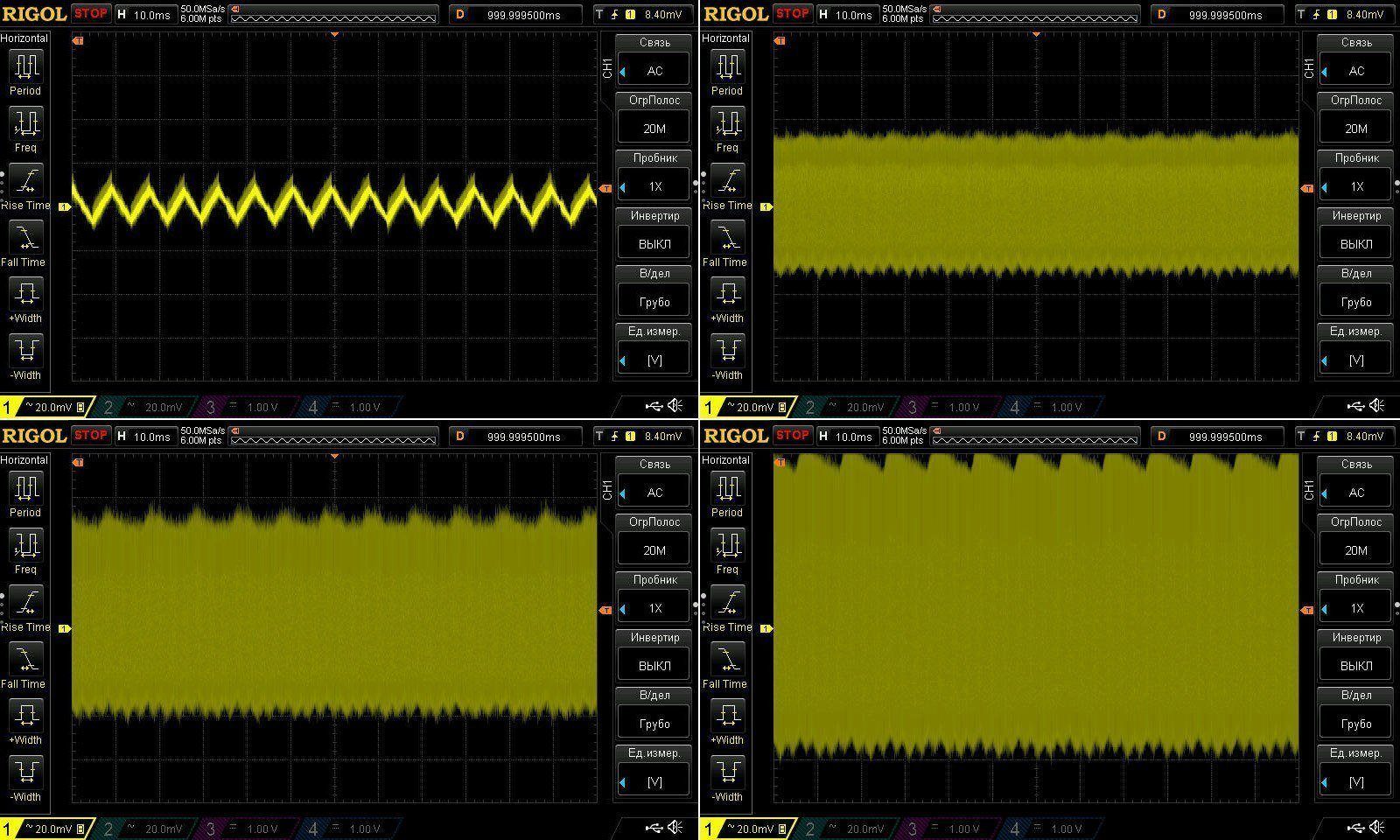
The warm-up test followed a slightly shorter procedure, at currents of 8, 16, and 25 A.
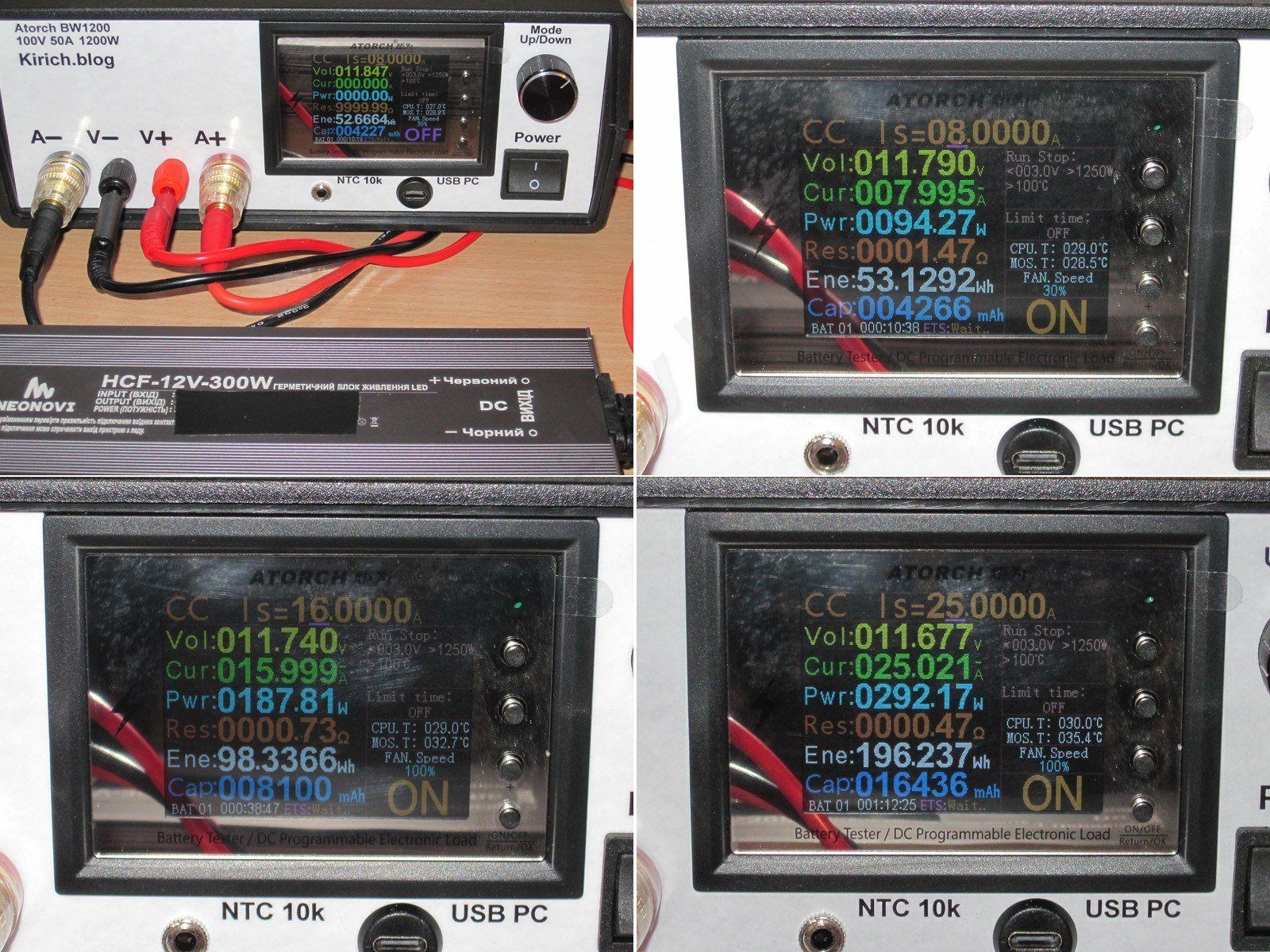
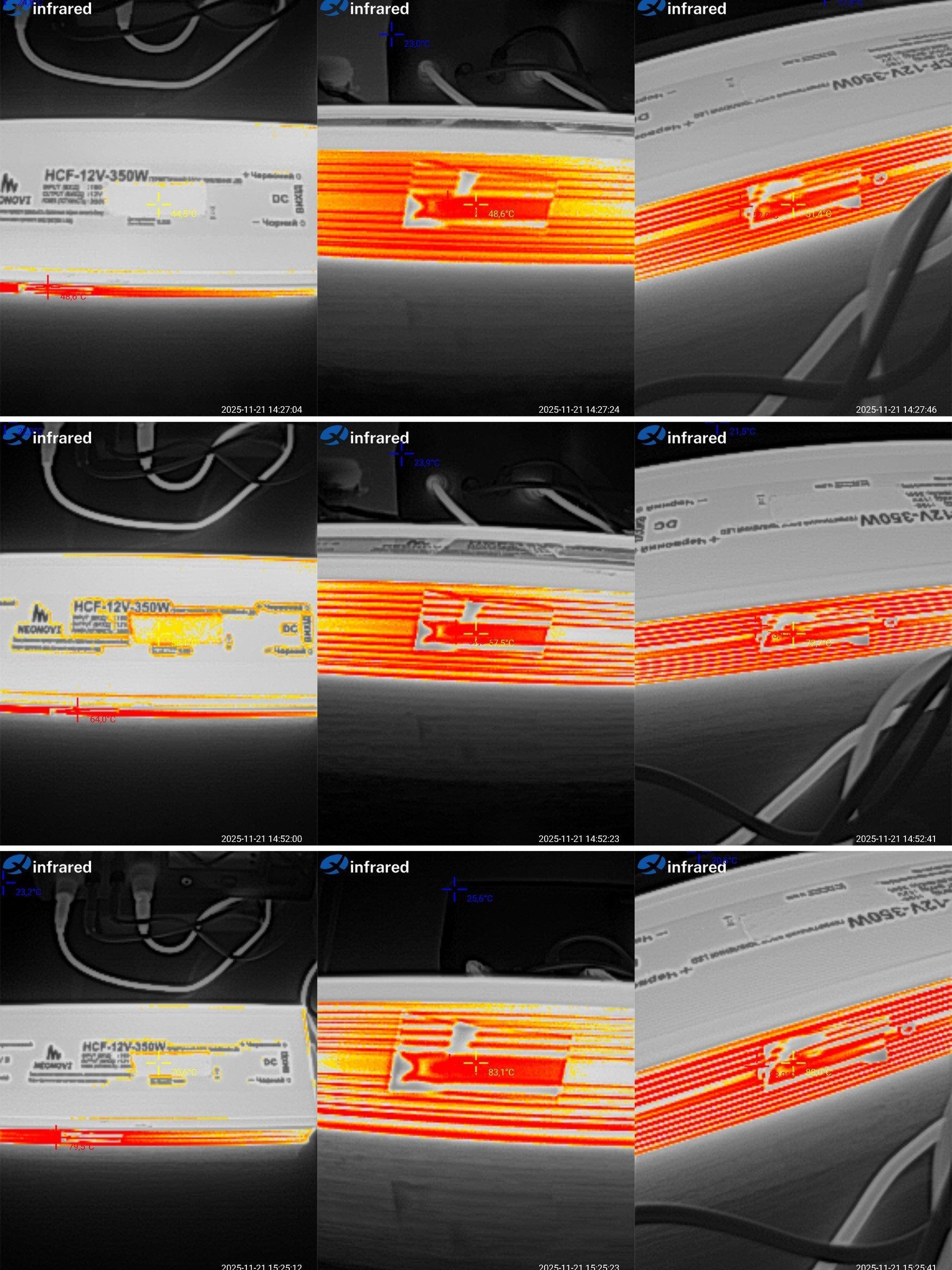
Results at 8, 16, 25, and 25 A, taken about 10 minutes later. The top photo shows the top cover, with temperatures of 34, 45, 65, and 67.5 degrees; the bottom photo shows the side near the diodes, at 36, 52, 78, and 83 degrees, respectively.
In essence, the results aren't much different from the previous model.
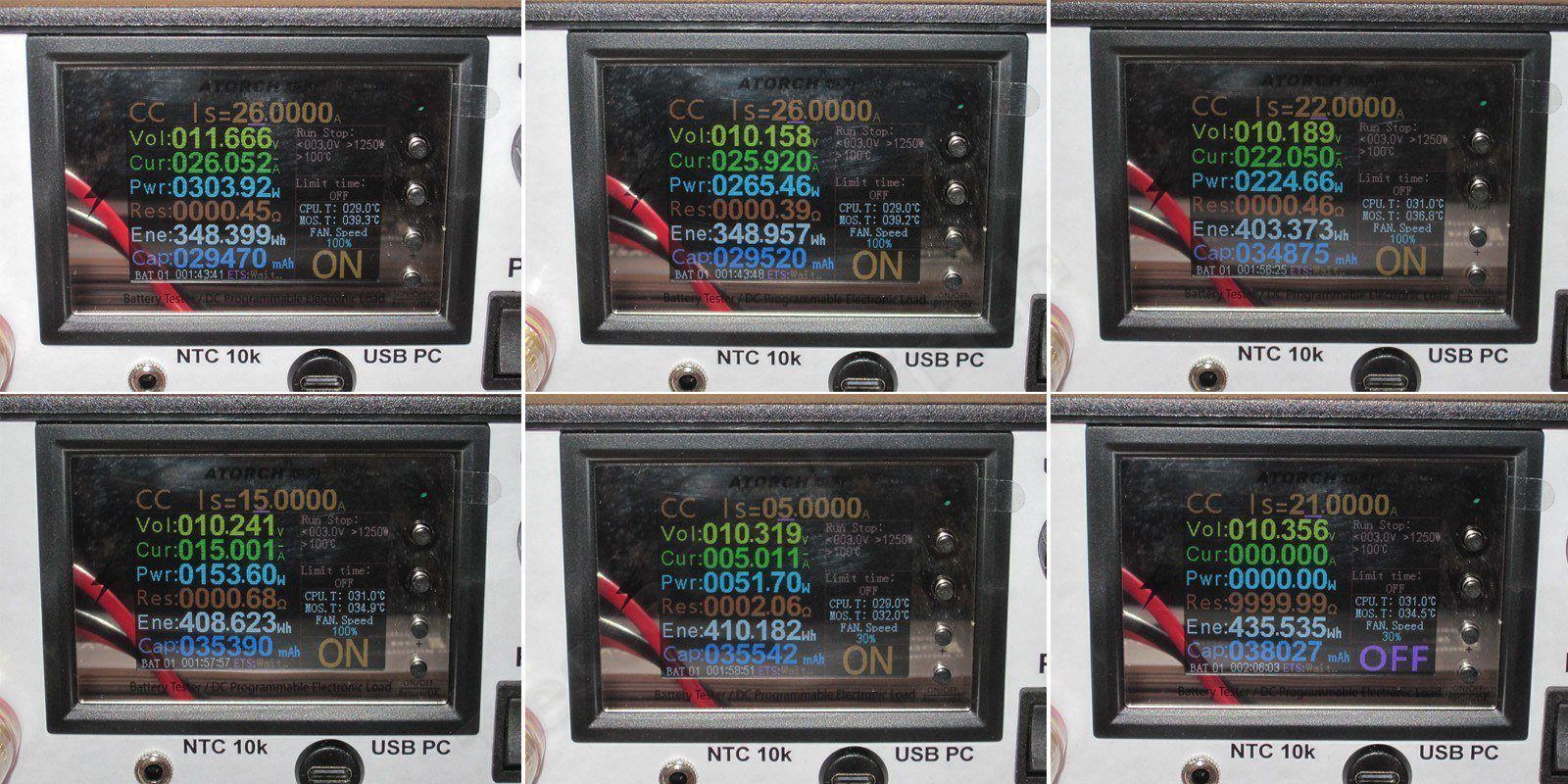
Everything would be fine if not for one “quirk”—a positive one in some ways, but one that initially left me completely stumped.
Here's what happened: when I set the load current to 26 A, everything was fine, but almost immediately the voltage dropped to about 10 V.
“Wait, what?” I said to myself. My first thought was that some kind of overload protection had kicked in—more specifically, overtemperature protection.
All right, I lowered the current to 22 A and let it run, then lowered it to 15 A, 10 A, and then 5 A, but nothing changed. Okay, I removed the load entirely, and still nothing changed, except that the voltage rose by about 0.2 V and the power supply's case cooled noticeably.
I switched off the power, waited a minute, and switched it back on. No change.
It turned out that this is a clever overtemperature protection feature. When it trips, it doesn't shut down the power supply; it just lowers the voltage. Once it has cooled completely and the overload is removed, everything returns to normal.
It's an unusual kind of protection, but for a power supply intended to power LED lighting, it's more than appropriate: if the unit overheats, the lights keep working, but at about 20–25% power. To restore normal operation, switch off the power, let the unit cool down, and switch it back on.
I think the previous 250 W model would have behaved exactly the same way; it just didn't get quite hot enough to trigger the protection.
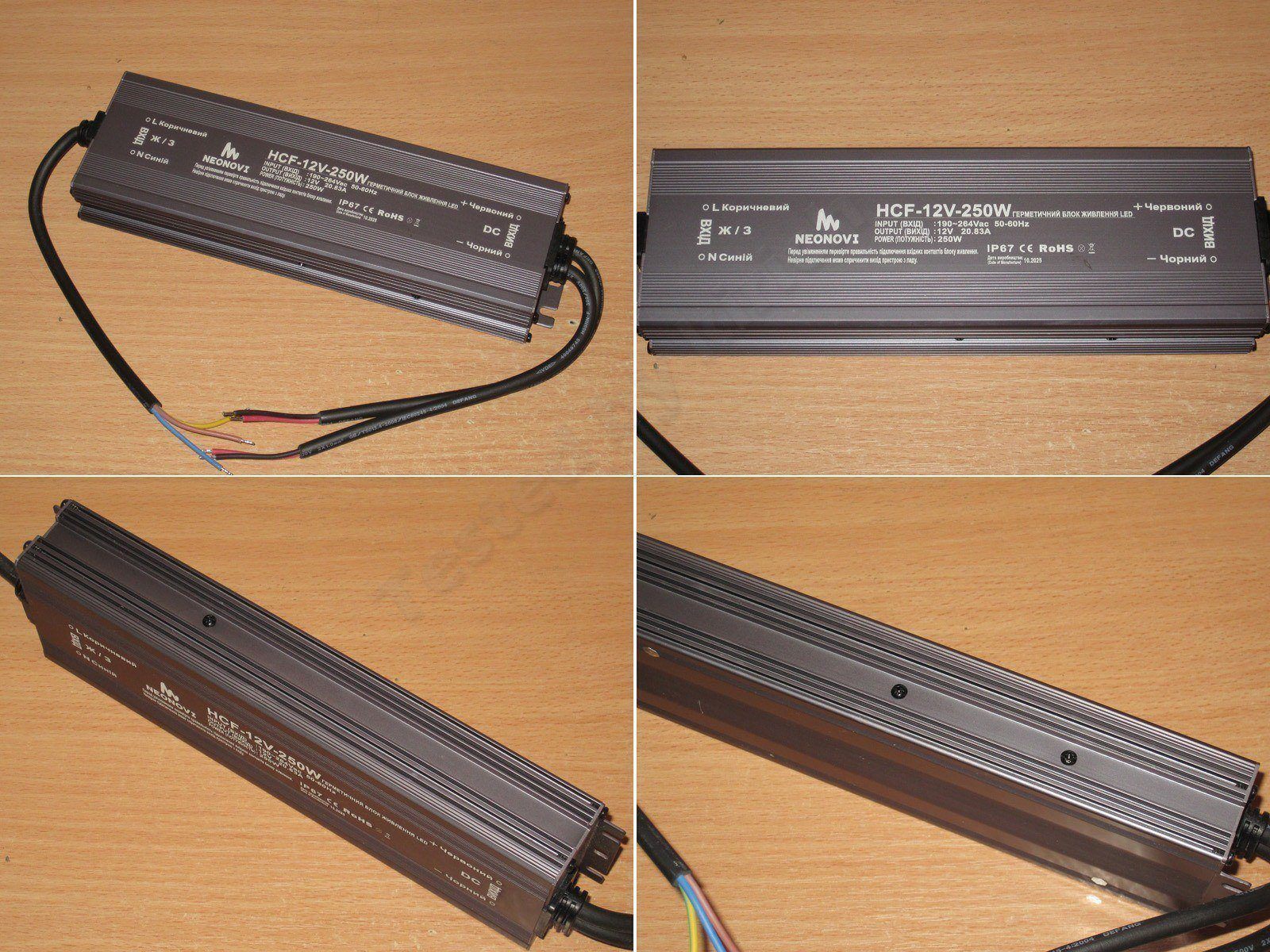
And here's the last model: 12 V, 350 W, weighing 1.5 kg. A real treat — link.
Dimensions: length 245/264 mm, width 91 mm, thickness 38 mm
Judging by the mounting points and number of power components, this appears to be a scaled-up version of the previous models.
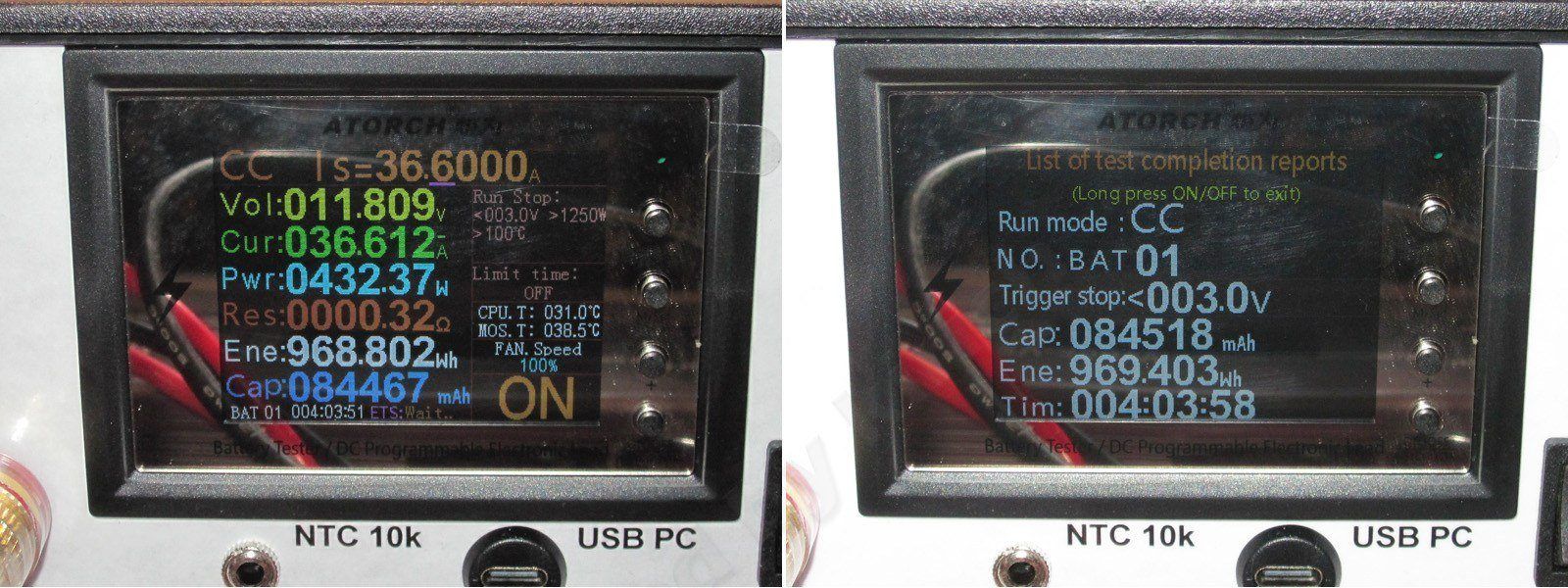
The protection trips at a current just over 36.6 A. The fact that it's threshold-based indicates that a different PWM controller is used.
In my opinion, 36 A is a bit much for this power supply; I'd recommend lowering the current to 32–33 A.
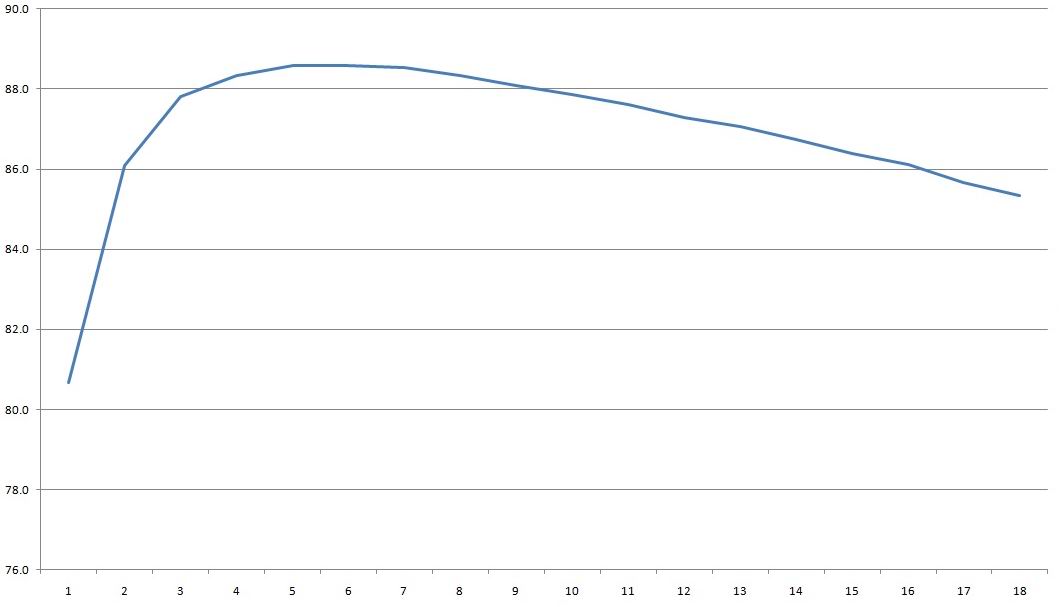
I measured efficiency from 2 to 36 A in 2 A increments. It was over 88% from 6 to 18 A, and not much lower at the other settings. For a 12 V model, that's not outstanding, but it's a pretty good result. If you need higher efficiency, you should look at 24 V systems.
No-load power consumption is about 1.5 W.
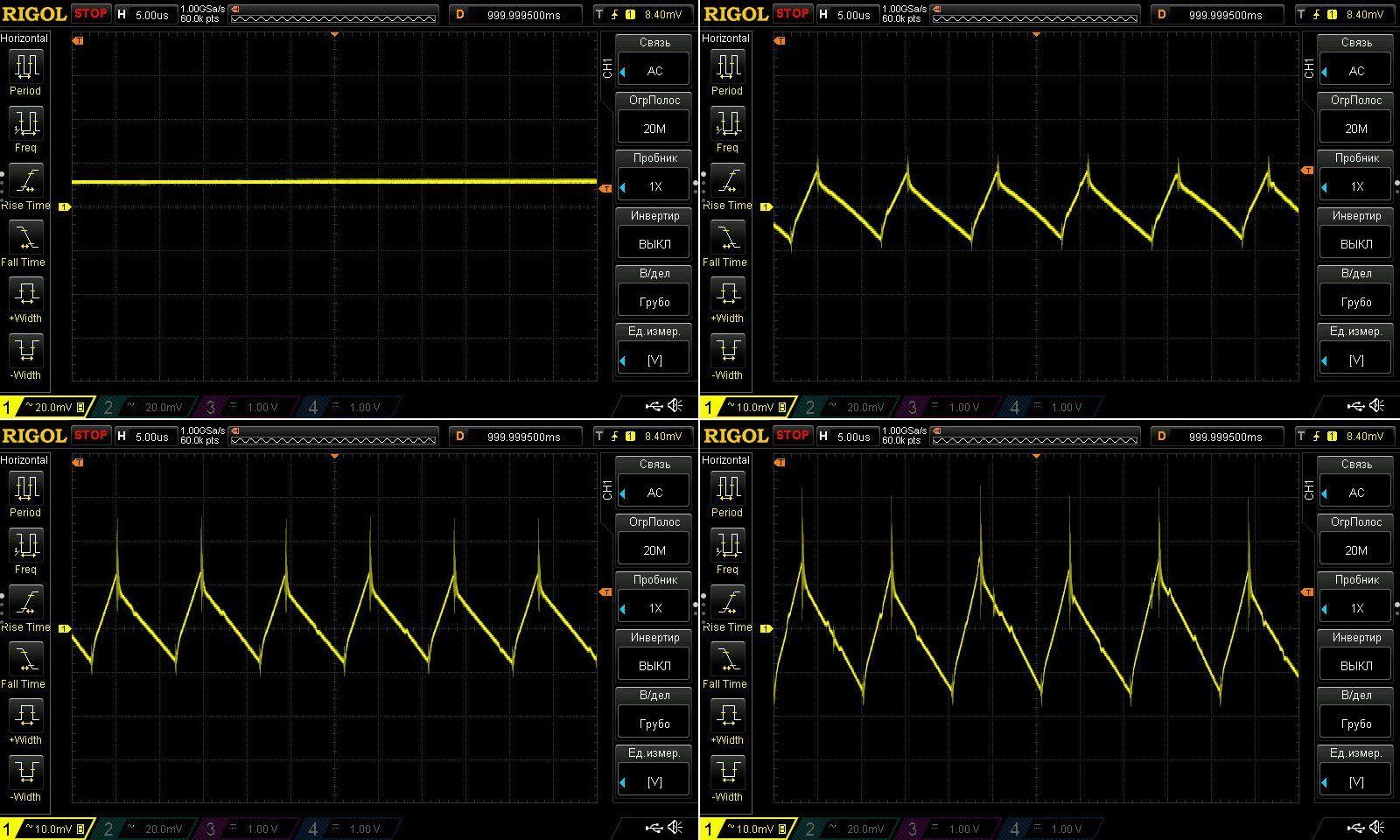
Ripple with no load and at currents of 10, 20, and 30 A.
Here, on the one hand, the power supply pleasantly surprised me: even at 30 A, ripple was no more than 50 mV peak-to-peak, including the “spikes.” On the other hand, it was a bit disappointing.
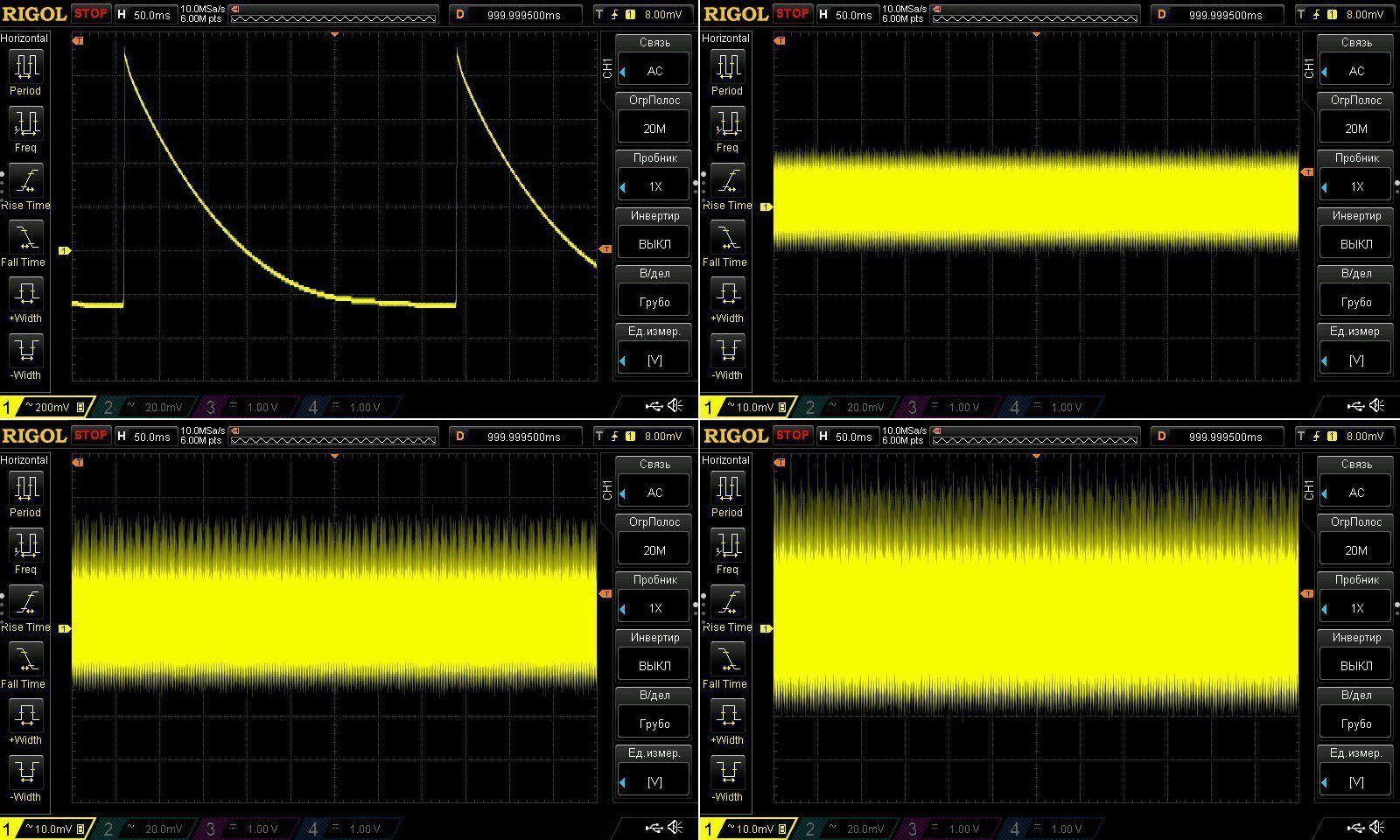
The disappointing part is that with no load, it switches to a start/stop mode at a relatively low frequency, resulting in ripple of about 1.2 V peak-to-peak, even though ripple under load is genuinely very low.
It's hard to say whether this should be considered a drawback. It's probably more accurate to call it a quirk of how it operates, and it's unlikely to show up in real-world use.
The output voltage does vary with load: at 30 A, it sags by about 0.12 V, but I don't think that will make much difference.
The temperature test was first run at 10, 20, and 30 A.

Then I raised the current to 32 A. The power supply was working normally, but when I came back about half an hour later, I saw that it had gone into protection, just like the 300 W model: it had lowered the output voltage.
This shows that the overtemperature protection isn't tied to the type of PWM controller, because this unit clearly uses a different one, yet the protection works in exactly the same way. Most likely, it's a separate thermal protection module on the secondary side that sends a signal to the main feedback loop. This shows that the manufacturer has thought about how to protect the product, which is a good thing.
This is also clearly a plus for safety: it's much harder to damage this power supply. And since it doesn't completely shut off the output when powering LED lighting, this is a really well-designed feature.
By the way, after cooling completely, the power supply resumed operation, and as far as I remember, without having to power-cycle it. But I’d probably make the hysteresis a little smaller; waiting for it to cool down completely takes quite a while.

Temperatures on the top, transistor side, and diode side at currents of 10, 20, and 30 A.
10 A — 45, 49, and 52 degrees
20 A — 58, 68, and 73 degrees
30 A — 71, 84, and 89 degrees.
Temperatures at 30 A are rather high. I think the realistic continuous current for this model is closer to 25 A than 30 A.
Above, I hinted—and at one point said almost outright—that there are probably pairs of identical power supplies labeled with different power ratings.
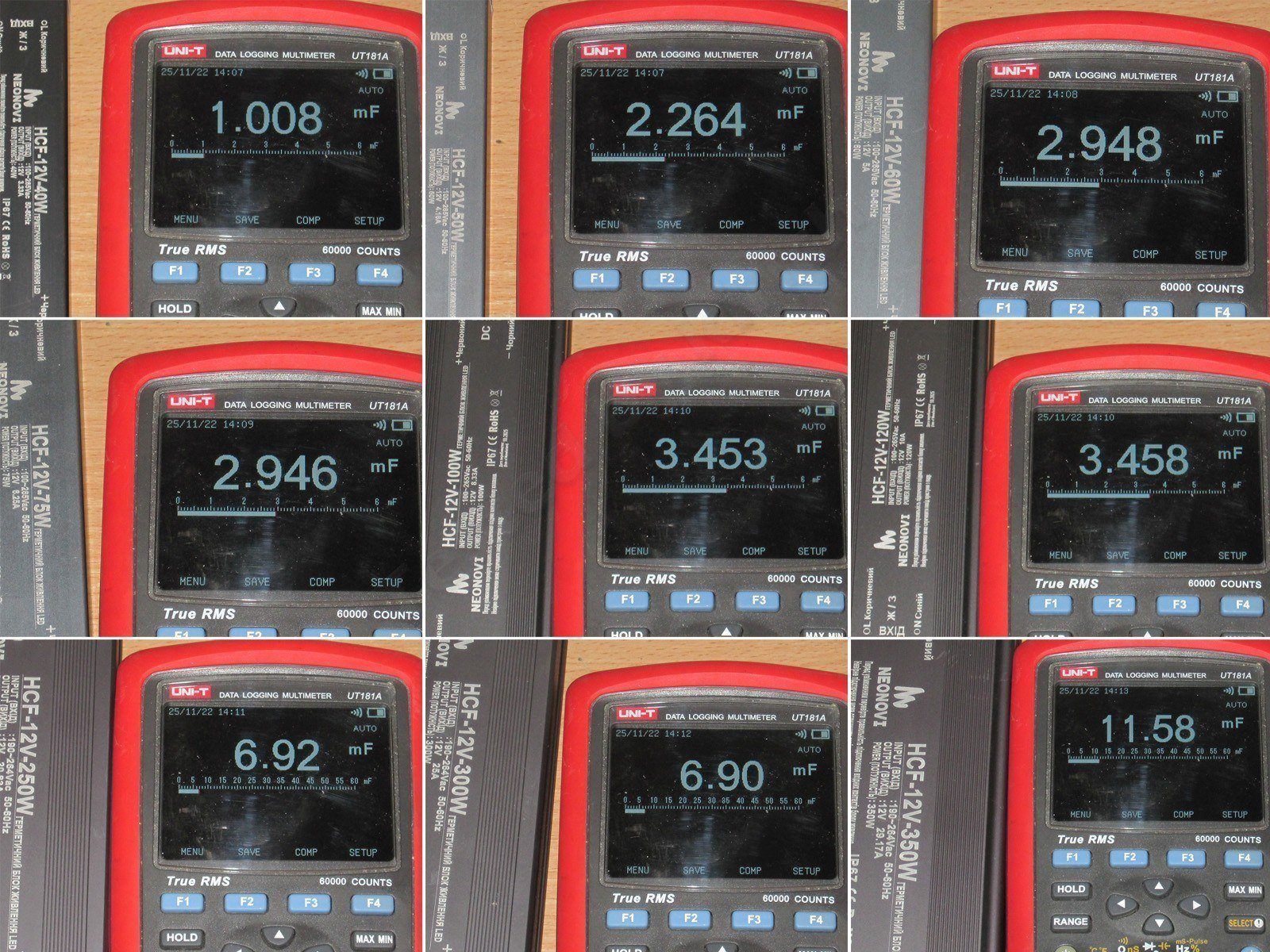
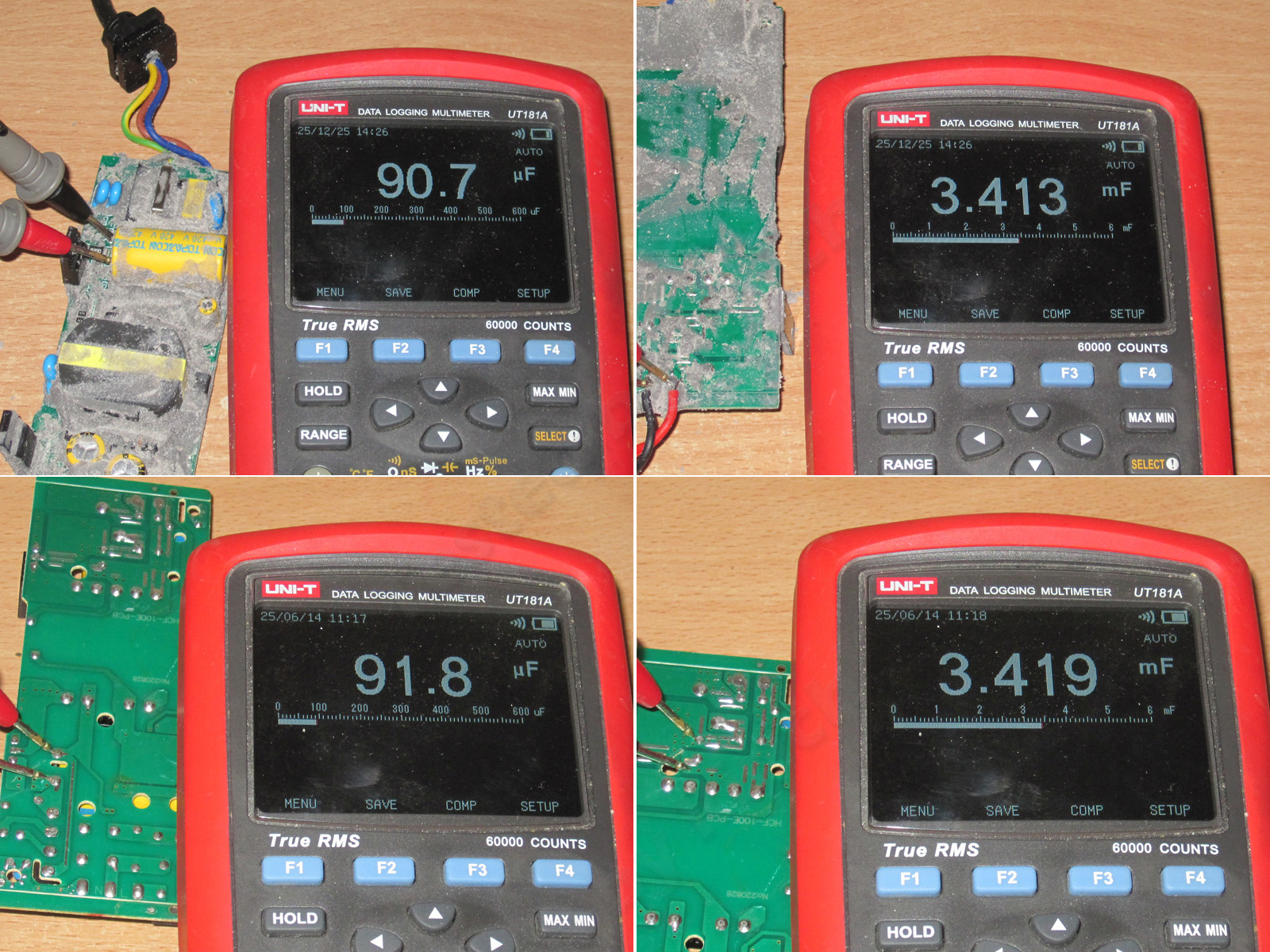
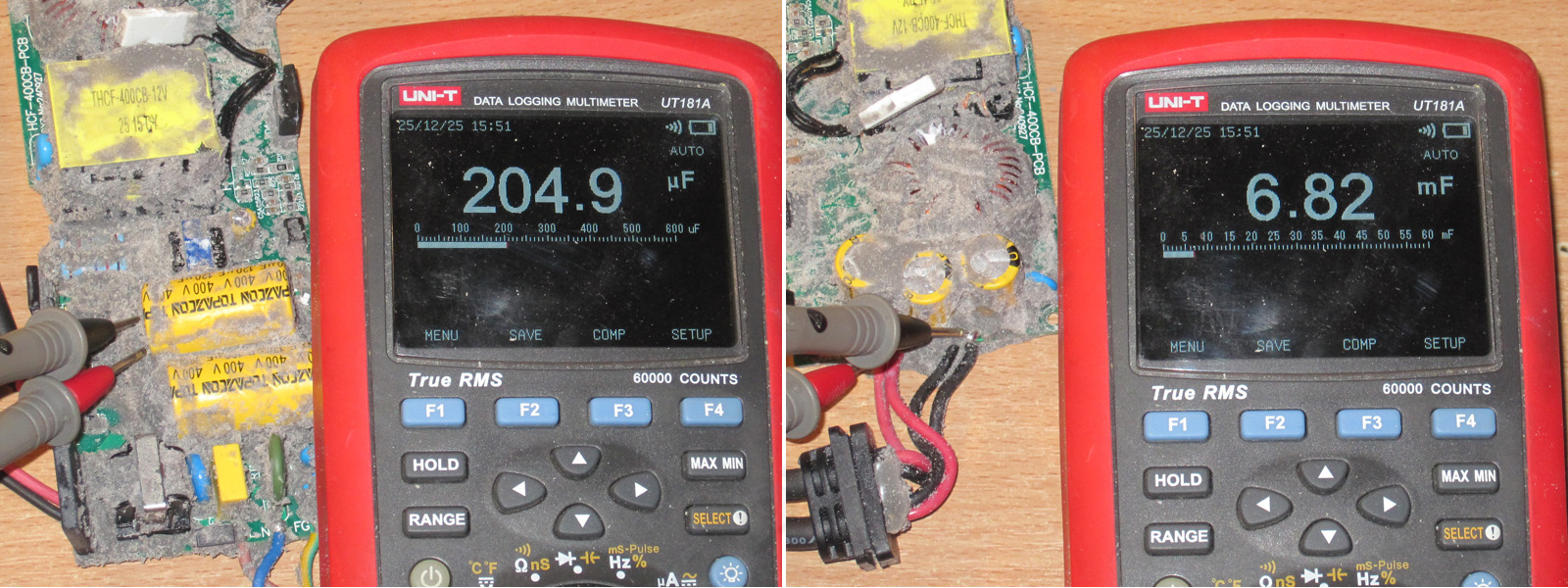
Another way to compare them, albeit indirectly, is to measure the capacitance of the output capacitors. Here are the results for all the models tested: 40, 50, 60, 75, 100, 120, 250, 300, and 350 W.
And for the paired models rated at 60/75, 100/120, and 250/300 W, the results are 2948/2946, 3453/3458, and 6920/6900 µF, respectively—differences within the margin of error.
Sure, I can imagine that some changes might have been made in theory, but something tells me the factory took one of these approaches to expand its product range:
1. Say a customer suddenly wants to buy the 100 W model, but the warehouse has plenty of unmarked 120 W units. Rather than lose the customer and leave stock sitting around, they label the 120 W units as 100 W. This sort of thing definitely happens in practice.
2. The factory makes 100 W models, but the customer wants 120 W. They check that the 100 W power supply works fine at 120 W, label it as 120 W, and sell it. Something tells me this is exactly what happened.
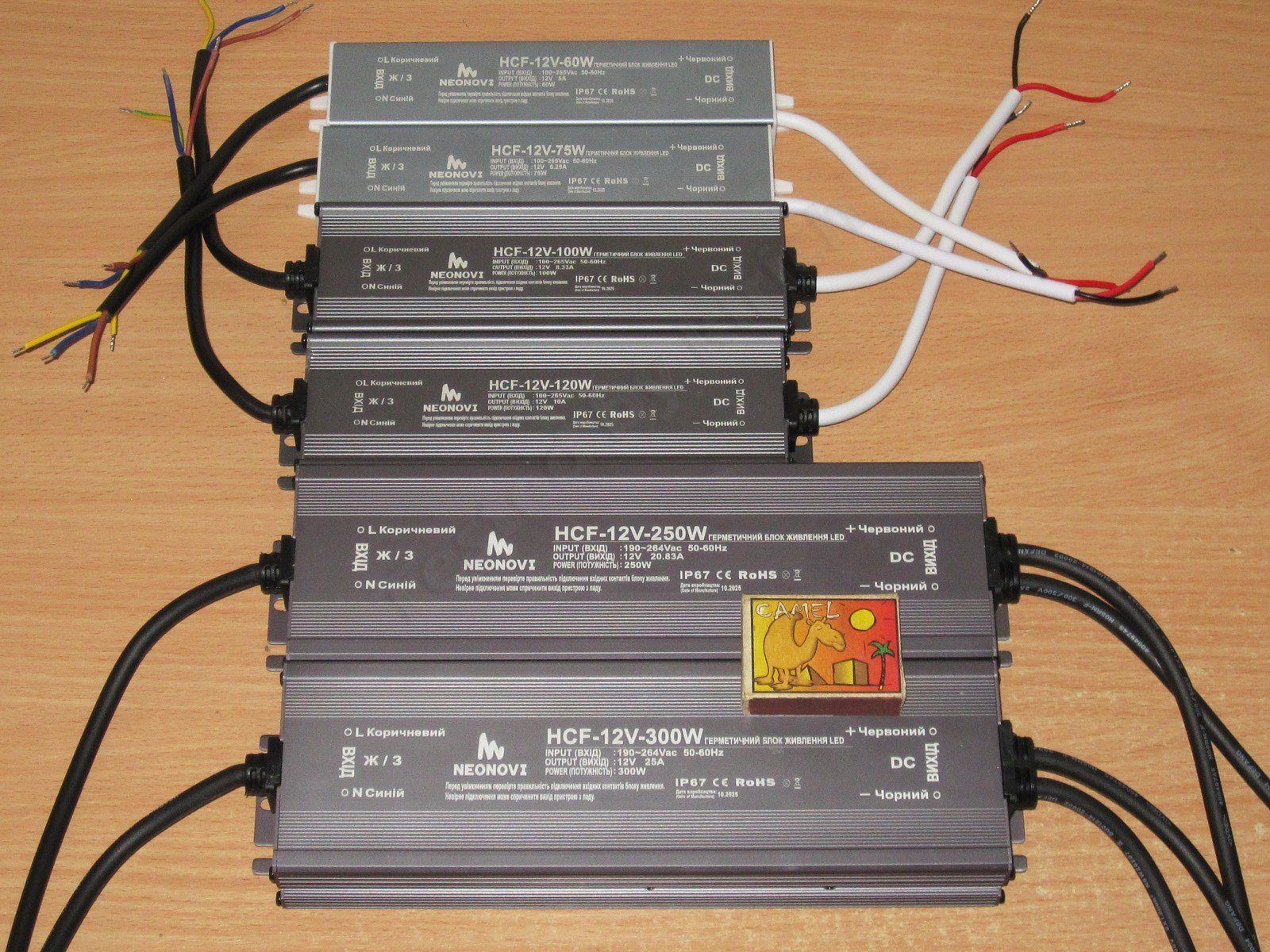
So we have three pairs that look alike on the outside, too:
The 60 and 75 W models handle 60 W without any trouble, but can also run at 75 W, although in my opinion they get rather hot at that level. The protection is actually set to 90–95 W, so this is closer to the 75 W model than the 60 W one.
The 100 and 120 W models have their overcurrent protection set closer to the 100 W version, since the voltage starts to drop at around 125 W.
The 250 and 300 W models have the same protection settings, but these power supplies handle 250 W with confidence. At a sustained 300–320 W, they can easily trip the overtemperature protection.
As promised at the beginning, here’s a bonus.
In the comments on my previous review, people said there was no point in reviews like this. Well, I want to show that there is a point after all.
The person who sends me all these power supplies wants to sell decent products. Even if they’re budget models, they should at least be reasonably good quality.
We’re working together to push back against Chinese factories, gradually bringing suitable power supplies up to standard and making sure there aren’t pairs of models like the ones I showed above. In fact, we’ve already filed a complaint with the manufacturer: nobody is going to pay extra for supposedly 75, 120, and 300 W models that are actually 60, 100, and 250 W, so these models simply won’t be ordered again.
People also told me that manufacturers can change the internals as they see fit. They can, but since we work directly with the factory and order in large batches, things are a little more complicated.
Not long ago, I reviewed several circuit boards for sealed power supplies. They were samples from the same factory whose power supplies I tested in this review.
So, after discussing it with Vitaly, we decided to put them to the test.
For this, I took apart the 100 W model, since it’s the most popular and, in my opinion, a good one.
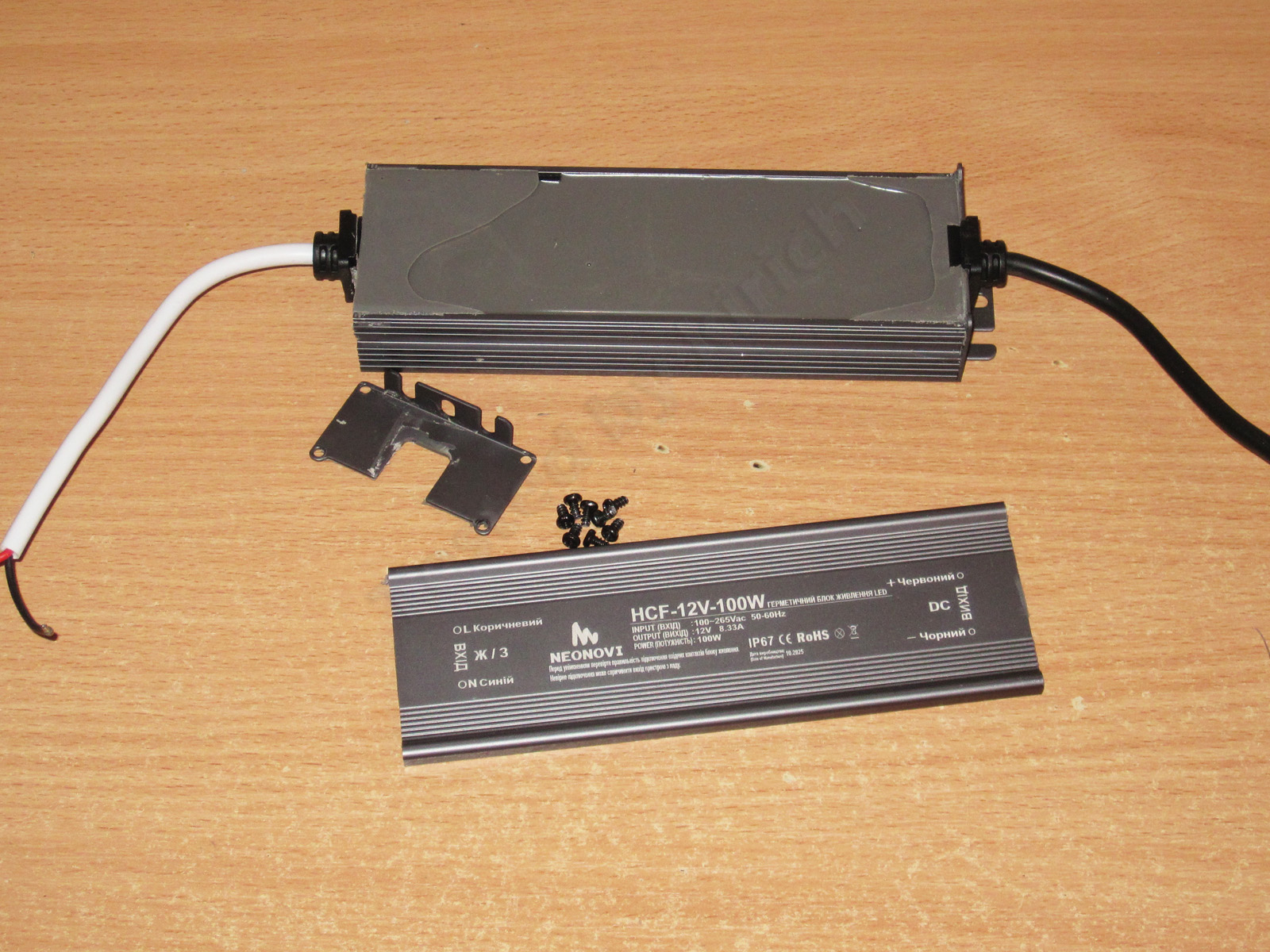
Everything inside is thoroughly and tightly potted, with no gaps. The compound itself is fairly soft, more like medium-density rubber.
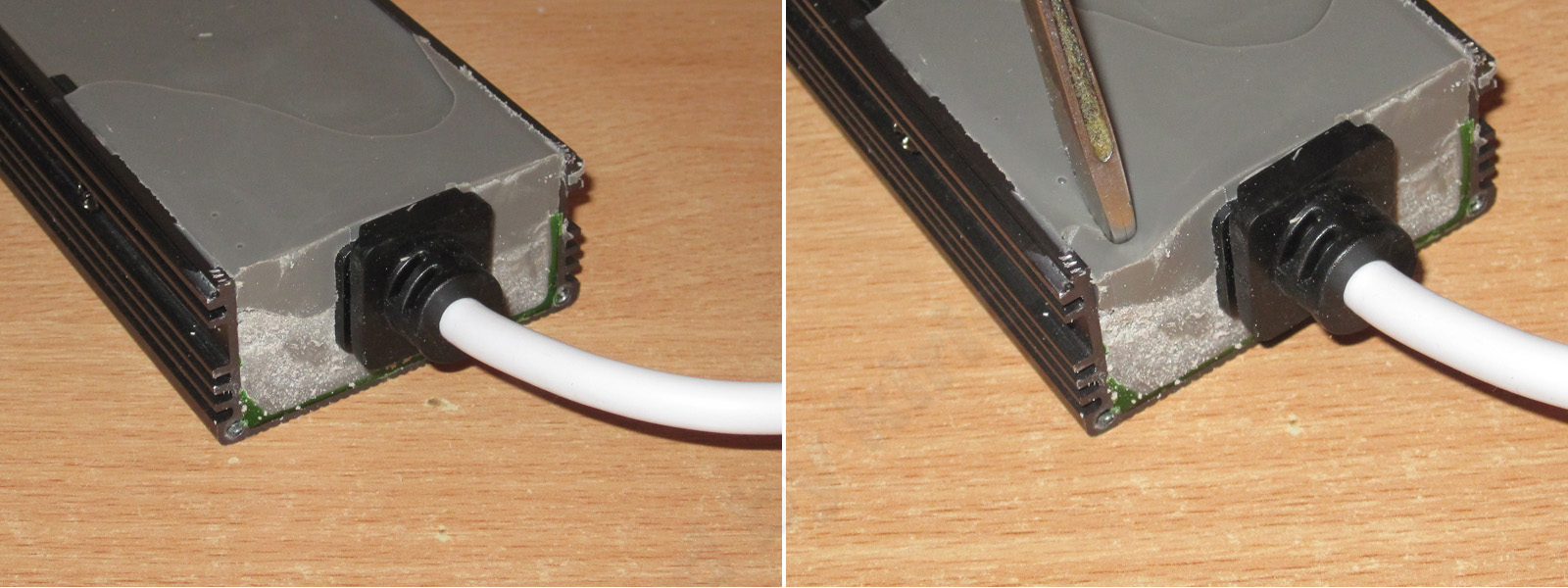
I should point out that the transistors were installed with thermal paste—they could easily have “forgotten” to use it.
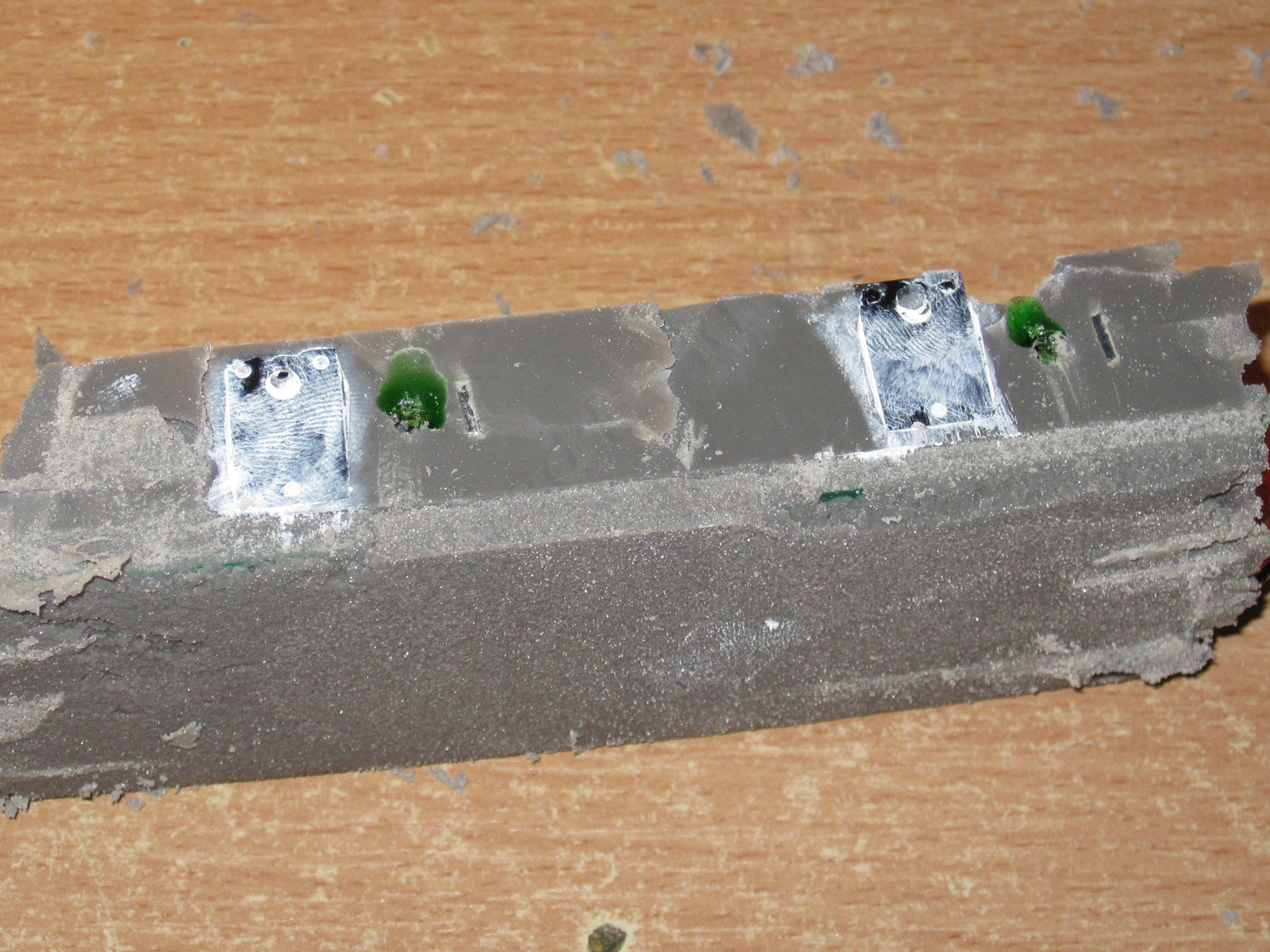
After a series of simple but lengthy and tedious steps, I got to the key components I was interested in.
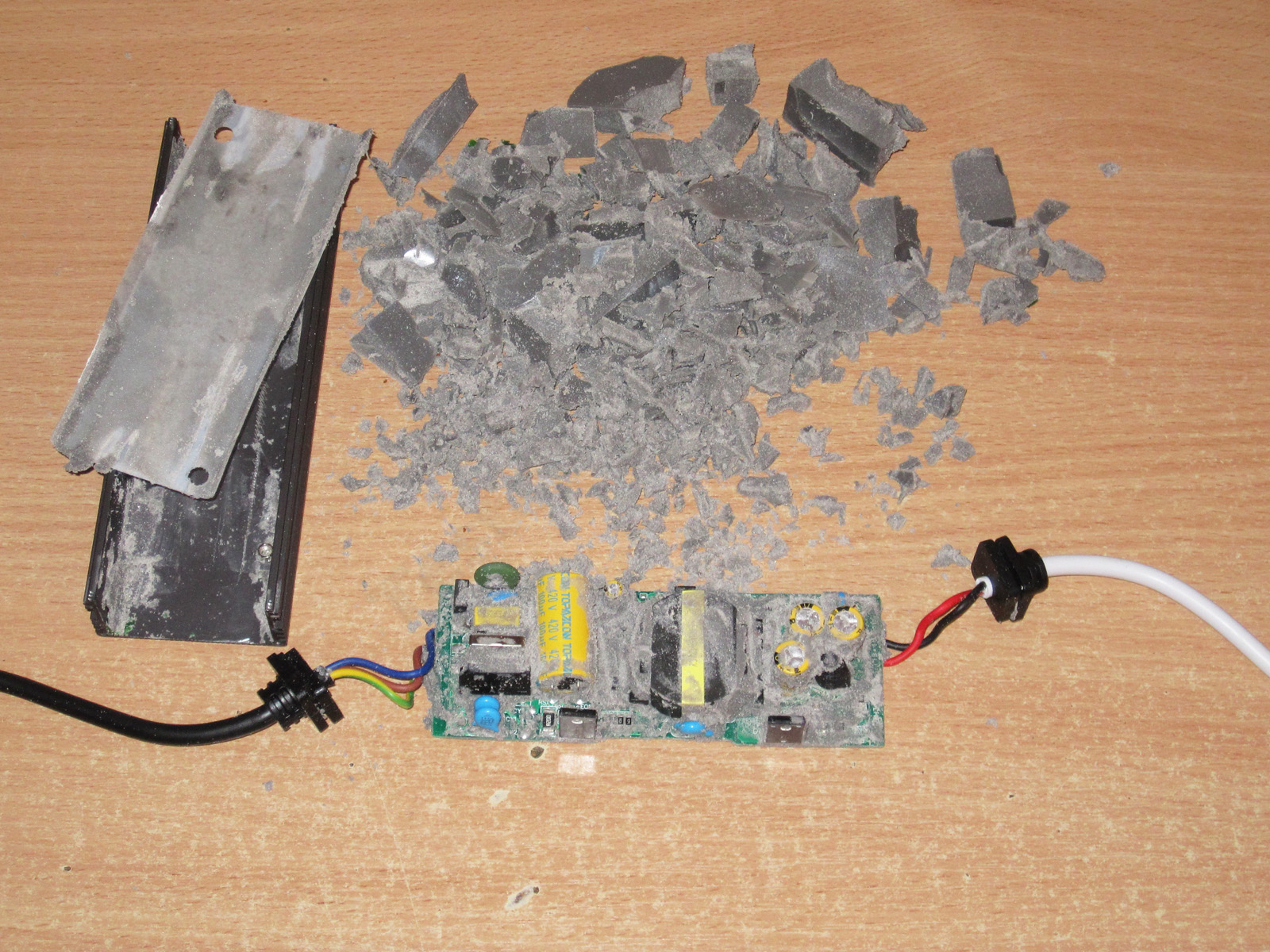
And now we can compare what we have with the sample they gave us. I don’t think I need to explain which is which :)
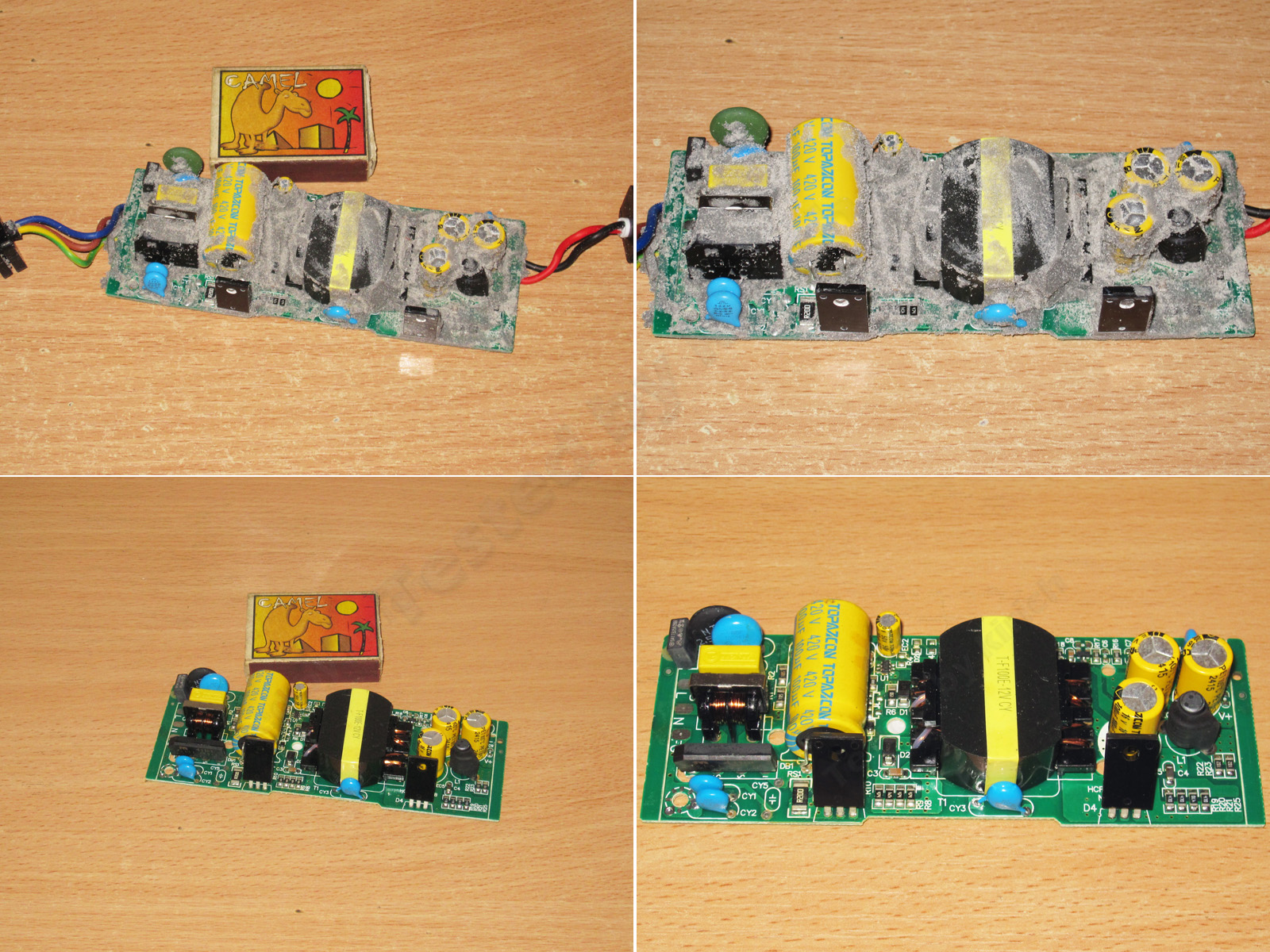
All the components match the sample exactly.
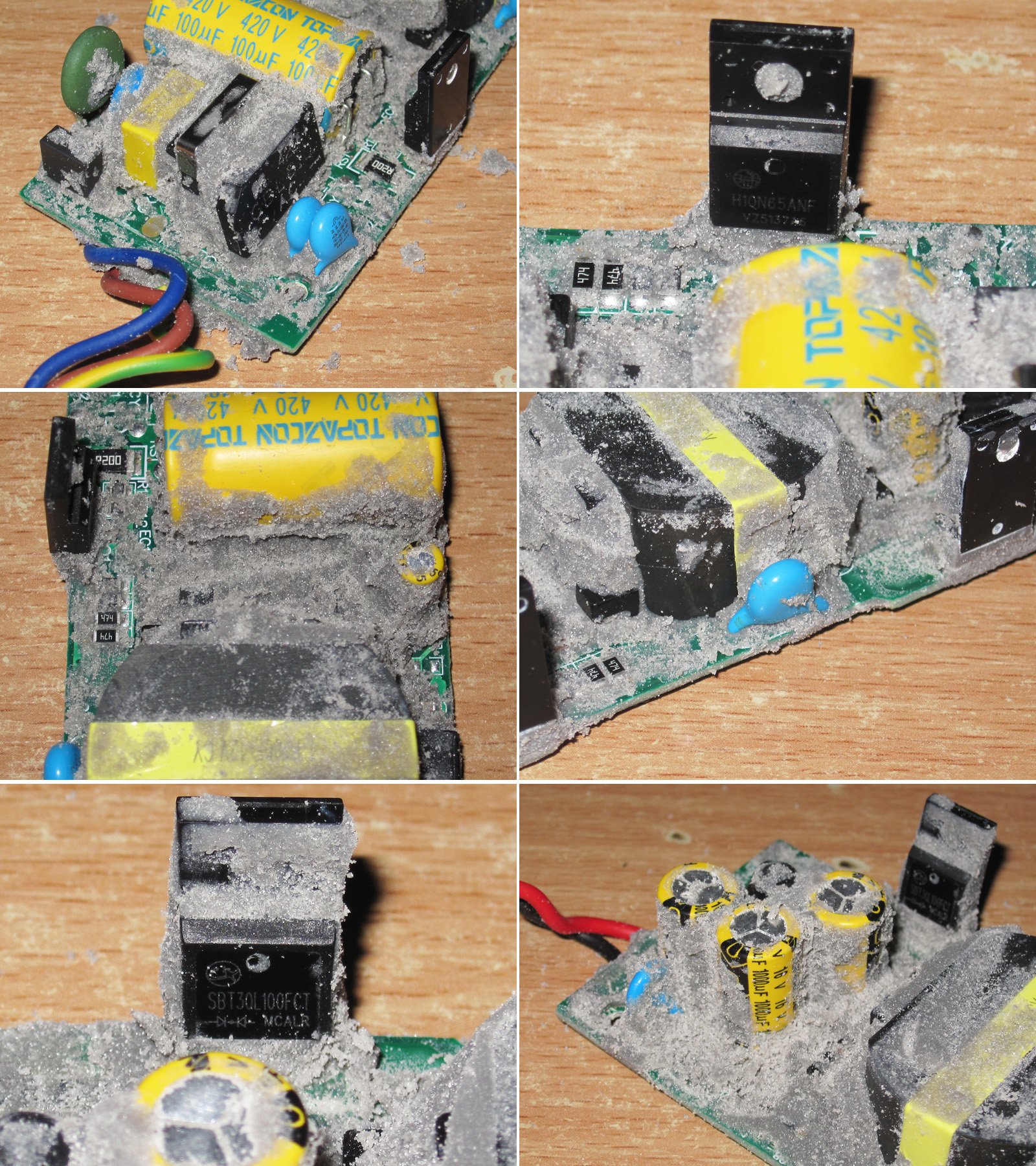
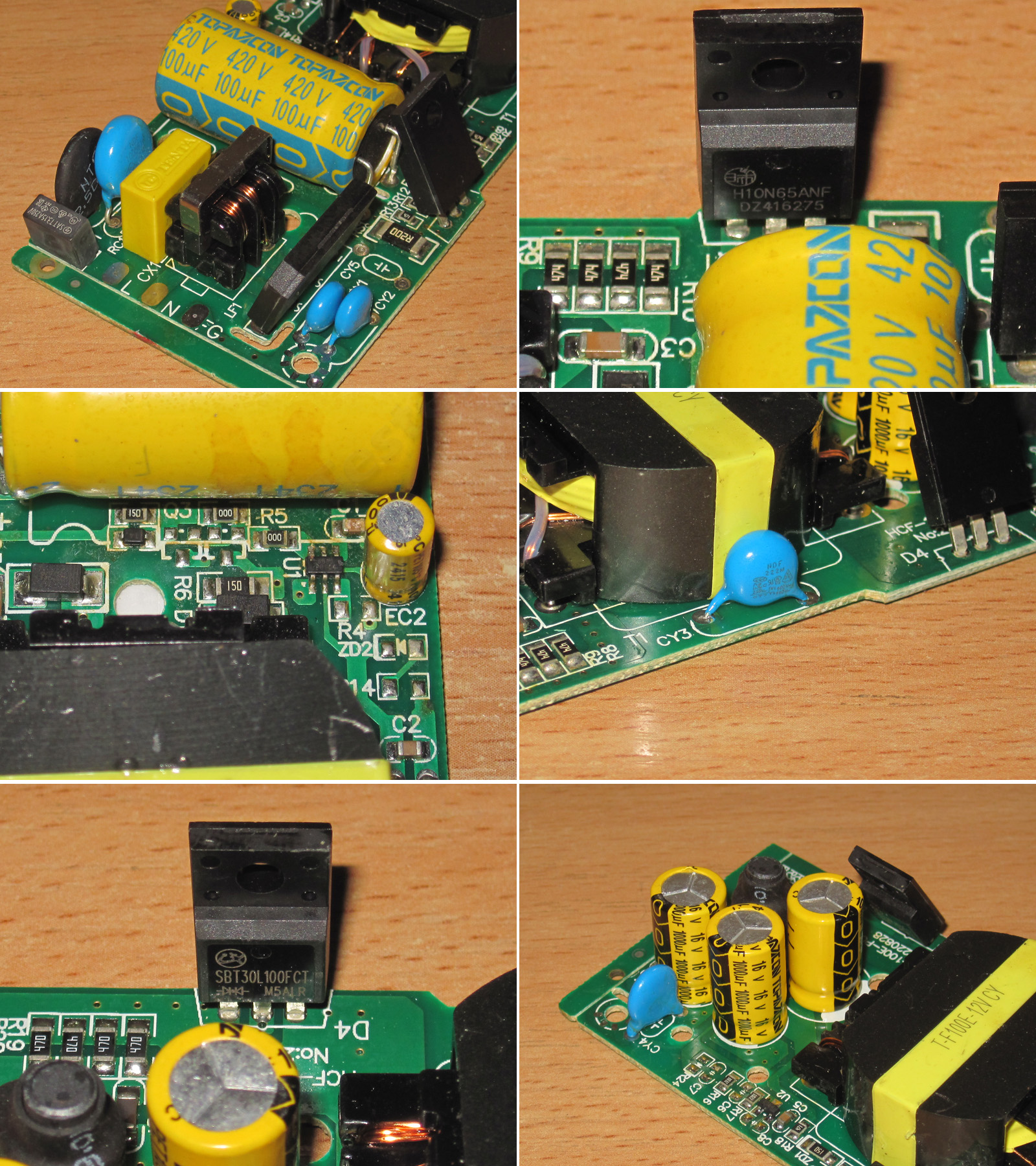
The capacitor values differ slightly, but that also depends on temperature, and to me the difference is within the margin of error.
This is also done to show the manufacturer that every so often we can do more than just open a box and take a look: we can even compare sealed power supplies and dig out the potting compound.
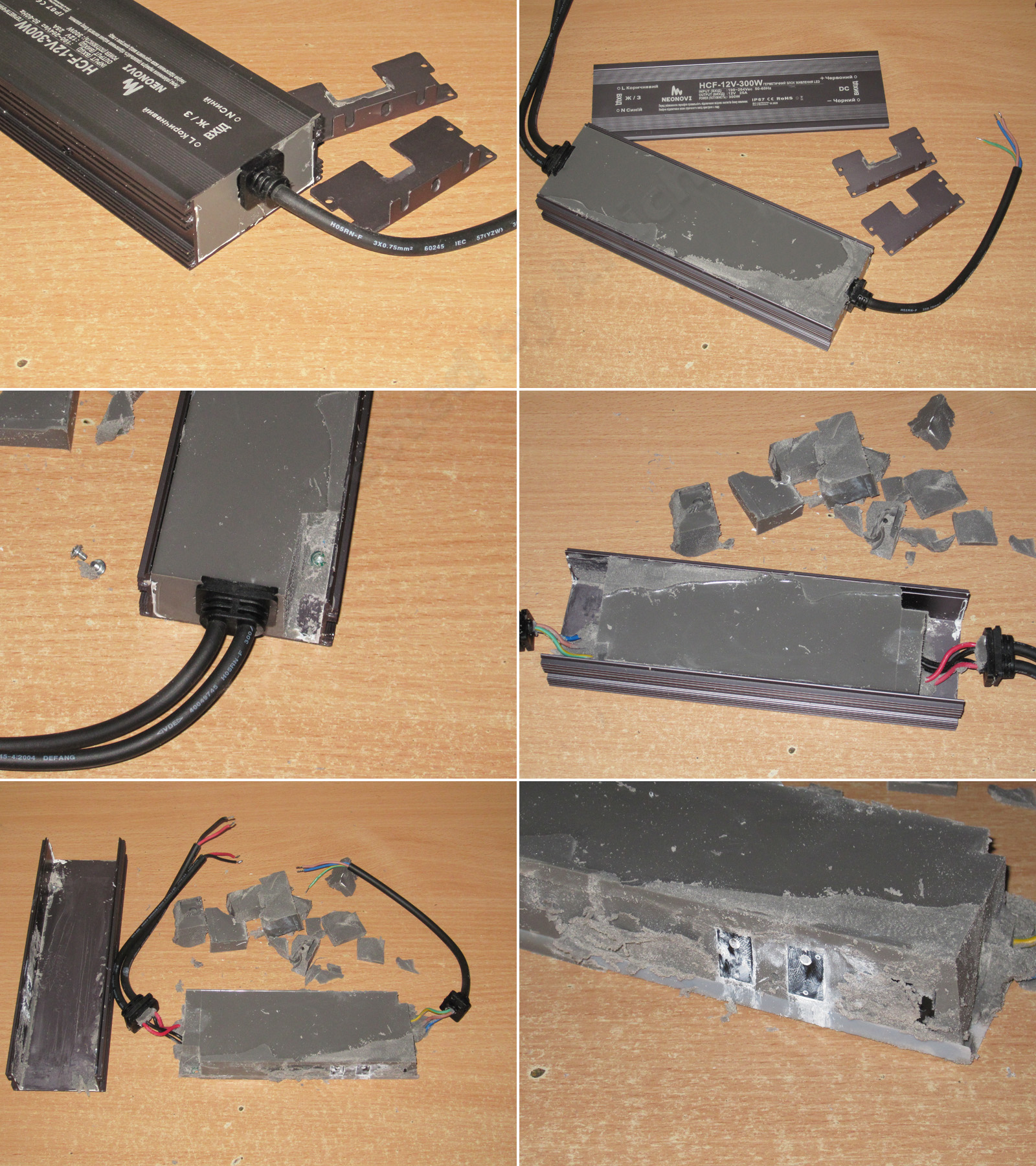
Someone also suggested opening up another power supply and let me choose which one. I figured there was little point in opening up the 350 W model, so I was choosing between the 250 W and 300 W versions. As I wrote above, the 300 W model is the same as the 250 W one, just with an inflated rating on the label, so I felt less bad about opening it up.
So I opened up the 300 W model. It's relatively easy to do.
1. Unscrew the side covers. You can also see here that the potting compound is dense, and I didn't notice any bubbles while taking it apart.
2. If the cover won't slide off, run a ruler between the cover and the potting compound; it usually isn't held very firmly there.
3. Unscrew the fasteners for the power components, then cut away the compound around the board fasteners and unscrew the screws.
4. Cut away as much compound as possible from the edges of the board. It's usually noticeably shorter than the enclosure. The goal is to reach the end of the board and clean it off.
5. Take a thin steel ruler and work it between the enclosure and the board's plastic insulator. The bond is usually a little weaker there, and you're less likely to damage the board itself. Be very careful, though, not to bend the ruler, and especially not to drive it into your hand, because it takes quite a bit of force. Once you've worked along the bottom, run a knife along the sides, then use something flat and sturdy to pull the board out. I use a thin steel pair of tweezers for this: spread them into a V and slide them under the board.
6. The power components are also coated with thermal paste here. Excellent.
I wrote above about the weight of these power supplies. In fact, most of it is the potting compound. I'd estimate it accounts for about 65–70% of the power supply's total weight.
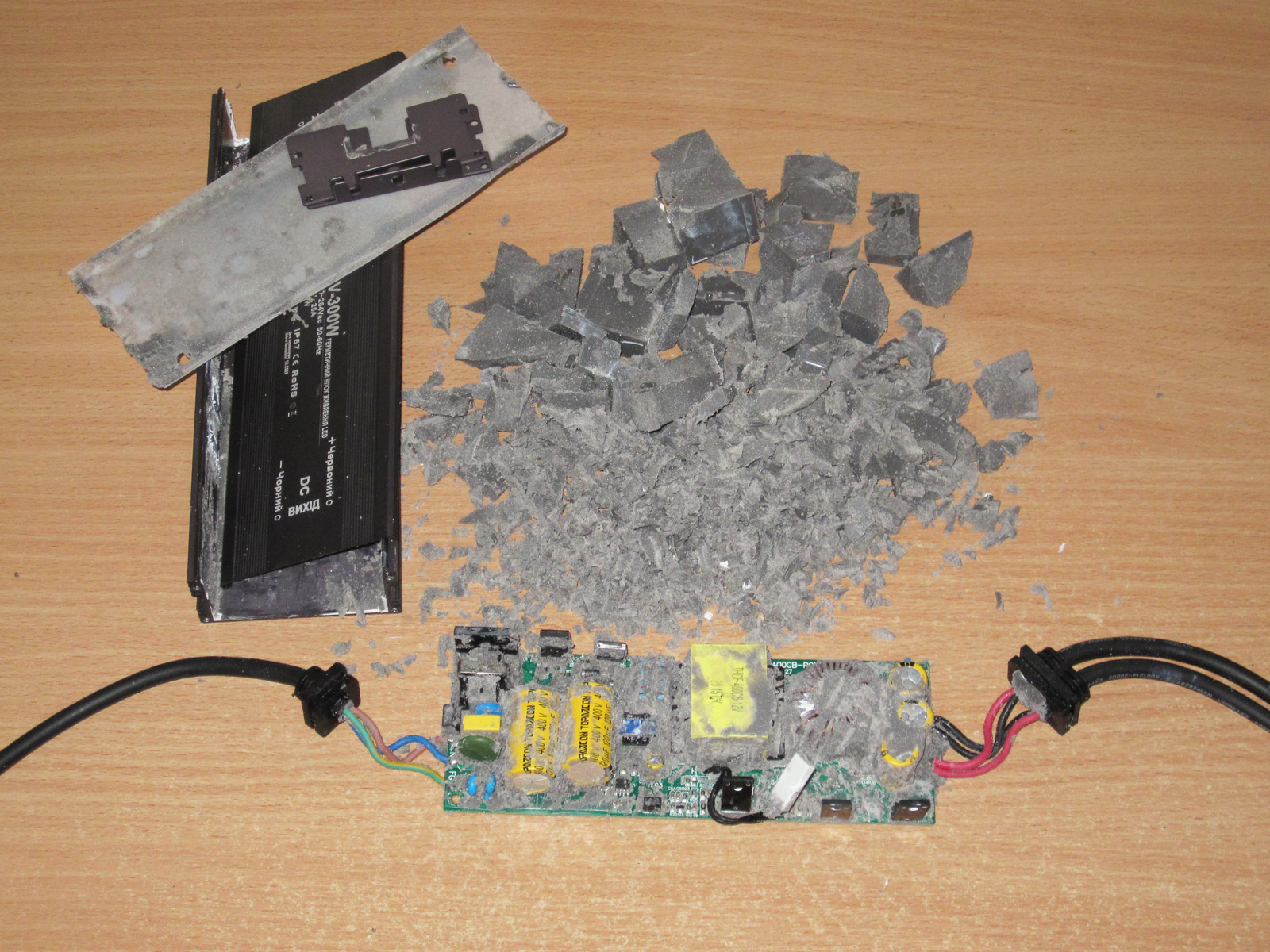
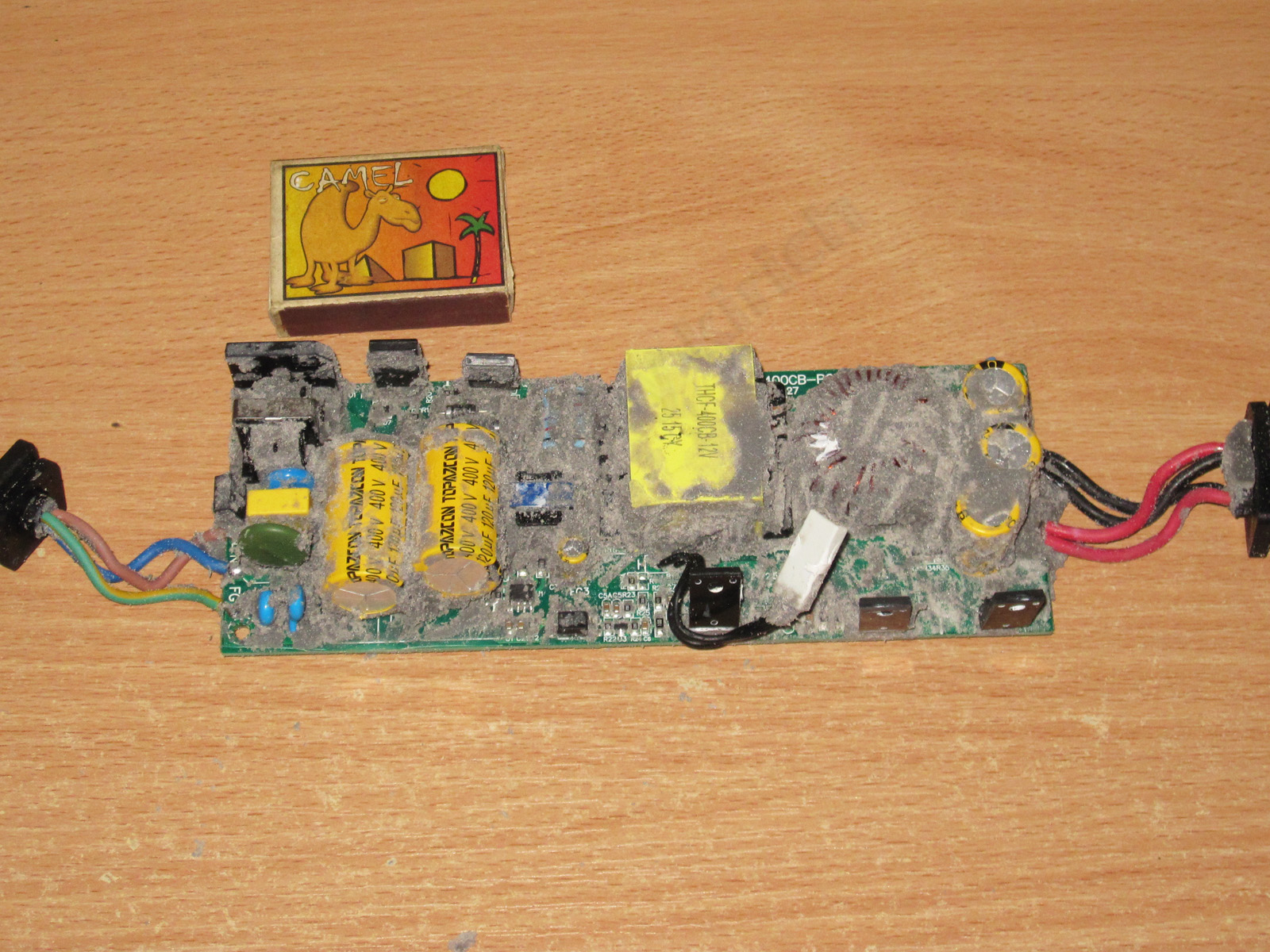
I didn't clean the board completely; it's a real pain. Even getting it to the state shown in the photo took ages. No, removing the compound itself doesn't take long; removing it carefully without damaging the components does.
Here we can see a typical asymmetric half-bridge, which is common in power supplies of this wattage.
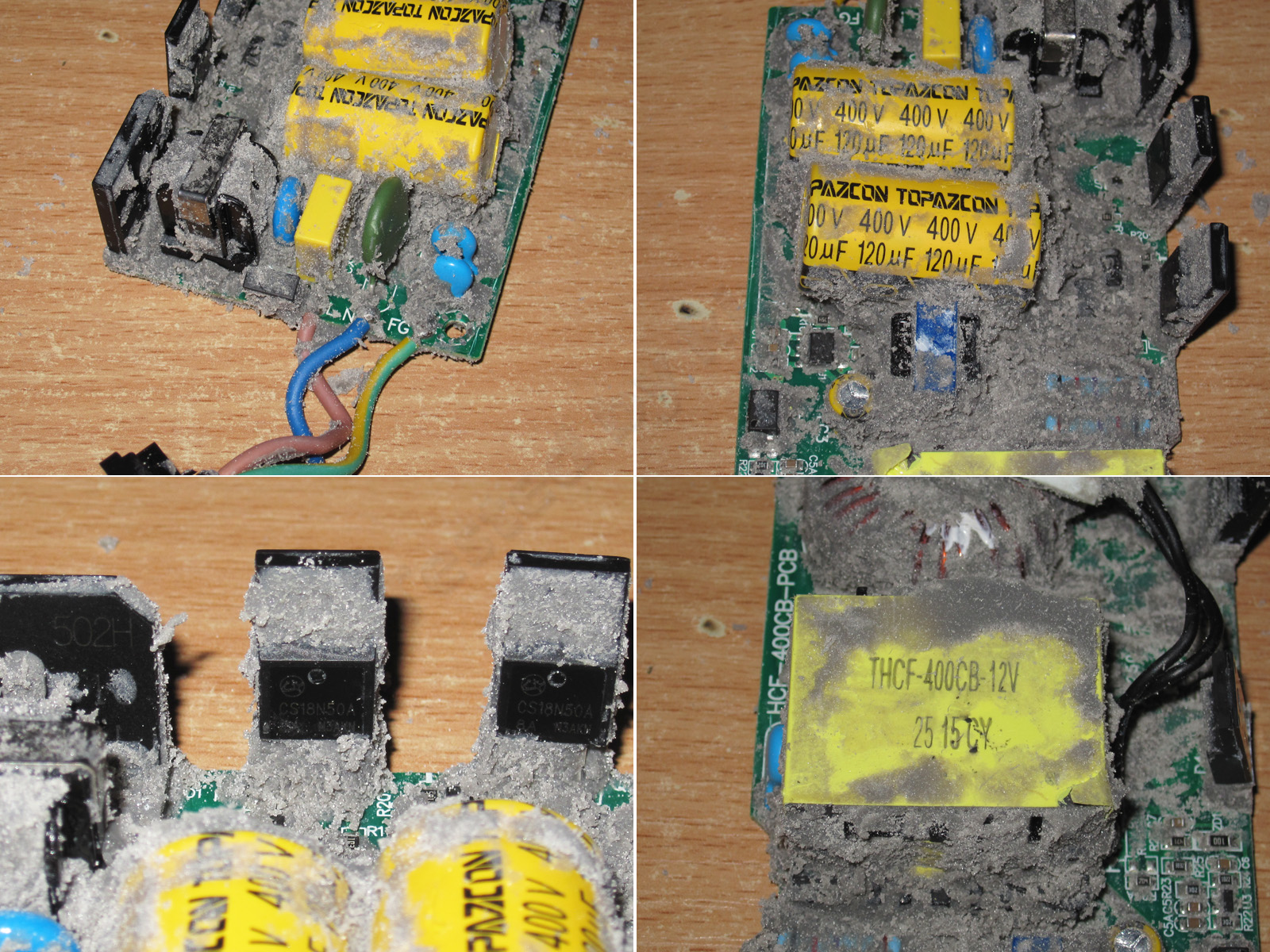
1. The input has a full filter, a fuse, a thermistor, and a varistor. So, it's not like the name-brand units with three rows of inductors, but it's clearly not some bargain-basement unit with jumpers in place of inductors either. That's a pass.
2. The capacitors have the same markings as those in the 100 W version: a pair of 120 µF capacitors. That's perfectly fine for 250 W, and basically acceptable for 300 W too.
3. CS18B50 transistors, which I understand to be rated for 18 A and 500 V. Perfectly fine.
4. The transformer is marked 400CB-12V. The 12 V part is clear, but what about 400—is that the claimed power rating?
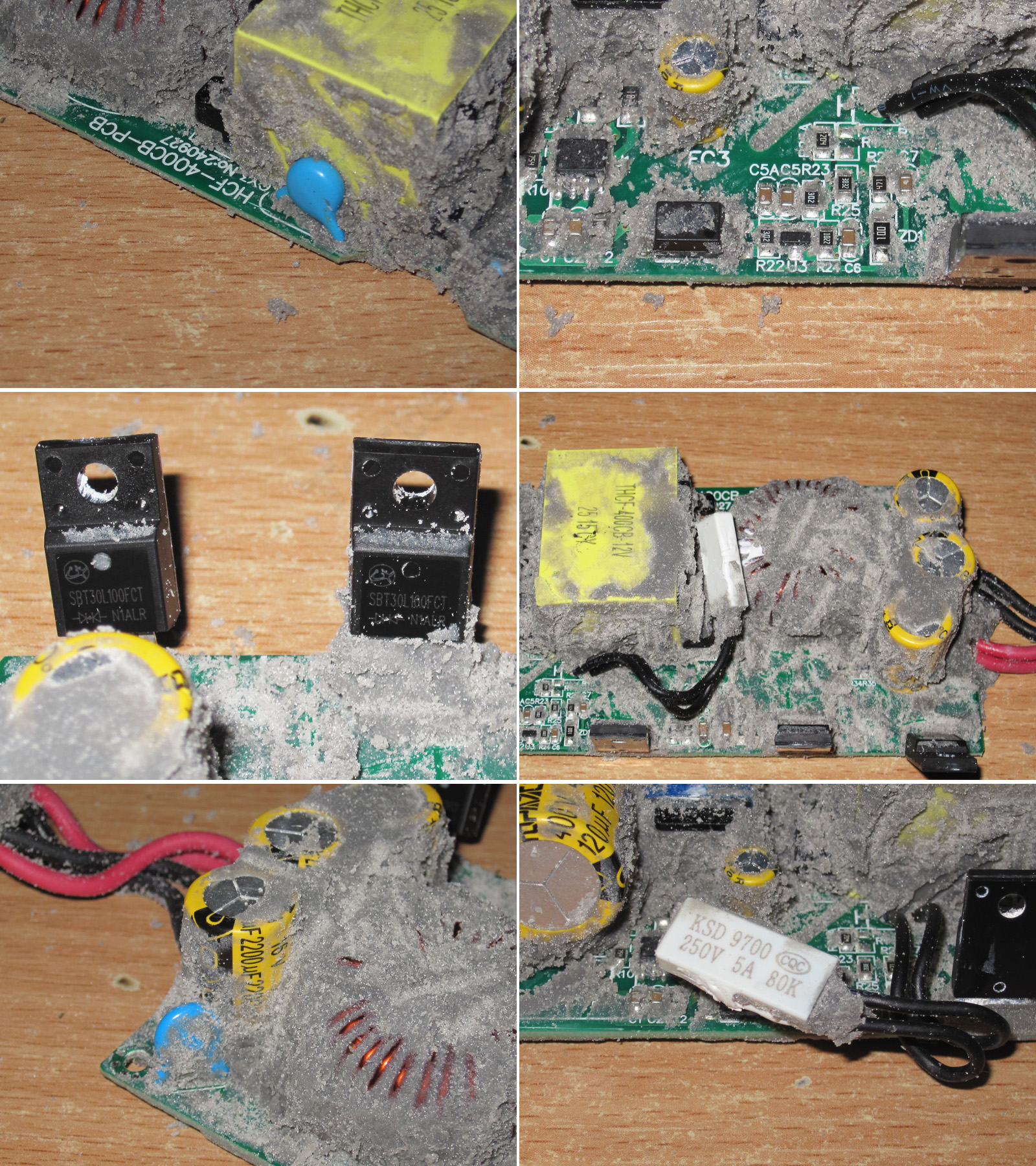
1. There's a Y capacitor, and the board also has a marking that includes both the model name and the number 400. I assume that's the same “Chinese” 400 W rating.
2. PWM controller section.
3. On the output there are three diode assemblies rated at 30 A and 100 V. So this is definitely fine for 250 W at 12 V, and also for 300 W at 12 V.
4. I found a thermostat between the transformer and the output inductor. So that's the thermal protection in these power supplies—excellent, although I thought it would be something electronic.
5. Three 2200 µF, 16 V output capacitors.
6. The thermostat really is connected to the feedback circuit, and when it trips, the output voltage drops. The trip temperature is 80 degrees, which seems reasonable to me.
As for this kind of protection, it works perfectly with LED lighting, but not so well if there's a DC-DC converter after the power supply. In that case, when the voltage drops, the current draw won't decrease—it'll increase.
The total input capacitance is 205 µF, or 102 µF per capacitor. Even so, that's quite enough for 250 W power supplies, especially since they operate over a “narrow” range. But in my opinion, it's a bit low for 300 W.
The output capacitance is 6800 µF. Given this model's topology, that's perfectly fine, as is the fact that the capacitors are rated for 16 V.
Conclusions.
Well, the conclusions will vary from model to model.
40 W - Overall, a decent power supply. The protection is set very close to the limit, but sometimes that's an advantage, especially when powering LED strips.
50 W - Also a decent power supply. The protection is set for 60–65 W, and the ripple is a bit high, but that's not critical for most undemanding applications. Otherwise, no complaints.
60 and 75 W - The same power supply. The protection current is set way too high; we'll definitely write to the factory and ask them to lower it. Ripple is within spec, and the temperature is fine at 60 W but a bit high at 75 W. Essentially, it's a decent 60 W power supply.
100 and 120 W - Also the same power supply. Ripple is excellent, and the protection current is excellent too, but in reality it's a decent 100 W power supply—110 W, maybe. No, it can handle 120 W, but that's not really what it's meant for, and the protection is set for a maximum of 125 W. Basically, you could label it 100 or even 120 W; I think it would work reliably, partly because the protection is set very close to the limit, and partly because the components here transfer heat directly to the case.
250 and 300 watts - Well, this clearly shows that this is still an honest 200 W power supply, 250 W at most, but definitely not 300 W. At that power, it will simply go into protection. Speaking of protection, that deserves a big plus, as do the relatively low ripple levels. Overall, if the load is somewhere between 200 and 250 W, it should work for a long time and quite reliably. Although the protection current is set rather high: 28 A might be suitable for a genuine 300 W model, but definitely not for a 250 W one.
350 watts - This is a genuinely great power supply, although its actual power is probably closer to 300–320 W. It has very low ripple, thermal protection, and a large case. The implementation of the "green mode" takes a little of the shine off, but it takes a whole lot of factors lining up for that to become an issue, so let's call it good.
A word about the paired models.
To be honest, I really dislike the "Chinese" approach of determining the power printed on the case not by the power rating of the components used, but by the test method.
Roughly speaking, here's how reputable companies do it: 150 W, small transformer; 200 W, larger, more powerful components; 350 W, active cooling added. But they all have one thing in common: the stated power is continuous, often with some headroom. In other words, you can run them continuously at the stated 150, 200, or 350 W.
Here's how less responsible companies do it: a power supply that's good for 200 W in reality; the same unit can run for an hour without overheating, so we label it 250 W; the same unit can run for 10 minutes without overheating, so we label it 300 W; the same unit can run for 5 seconds without overheating, so we label it 400 W. The common thread is that it's the same power supply in every case; only the method used to rate its power has changed. It's infuriating and misleading.
As for the paired models, the ones with higher claimed power ratings probably won't be ordered again, so as not to mislead buyers.
I really like Vitaly's approach here: products should have the most honest specifications possible, not 100500 W PMPO. We're also working on the safety of future models.
That's all for now. Thanks to Vitaly for sending the samples, and apologies for the long delay with the article. Things really have been hectic lately.
As usual, I'd be glad to hear your comments. I'll reply when I can and have the time.
Questions and answers
Which 12 V power supplies were tested in the review?
Nine sealed models with rated outputs from 40 to 350 W were tested. The review reports measurements and load tests, and groups the supplies by construction.
What efficiency did the 40 W and 50 W sealed 12 V power supplies achieve?
The measured efficiency was a little over 84% for the 40 W model and about 85% for the 50 W model.
Are the reviewed power supplies suitable for sensitive electronics?
At full load, ripple on the 40 W and 50 W models was about 650 and 800 mV respectively, including spikes. The author considers this acceptable for LED strips but doubts it is suitable for sensitive devices.
This model is included in the summary table: Comparison of power supplies: ripple, efficiency, and temperature rise
The figures from this review are in the measurement database: Power supplies
Discounted products
You may be interested in



Discounted products
All the content on the site and the advice are free, but we’d be grateful for your support of the project and the channel!
Only registered readers can comment. It takes a minute to sign up, and you can log in with the same account you use on the forum.
Log inRegister