
RK8009, the last of Riden’s five compact DC-DC converters
To keep up with new posts on the blog, I recommend following me on Instagram. I’ll post notifications about new articles there, and maybe write about something interesting too: link to my account
You can also subscribe to updates and new articles on the Telegram channel - https://t.me/KirichBlog Note that discussion of reviews and articles is enabled on the channel, along with general chat. I recommend it.
As usual, before getting into the review itself, here’s a list of products from this company that I’ve tested.
DPH5005
DPS8005
DPS5020
RD6006
RD6012
RD6018
RD6006P
RD6012P
RD6024
RK6006
Enclosure and power supply for the RK6006
RD6030
Silicone case covers
RD 25A cable set
RS485 module with galvanic isolation for connecting RD60xx-series converters
RD6018P
RD6012H
RK6012
RD6030-max
RK6006H
RK6018
Unfortunately, manufacturers of converters like these don’t offer many models with output voltages above 60 V. Until now, for example, Riden had just one (!) model rated for up to 80 V and 5 A.
Of course, I’d like to see more powerful options, as well as models with higher voltage—up to 120 V. But getting ahead of myself, I personally don’t understand what stopped them from making a model rated for 84–85 V instead of 80 V. The point is that 20S battery packs are fairly common, and they need 84 V for a full charge; 80 V is enough for 19S packs at most.
In other words, just a few extra volts would have moved this converter from the “not bad” category into the “must-have” group. But alas, manufacturers rarely listen to users and engineers. The same goes for Riden, whom I’ve repeatedly asked to finally make an electronic load controller—ideally one that supports modular configurations.
The samurai has no goal, only a path...
All right, I got a little carried away. The review will be fairly straightforward; essentially, this is the same module as the previous ones, just with a higher voltage.
So, yes, it’s a standard little box, with a table listing the models.
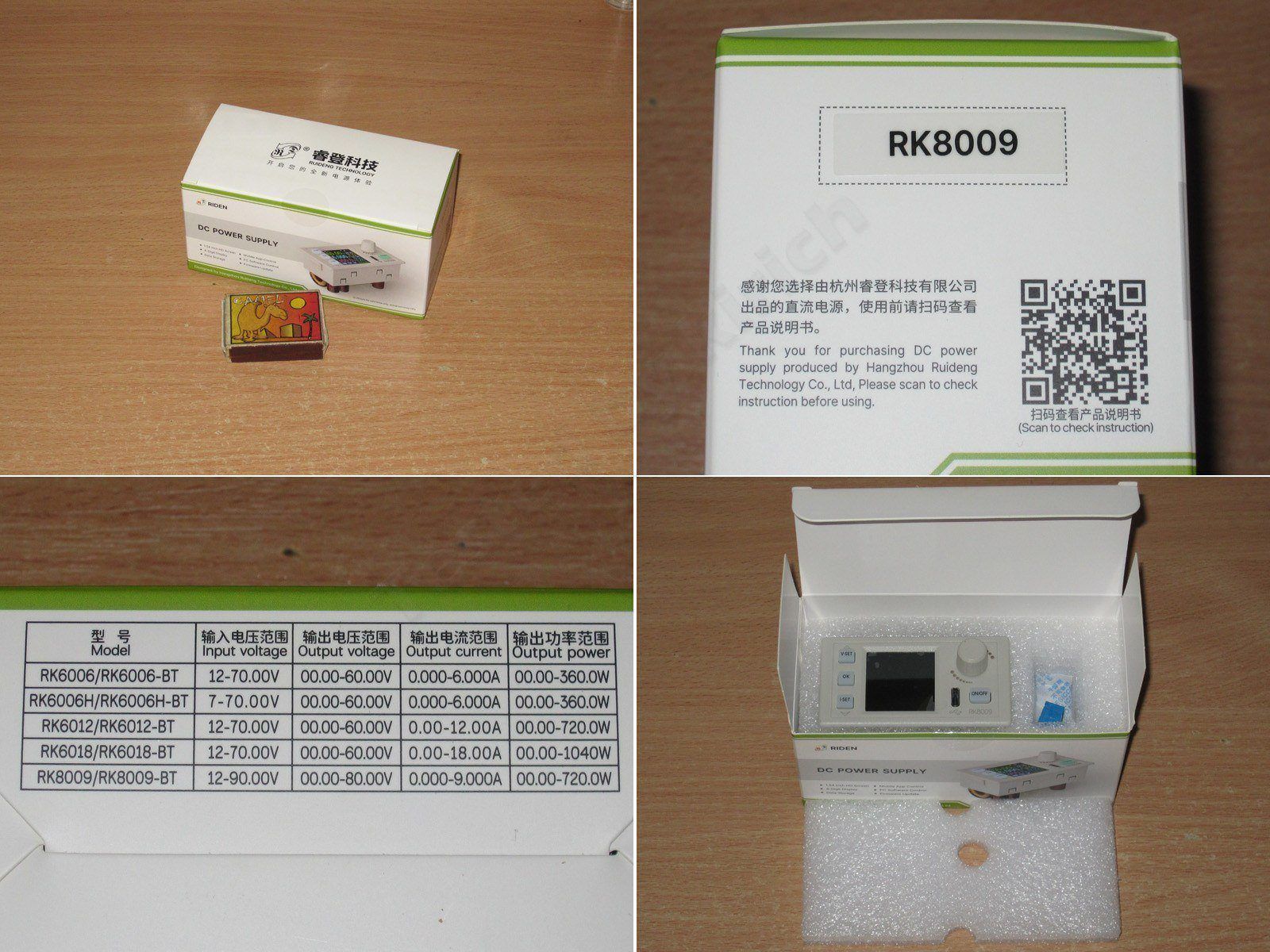
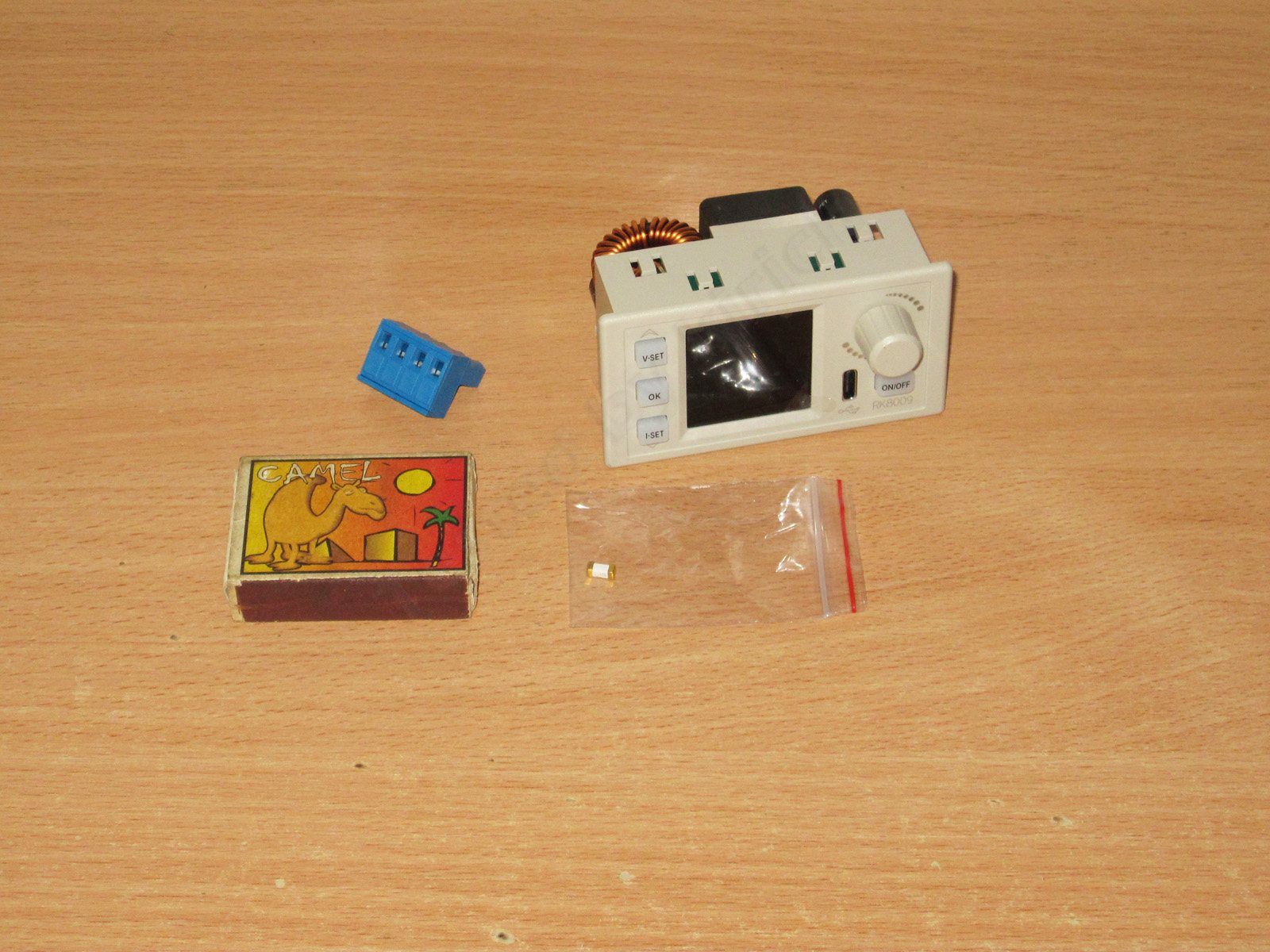
And here’s what’s included. This is the basic kit: the module, a terminal block, and a fuse. The full kit also includes a Bluetooth module and an external temperature sensor.
Model: RK8009/RK8009-BT
Input voltage range: 12-90.00V
Output voltage range: 0-80.00V
Output current range: 0-9.000A
Output power range: 0-720W
Input voltage measurement resolution: 0.01V
Output voltage setting measurement resolution: 0.01V
Output current setting measurement resolution: 0.001A
Input voltage measurement accuracy: ±(1%+7 digits)
Output voltage accuracy: ±(0.3%+5 digits)
Output current accuracy:±(0.5%+7 digits)
Output ripple typical:100mV VPP①
Working temperature range: -10℃~40℃
External sensor Temperature detection range:-10℃~100℃/0℉~200℉
External sensor Temperature detection accuracy:±3℃/±6℉
Constant voltage moderesponse time: 2ms(0.1A-5A Load)
Constant voltage mode load regulation: ≤0.5% or ≤100mV(higher one)
Constant current mode load regulation: ≤0.5% or ≤100mA(higher one)
Capacity measurement range: 0-9999.99Ah
Energy measurement range: 0-9999.99Wh
Capacity and energy statistical error: ±2%
Buck working mode: (input voltage÷1.1)-1②
Over temperature protection: System temperature>85℃
Screen brightness setting: 0-5(6 level in total)
Screen: 1.54 inch 240*240 color HD display
Cooling fan start condition:Output current>6A or System temperature>55℃
Cooling fan shut down condition:Output current<5.9A and System temperature<45℃
Weight(with package):About 0.15kg
Product dimension: 79*43*55mm
Support USB communication: yes
Support Bluetooth communication: Only RK8009-BT supports
①:Ripple measurement method: noise and ripple are measured at X1 range, AC coupling, 20MHz of bandwidth on your oscilloscope, with a 0.1uF parallel capacitor at the output terminals
②for example: input voltage is 24V,the max output voltage is 20.8V
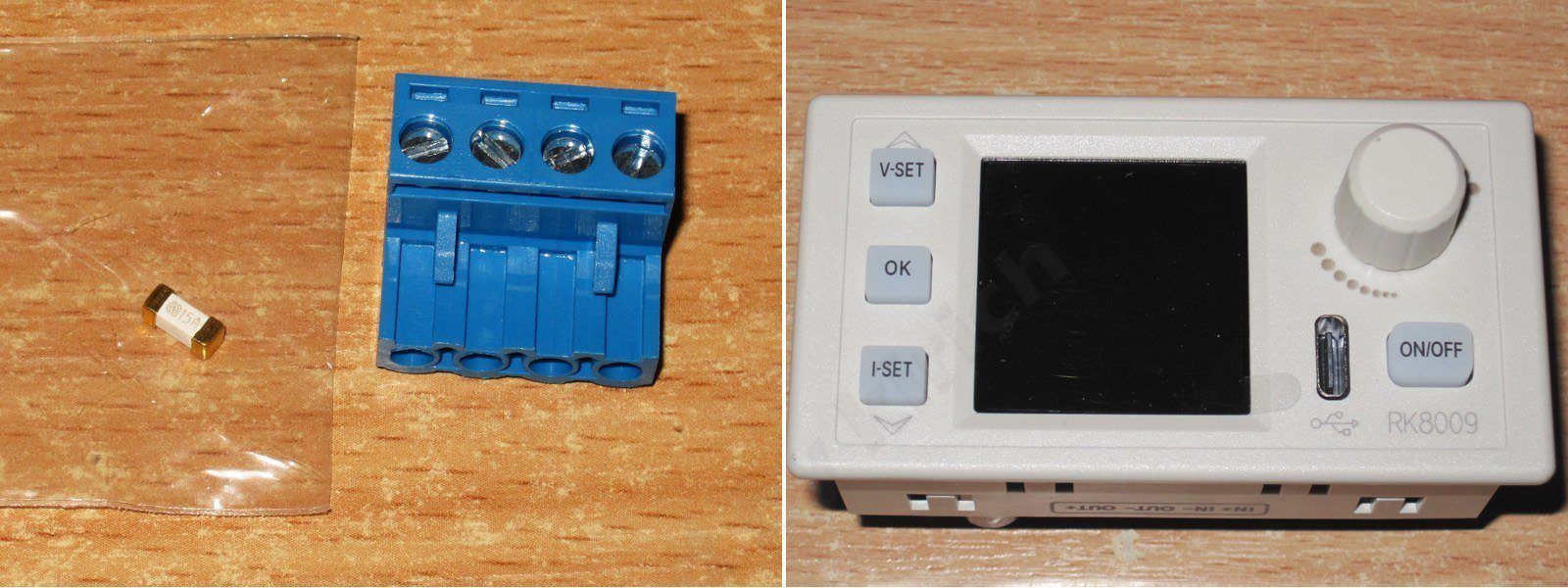
The terminal block is the same as on all models except the 6018, and the fuse is rated at 15 A. The converter looks identical to the previous ones and has the same dimensions.
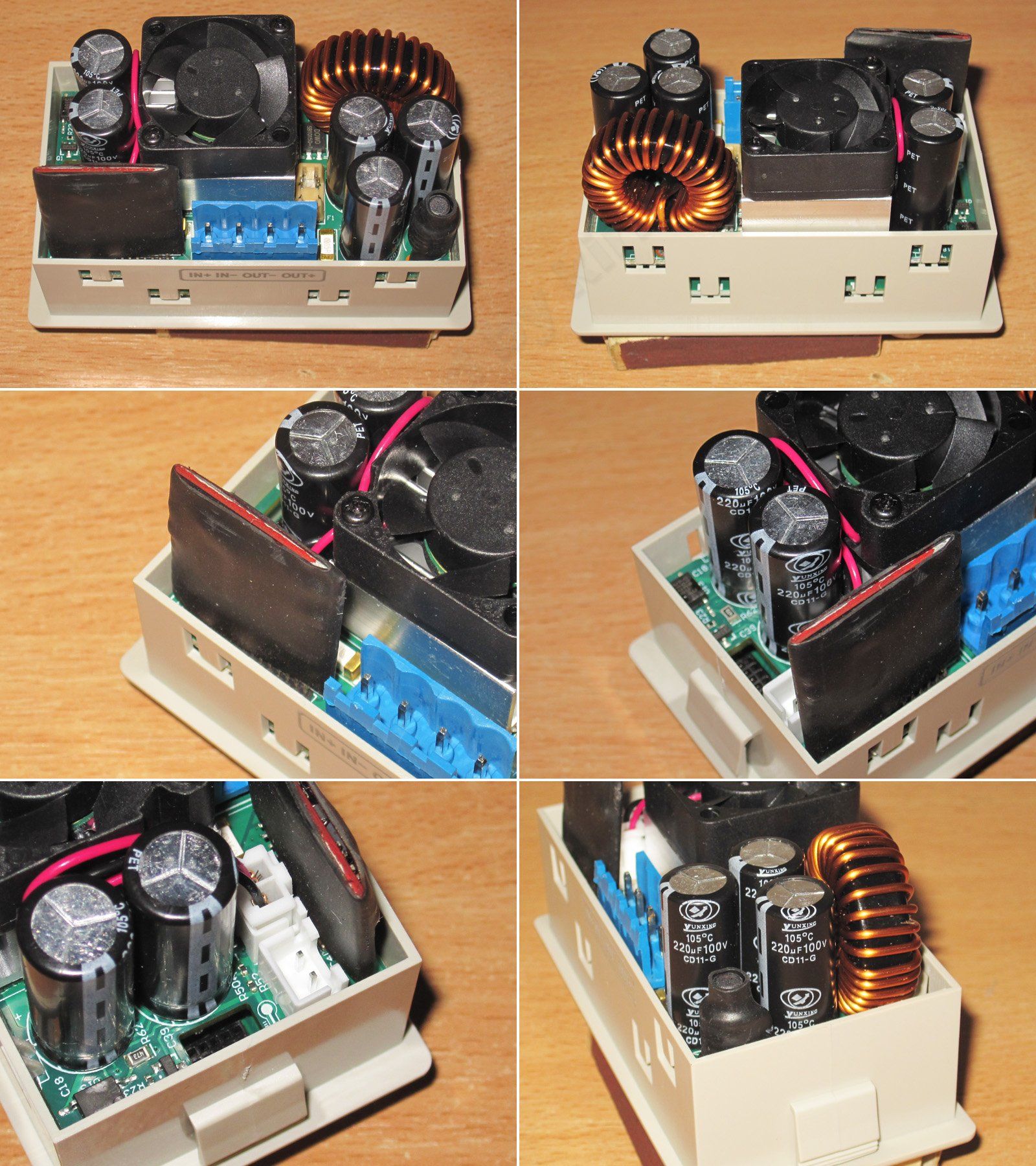
On the back, the only differences are the component configuration, their ratings, and a few changes in placement.
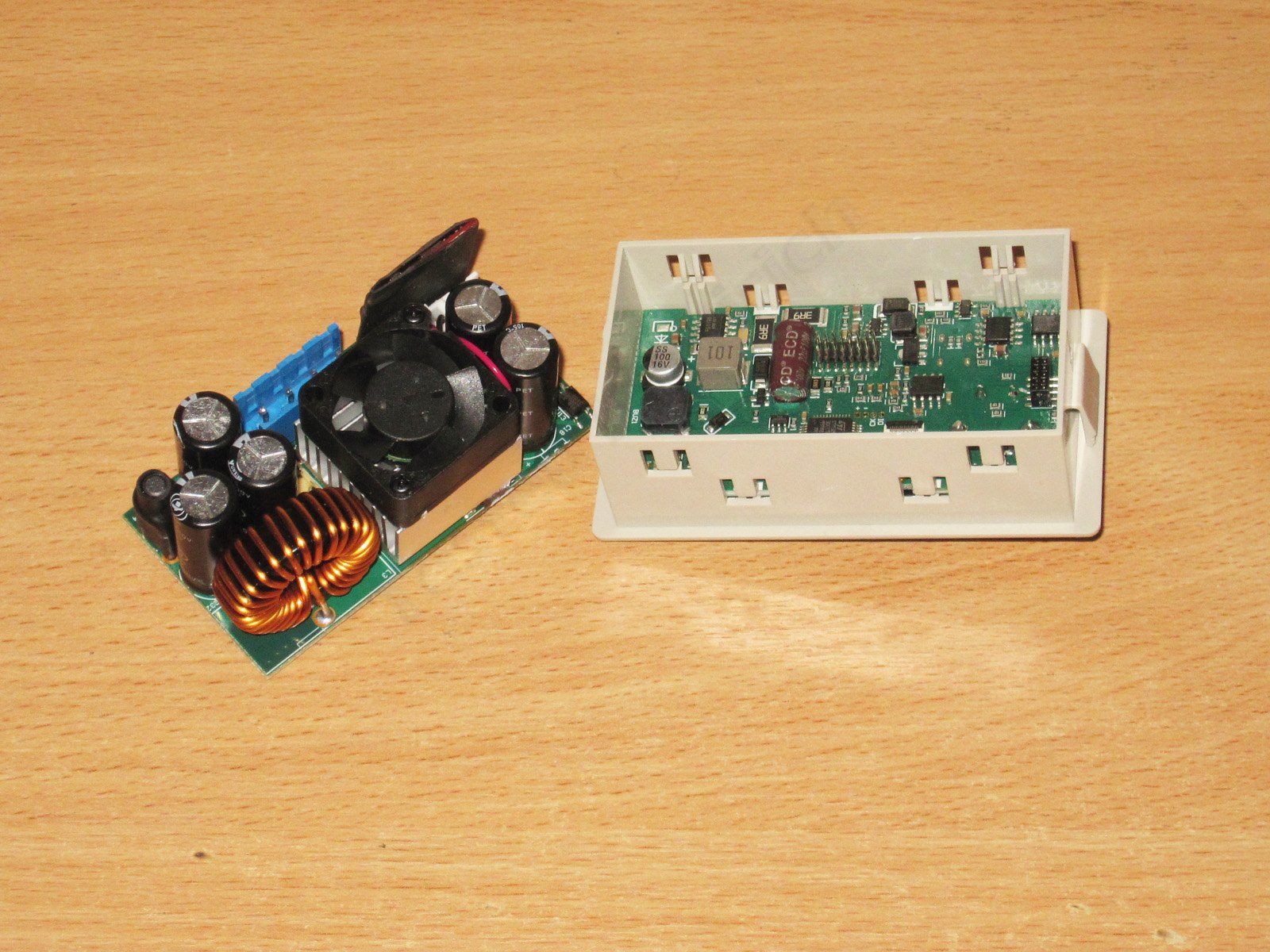
It has a heatsink with a fan, a power inductor, and an inductor for reducing ripple. There are two input capacitors and three output capacitors, all rated at 220 µF, 100 V.
The control board is wrapped in heat-shrink tubing, but as I mentioned, there’s nothing interesting on it: a TL594 PWM controller, a MOSFET driver, and the usual assortment of small components.
There’s a connector for the external temperature sensor and a connector for the Bluetooth module next to the fan connector.
If you release the clips, you can remove the power board, but there’s nothing interesting there.
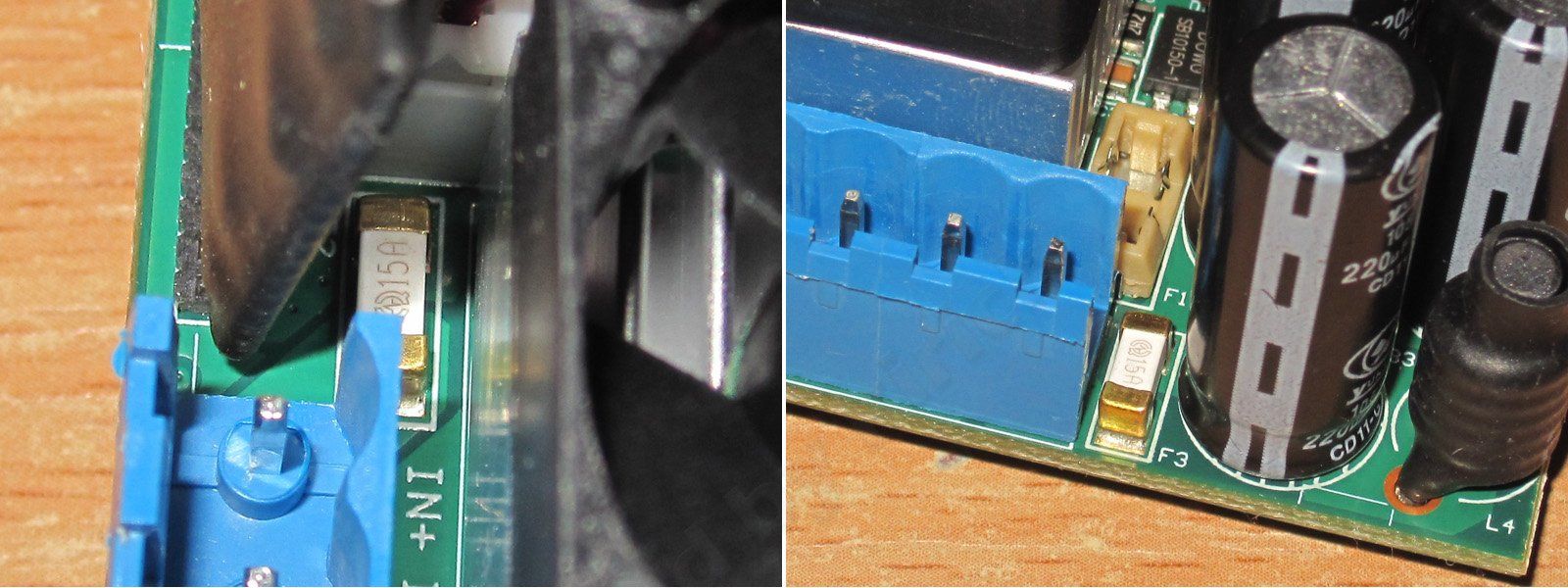
The only thing worth noting is that the fuses are easier to inspect. Both are soldered in, but there’s a fuse holder near the output fuse, since it’s much more likely to blow. If the input fuse has blown, though, I’m afraid simply replacing it probably won’t be enough.
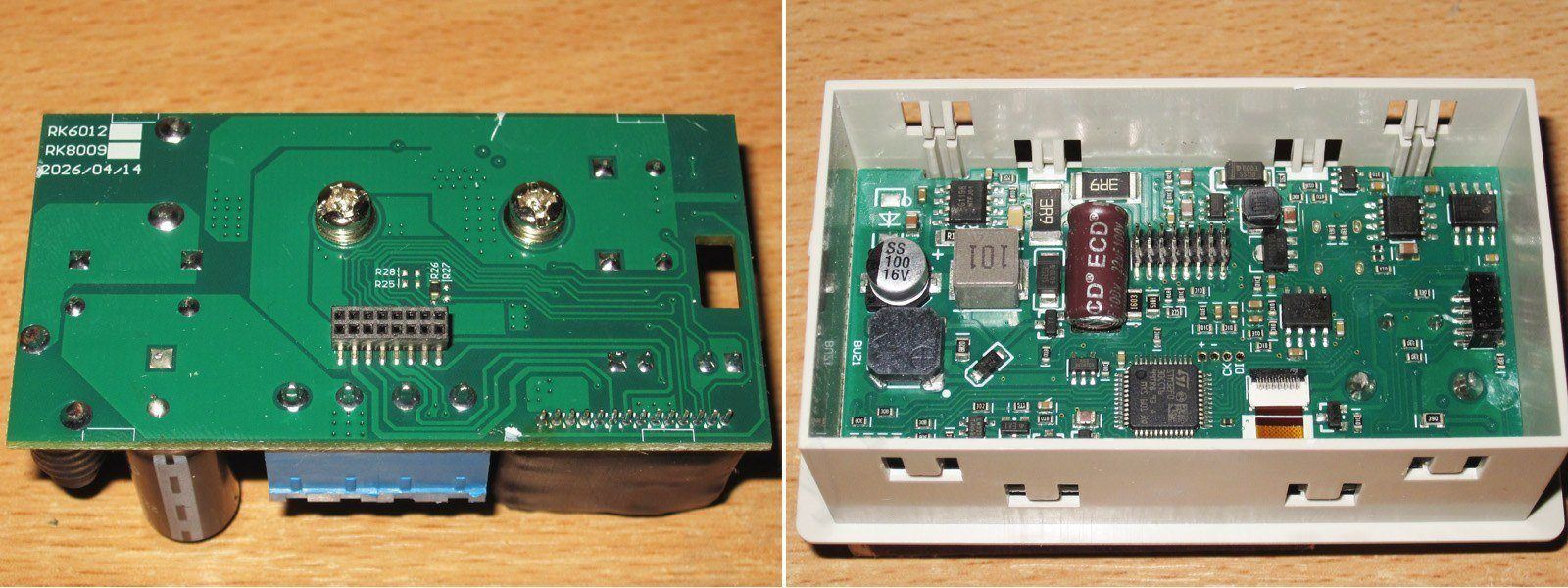
The most interesting thing about the back of the power board is that it’s universal, used in both the 8009 and 6012 models. In other words, it’s essentially the same RK6012, with the same power rating but a different current/voltage configuration.
The controller board is the same across all models, so there’s even less to say about it. Once again, I have to point out that the manufacturer gave the USB port galvanic isolation, and finally switched to USB-C.
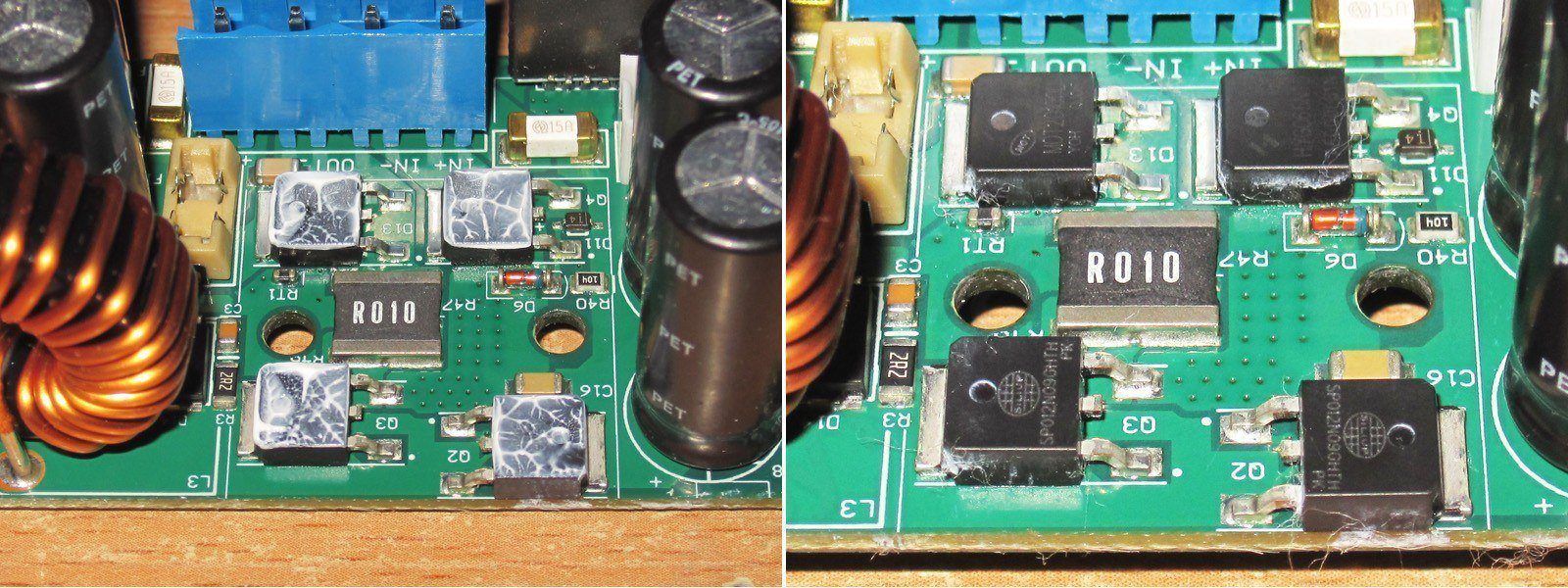
Let's see what's under the heatsink. To do that, we remove a couple of screws.
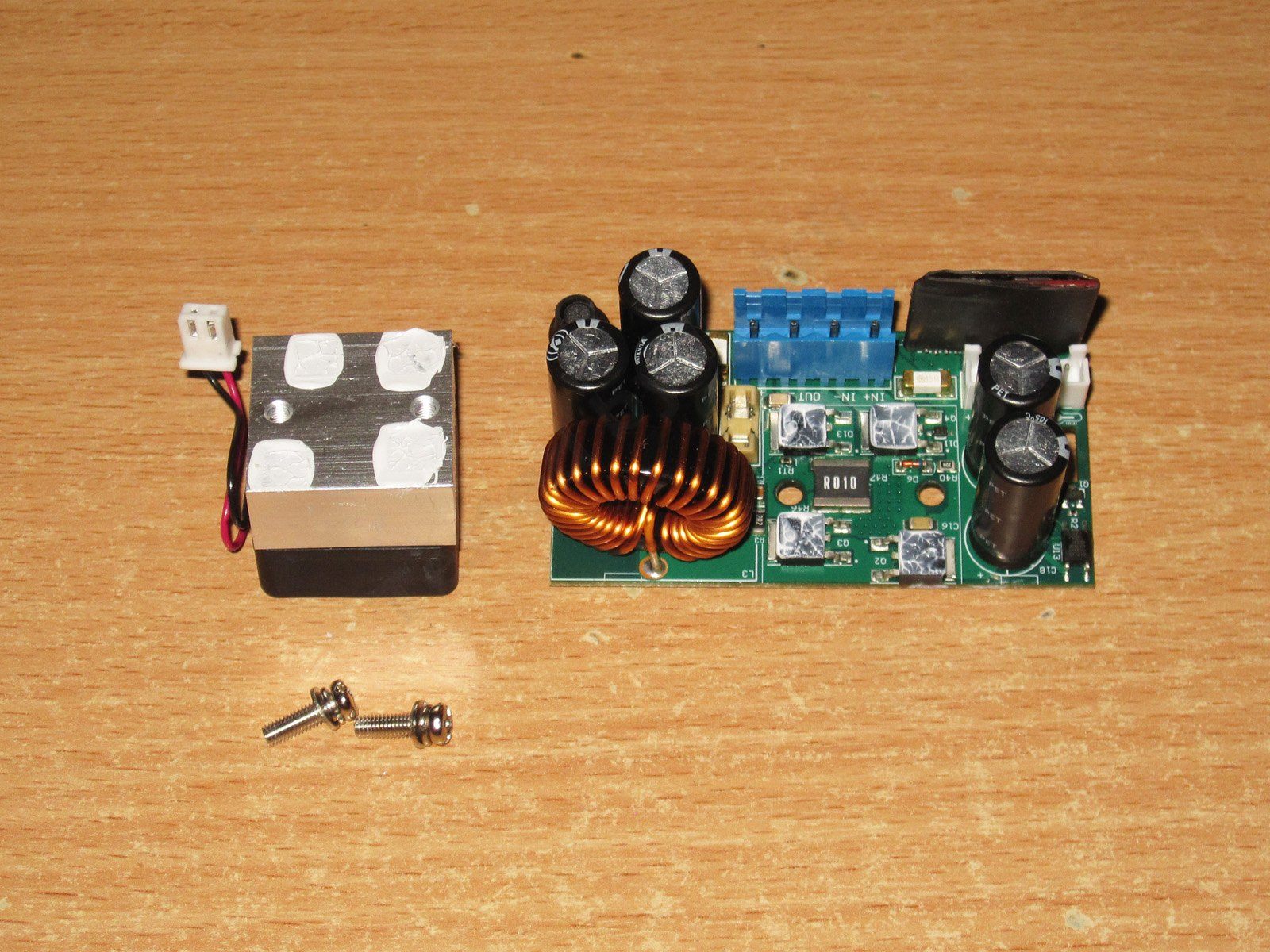
There's thermal paste under the heatsink, which I replace every time I take it apart :)
There's also a fairly substantial shunt, a diode assembly, and a HYG065N10 transistor (100 V, 6.5 mΩ) next to it, plus a pair of separate SP012N09s.
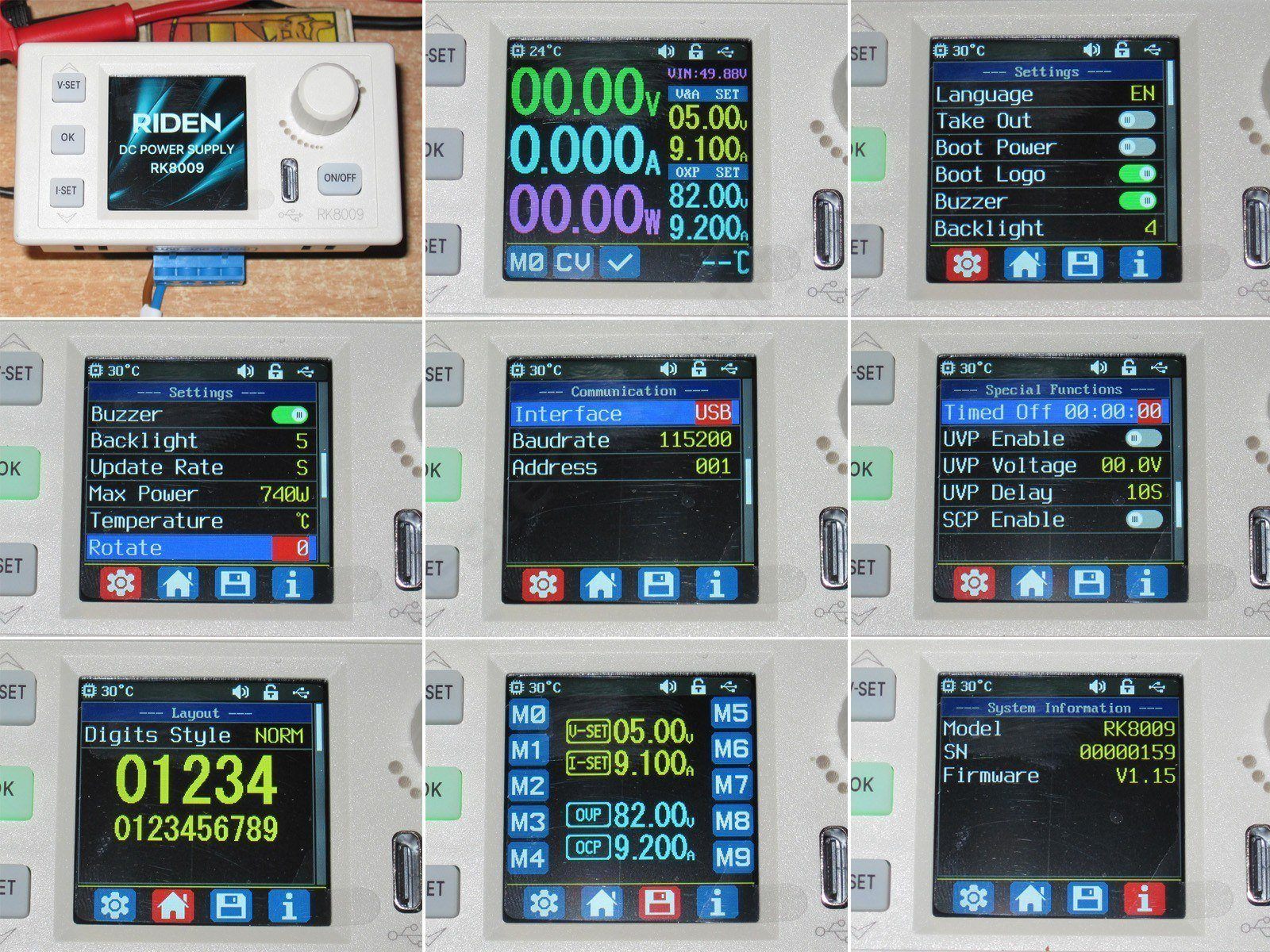
The menu, settings, and so on are the same as on the previous 6018, except for the maximum power settings.
And now for the tests.
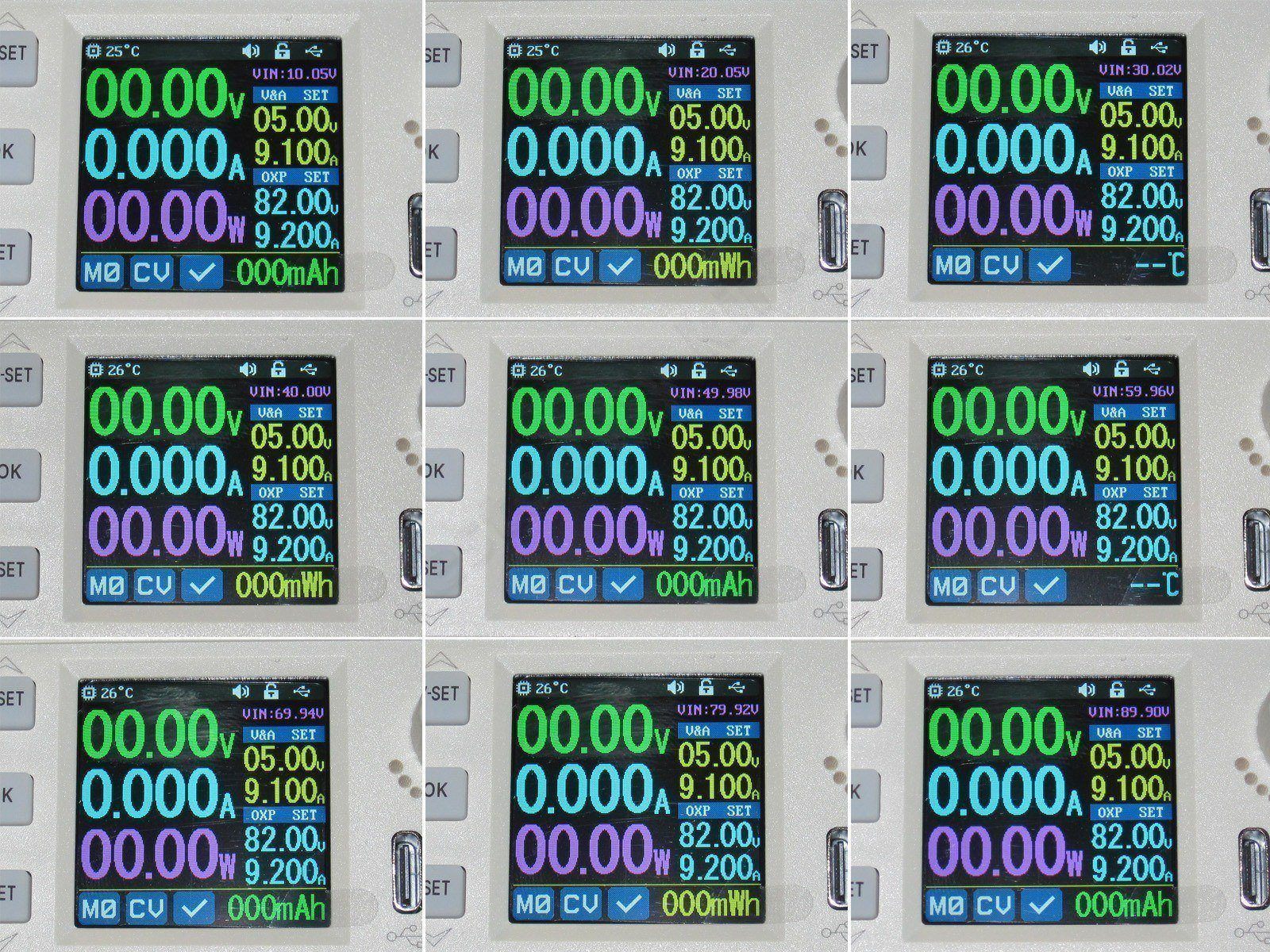
Test 1: input voltage measurement accuracy.
I didn't check the minimum input voltage, but it works without any problems at 10 V. I also tested it at 20, 30, 40, 50, 60, 70, 80, and 90 V.
There are some small discrepancies: it reads a little high at the low end and low at the high end, with an error of roughly +0.05 to -0.1 V.
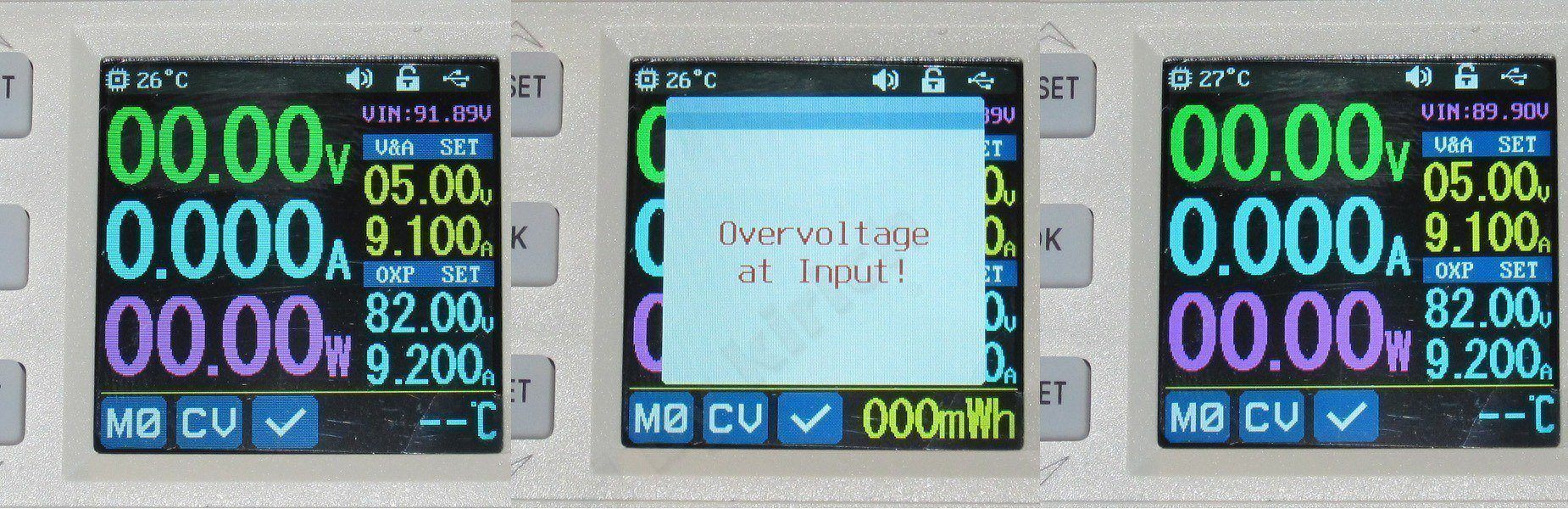
While testing it, I noticed that it works normally with 92 V at the input. Raise that to 93 V and it reports an overvoltage, but to make the warning disappear, you have to lower the voltage to about 90 V.
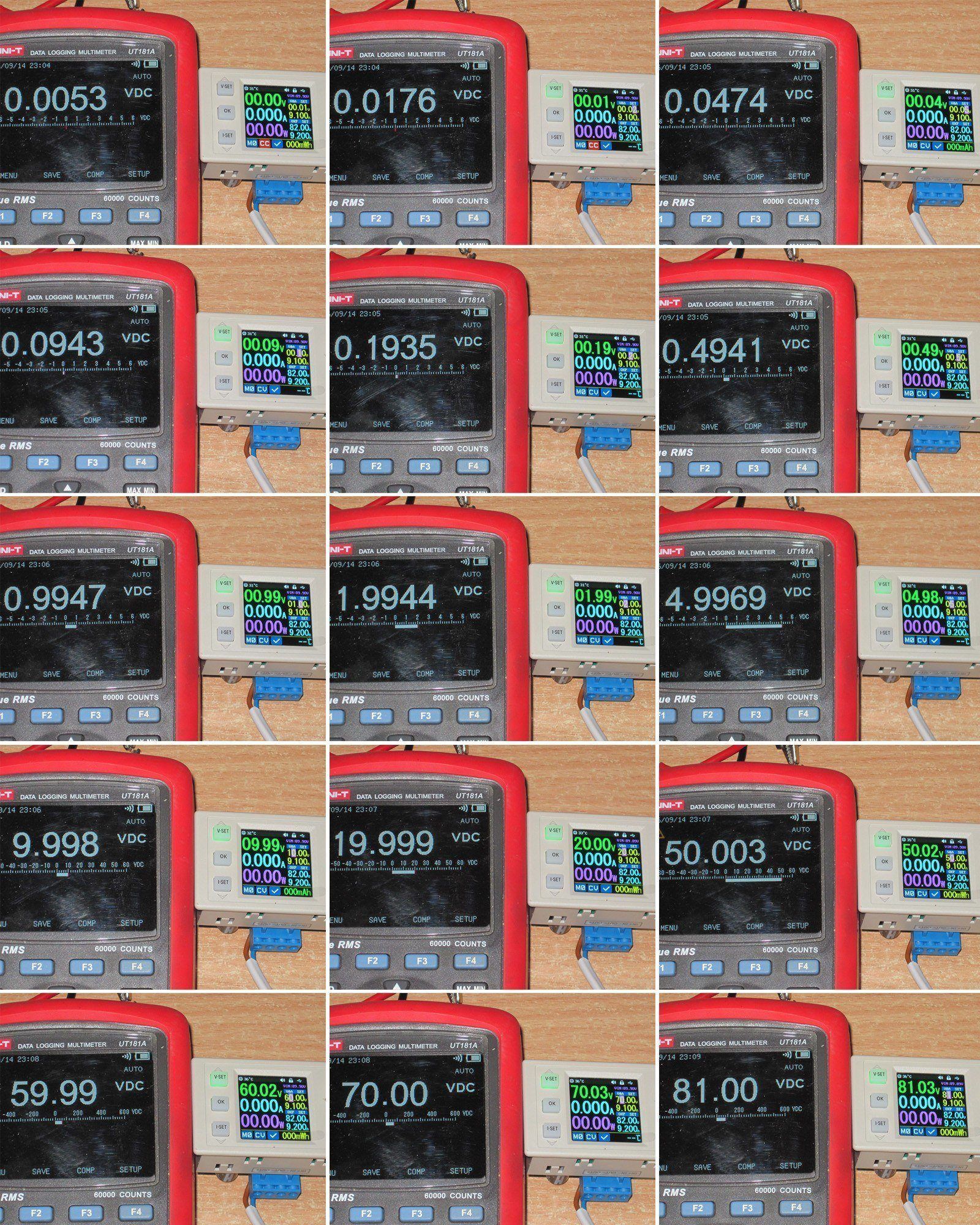
Test 2: voltage setting and measurement accuracy.
I used the standard 1-2-5 sequence, but above 50 V I took measurements at 60, 70, and the maximum of 81 V.
Up to about 0.1 V, both setting and measurement are so-so. Above that, they're quite good, and above 1 V, they're excellent.
It's worth noting that the voltage setting is more accurate than the module's own voltage measurement.
Test 3: current setting and measurement accuracy.
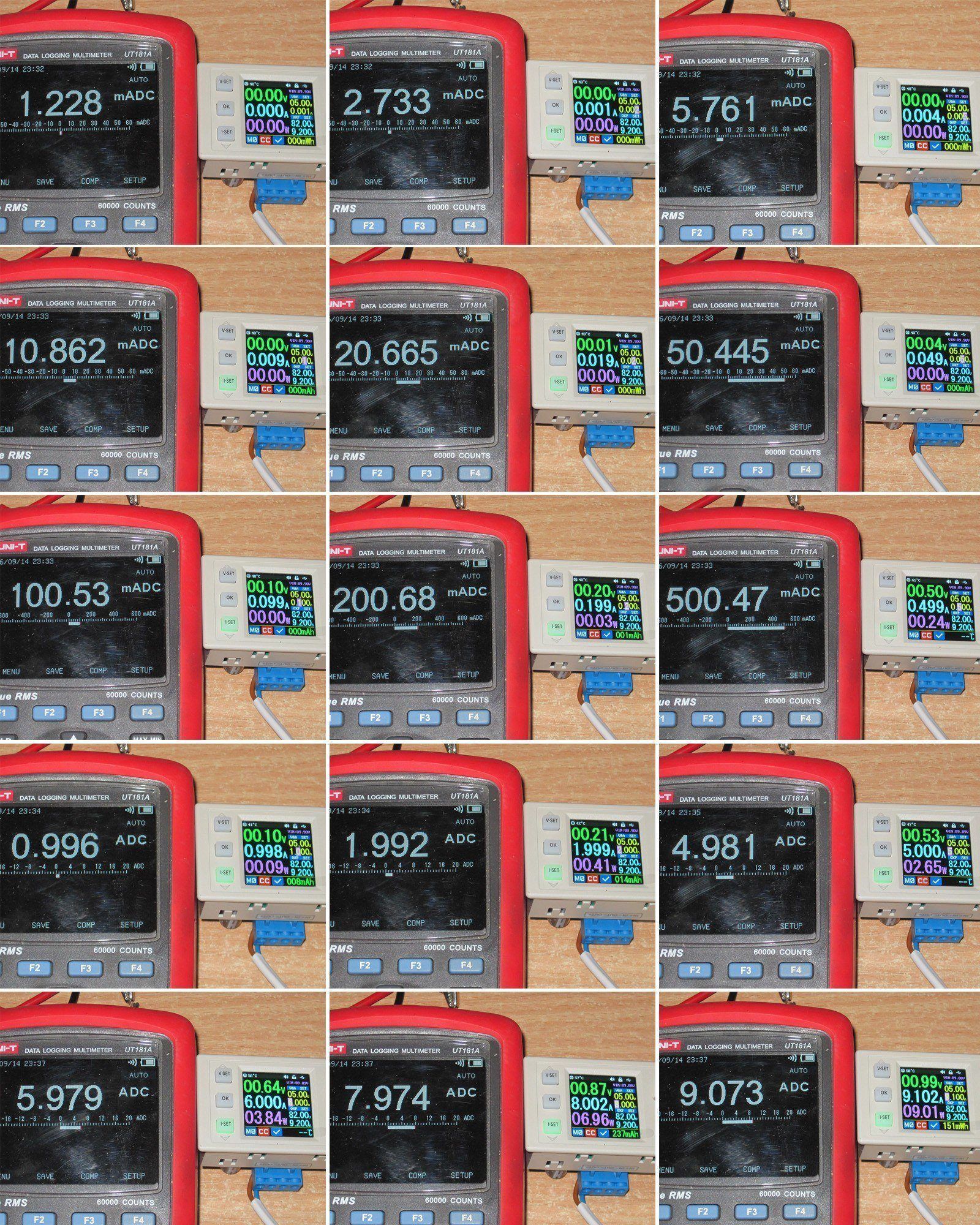
I used the same sequence, but above 5 A I tested at 6, 8, and 9.1 A. I'll also note that this is the first converter in the RD and RK series whose output current doesn't follow the 6-12-18 A sequence.
Overall, not bad. The low range is surprisingly good, although accuracy does get worse below 10-20 mA. I also have a slight complaint about high current: it reads a little low. But then again, this isn't a calibrator or a precision source, so it's more than good enough in practice.
Test 4: output voltage versus load.
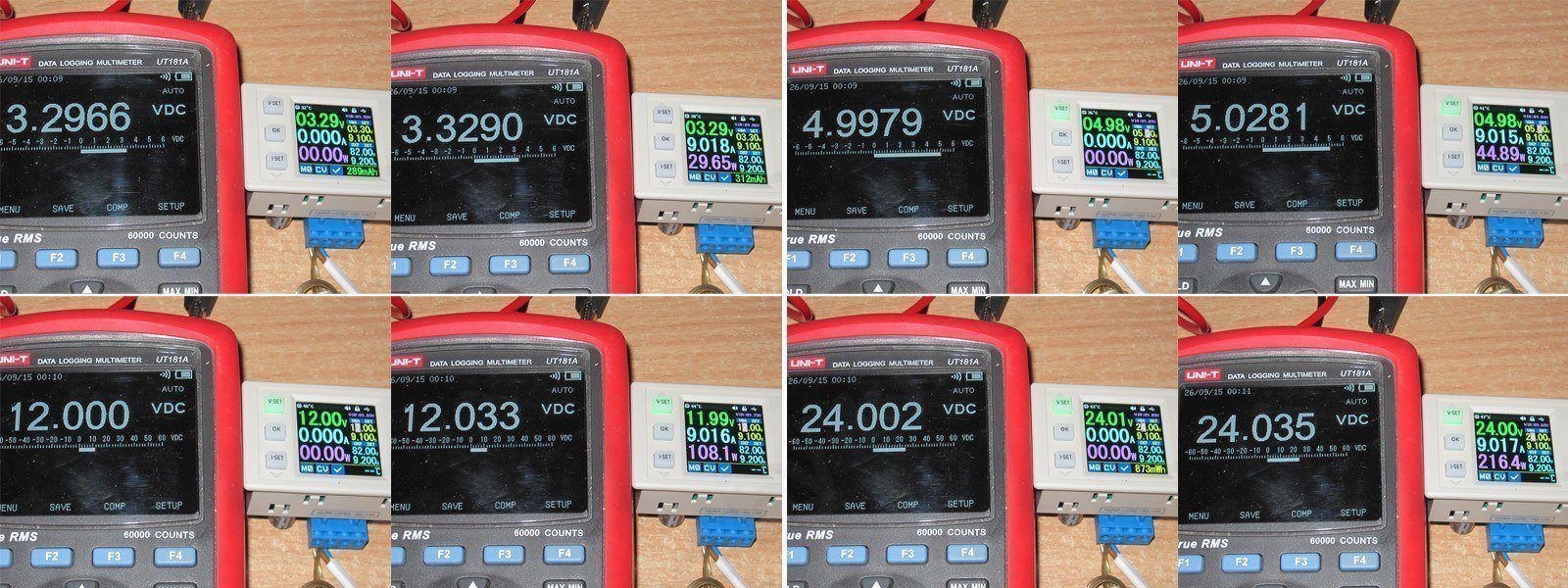
I tested at 3.3, 5, 12, and 24 V, and the converter managed to surprise me: this is the first Riden converter I've seen with a positive relationship, meaning that at full current the output voltage is slightly higher than with no load.
It feels like there's software compensation for the voltage drop in the wires. I think that, given the length of the wires to the terminals, the voltage at the terminals should be pretty much what you set.
Test 5: minimum input/output voltage difference.
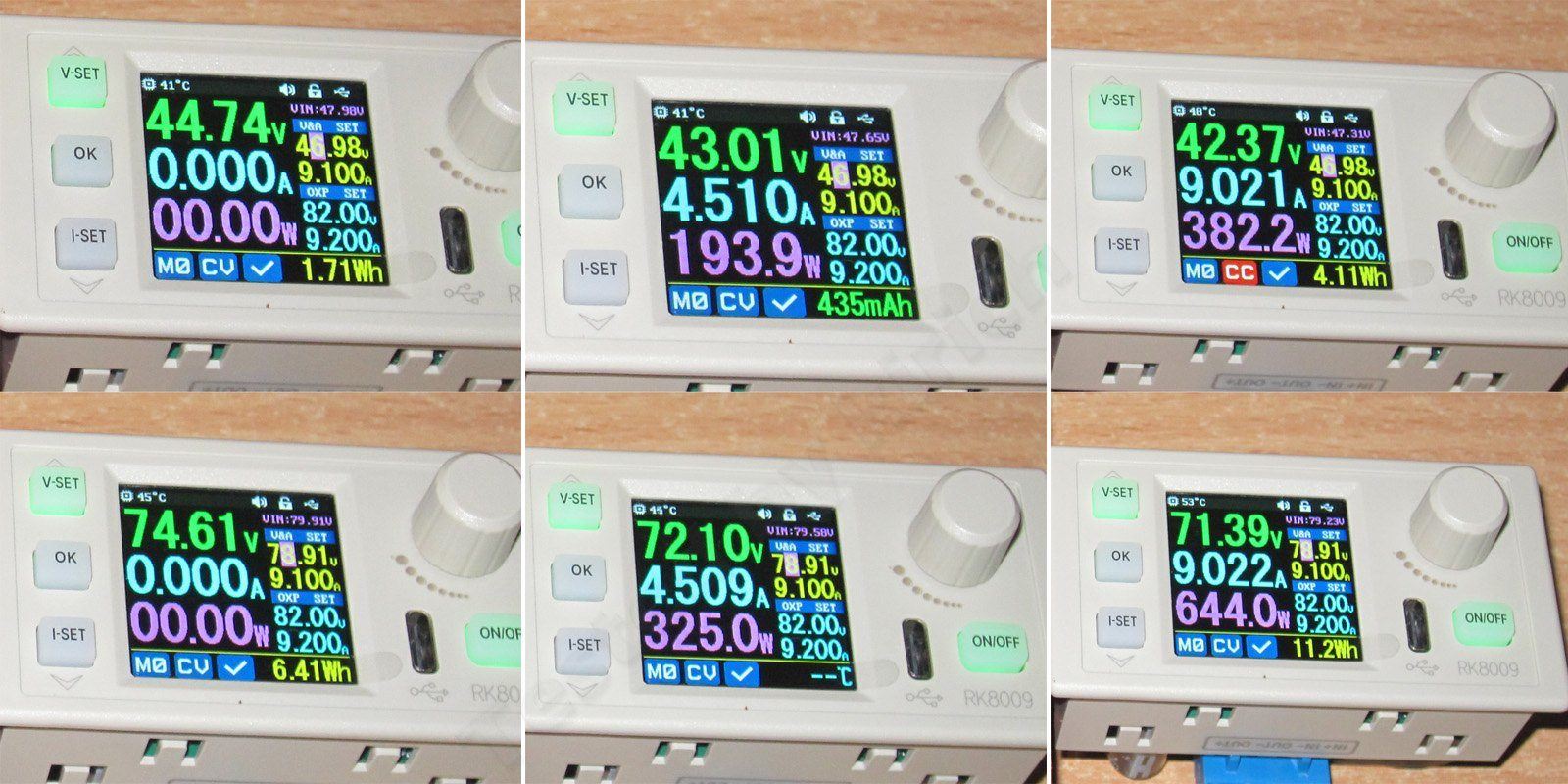
I usually test the 60 V versions at 24 and 48 V. Here I decided to change the test points a little and used 48 and 80 V.
The results are with no load and at 4.5 and 9 A. Sorry about the photo quality; that's how it turned out.
So, at 48 V, the differences are 3.2, 4.65, and almost 5 V.
At 80 V, they are 5.3, 7.5, and 7.8 V.
That seems like quite a lot to me. To guarantee 81 V at the output under full load, you need at least 89 V at the input, even though the stated maximum is 90 V and the protection trips at 93 V.
Keep this in mind: your power supply definitely needs to be regulated and accurately set to 90 V.
Test 6: measuring output voltage ripple.
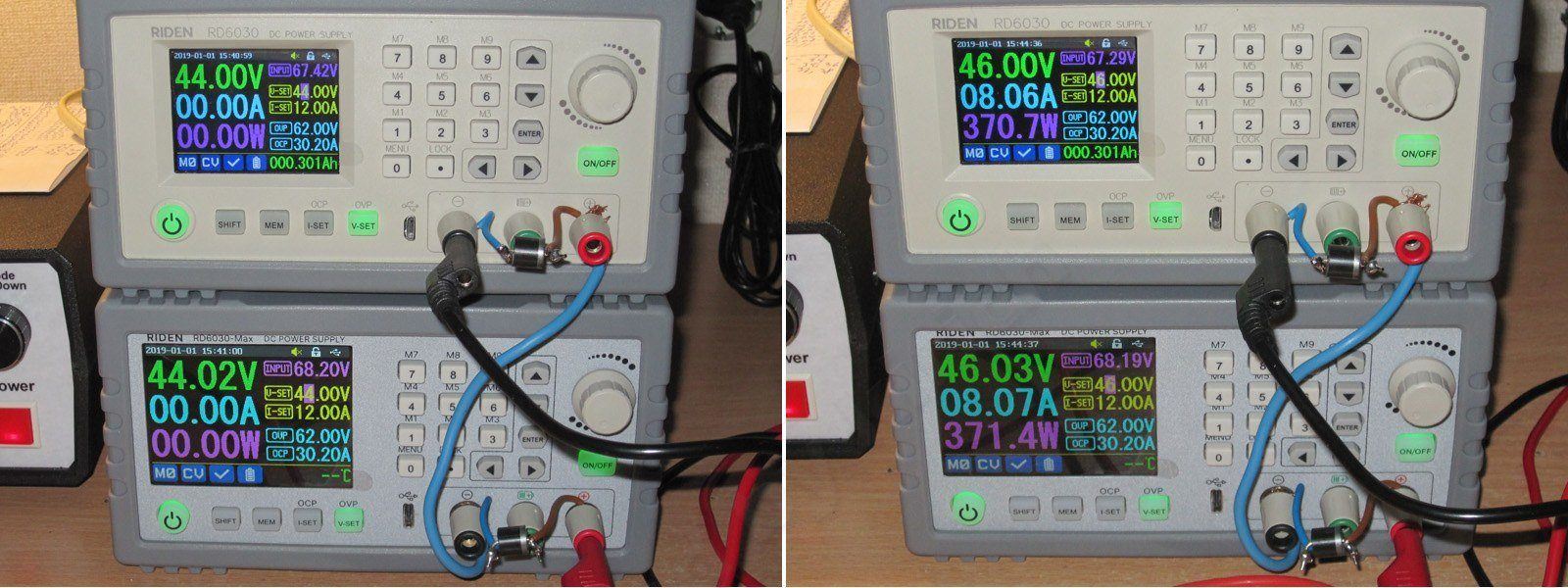
For this test, I had to put together a setup using my Atorch-controlled 1.2 kW electronic load, a pair of 6030 power supplies connected in series, and an oscilloscope. This is probably one of my biggest test setups for the smallest adjustable converter :)
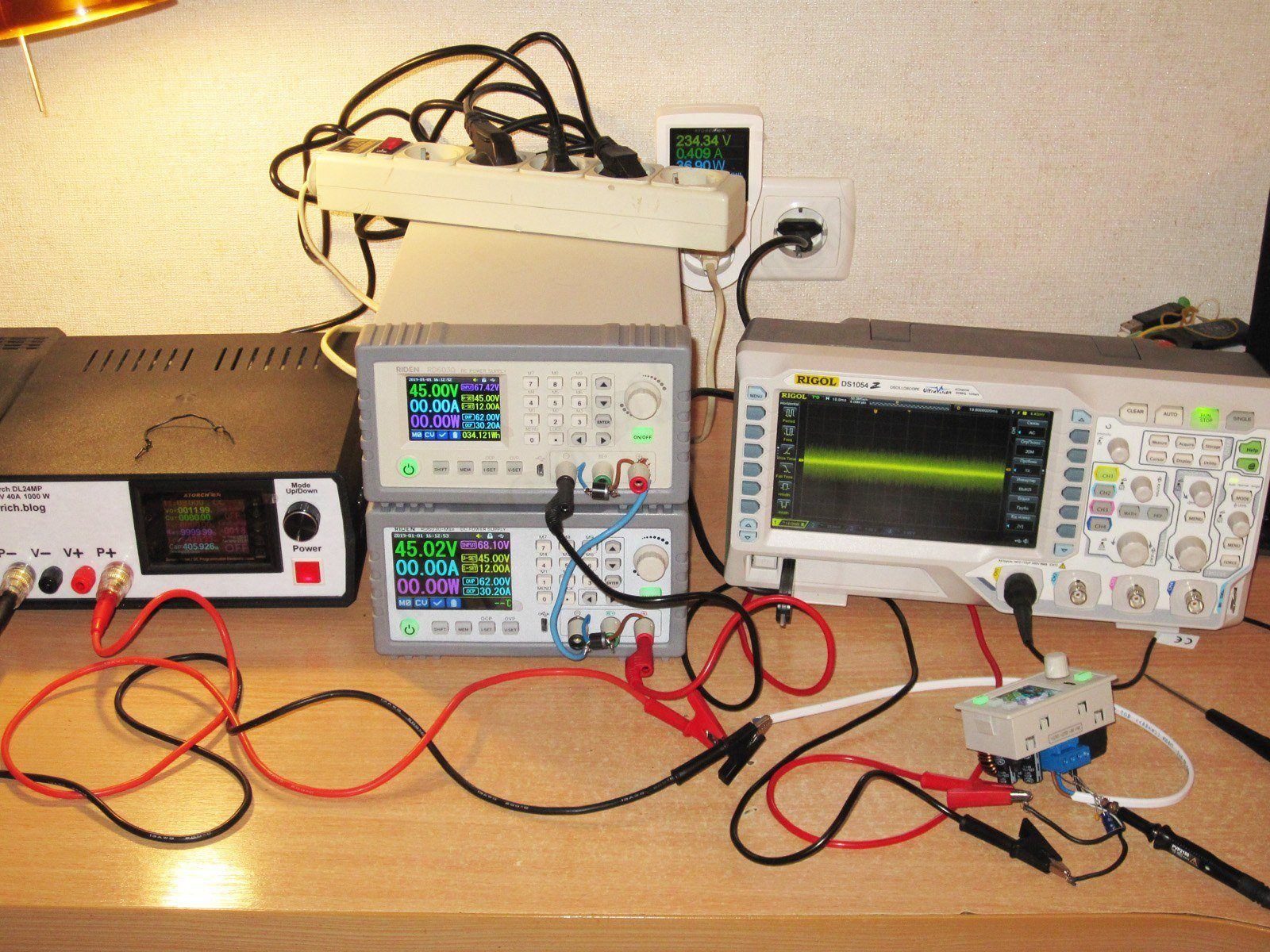
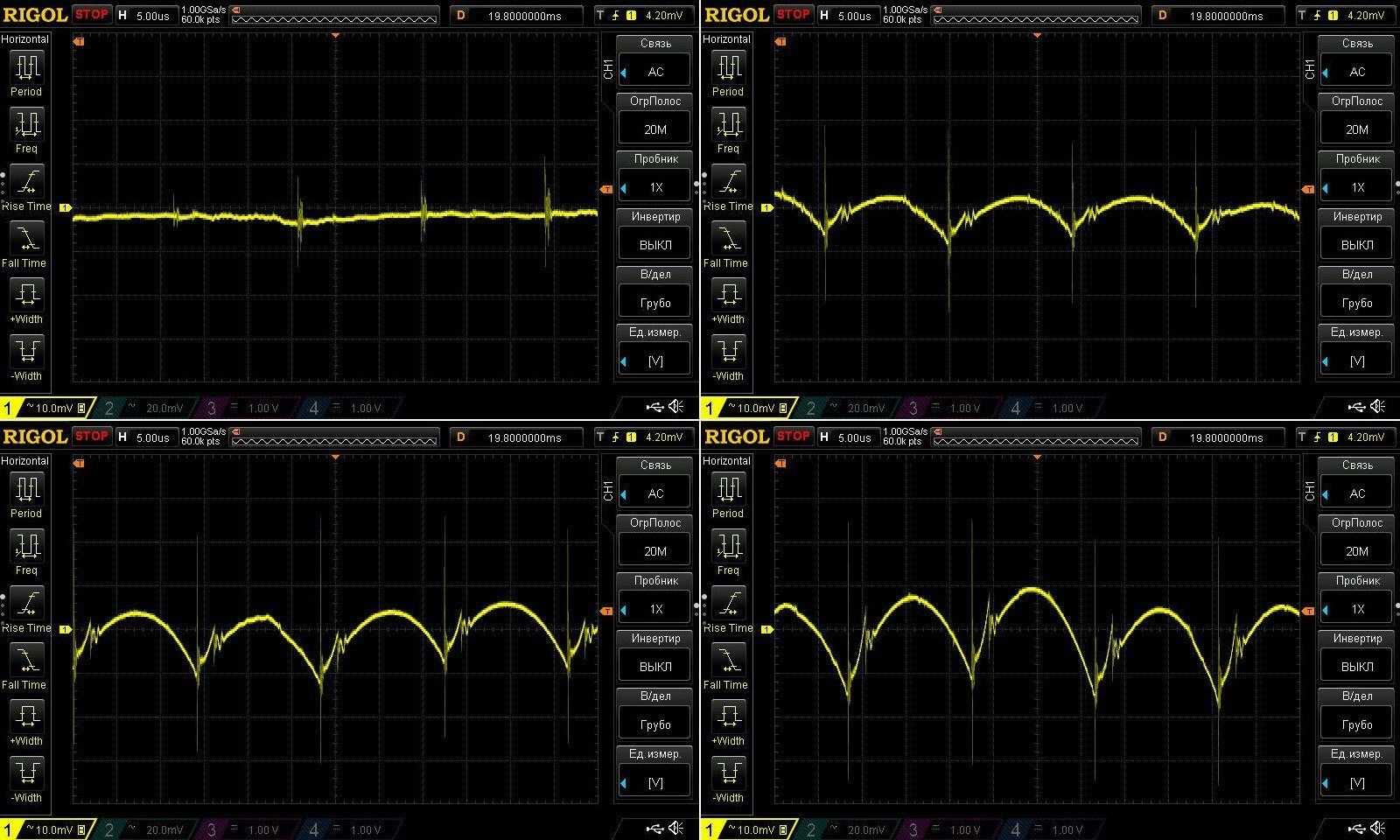
In all cases, the input voltage was 90 V.
First, I tested it at an output voltage of 12 V, with no load and at currents of 3, 6, and 9 A.
The manufacturer specifies up to 100 mV peak-to-peak; in reality, we get up to 50 mV, even including the “spikes.” Most of the ripple is closer to 25 mV.
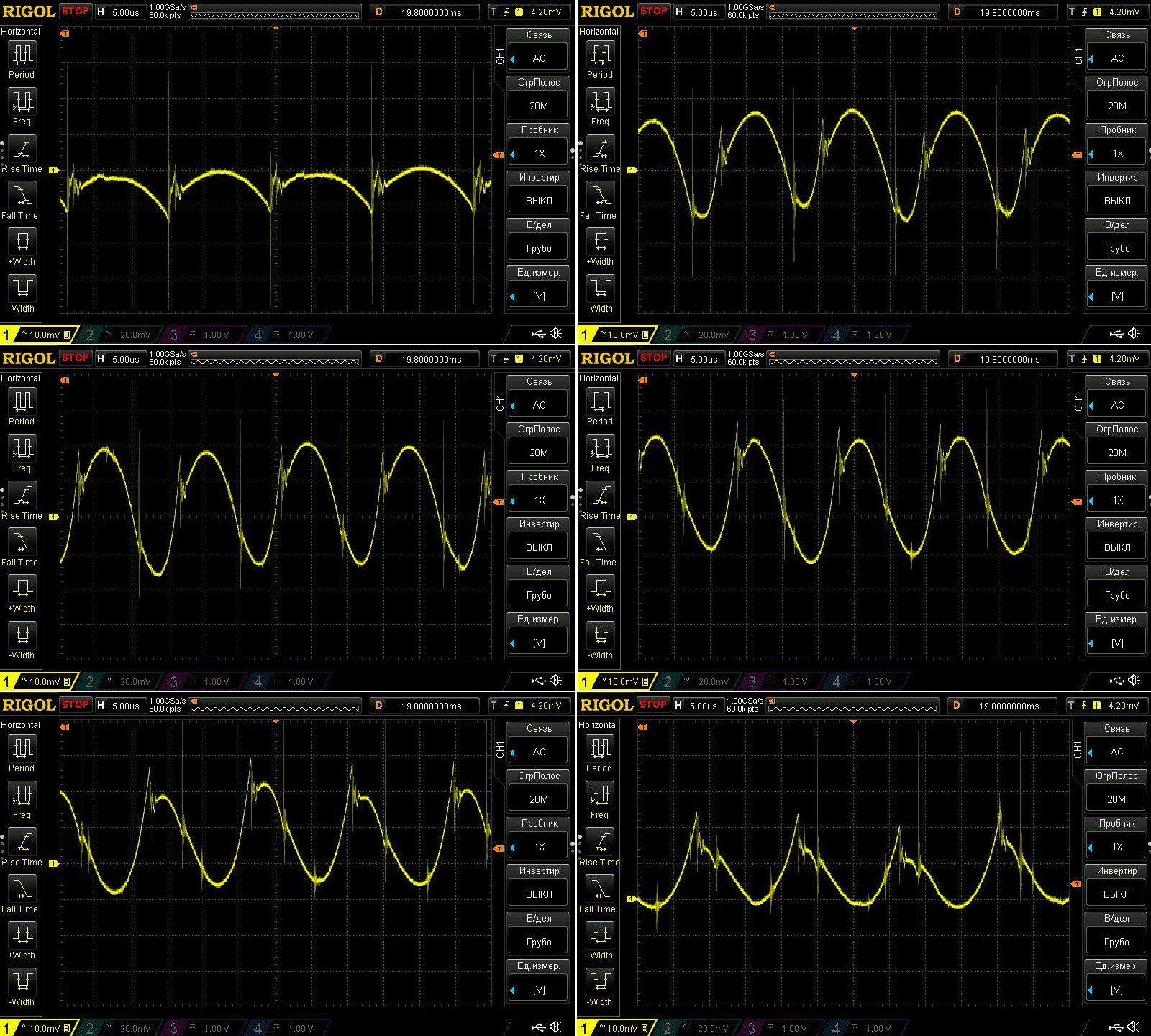
Next, I tested it at maximum current and output voltages of 5, 25, 36, 48, 60, and 72 V.
It didn’t get much worse, really. The highest ripple is in the middle of the range, at 36 and 48 V—around 35–40 mV. It’s lower at the other settings.
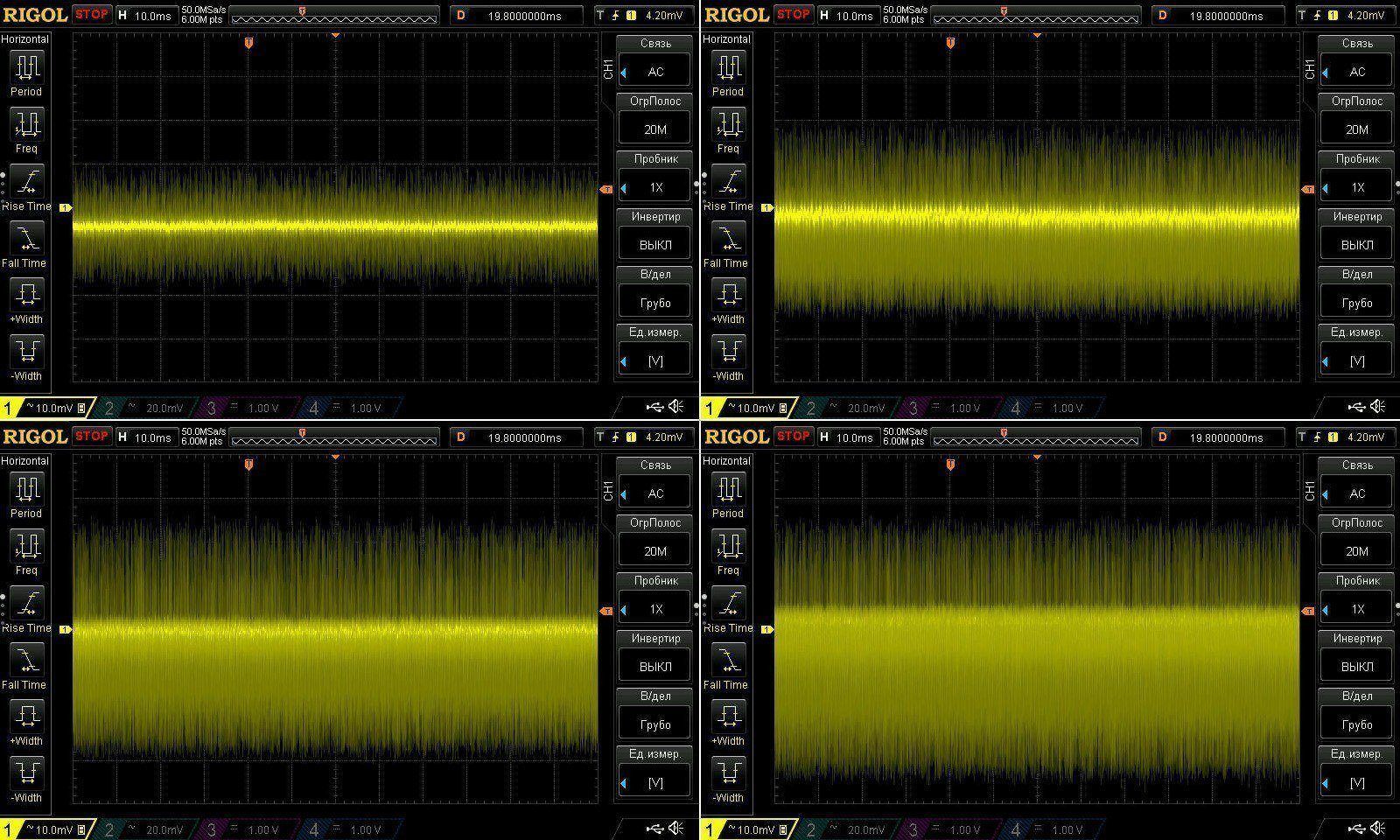
And here’s the output at 12 V, with no load and at 3, 6, and 9 A, but with a slower sweep. We’re basically just seeing the overall noise, nothing more.
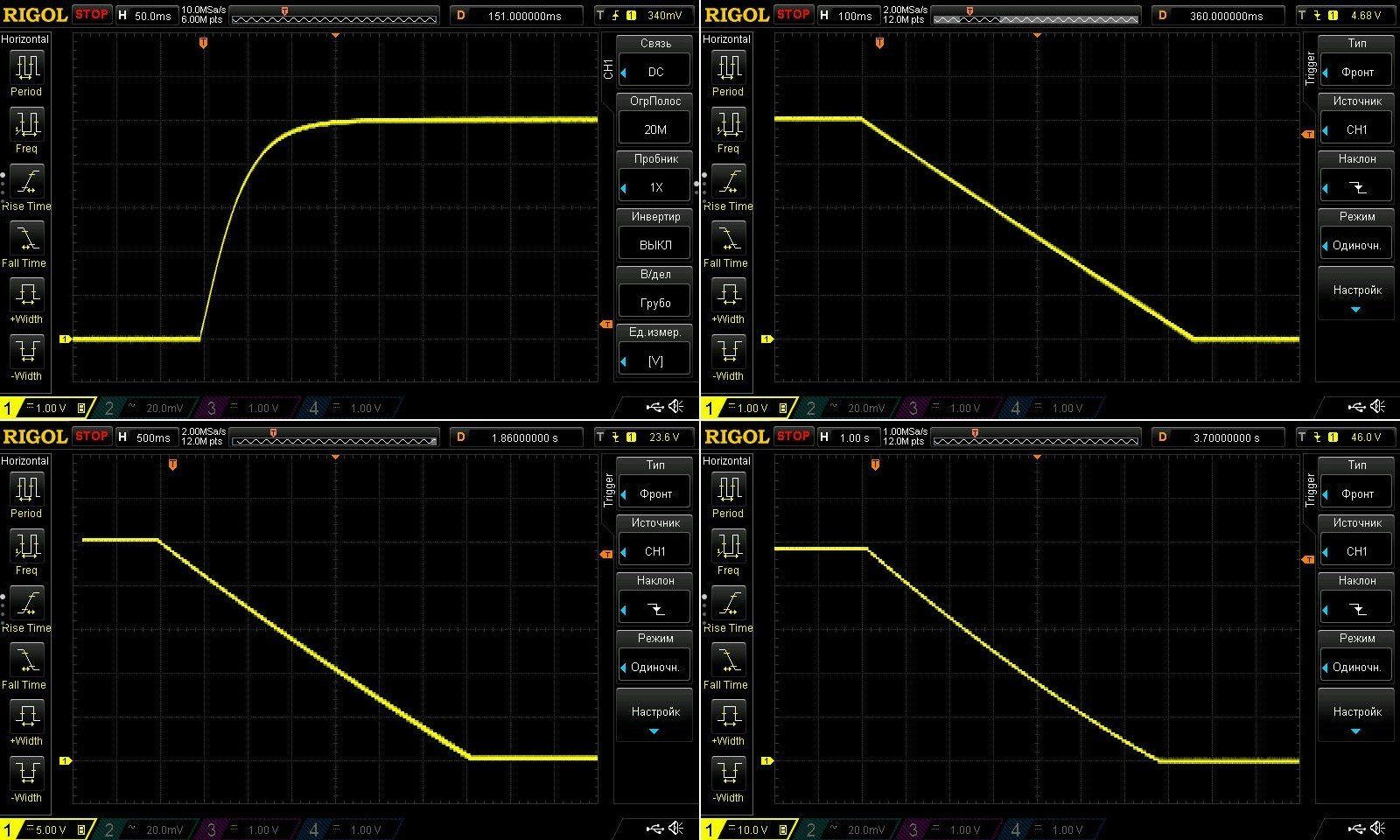
Test seven: transient response.
First, I applied 5 V to the output, then switched it off at 5, 24, and 48 V. As with the previous 6018 model, shutdown is drawn out, but noticeably less so. Even at 48 V, it takes 7 seconds to switch off—half as long as the 6018. The lower capacitor capacity is the reason.
There are no overshoots in either case.
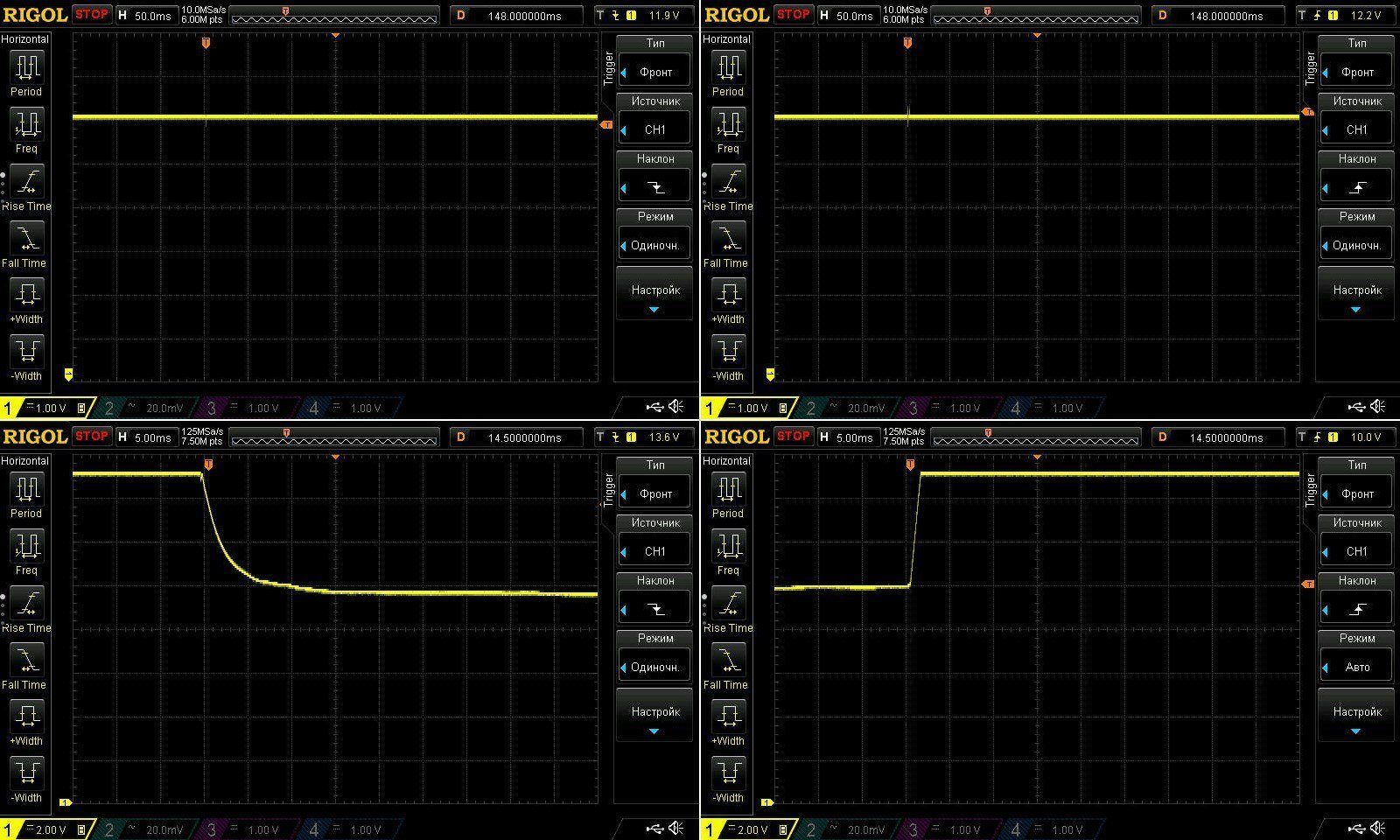
1, 2. Response to connecting/disconnecting a load. The output was set to 12 V. A 30 Ω resistor was connected continuously, and a 3.3 Ω resistor was connected in parallel with it (or disconnected). So this shows the response to a current step from 0.4 to 4 A and from 4 to 0.4 A.
3, 4. Transition from CV mode to CC mode and back. Voltage: 14 V; load current: 4.5 A; current limit set to 3 A.
In the first case, there are small, brief spikes with an amplitude of about 0.2 V. In the second, there are no spikes at all.
Test eight: efficiency measurement.
I started with 88 V (44 + 44), but the wires were relatively long, and there were also the multimeter leads. So, to reach the maximum output voltage, I had to raise the input voltage (or, more precisely, the output voltage from the power supplies) to 92 V.
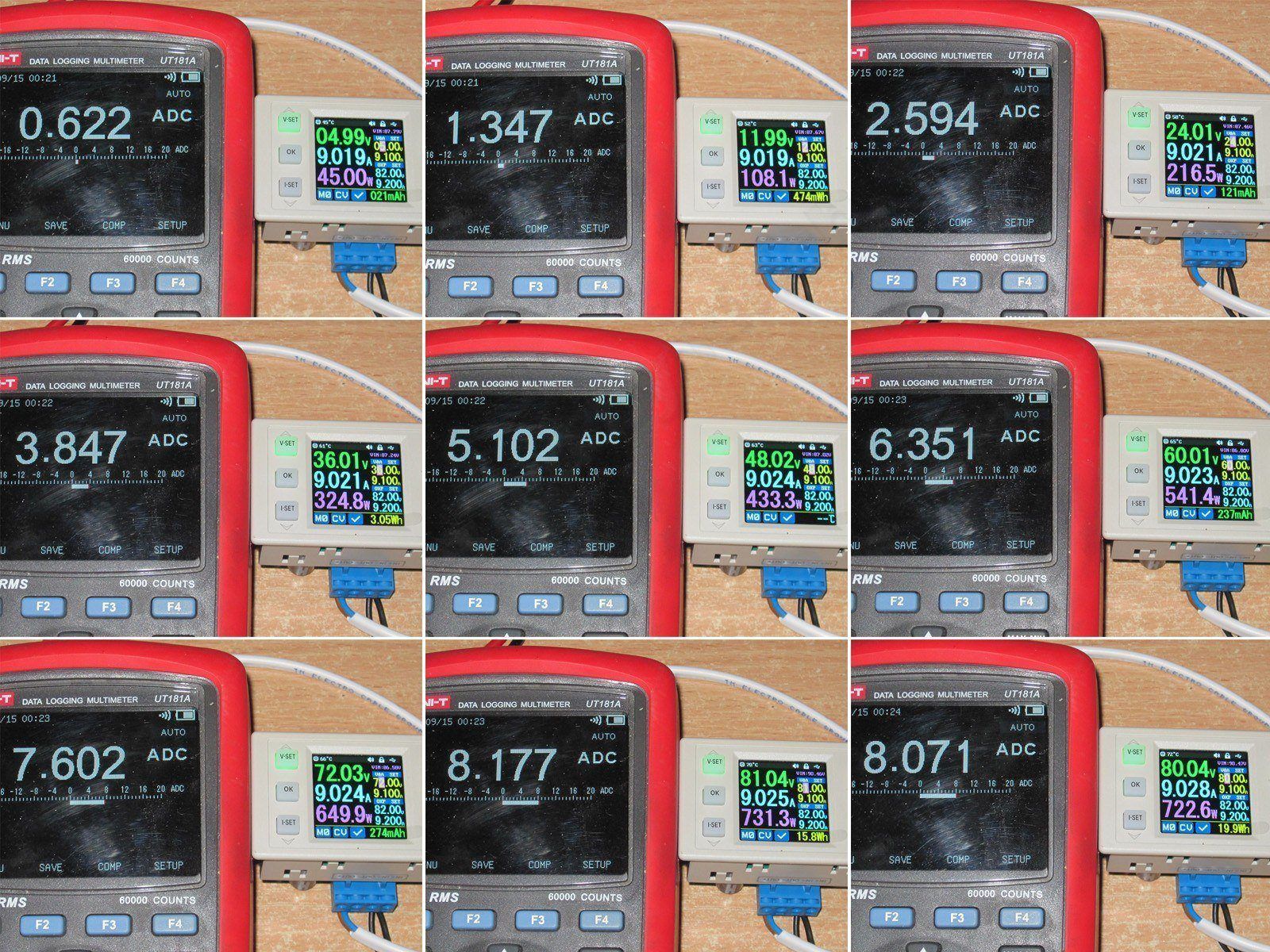
I tested it at the maximum current of 9 A and output voltages of 5, 12, 24, 36, 48, 60, 72, 80, and 81 V (the last two photos are swapped).
Here are the results: voltage, efficiency, power loss.
5 V — 82.4% — 9.6 W
12 V — 91.5% — 10 W
24 V — 95.4% — 10.4 W
36 V — 96.8% — 10.8 W
48 V — 97.5% — 10.8 W
60 V — 98.2% — 9.9 W
72 V — 98.8% — 7.7 W
80 V — 98.9% — 7.6 W
81 V — 98.9% — 8.4 W
As you can see, the efficiency is simply excellent. Sure, there’s some measurement error due to the large number of parameters being measured, but it’s still impressive.
I’ll also note that the highest losses occur at 36–48 V, i.e. in the middle of the range. But even 11 W isn’t all that much, in my opinion.
Test nine: converter thermal performance.
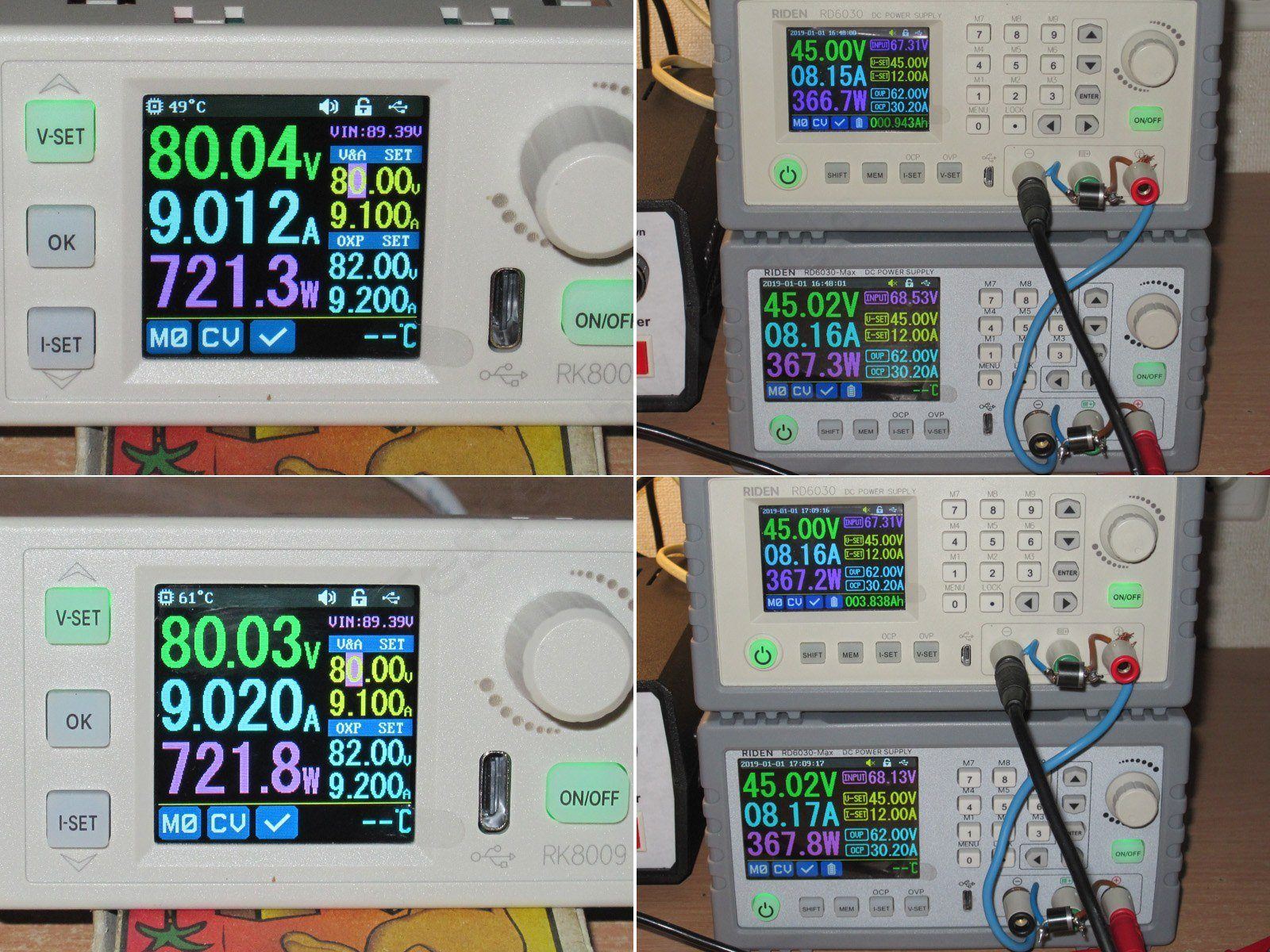
This test was run at an output voltage of 80 V and a load current of 9 A, with about 90 V at the input. There’s a bit of a catch here.
In terms of absolute output power, yes, it looks impressive: 720 W. But if you look at the results of the previous test, you’ll see that it would heat up more with an output voltage around 40 V. Still, 360 W of output doesn’t look as impressive as 720 :)
Put simply, it’ll heat up more at 36–48 V. But since the difference in losses isn’t that large, it’s not worth worrying about. Besides, the heat is actually distributed a little differently between the components, too.
Photos at the start and end of the test.
Before the test, I ran it for a while with no load.
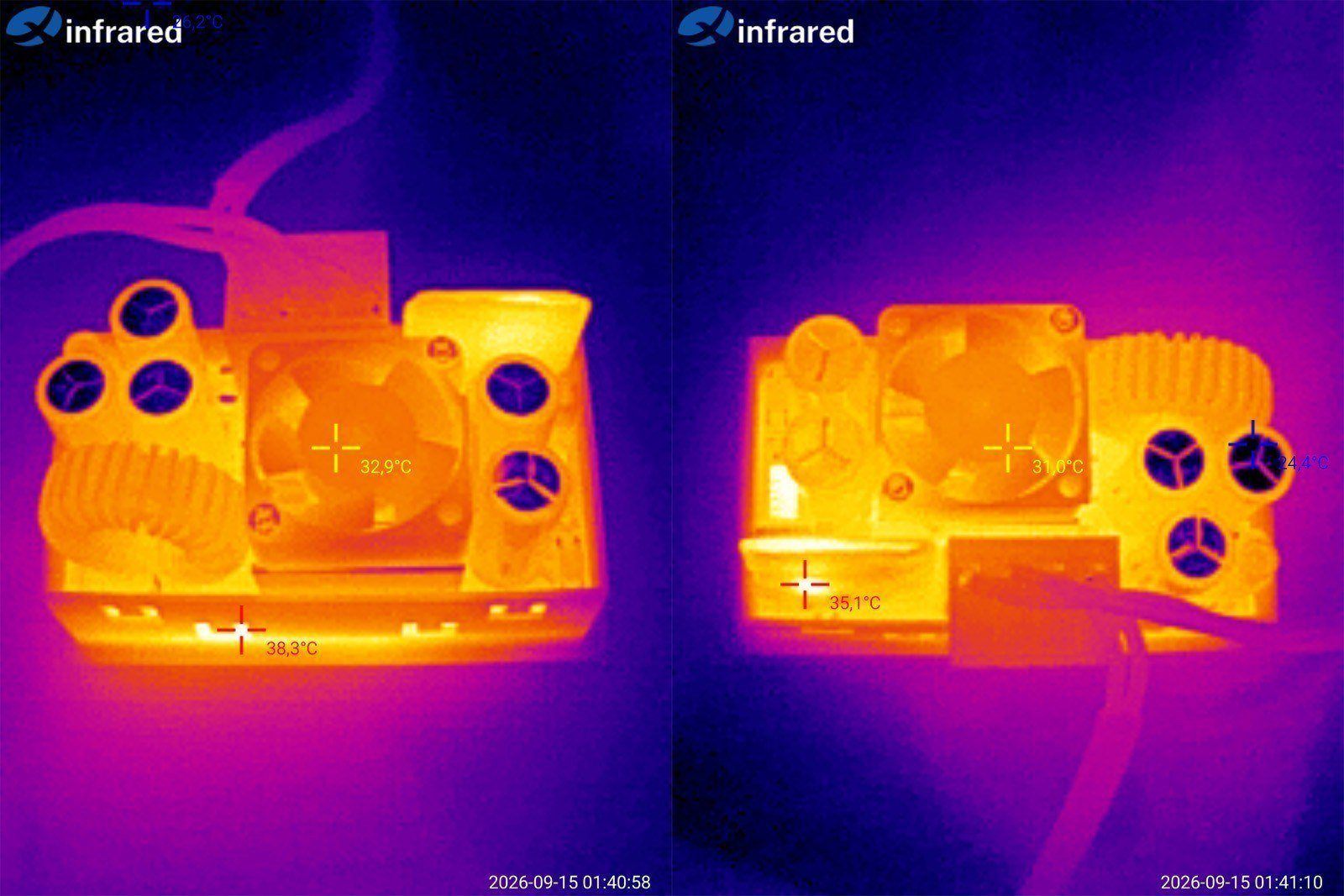
And after a while.
Everything feels almost cool to the touch, in my opinion. At least, I can’t see any hot spots at all, which is really good.
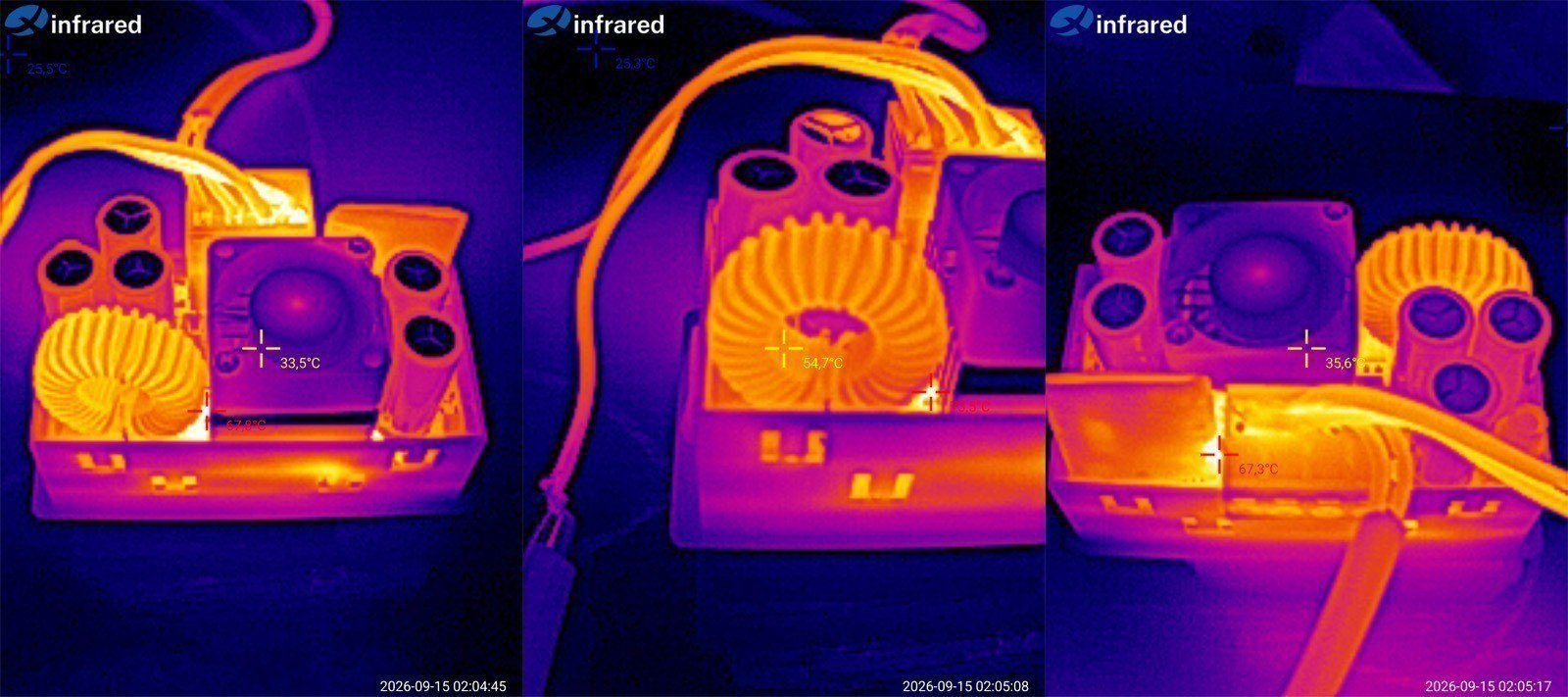
As last time, I don’t see any point in reviewing the software or taking a bunch of screenshots all over again.
Conclusion.
I wasn’t really in any doubt that the test results would be good: ripple, efficiency, losses, accuracy. There’s basically nothing to complain about—it just works, and that’s it.
Actually, I do have a couple of complaints. First, there’s very little headroom for the minimum voltage drop: to get the specified 81 V, you need at least 89 V at the input, preferably 90 V. That’s cutting it close to the protection threshold of 93 V. And I’ll ask the manufacturer again: why didn’t they make the output 84–85 V? It would have been much more useful and not much harder to do.
I also asked the manufacturer whether a power supply for this converter was available. They said no, which is a shame. So we’ll take a pair of 48 V units and adjust them down to 45 V each.
I’ll remind you once again about the handy undervoltage protection feature. I recommend setting it a few volts below the voltage of your power supply. That way, if the mains power goes out while the batteries are charging, your setup will work much more reliably.
That’s all for now. I hope this was useful, and I’d be glad to hear your comments and thoughts on this product line.
rd rk8009 80в 9а
Questions and answers
What are the specifications of the Raiden RK8009?
The article lists an output range of 0–80 V and 0–9 A, up to 720 W, and an input range of 12–90 V.
How does the RK8009 perform in the author's tests?
The author reports good results for ripple, efficiency, losses, and measurement accuracy, with no notable overheating observed.
Why does the author want a higher output voltage from the RK8009?
Getting the stated 81 V requires at least 89 V at the input, close to the 93 V protection threshold. The author also says 84–85 V would be more useful for charging 20S battery packs.
This model is included in the summary table: Comparison of adjustable converters for a bench power supply
The figures from this review are in the measurement database: Converters
Discounted products
You may be interested in


Discounted products
All the content on the site and the advice are free, but we’d be grateful for your support of the project and the channel!
Only registered readers can comment. It takes a minute to sign up, and you can log in with the same account you use on the forum.
Log inRegister