
EVE 21700 batteries, two types
As a reminder, to keep up with new posts on the blog, I recommend following me on Instagram, where I’ll post notifications about every new article and maybe write about something interesting now and then: link to my account
You can also subscribe to updates and new articles on the Telegram channel - https://t.me/KirichBlog
These cells were particularly interesting to me because, in my opinion, the 18650 format is already quite outdated and has also reached its technological limit at 4000 mAh. The 18650 format is outdated in part because modern applications often require more capacity and, just as importantly, higher current—something 18650 cells simply can’t deliver.
Meanwhile, 21700 cells have long surpassed the old limits in both capacity, with options rated at 5600 and even 5800 mAh, and current: models capable of over 100 A are already available, such as the EVE 50PL, which I also plan to review.
But this time we’re not looking at record-breakers, but rather solid mid-range cells that offer a good balance of price and performance.
As a reminder, the promo code kirich_blog gives you 5% off all products at the miliom.com.ua online store. The discount is valid until February 28, 2026, and applies only to orders placed by individuals through the website using the promo code.
The first pair: EVE 21700 40P 4Ah - link.
These cells are marketed as high-current cells, so, like the 25P, they may be useful in power tool battery packs.
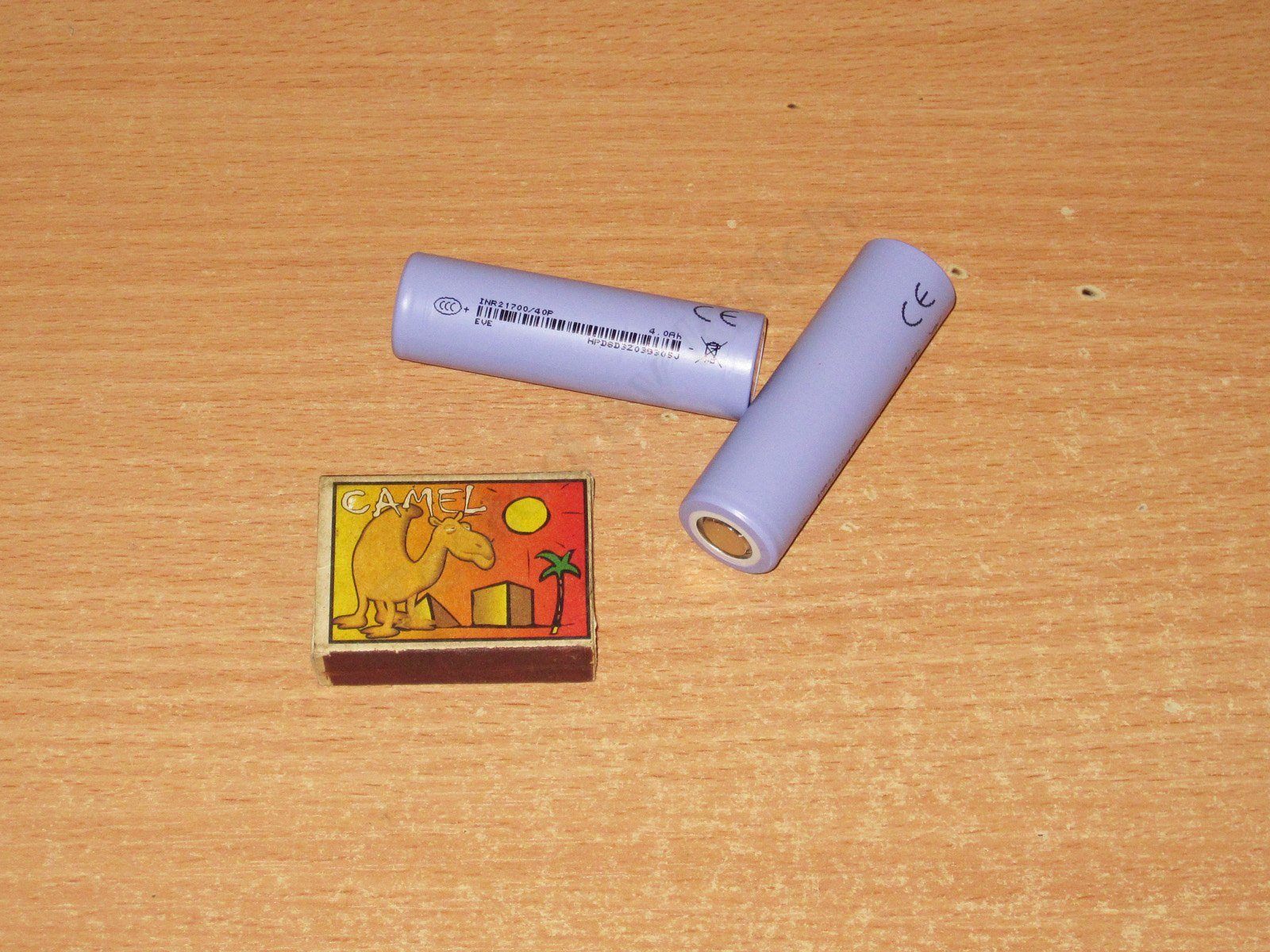
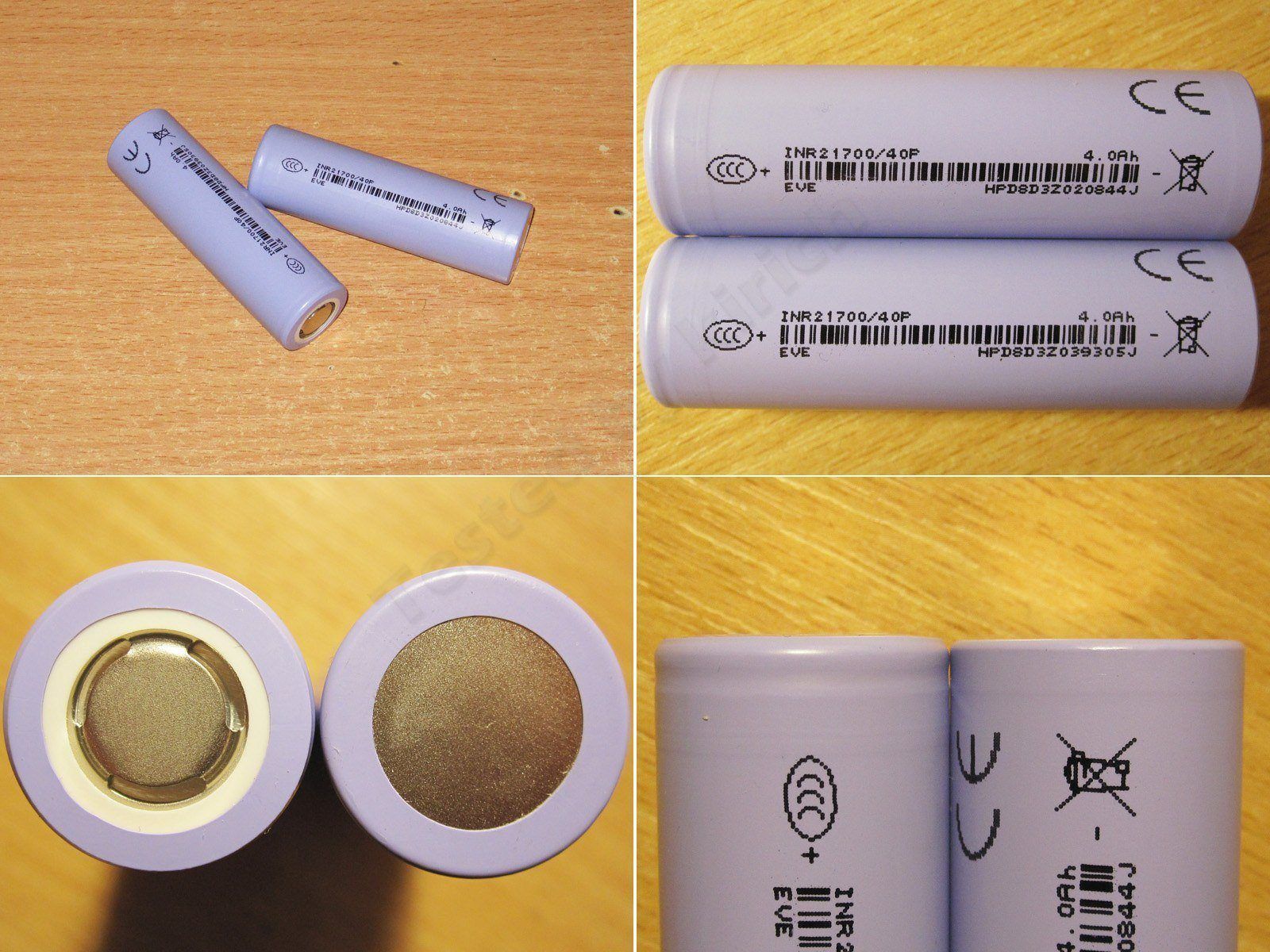
The model is marked 40P, and the capacity is listed as 4 Ah, which makes sense. The positive terminal is flat and has three tabs.
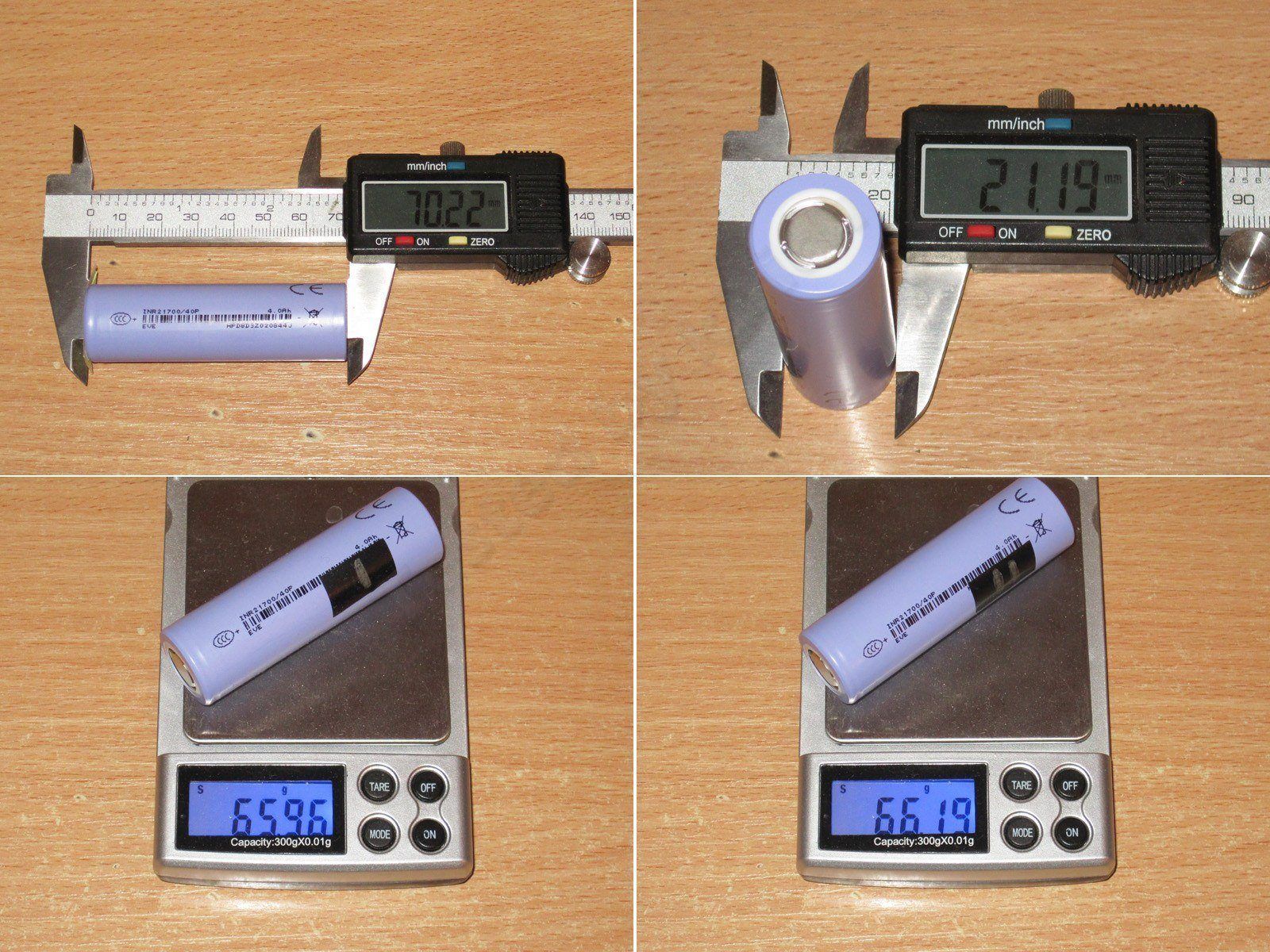
As last time, the battery diameter was measured at its widest point. Otherwise, these look like perfectly ordinary 21700 cells.
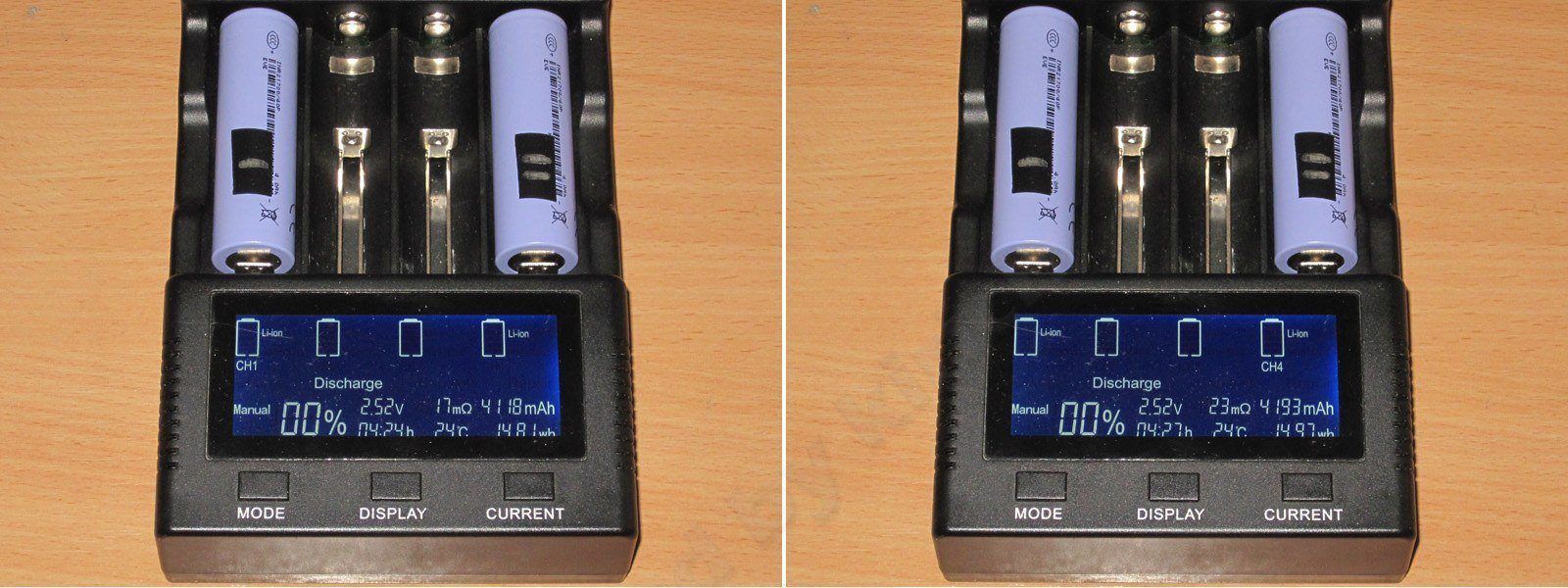
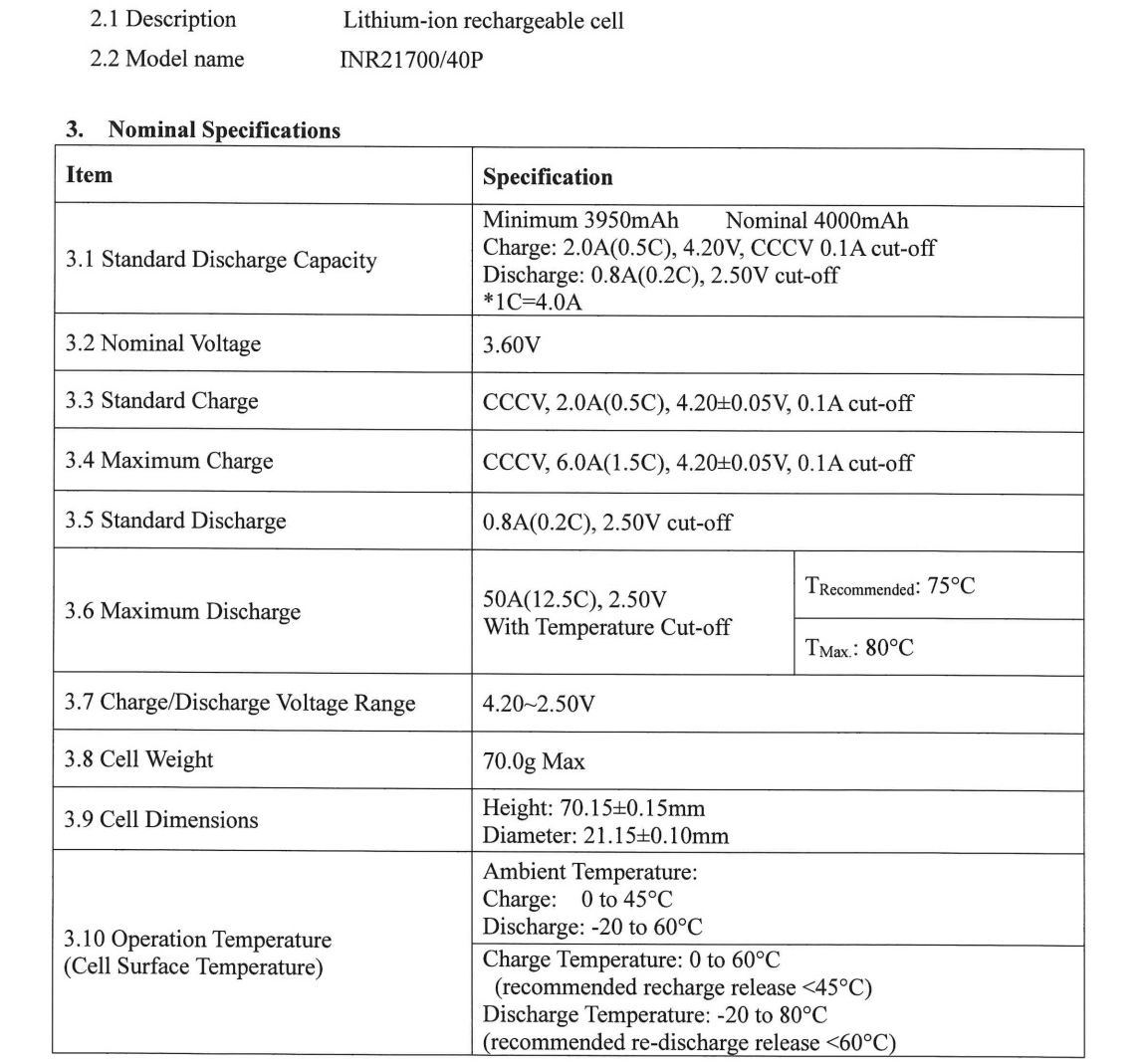
They took about 3400 mAh on the initial charge, meaning they were at roughly 15% charge. After a full charge, they delivered about 4150 mAh at a 1C discharge rate.
According to the specifications, these batteries have a standard charge rate of 0.5C and a maximum charge rate of 1.5C (6 A).
The maximum continuous discharge current is listed as 50 A (12.5C). That’s not record-breaking, but it’s still impressive.
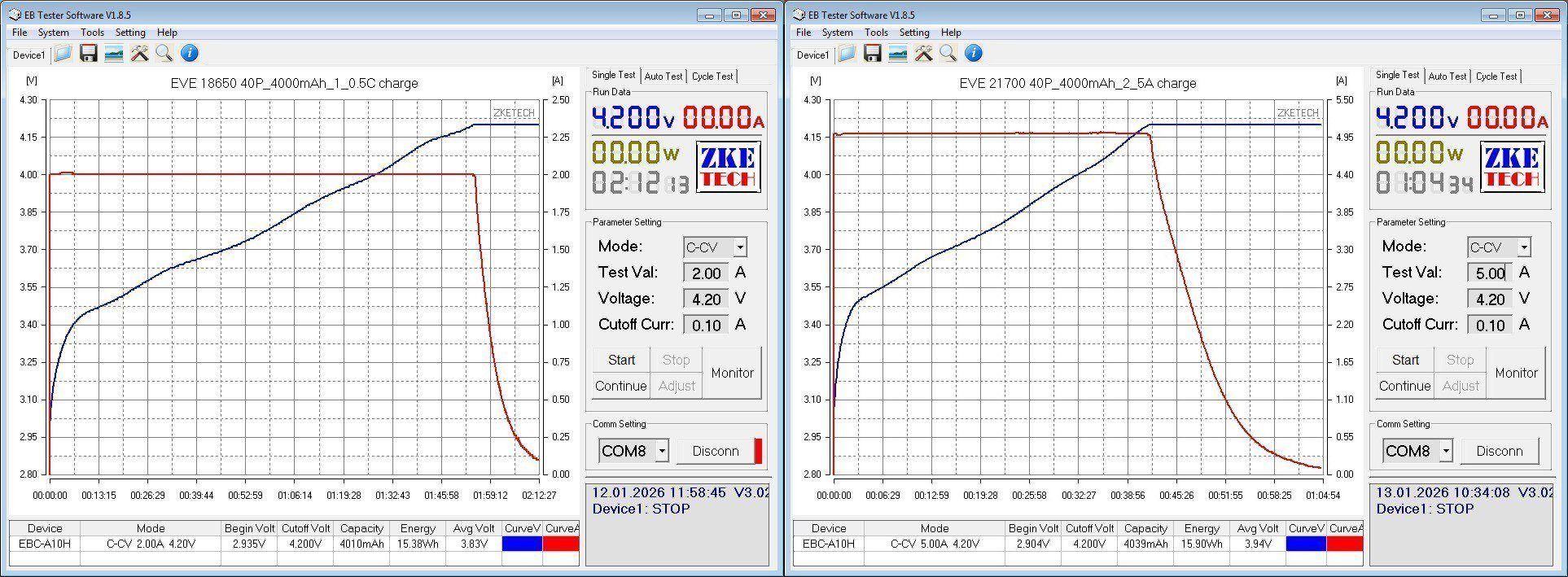
At a 0.5C charge rate, charging took 2 hours and 12 minutes—a perfectly normal result for high-current cells. I tested fast charging at 5 A, since that’s the maximum current supported by the EBC A10H tester. As it’s close to the 6 A maximum, I didn’t use a more powerful load for this test.
At 5 A, the process took a little longer than expected, but just over an hour is still a good result.
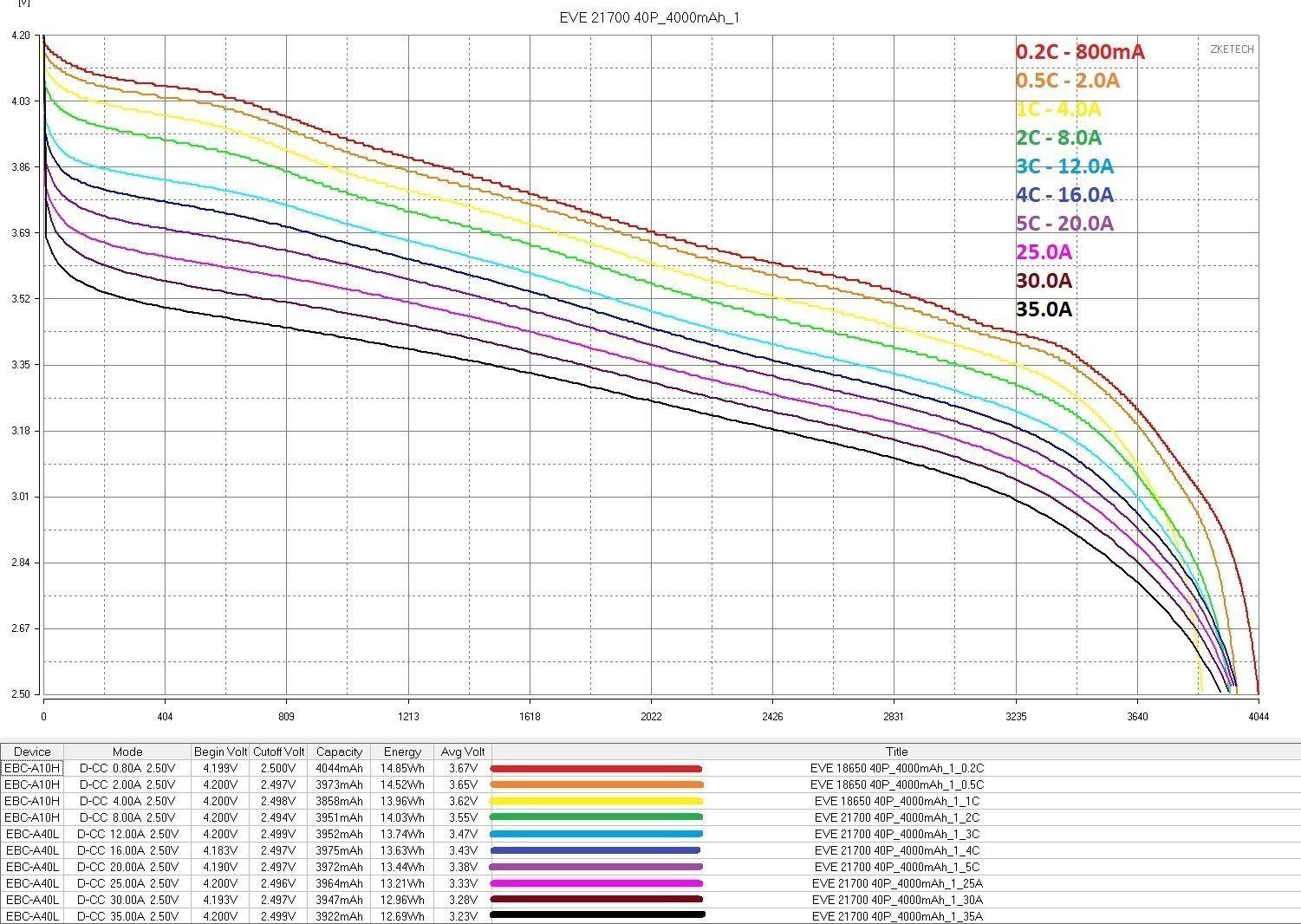
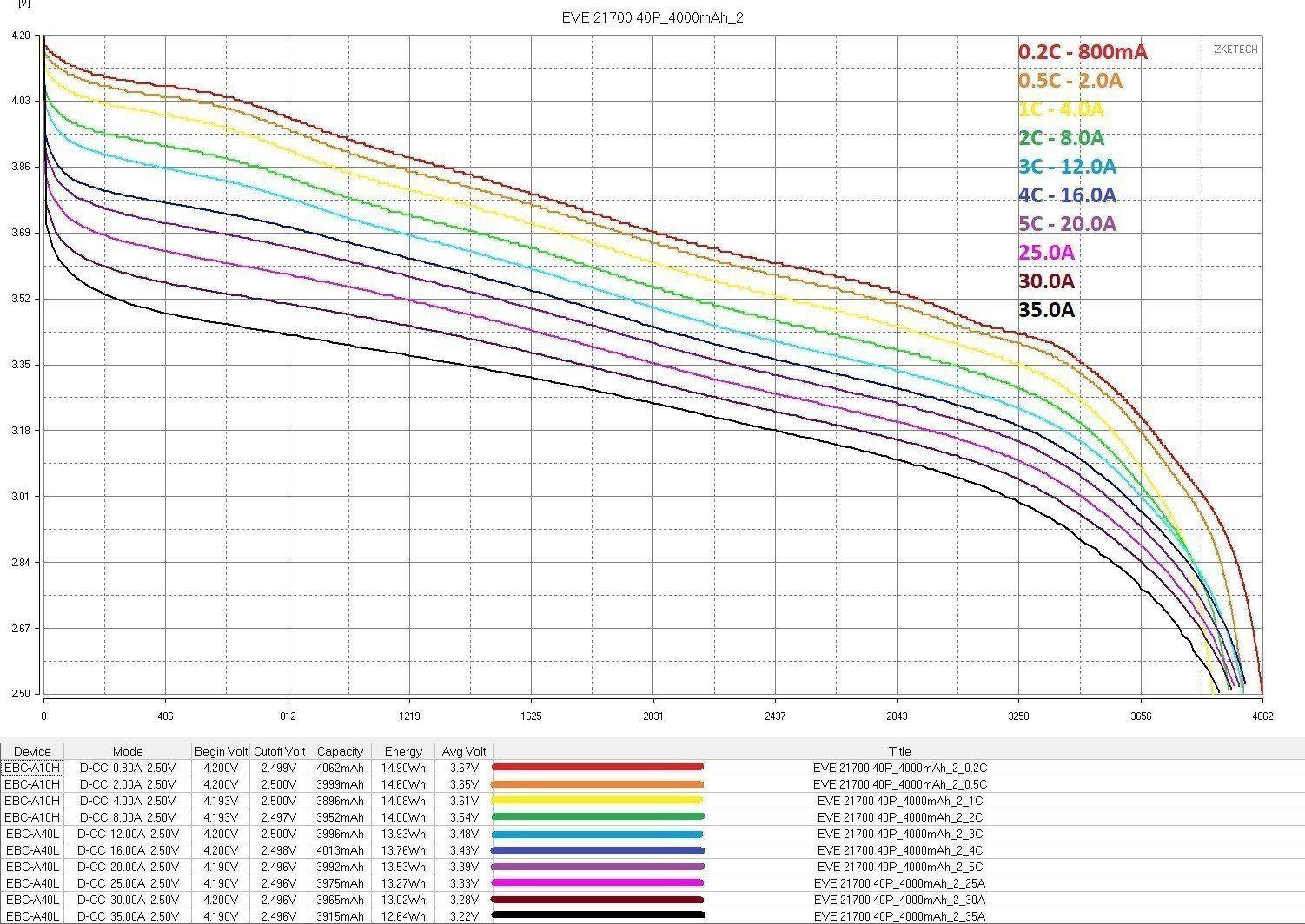
There are lots of tests here: 10 different modes—0.2, 0.5, 1, 2, 3, 4, and 5C, plus 25, 30, and 35 A. Yes, the maximum is stated as 50 A, but I think you’ve already guessed why I stopped at 35 A.
In any case, at the standard test current of 0.2C, the cell delivered the stated 4000 mAh without any issues.
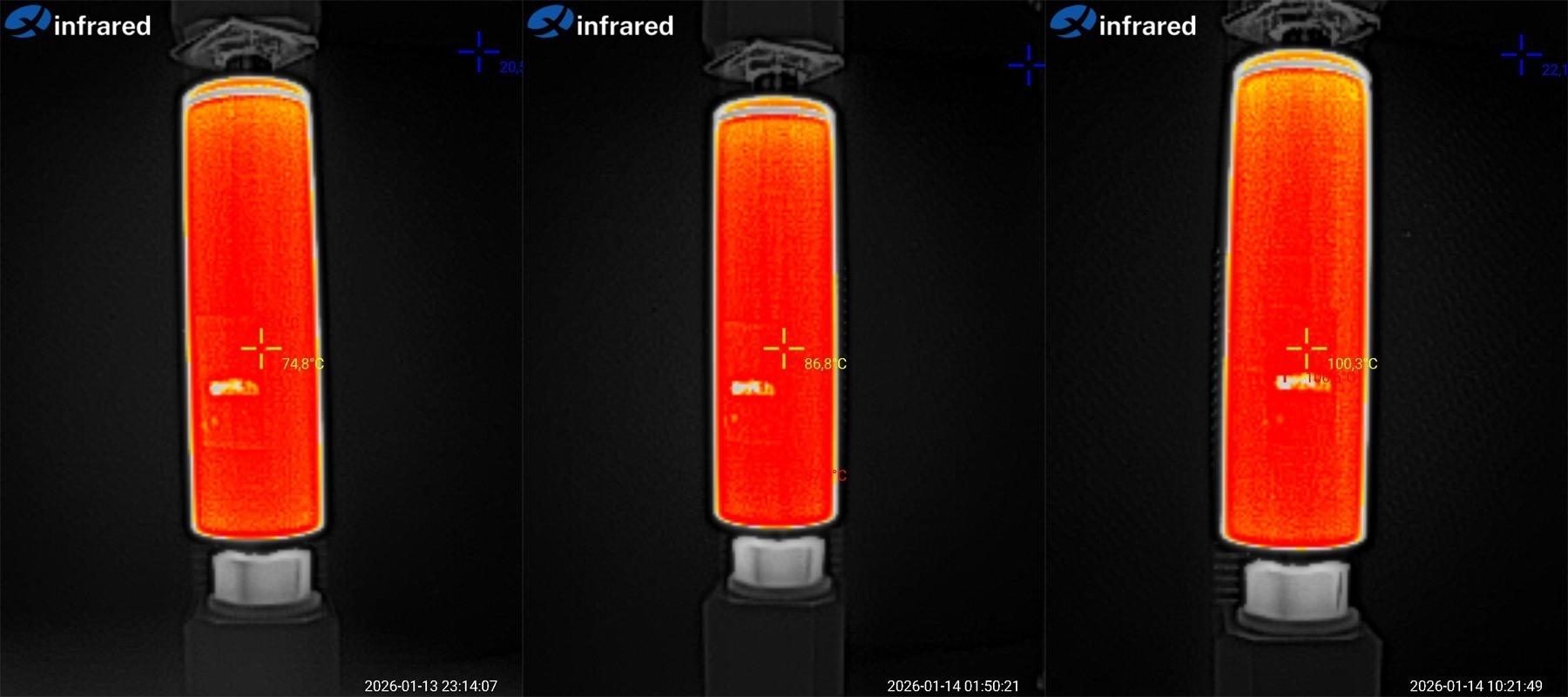
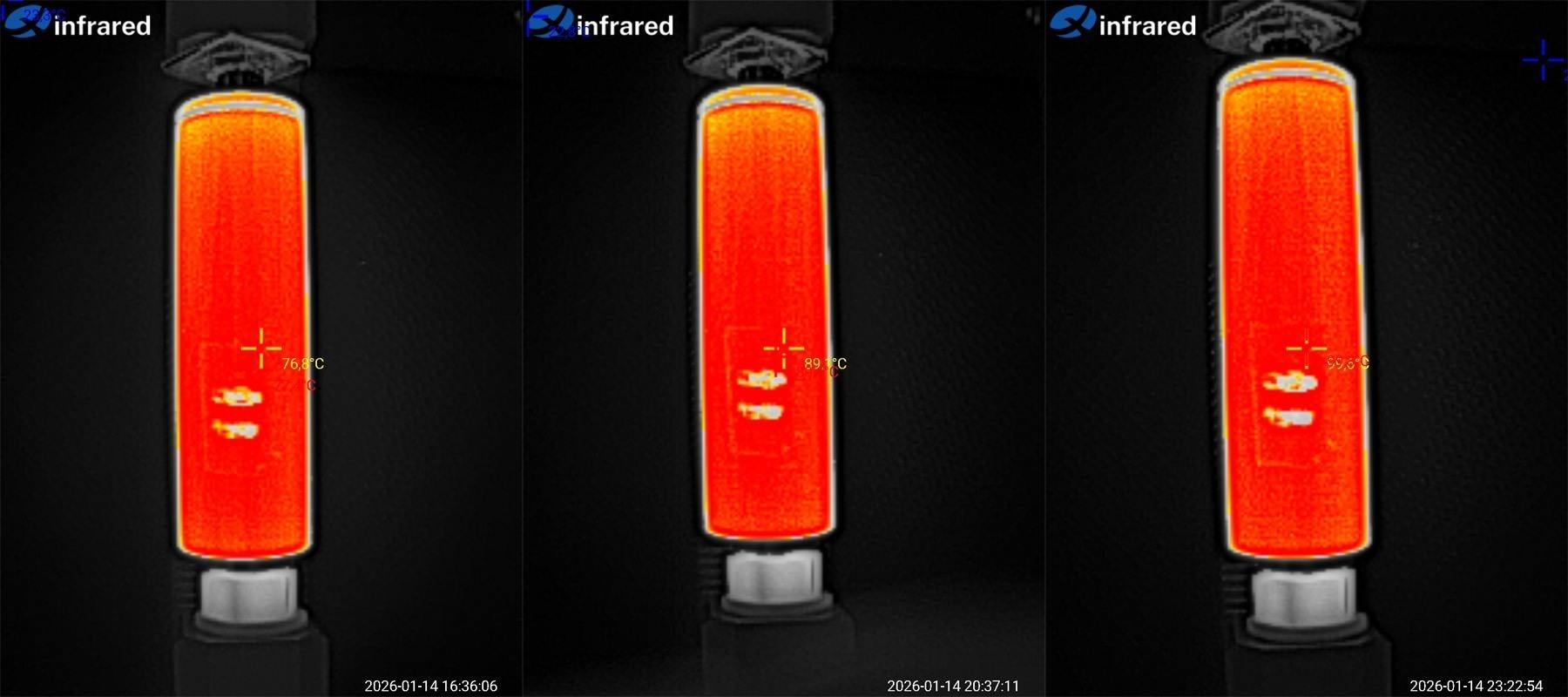
Case temperature at 25, 30, and 35 A. And yes, at 35 A I was already getting a little over 100°C, so I stopped the test there.
In my opinion, a more realistic and relatively safe continuous current for these cells is closer to 25 A, maybe 30 A. The 50 A rating is specified with a temperature cutoff at 80°C.
The results for the second test cell are about the same, within the measurement error.
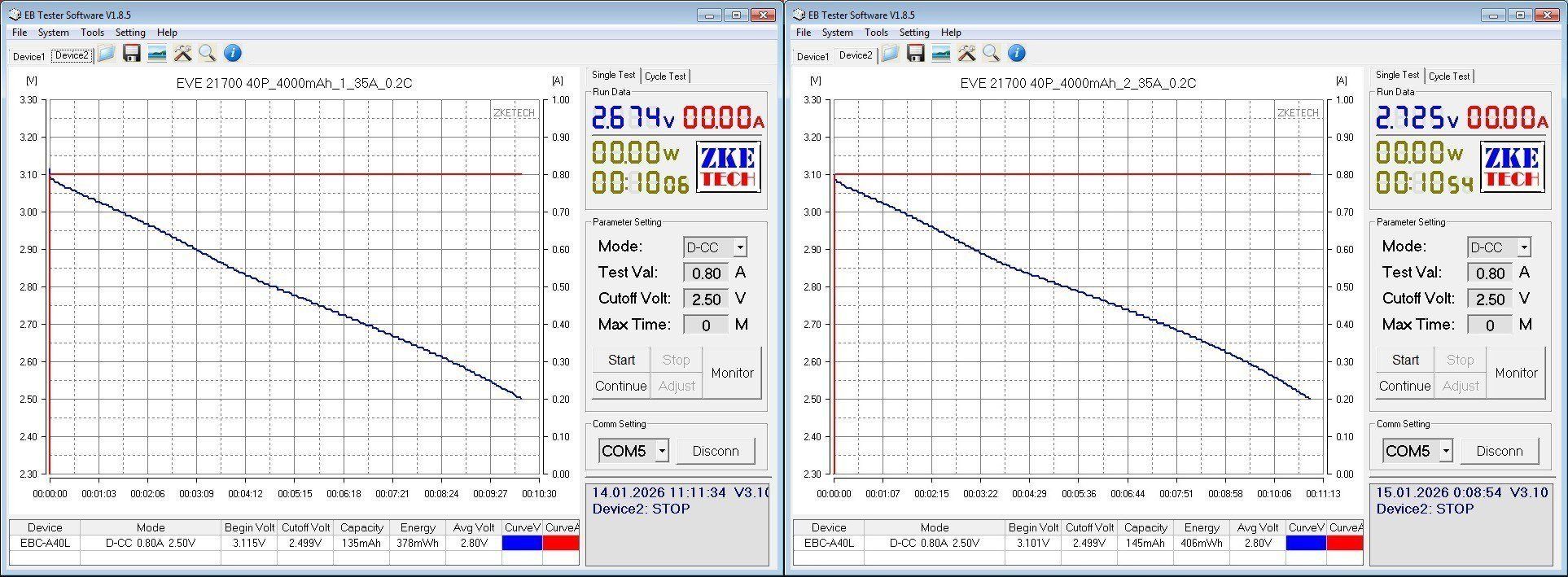
I sometimes run this test on high-current cells. The idea is simple: discharge the cell at the maximum current, let it cool completely, then measure the remaining capacity at 0.2C. The less capacity is left, the better—the battery was able to deliver more of its full capacity.
And yes, I got about 140 mAh here, which is very good. In effect, I had already “drained” about 96% of it.
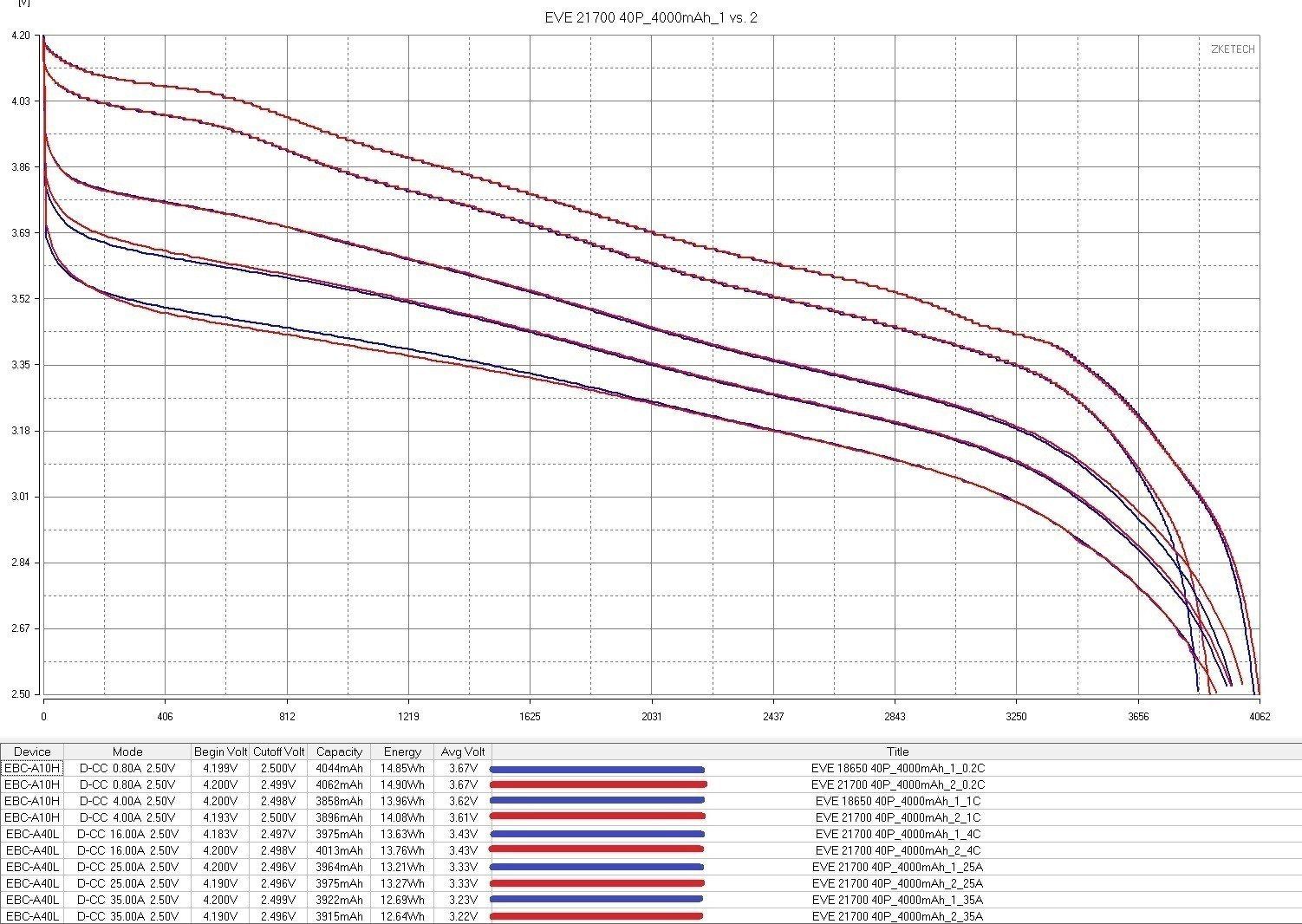
I have no complaints about the parameter consistency test. There is some variation in one of the modes, but otherwise everything looks pretty good.
Cell impedance after all the tests.
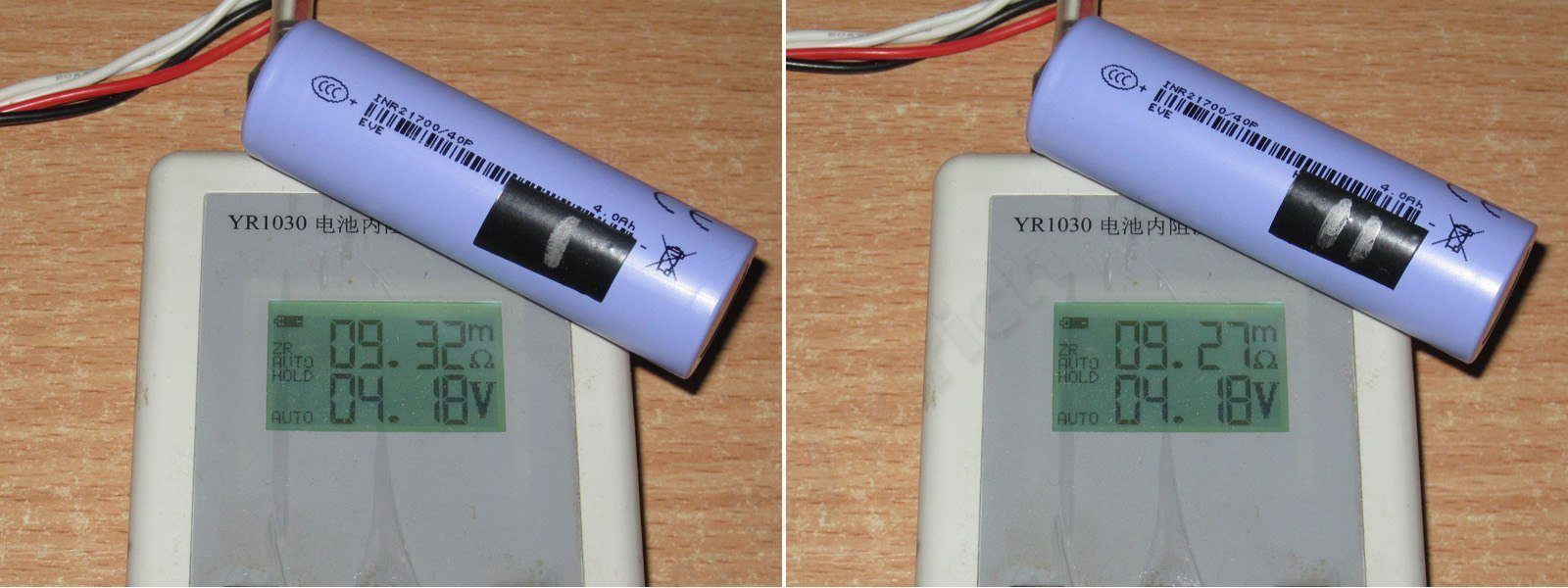
As always, the best part is at the end :)
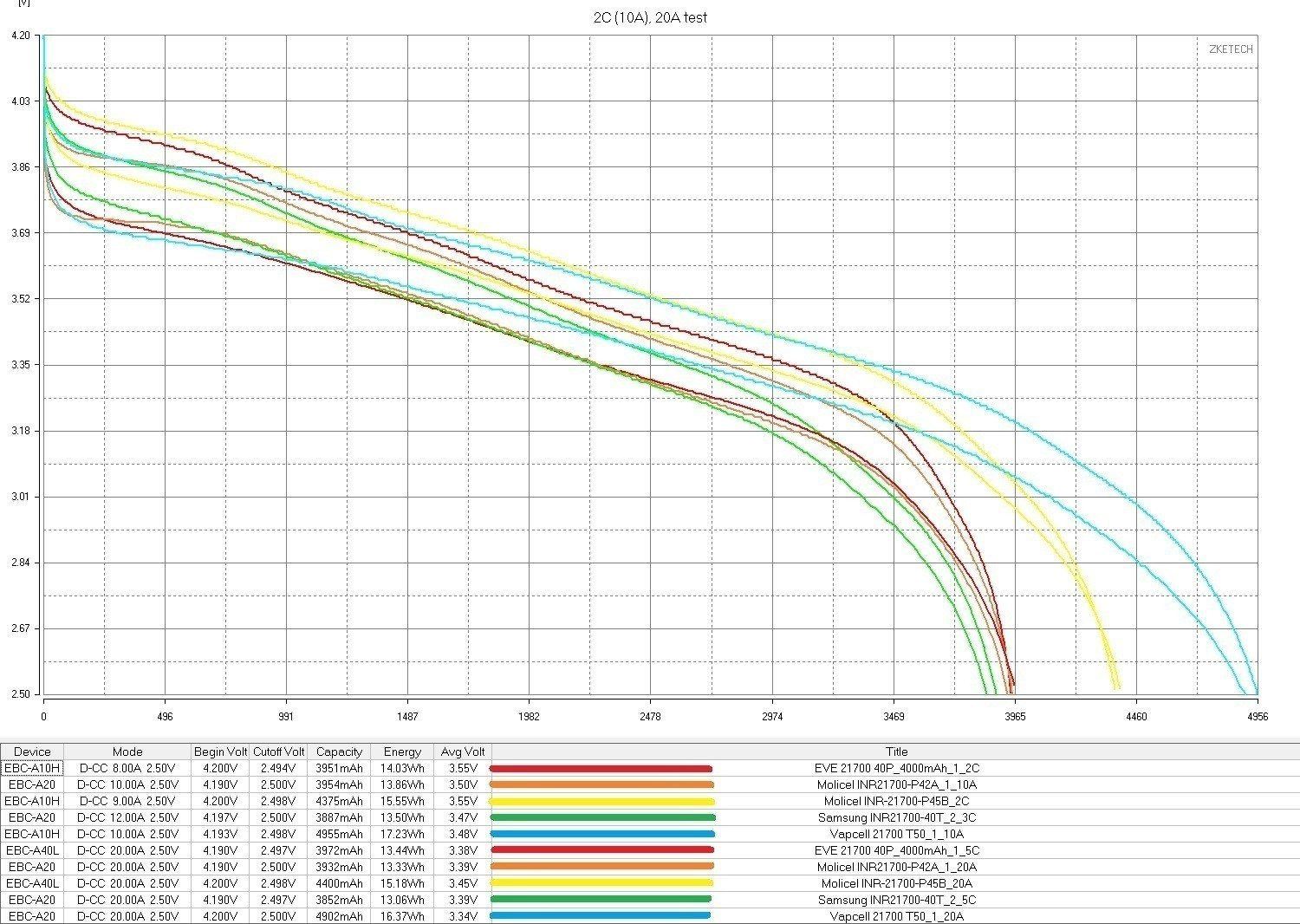
In this case, it’s a comparison with other similar cells. I don’t have many cells rated at exactly 4000 mAh, so I’ll compare these with a few reasonably similar models. Here’s how they stack up:
1. The batteries under review
2. Molicel INR21700-P45B
3. Molicel INR21700-P42A
4. Samsung INR21700-40T
5. Vapcell T50
Since some of the batteries have a significantly higher capacity, it makes more sense to compare them with the 4 Ah models. The cells under review perform very well here, both at 2C and at 20 A. I can’t compare them at higher currents because I don’t have those results for some of the models I tested earlier.
Second pair: EVE 21700 50E 5Ah - link
These cells are high-capacity, though not exceptionally so.
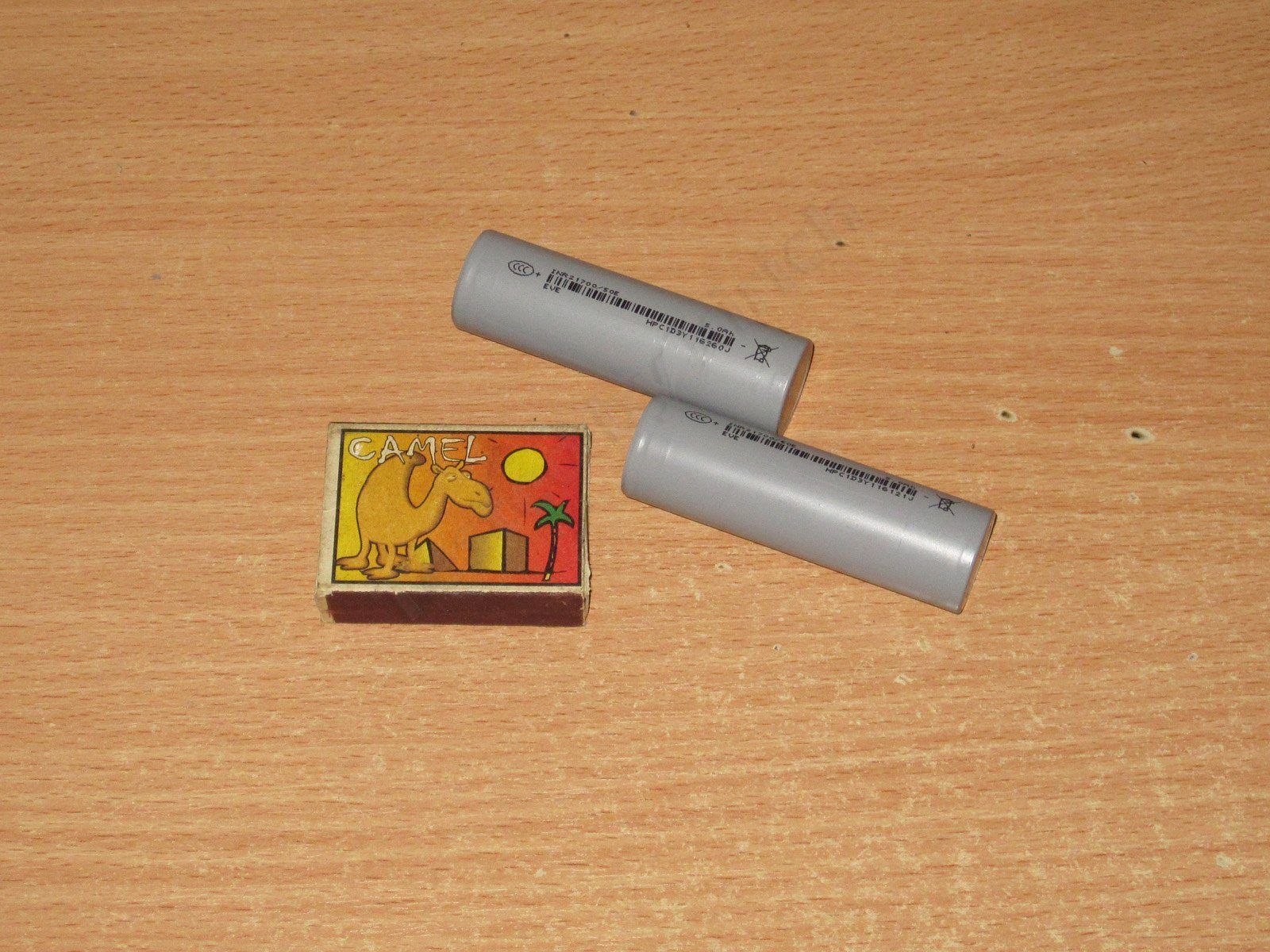
Gray cells, model 50E, rated at 5 Ah, with a flat, three-tab positive terminal. Their only obvious difference from the previous cells is the color—and, of course, the markings.
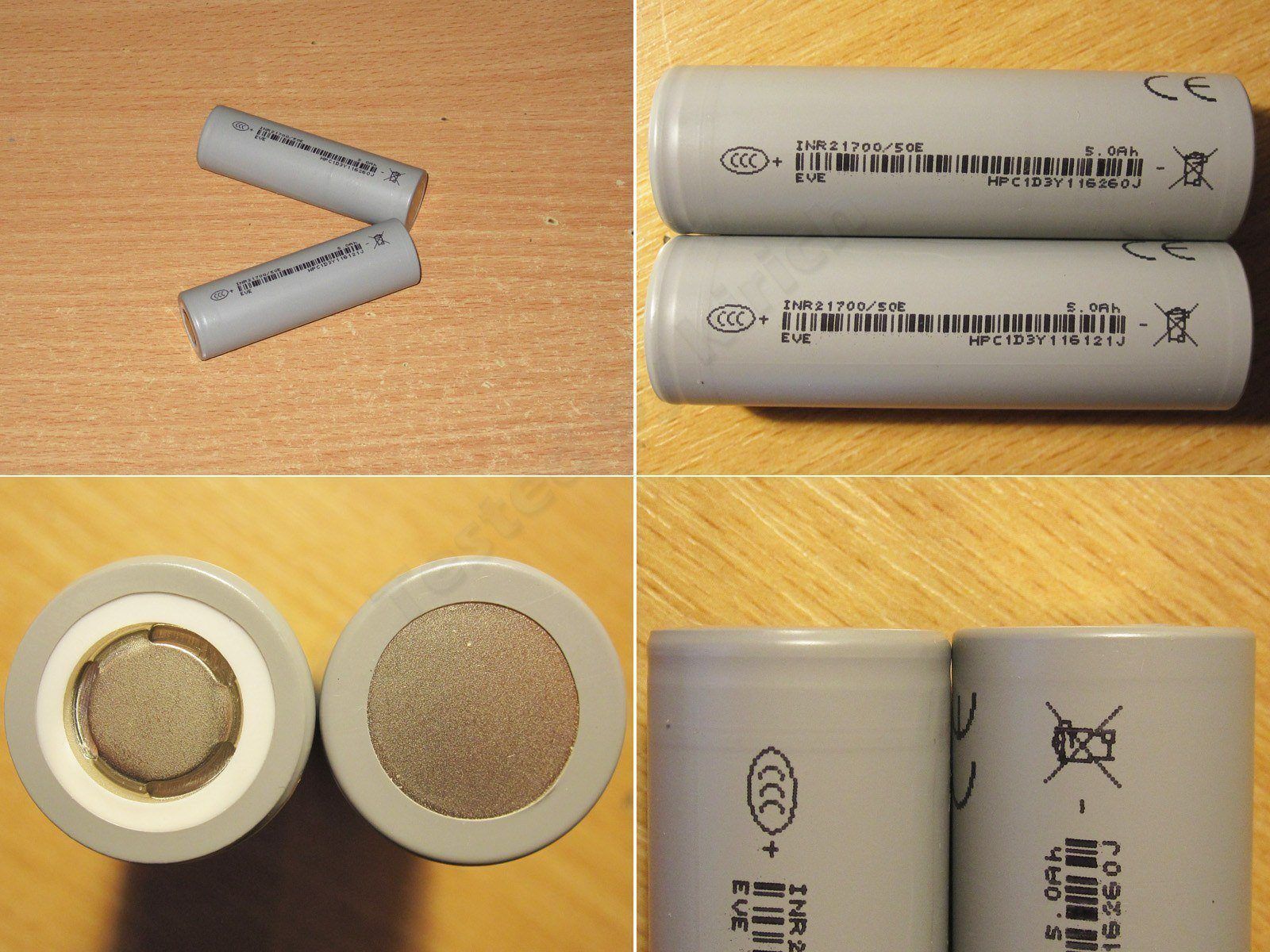
The dimensions and weight are typical too.
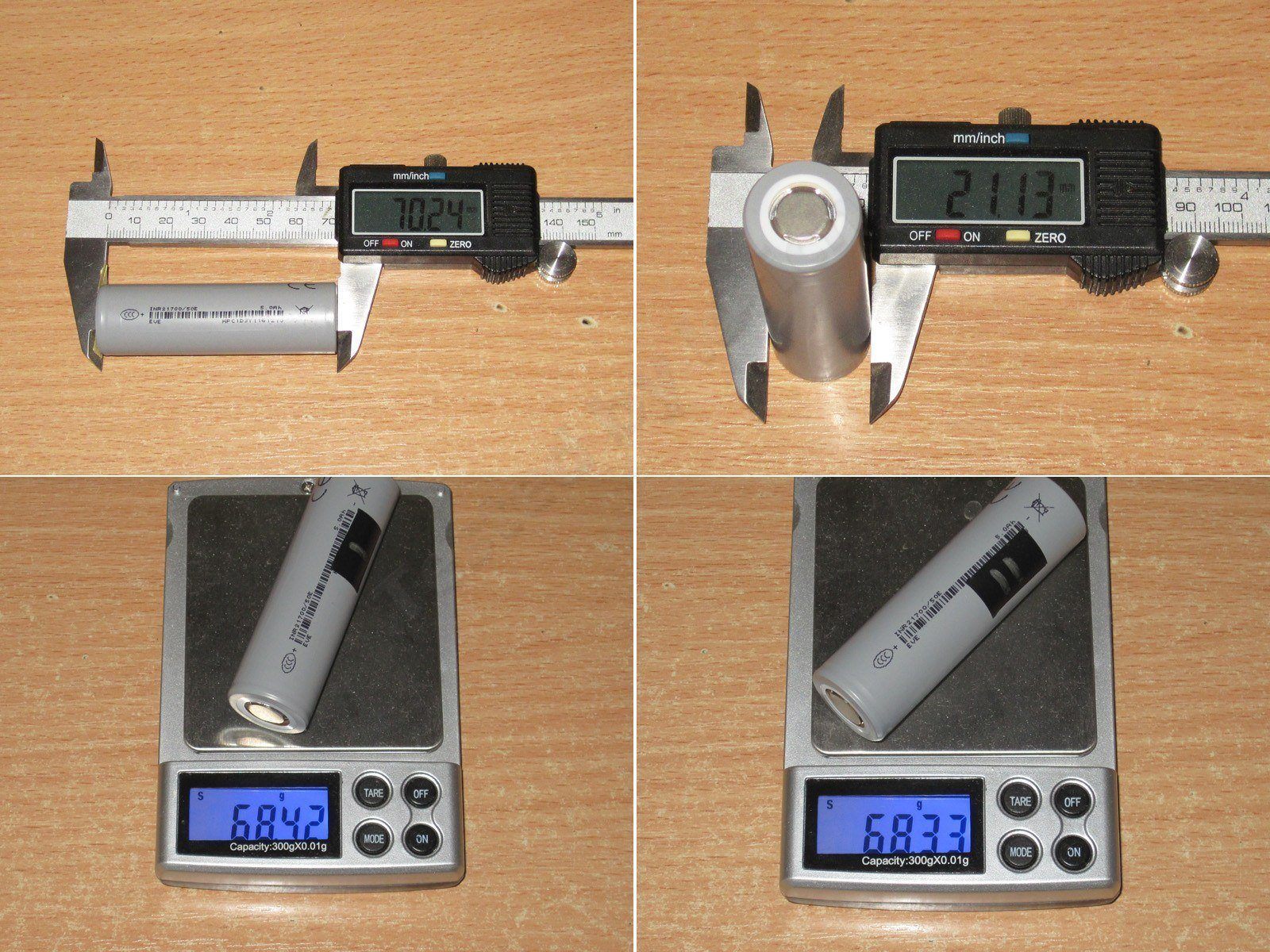
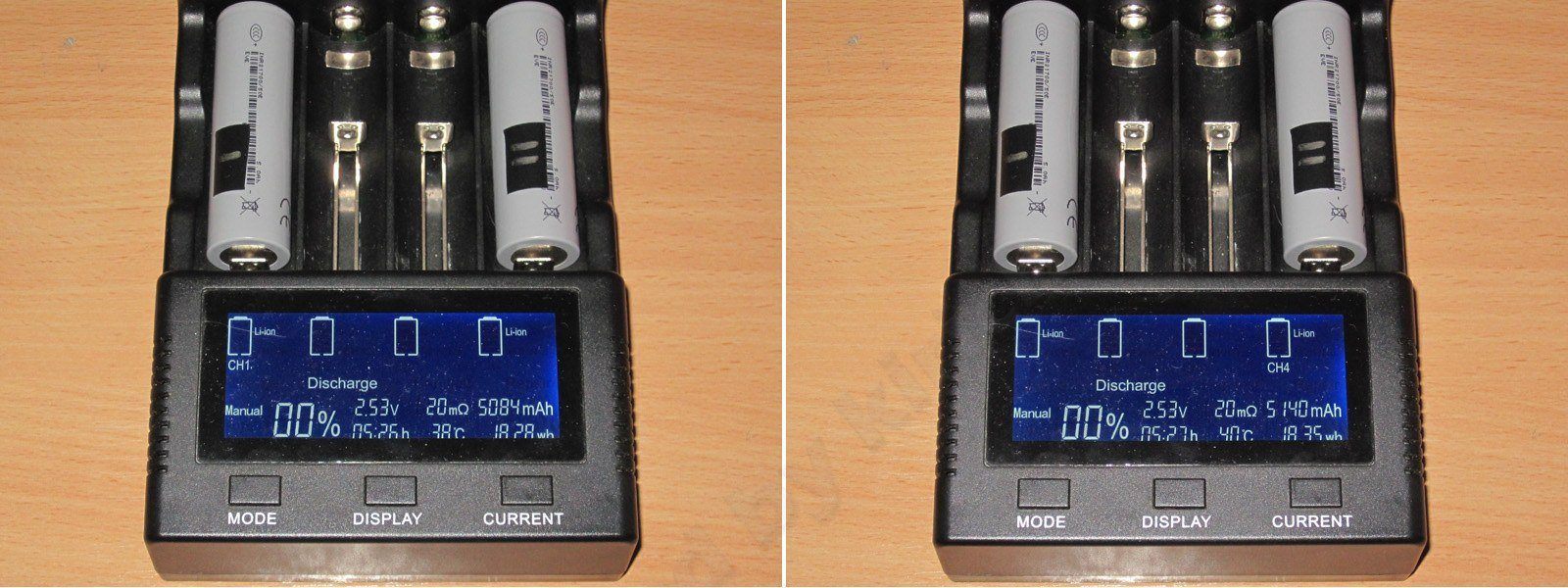
The first charge took about 4100 mAh, meaning the initial charge was around 20–25%. The first test discharge at 1 A yielded about 5100 mAh.
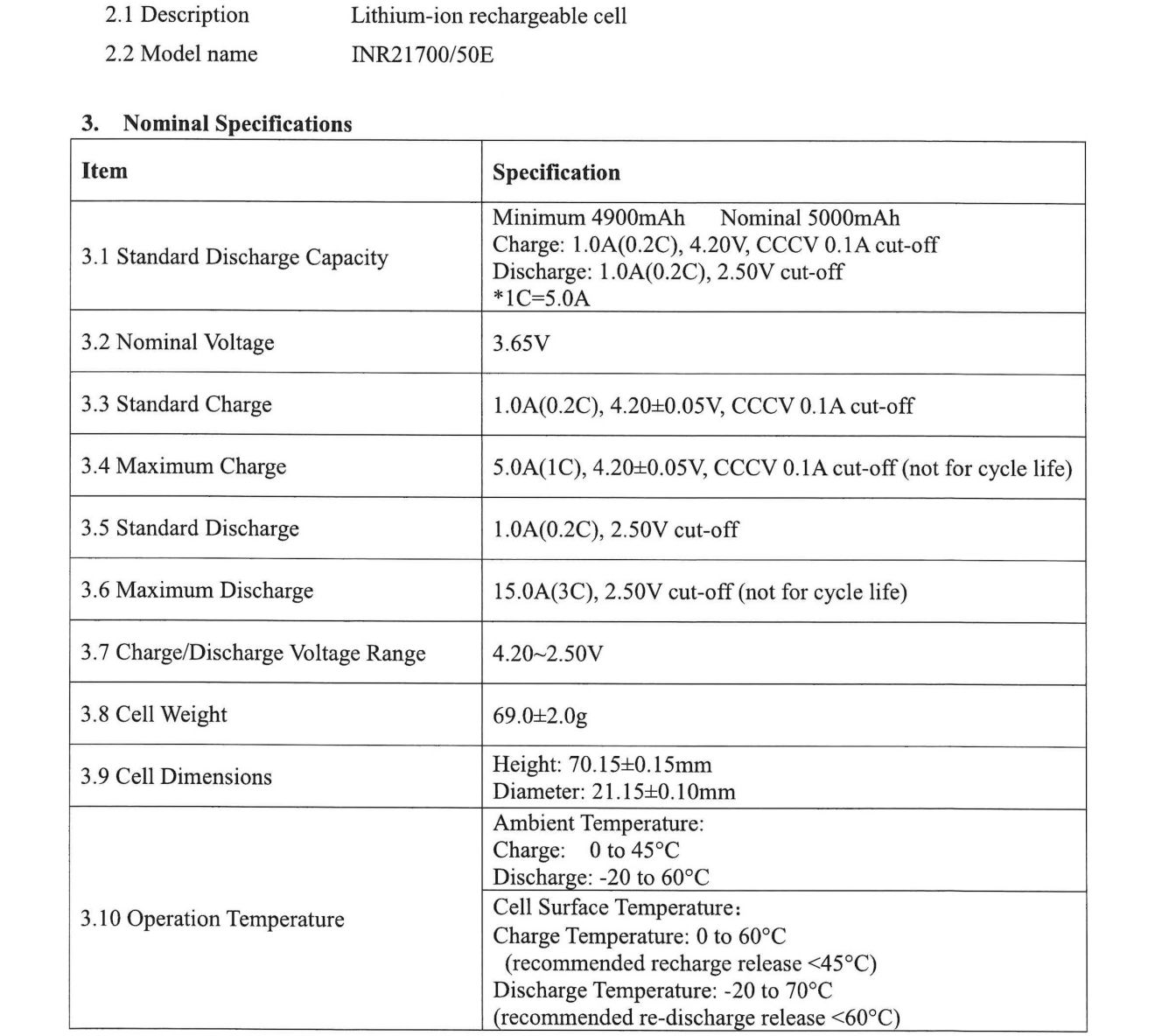
Sometimes I get the impression that EVE’s engineers write their documentation by guesswork—or, more accurately, just copy and paste it. Otherwise, I can’t explain the specified nominal charge current of 0.2C and maximum of 1C. The 18650 3.5 Ah cells had the same specs.
The thing is, 0.2C is all well and good, but painfully slow. Usually, the nominal charging current is 0.5C.
Yes, I tested charging at the specified rates. At 0.2C, charging took 5 hours 13 minutes, while at 1C it took 1 hour 33 minutes. In my opinion, the behavior at 1C is a little better than with the 18650 3.5 Ah cells.
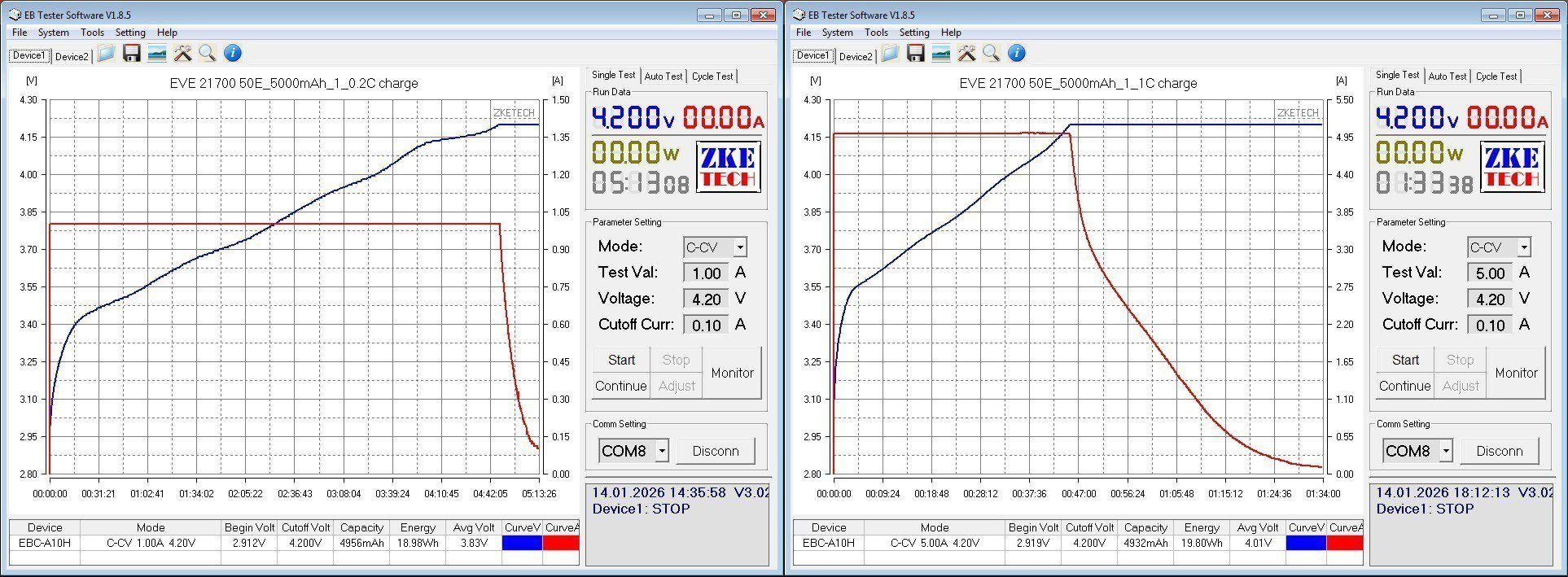
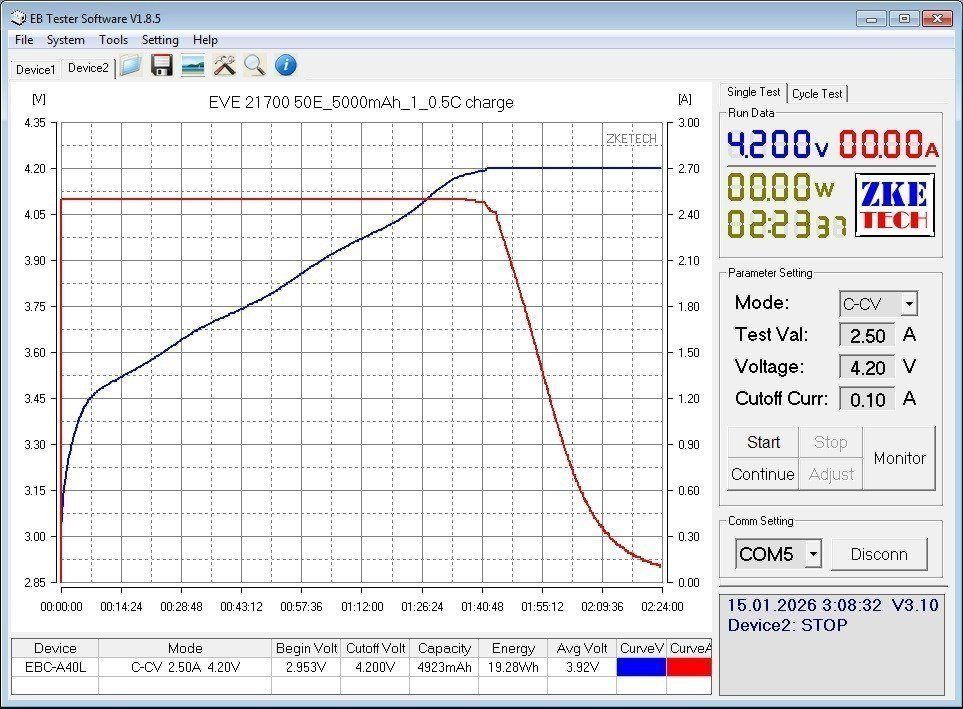
I also ran a charge test at 0.5C on my own initiative. It took 2 hours 23 minutes, and in my opinion this is the optimal rate for these cells: not too slow, without putting too much strain on their service life.
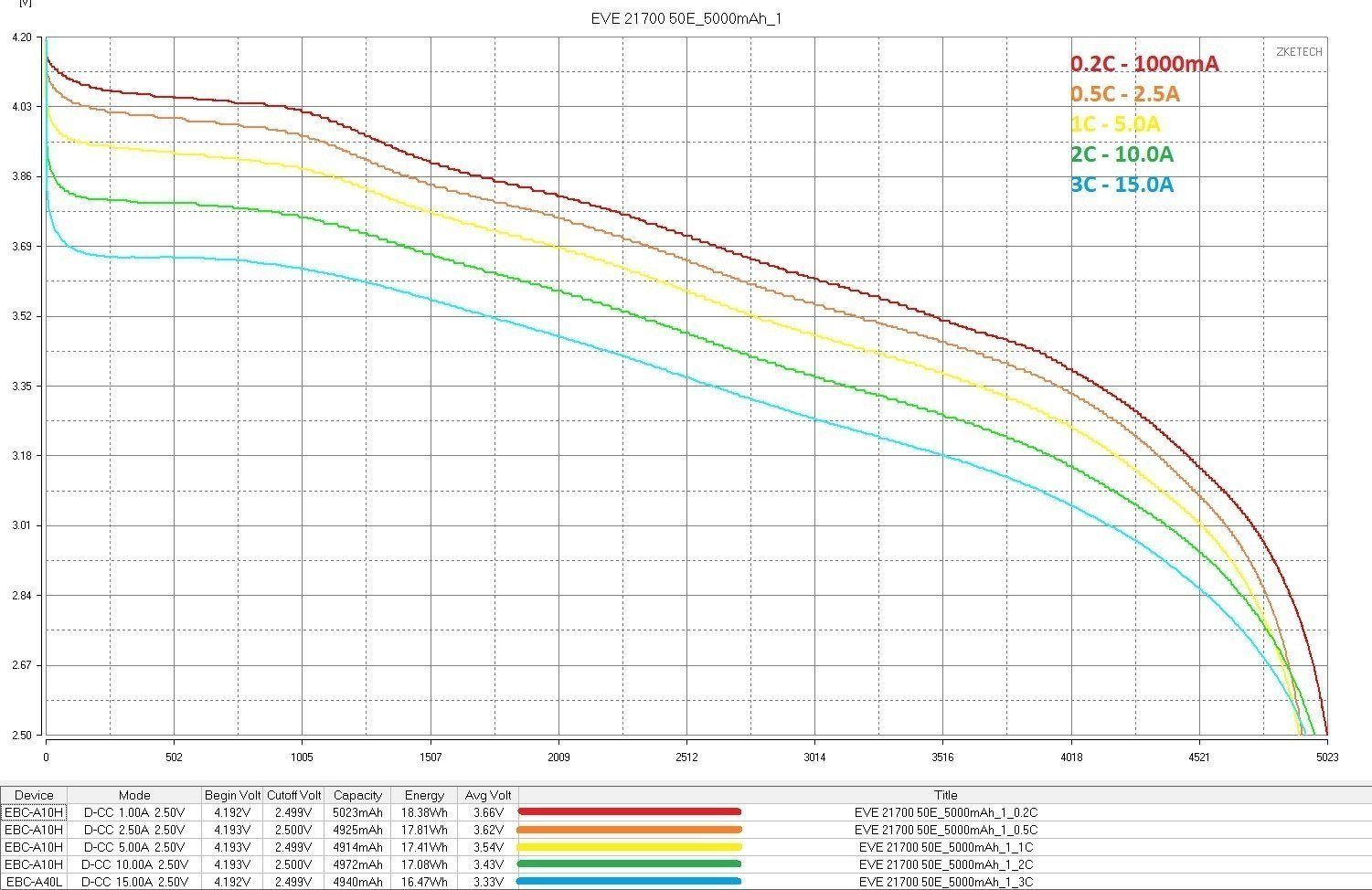
There are noticeably fewer stages here: 0.2, 0.5, 1, 2, and 3C.
At the standard discharge rate of 0.2C, I got the stated 5000 mAh.
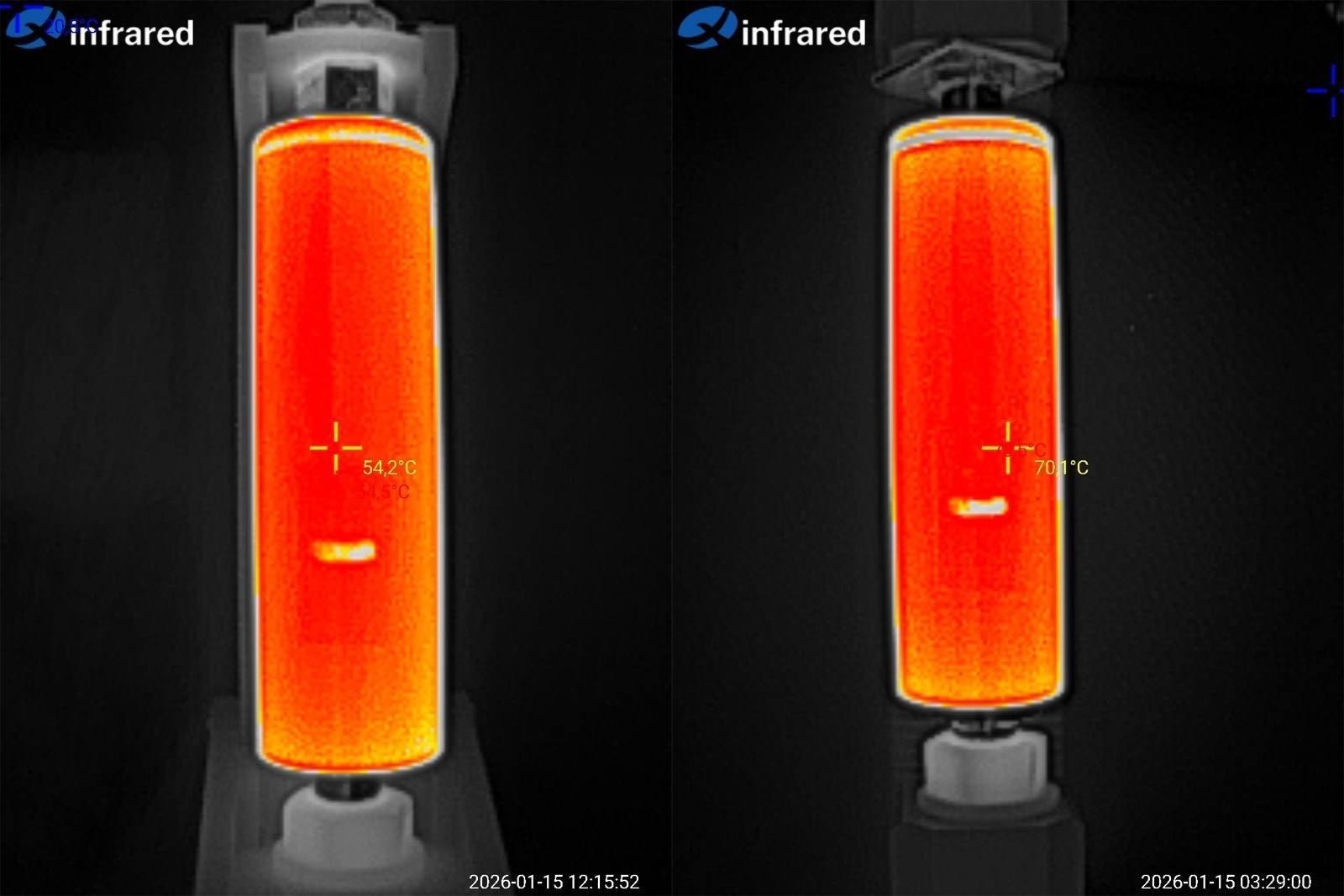
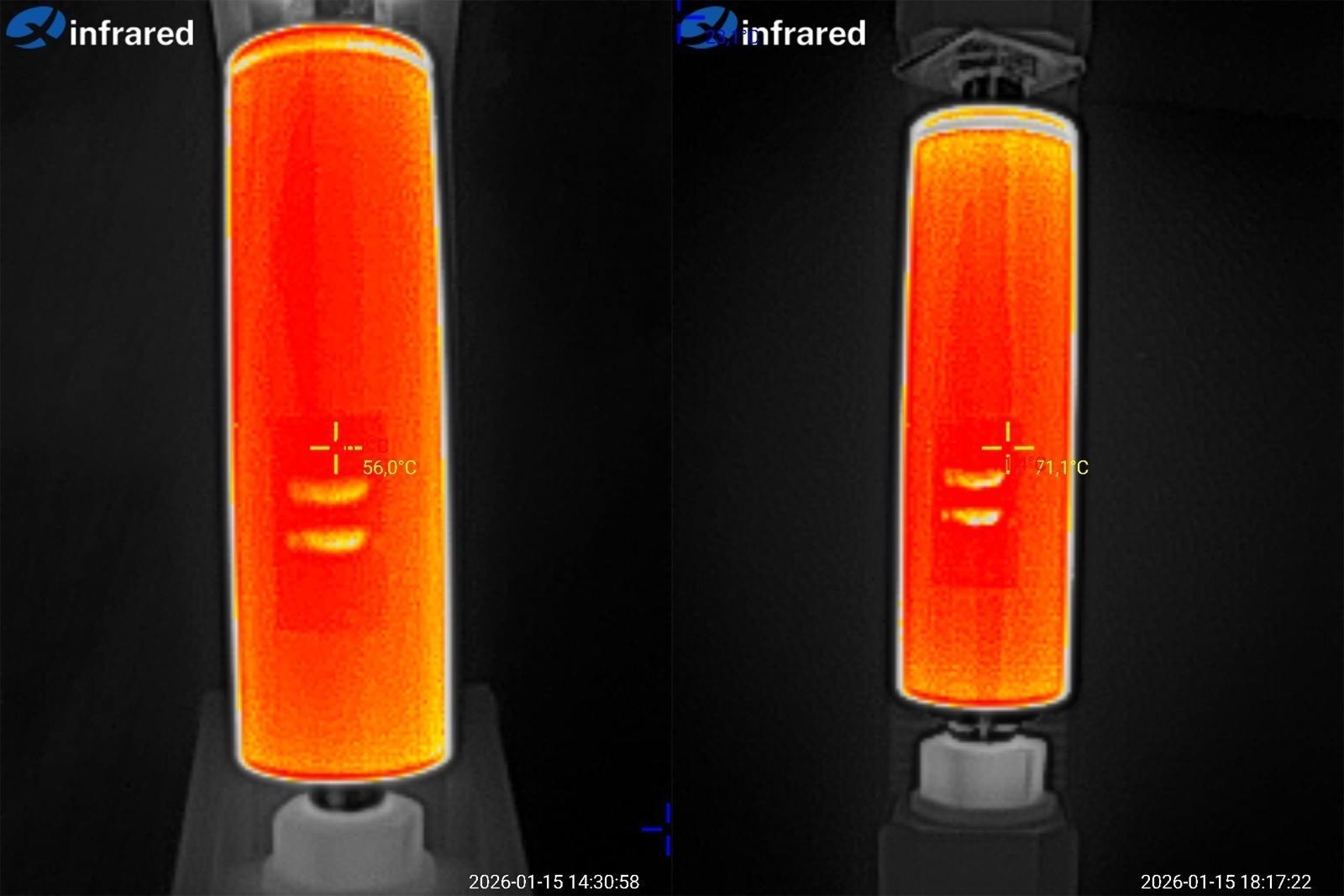
Case temperature at discharge rates of 2C and 3C. At a 3C discharge rate, the case temperature reached about 70 degrees, which is perfectly normal. But as a reminder, high-capacity cells are more sensitive to overheating than high-current cells, so I still recommend keeping it to 2C at most.
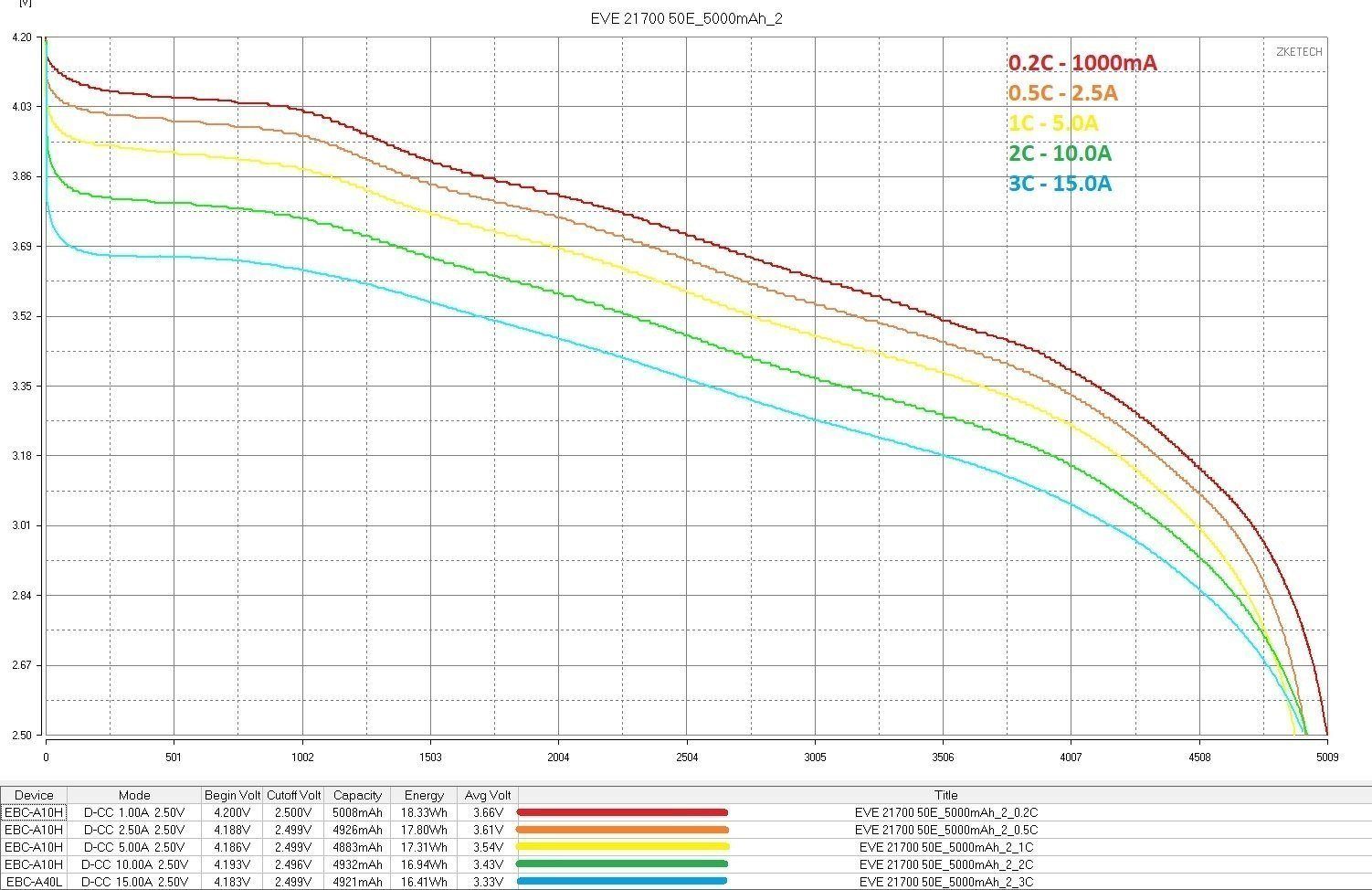
The test results for the second sample are practically identical.
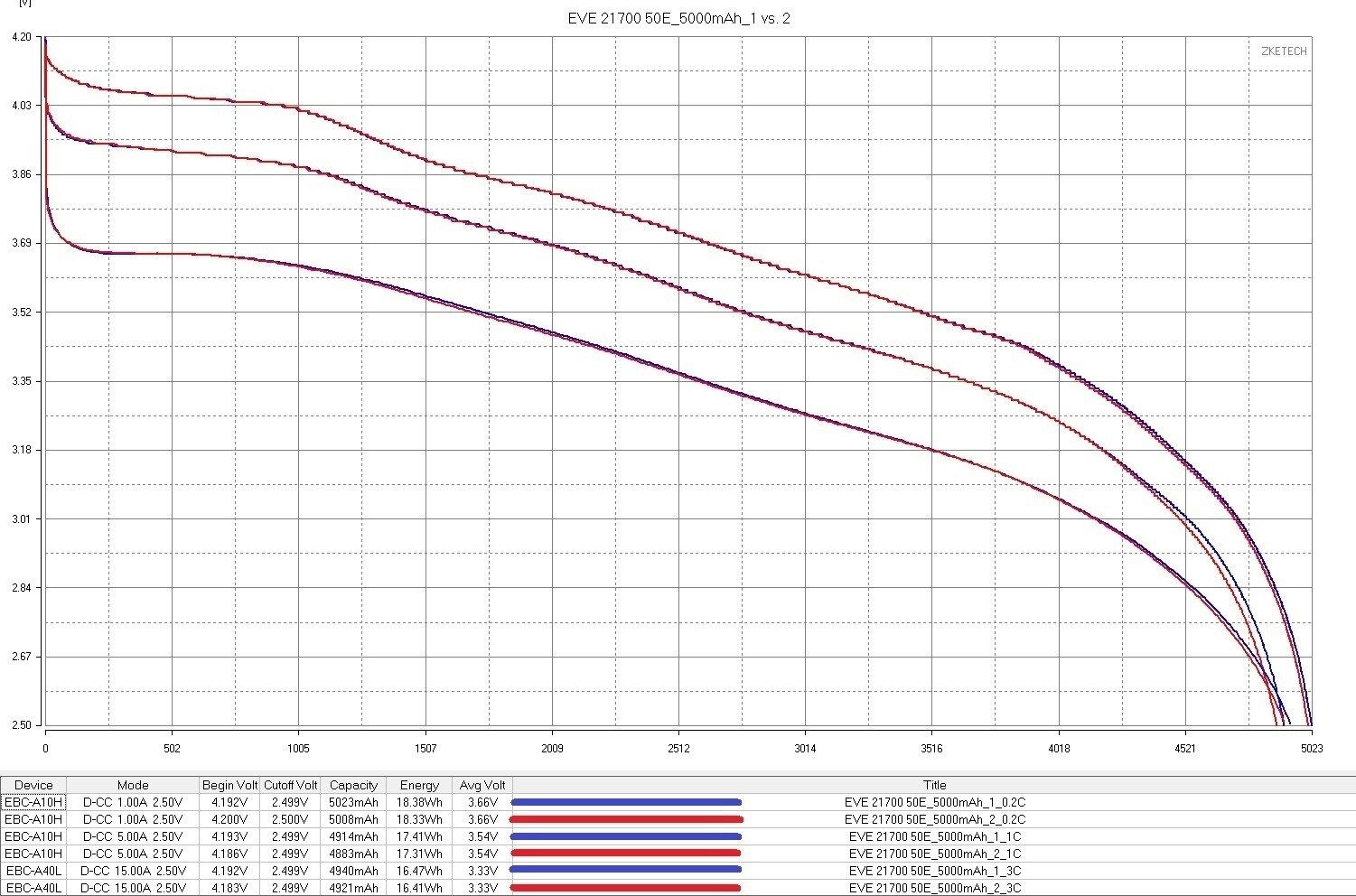
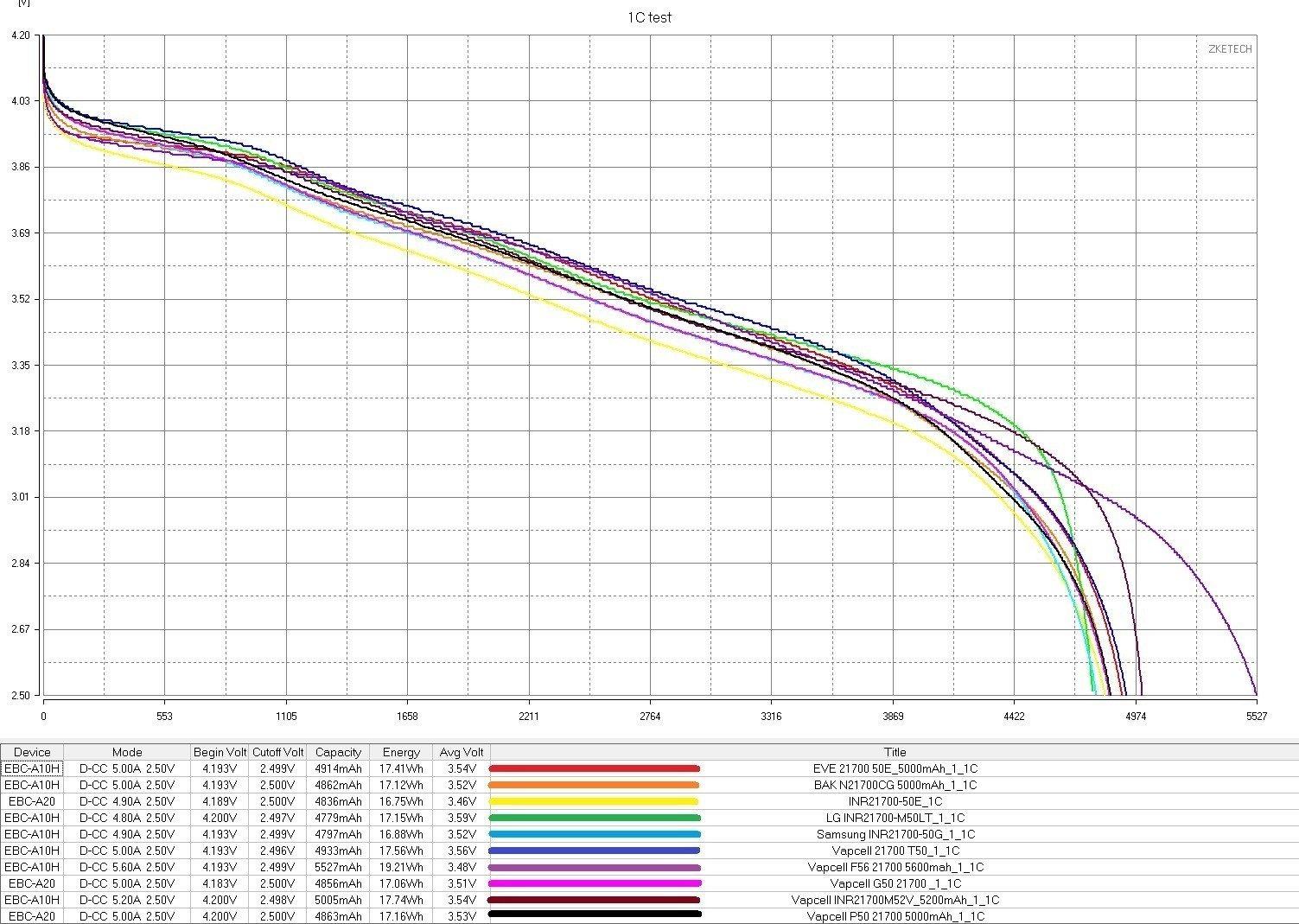
The comparative graph shows just how consistent the test results are. The cells were compared at discharge rates of 0.2C, 1C, and 3C.
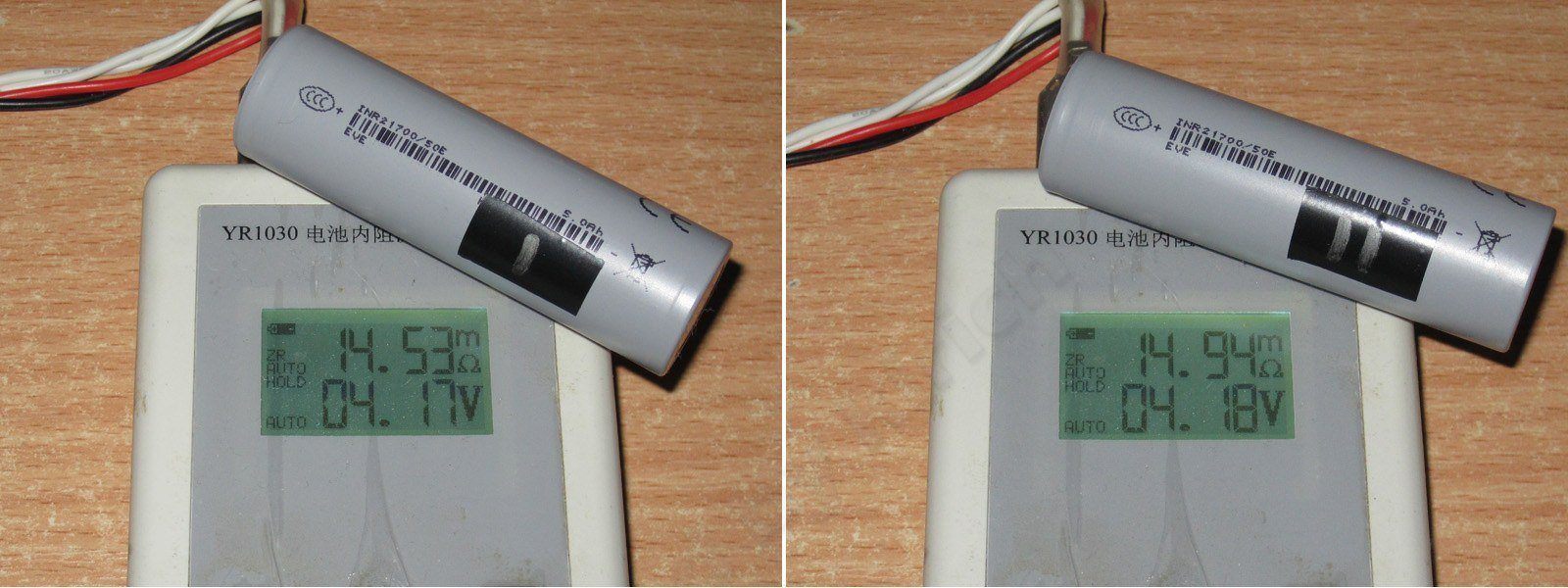
The impedance is also relatively low for a cell of this capacity.
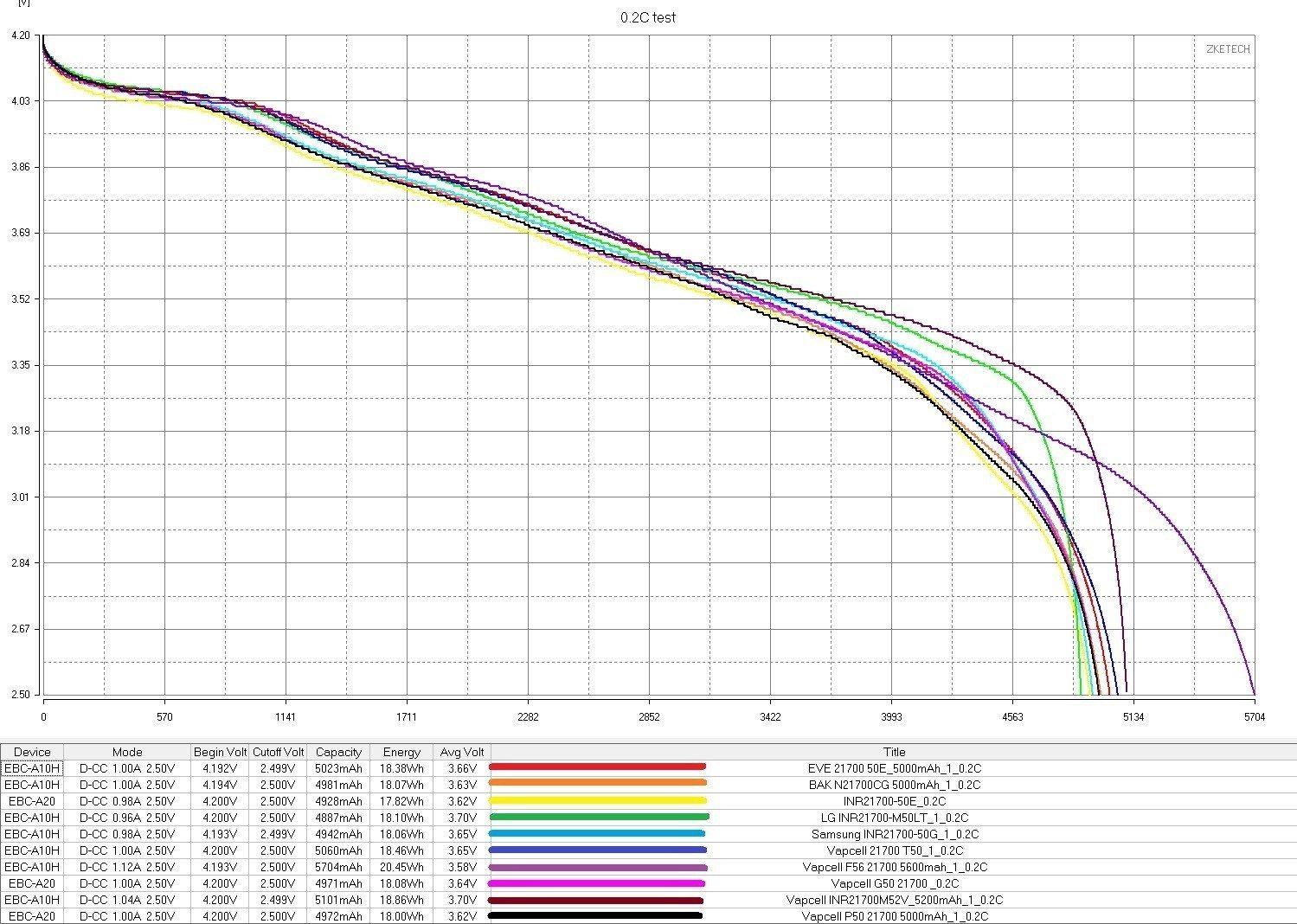
And now for my favorite part: comparing them with other cells. There are quite a few this time, and some didn't even make it into the comparison—I removed the oldest samples.
The comparison included:
1. The cells under review
2. BAK N21700CG 5000mAh - review
3. Samsung INR21700-50E - review
4. LG INR21700-M50LT - review
5. LG INR21700-M50T - review
6. Samsung INR21700-50G - review
7. Vapcell 21700 T50 - review
8. Vapcell F56 5600mAh - review
9. Vapcell G50 21700 - review
10. INR21700M52V - review
10. Vapcell P50 21700 - review
At 0.2C, the EVE falls only slightly behind the 5200mAh models and clearly outperforms the other 5000mAh options.
At 1C, the ranking is practically unchanged: the 5600mAh cell is naturally in the lead, followed by the 5200mAh model, then the Vapcell T50 and the EVE. Not bad.
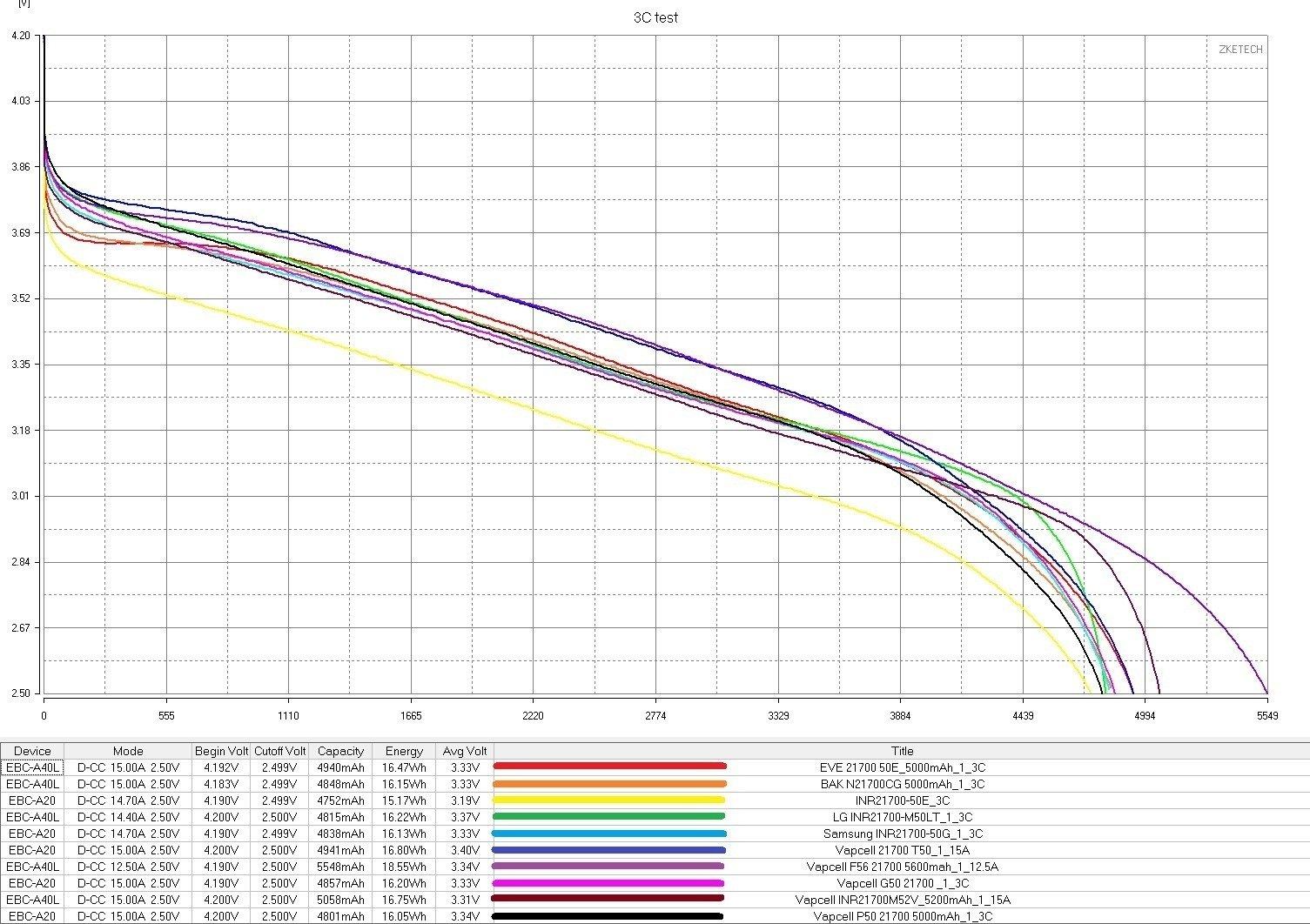
And finally, the maximum 15A for cells like these. The 5600mAh cell was measured at 2C here, though that's 12.5A for that cell—so it's close to the 15A used for the others.
What can I say? In my opinion, that's an excellent result for the "5000" category.
Conclusions.
EVE 21700 40P_4000mAh — On the one hand, these are pretty decent cells, but I somehow expected them to run cooler. That said, the datasheet specifies a discharge current of up to 50A, provided the case temperature stays below 80 degrees, so I don't really have any complaints. In my opinion, they're good cells for the money.
EVE 21700 50E_5000mAh — I liked these much more. The test results put them right up there with well-known branded cells of comparable capacity. Sure, they're not top-tier 5600–5800mAh cells, but they're also quite affordable. Overall, I recommend them, especially for power banks. I think they'd also handle a two-row power tool battery pack.
That wraps up part two. I hope you found it useful and that it might come in handy for someone.
маркировка на акб inr21700/50e eve, как отличить оригинальные акб 21700 eve, eve 25 p или eve 40p что лучше, eve 40pl дата маркировка, eve 50p datasheet, eve 21700 40p datasheet, чем отличаются аккумуляторы eve sea от eve air
Questions and answers
What capacity did the EVE 21700 40P and 50E deliver?
At a 0.2C discharge rate, both cells delivered their rated capacity: 4000 mAh for the 40P and 5000 mAh for the 50E.
What continuous discharge current is suitable for the EVE 21700 40P?
Although 50 A is specified as the maximum, the cell reached over 100 °C at 35 A. The author considers about 25–30 A a more sensible continuous current.
How should the EVE 21700 50E be charged?
The author considers 0.5C the best balance: charging took 2 hours 23 minutes. Charging at the specified 1C took 1 hour 33 minutes, while 0.2C took 5 hours 13 minutes.
This model is included in the summary table: Battery comparison: measured capacity and resistance
The figures from this review are in the measurement database: Batteries
Discounted products
You may be interested in


Discounted products
All the content on the site and the advice are free, but we’d be grateful for your support of the project and the channel!
Comments5
Only registered readers can comment. It takes a minute to sign up, and you can log in with the same account you use on the forum.
Log inRegister
Comments are published in their original language.