
Panasonic NCR18650G, the highest-capacity 18650 battery—is it for real?
I should probably say right away that these batteries don’t exactly qualify as “budget” models, since they cost more than seven dollars apiece. Still, I can imagine applications where even that price wouldn’t put buyers off. High-capacity power banks are one example, where a high capacity-to-size-and-weight ratio matters.
They look exactly like the well-known NCR18650B: the same light green color and the same design.

While preparing this review, I found that there’s practically no documentation for them. At first, all I could find was a summary table that included these batteries and listed a few basic specs. I was particularly interested in the charging parameters, since discharge testing is usually standard: 0.2C to measure capacity, then 0.5C, 1C, 2C, and so on for additional tests.
The store page also stated that they’re rated for a maximum current of 4.87 A.
Incidentally, the table already shows that the manufacturer lists a typical capacity of 3550 mAh, not 3600, while the minimum capacity is only 3400 mAh.
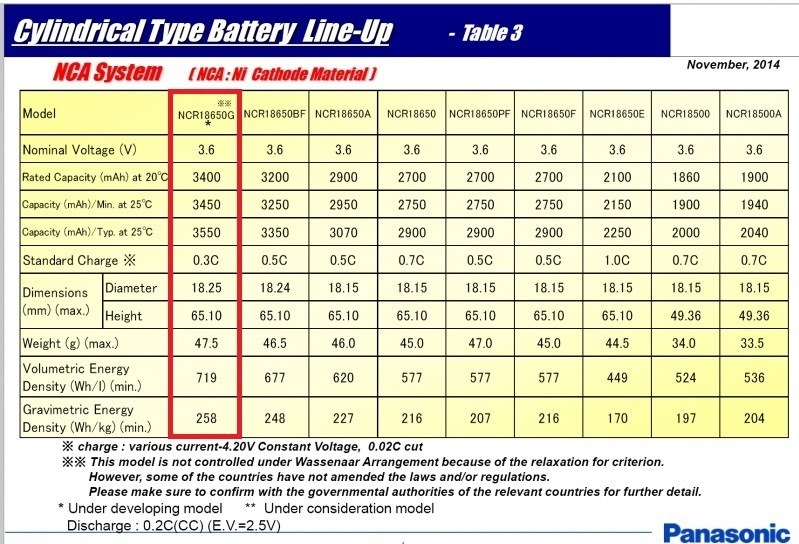
One of my readers, Qwertus, was able to help by providing a more complete datasheet, so many thanks to him. At least this datasheet included the charging parameters and a few graphs, which I’ll show a little later.

As I mentioned above, these batteries are easy to mistake for the more popular NCR18650B—they look very, very similar.
According to the code 8307, the manufacture date is March 7, 2018.
There’s a matrix code, which makes these batteries noticeably harder to counterfeit. I’m glad other companies have started putting these codes on their batteries too. Each code should be unique, and it also lets even an inexperienced buyer tell whether they’re looking at a genuine product or a fake.
The positive terminal is recessed below the front edge of the casing, and the negative terminal has a characteristic raised dimple.

Dimensions and weight. Incidentally, they weigh less than the stated maximum of 48 g.

As with all the batteries I’ve tested so far, the factory charge was around 30%. Then came the usual “conditioning” cycle, with capacity measured along the way at a discharge current of 500 mA. As always, my charger overstated the result, showing an utterly unrealistic 3700 mAh.

This is a high-capacity battery that isn’t designed for high discharge currents, so I used the ZKE EBC-A10H electronic load. It’s a little more accurate than the more powerful EBC-A20, which I use to test high-current batteries.
As usual, I connected the battery using a holder with a four-wire connection to improve measurement accuracy.

First, charging.
The manufacturer specifies a charging current of 0.3C (1.035 A), a cutoff voltage of 4.2 V, and a cutoff current of 69 mA. I charged it at 1.04 A with a cutoff current of 70 mA, since my charger’s current setting has a minimum step size of 10 mA.
Charging from fully discharged at 0.2C took about four hours. I’d have liked it to be faster, of course, but slow charging is the price you pay for high capacity.

The second datasheet included a very interesting graph. Along with discharge tests at 2, 4, and 6 A, it showed a test at 8 A—clearly higher than the 4.87 A listed on the store page.

I decided to stick with my usual testing format, so I tested these batteries at discharge currents of 0.2C, 0.5C, 1C, 4.87 A, and 2C.
For 1C, I used 3450 mA, calculated from the specified charging current of 1035 mA, or 0.3C: (1035/3)×10 = 3450.
At 0.2C, the battery delivered 3568 mAh, very close to the 3550 mAh listed in the datasheet, but a little short of the 3600 mAh usually advertised on store pages.

At 4.87 A and 6.9 A (2C), the temperature reached 48 and 64 degrees, respectively.

Although 8 A is very close to the 2C current of 6.9 A, I still wanted to test it at that level. But during the test I made a mistake and accidentally set the discharge current to 10 A, which is clearly too much for this battery. The voltage dropped sharply and the load shut off. Almost immediately afterward, the voltage returned to normal. I let the battery cool down a little, then continued the test. No problems with the battery were found; the test cycle showed that everything was fine.

Temperature at discharge currents of 4.87 A, 6.9 A and 10 A (it was around 80 degrees when the test stopped).

These batteries are quite "delicate" and should not be discharged at high currents. For example, the datasheet includes a graph showing how capacity loss depends on discharge current: at 6 A, capacity drops from 3500 mAh to 2500 mAh after just 300 cycles. So it may well be best not to exceed the maximum 4.87 A listed on the store page.

Internal resistance measurements when received, after "conditioning" and after all the tests,

And of course, the most interesting part: a comparison with the closest competitors:
LG MJ1
Samsung INR18650-35E
LG M36
The graph shows results at 0.2C and 2C, except for the M36, which is shown at 5 A, or about 1.5C.
At 0.2C, the Panasonic NCR18650G does indeed have more capacity than the other batteries; that's hard to argue with. But at 2C, the LG MJ1 clearly comes out ahead, albeit by a small margin.
It's worth noting, though, that unlike the Panasonic, its Korean competitor has a rated maximum discharge current of 10 A, making it better suited to high-current applications.
In terms of energy in Wh at 2C, the NCR18650G actually came in second to last, beating the Samsung 35E by just 0.01 Wh. But the 35E was discharged down to 2.75 V, so it's a questionable win.

I was about to wrap up the review here, but then I spotted a battery on AliExpress that I had once run a cycle-life test on. I don't want to get into clones, counterfeits and all that, but they really do look alike, especially at a quick glance.

To sum up.
Yes, at 0.2C the battery delivered more capacity than the others, but the difference is so small that it could easily be down to measurement error. What's more, it falls noticeably behind the LG MJ1 at higher load currents; the MJ1 is designed for a higher discharge current in the first place. The MJ1 also costs about half as much. Is the NCR18650G worth the difference? I don't know; personally, I don't think so. The NCR18650G is certainly a good battery, no question, but for that price I'd like to see more capacity.
That's all from me. I hope you found this useful.
аккумулятор 18650 характеристики, аккумулятор 18650 3.7v 3600mah, 18650 vfrcbvfkmysq j,mtv, https://www.kirich.blog/obzory/akkumulyatory/797-panasonic-ncr18650g-samyy-emkiy-akkumulyator-razmera-18650-realno, панасоник аккумуляторы 18650 dns, габариты аккумулятора 18650, panasonic 3600mah ncr18650g 4.2, 18650 аккумулятор емкость, аккумуляторы 18650 панасоник 3600 мач 4.2 вольт, ncr 18650 g, характеристика аккумулятора панасоник 18650 на 3450мач, литиевые аккумуляторы 18650 высокоемкие панасоник, аккумулятор ncr16850g характеристики, аккумуляторы 18650 панасоник, 18650 аккумулятор 3600mah, паспортная емкость батареи 31680, самые емкие батарейки 18650, аккумулятор panasonic ncr18650g плюсы и минусы, акамуляторы панасоник 1860в являются они невысокотоковыми?, 18650 аккумулятор емкость 3600, аккумулятор panasonic ncr18650g 3600 mah, аккумулятор панасоник ncr 18650 g 3600 mah, аккумулятор 18650 panasonic ncr18650g, 18650 аккумулятор емкостью 3600, характеристики аккумуляторных батарей 18650
Questions and answers
What capacity did the Panasonic NCR18650G deliver at 0.2C?
It delivered 3568 mAh, close to the 3550 mAh listed in the datasheet but below the 3600 mAh often stated by sellers.
How does the Panasonic NCR18650G compare with the LG MJ1 at 2C?
The LG MJ1 slightly outperformed it at 2C and is rated for a higher maximum discharge current. The author says the Panasonic’s small capacity advantage does not justify roughly double the price.
What charging current does the Panasonic NCR18650G datasheet specify?
The datasheet specifies 0.3C (1.035 A), a 4.2 V charge voltage, and cutoff when the current falls to 69 mA. The author charged at 1.04 A with a 70 mA cutoff.
This model is included in the summary table: Battery comparison: measured capacity and resistance
The figures from this review are in the measurement database: Batteries
Discounted products
You may be interested in


Discounted products
All the content on the site and the advice are free, but we’d be grateful for your support of the project and the channel!
Only registered readers can comment. It takes a minute to sign up, and you can log in with the same account you use on the forum.
Log inRegister