
RK6006H, an adjustable DC-DC converter with universal input.
$33.75
Though, to be fair, I wouldn’t mind seeing an RD6036, first of all, and an electronic load from them as well.
A reminder: to keep up with new posts on the blog, I recommend following me on Instagram, where I’ll post notifications about every new article and maybe write about something interesting now and then — link to the account
You can also subscribe to updates and new articles on the Telegram channel - https://t.me/KirichBlog Note that discussion of reviews and articles is enabled on the channel, along with general chat. recommended.
Before moving on to the review itself, here's a list of products from this company that I've tested.
DPH5005
DPS8005
DPS5020
RD6006
RD6012
RD6018
RD6006P
RD6012P
RD6024
RK6006
Enclosure and power supply for RK6006
RD6030
Silicone case covers
RD 25A cable set
RS485 module with galvanic isolation for connecting RD60xx series converters
RD6018P
RD6012H
RK6012
RD6030-max
They sent me two models right away, the 6006H and 6018. Another one is on its way, but we can already tell which model it is, since the packaging lists the entire product line—and the one on its way is the last one.
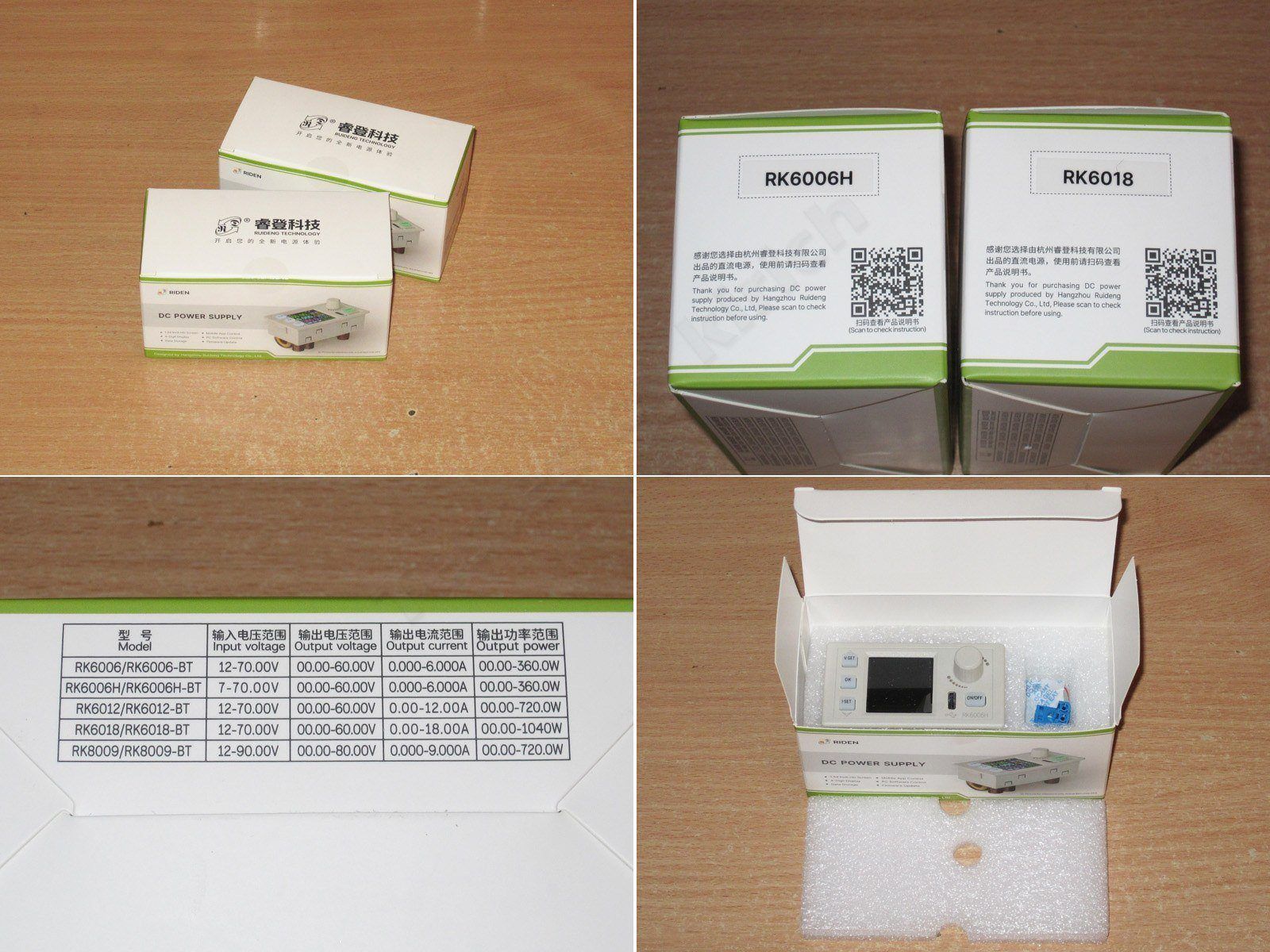
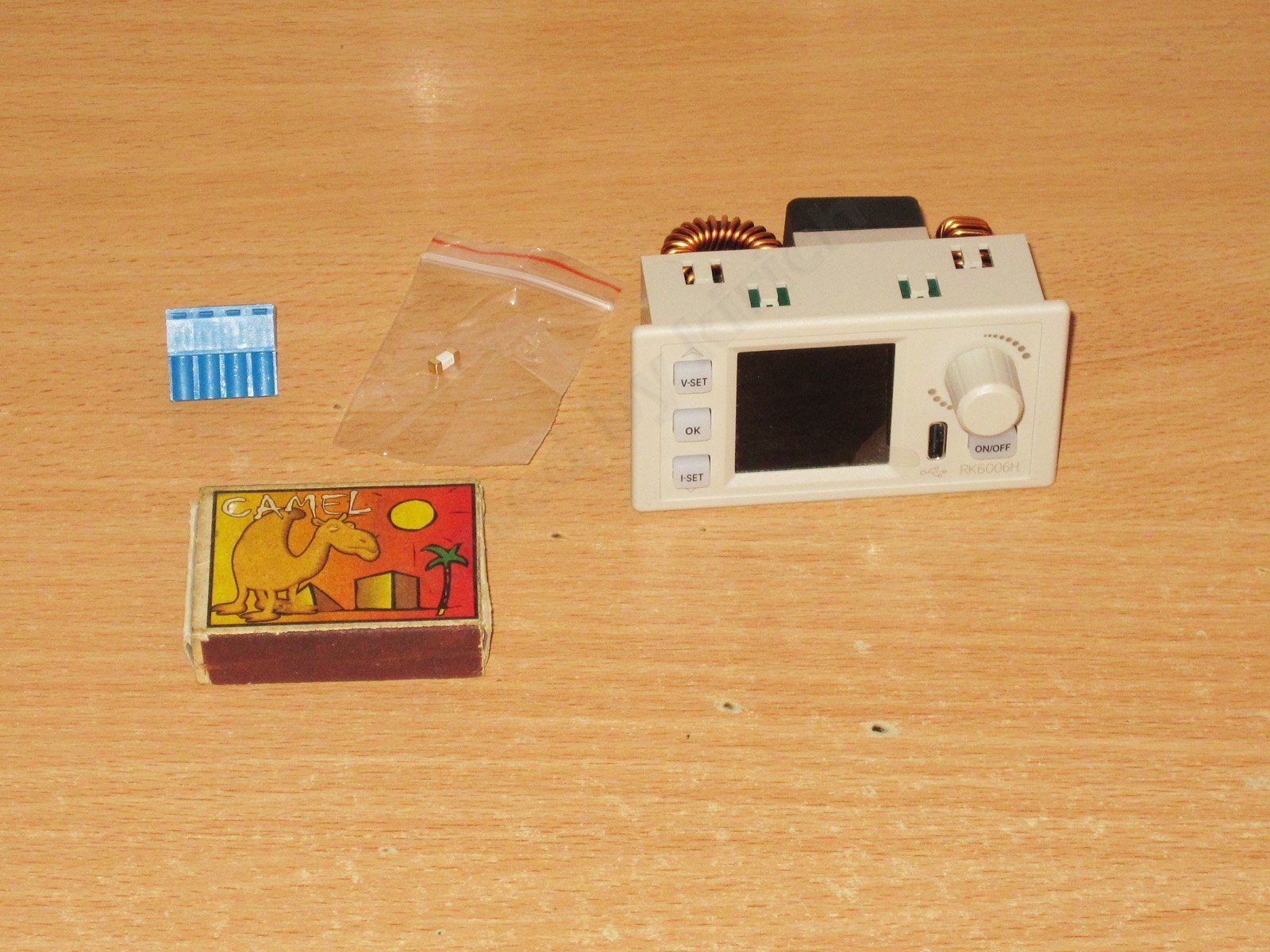
The package is simple: the converter, a terminal block, and a fuse. There's also a Bluetooth version, but mine doesn't have it.
Technical specifications.
Model: RK6006H/RK6006H-BT
Input voltage range: 7-70.00V
Max input current: 8A
Output voltage range: 0-60.00V
Output current range: 0-6.000A
Output power range: 0-360.0W
Input voltage measurement resolution: 0.01V
Output voltage setting measurement resolution: 0.01V
Output current setting measurement resolution: 0.001A
Input voltage measurement accuracy: ±(1%+5 digits)
Output voltage accuracy: ±(0.3%+3 digits)
Output current accuracy: ±(0.5%+5 digits)
Typical output ripple: 100mV VPP①
Operating temperature range: -10℃~40℃
Constant voltage mode response time: 2ms(0.1A-5A Load)
Constant voltage mode load regulation: ≤0.5% or ≤100mV(whichever is greater)
Constant current mode load regulation: ≤0.5% or ≤100mV(whichever is greater)
Capacity measurement range: 0-9999.99Ah
Energy measurement range: 0-9999.99Wh
Capacity and energy measurement error: ±2%
Buck-boost mode
Overtemperature protection: System temperature>85℃
Screen brightness setting: 0-5 (6 levels total)
Screen: 1.54-inch 240*240 color HD display
Cooling fan start condition: Input current>5A or output current>5A or system temperature>55℃
Cooling fan shutdown condition: Output current<4.9A and system temperature<45℃
Weight (with package): About 0.17kg
Product dimensions: 79*43*55mm
USB communication supported: yes
Bluetooth communication supported: RK6006H-BT only
Note: This device does not include a temperature sensor cable
① Ripple measurement method: noise and ripple are measured on your oscilloscope at the X1 range, with AC coupling and 20MHz bandwidth, using a 0.1uF capacitor connected in parallel across the output terminals
② For example: if the input voltage is 24V, the maximum output voltage is 20.8V\
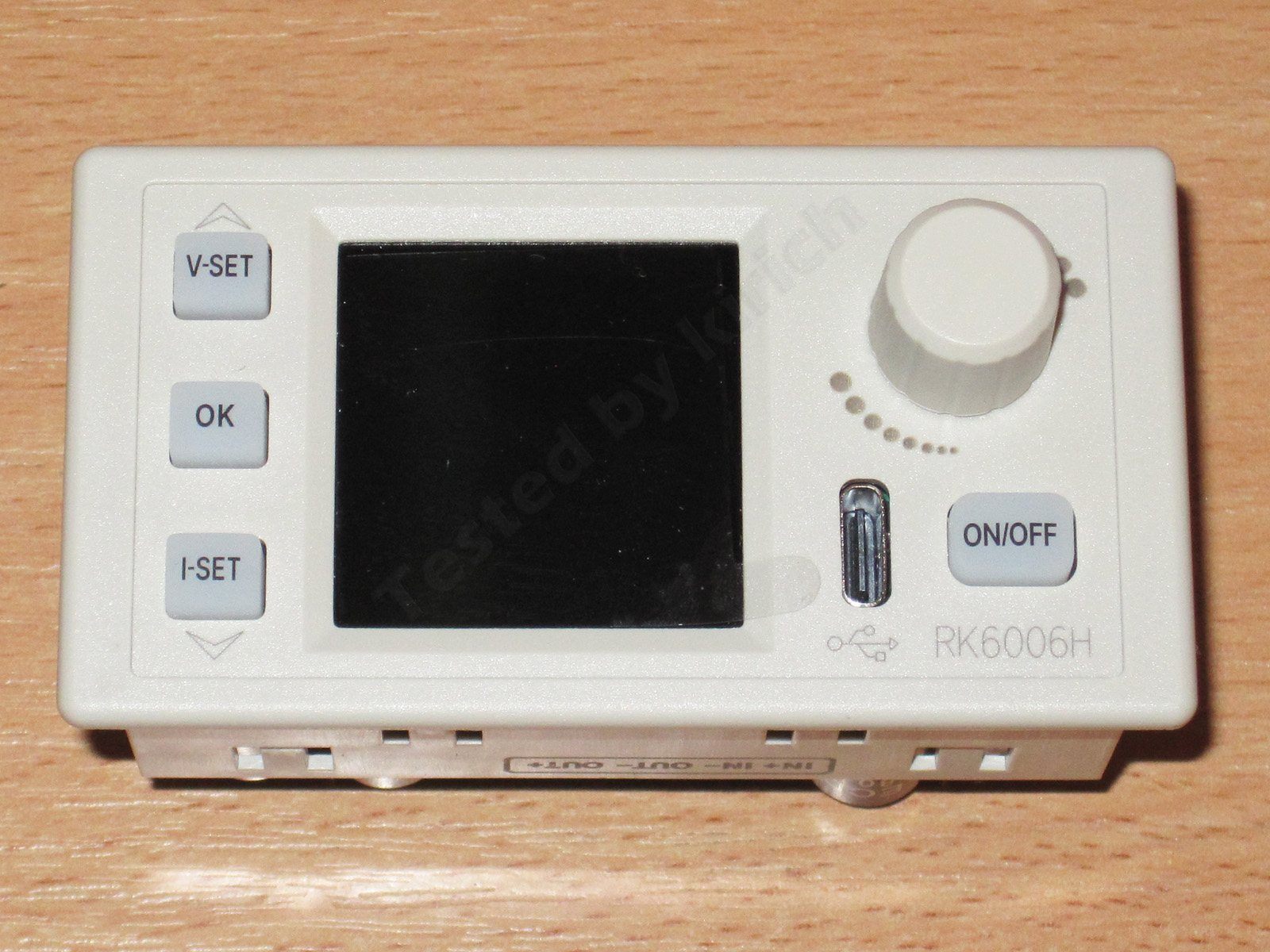
The front panel is exactly the same as on previous versions, apart from the label.
I really like that they switched to rubber keypads at some point, because engineers who use membrane keypads in production devices have a special place in hell.
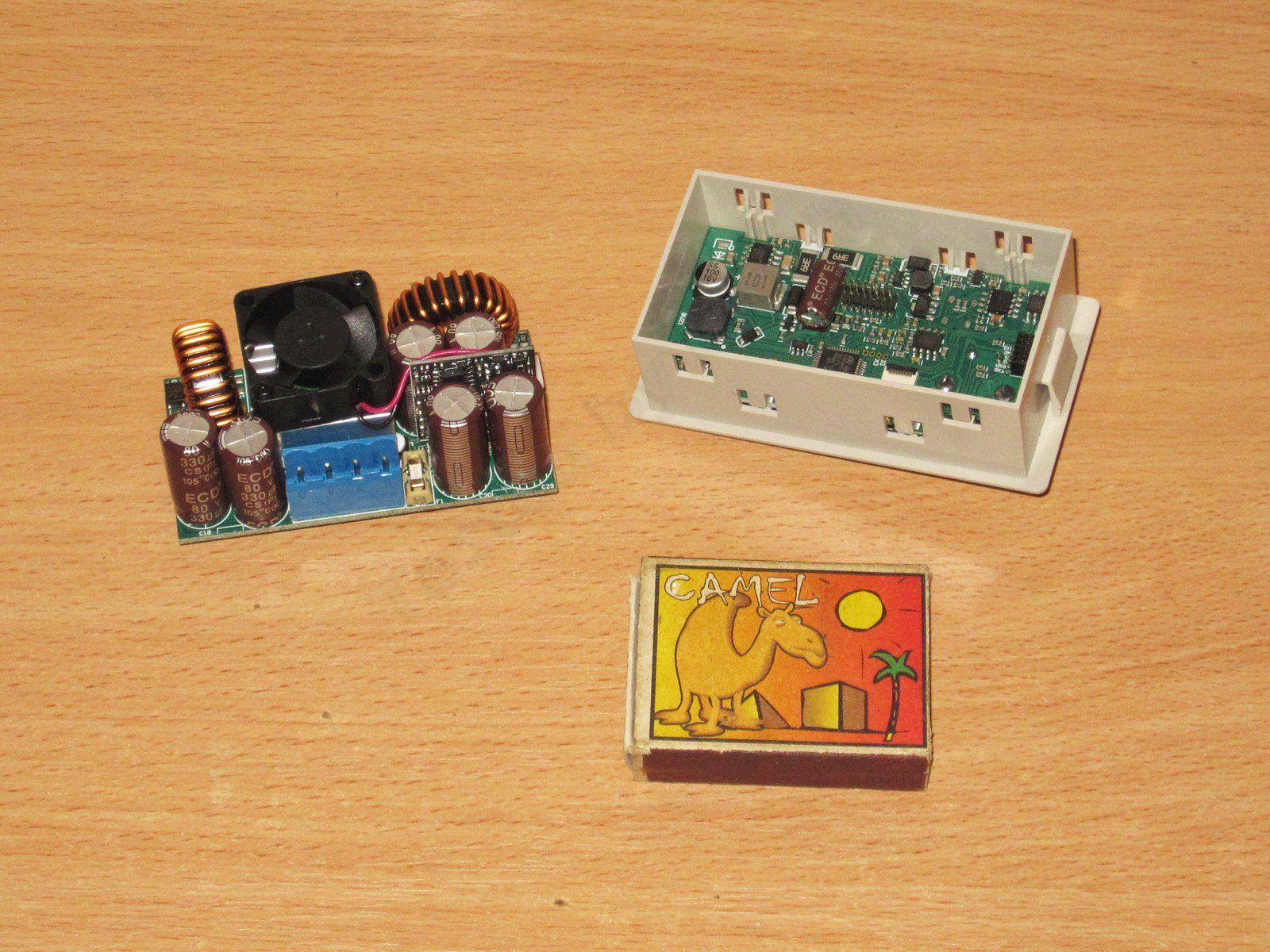
The layout is incredibly cramped. I'm amazed they managed to fit what is essentially a less powerful version of the RD6012H into such a small space. By the way, the H in Riden's model names means universal input power, while P stands for higher accuracy and hybrid circuitry.
They decided to keep the same topology: there's a step-up DC-DC converter, followed by an adjustable step-down DC-DC converter. I could, of course, explain why they didn’t use a universal H-bridge, but apparently this is better. I won’t get into SEPIC; for converters like these, it’s a dead end.
In any case, the circuit design is well proven, so why change anything?
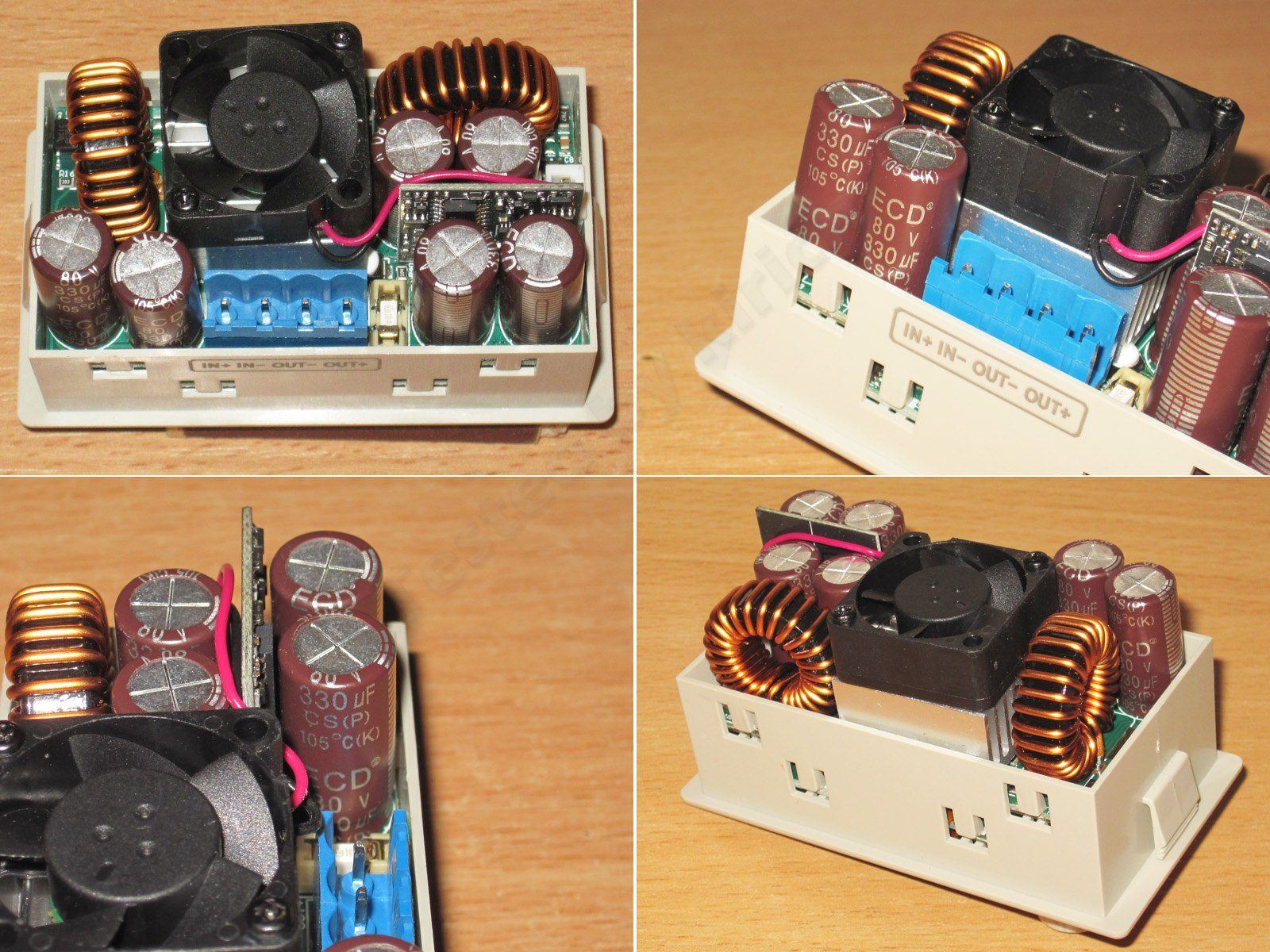
To get inside, remove the top board.
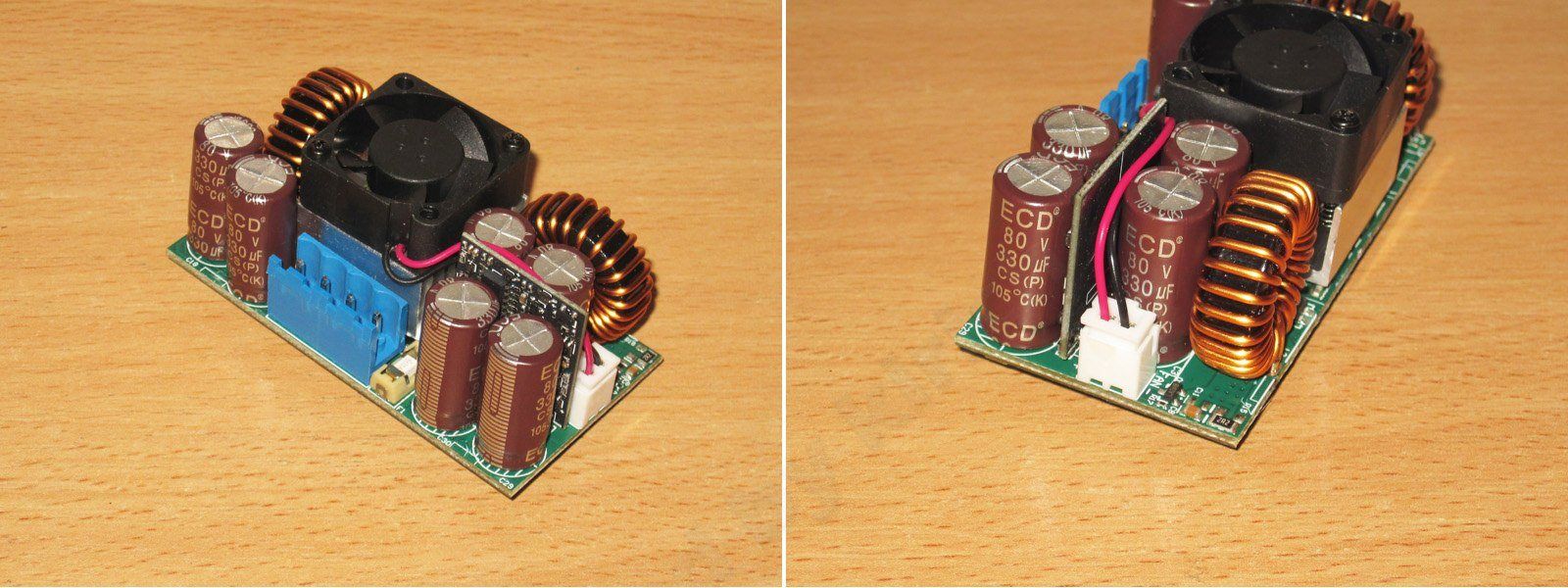
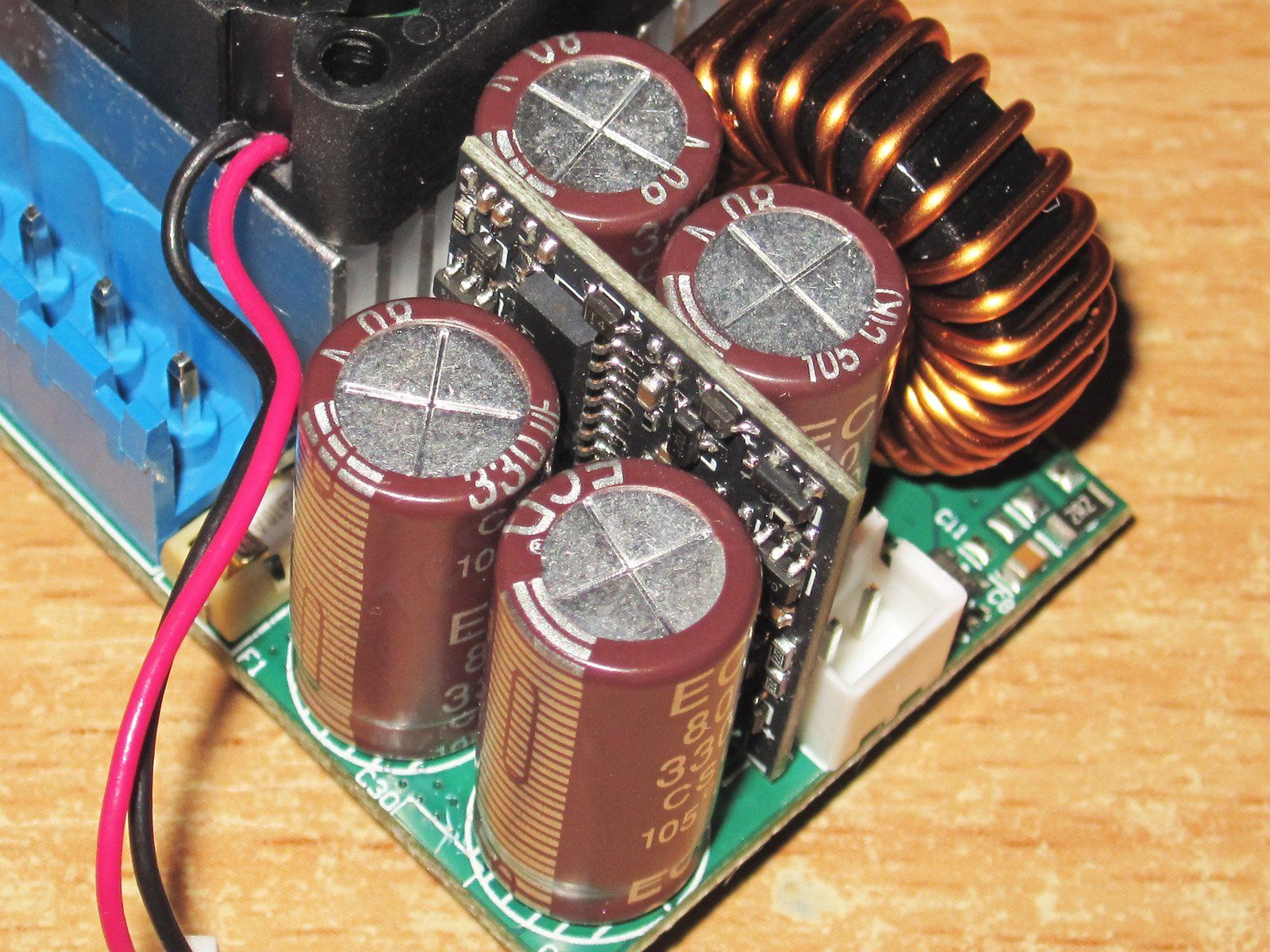
There are two 330 µF, 80 V capacitors each on the input and output, as well as on the intermediate bus.
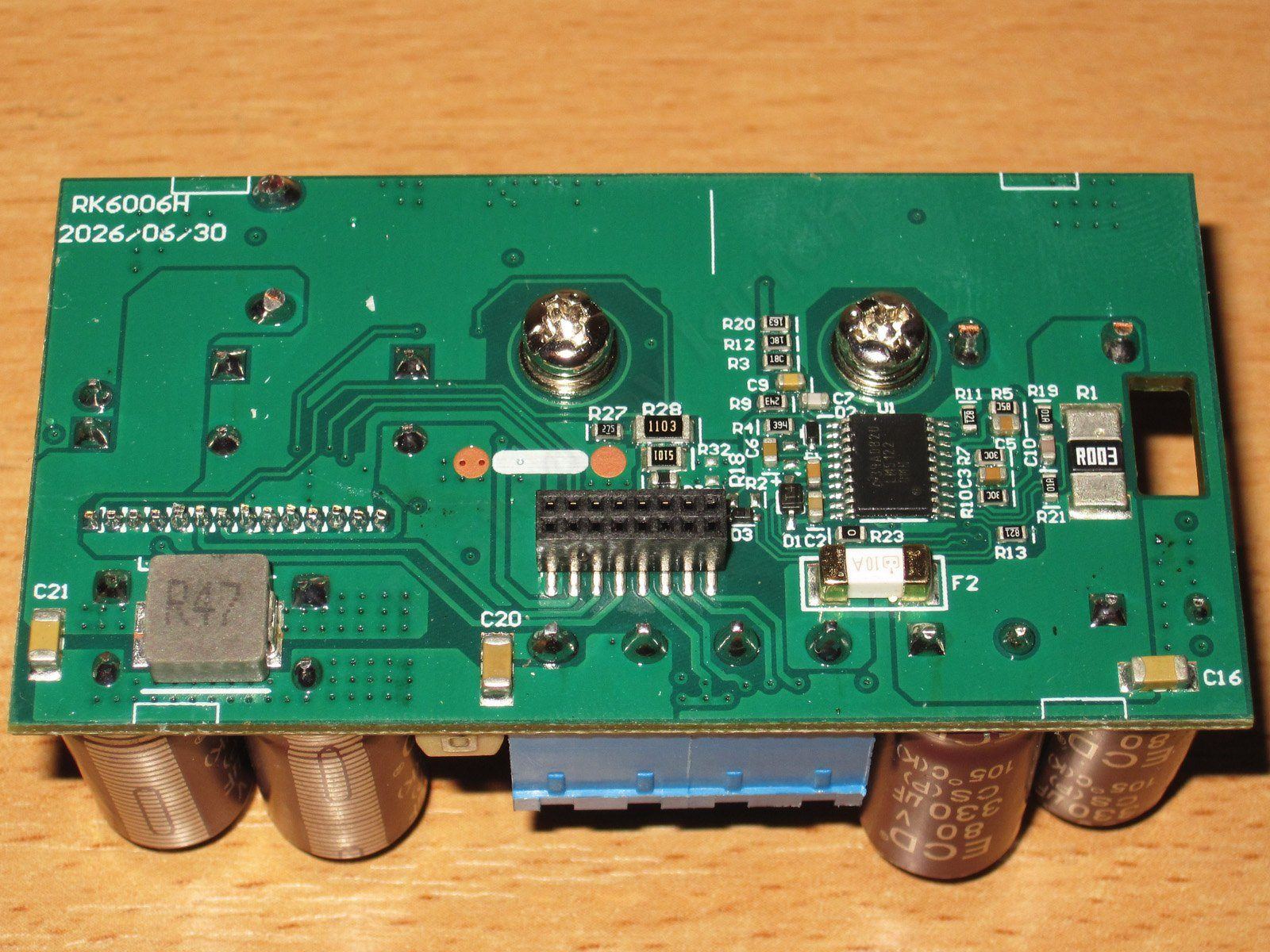
I was also interested in the back of the board. Everything is neat here, and this is where the 10 A input fuse is located.
You can also see the inductor at the bottom left, which reduces output ripple.
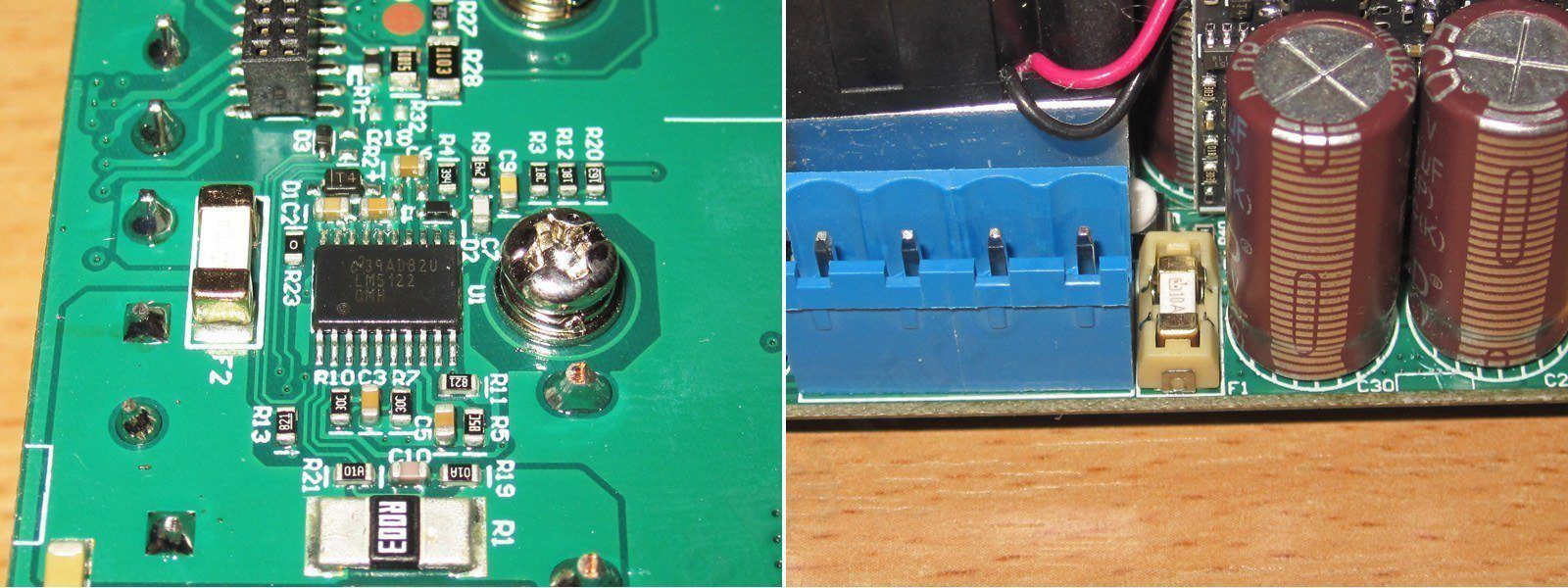
The boost section is built around a rather interesting chip, the LM5122. I tried to find out what products are made using this chip, and I have to say that even a small converter can easily cost $15–20. And that’s just a basic boost converter.
The idea is that it’s a high-efficiency boost DC-DC converter with synchronous rectification.
There’s a second fuse near the output, also rated for 10 A, but this one is in a holder—which makes sense, since it’s much easier to blow.
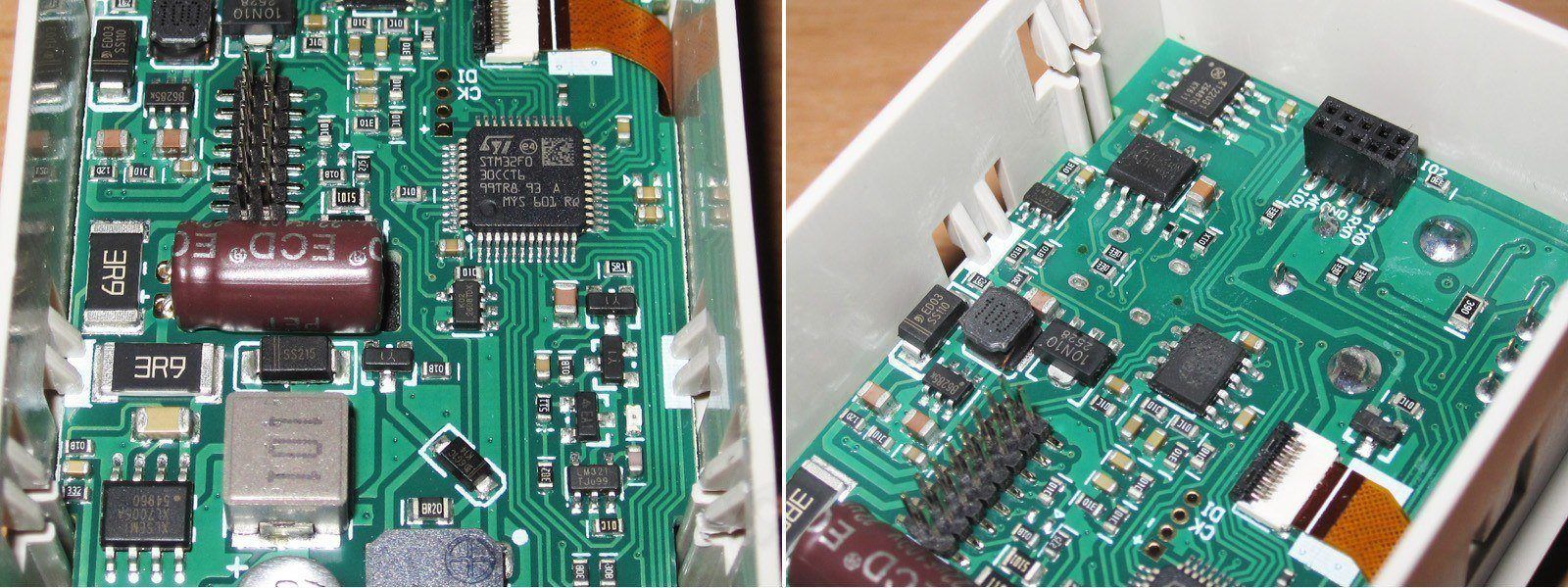
The control module layout isn’t much less cramped. It has the controller, power and control circuits, and USB.
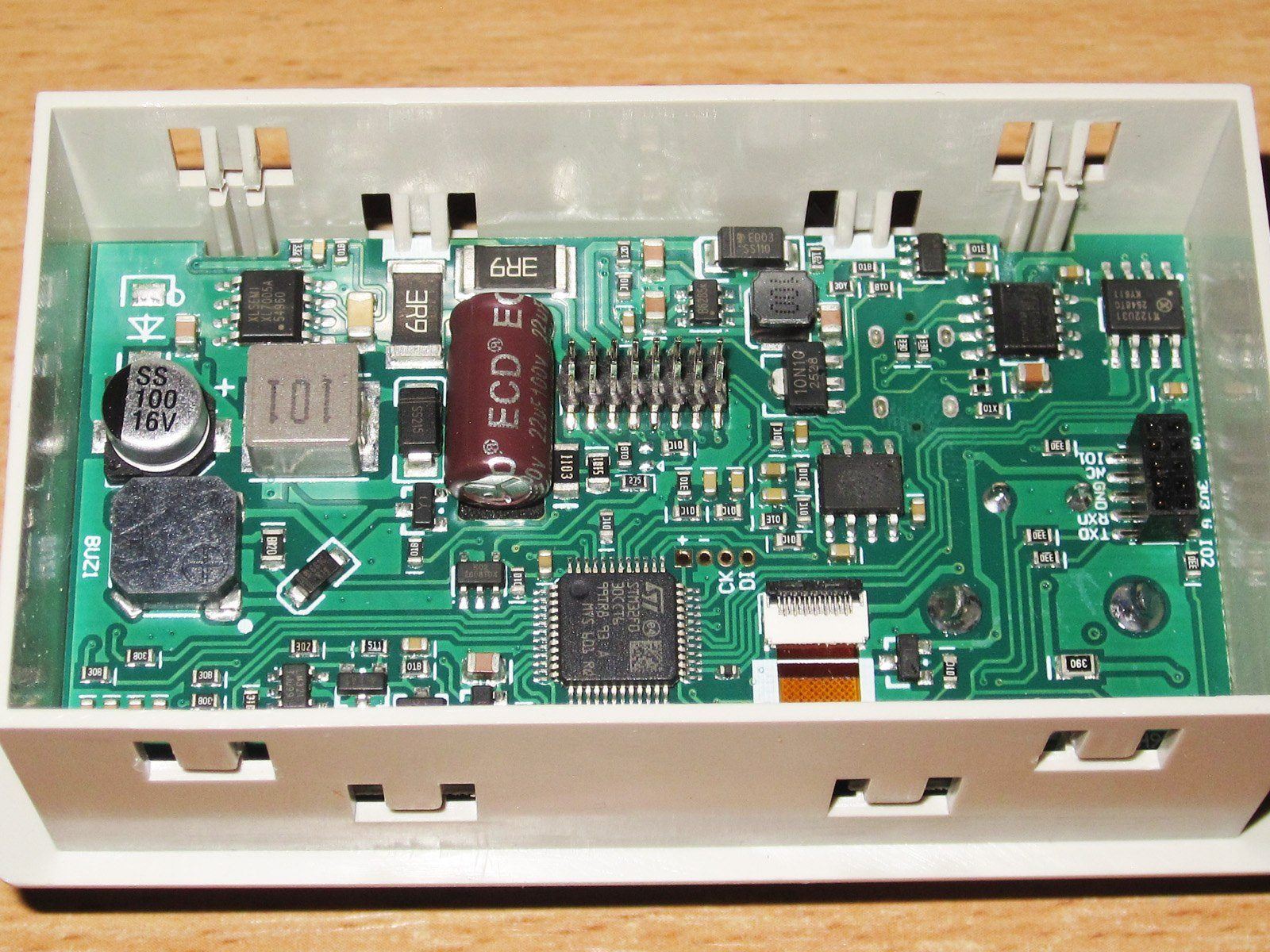
1. Microcontroller and auxiliary power circuits
2. UART-to-USB converter section. The converter itself is a CH340, with an X122U31 galvanic isolation chip next to it.
The control board for the buck DC-DC converter is really compact—they packed it in as tightly as they could :)
I’d guess it uses their classic TL594.
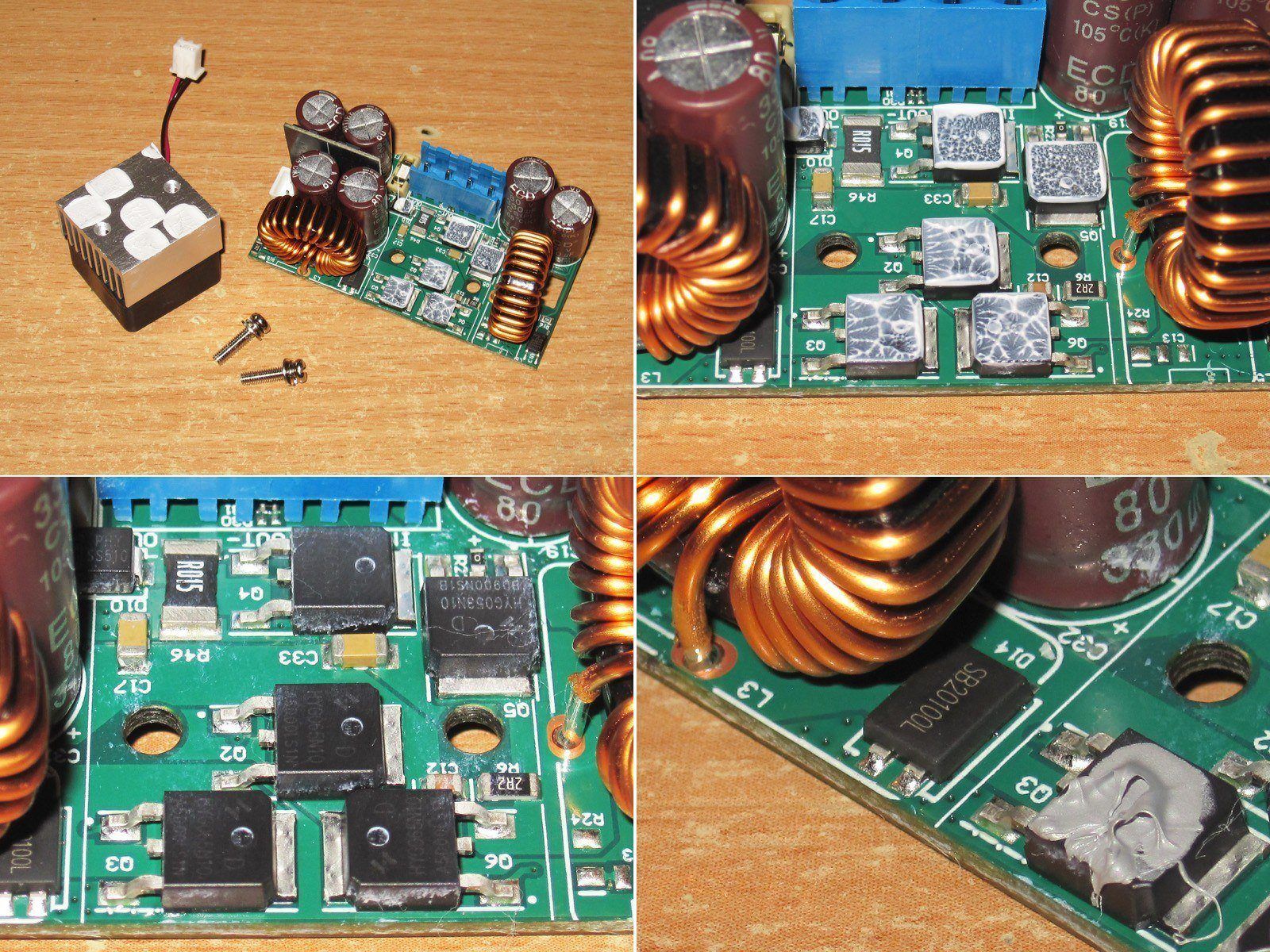
Remove the heatsink and you’ll find five transistors and a diode underneath. Since all these components had thermal paste on them, they’re clearly the power stage.
There’s also a small, neat diode hiding somewhere under the inductor. Judging by the markings, it’s rated for 20 A and 100 V, but I assume that’s a peak current rating. In other words, they used a large die in a small package. It obviously can’t handle that much current continuously, but it should be fine for short bursts.
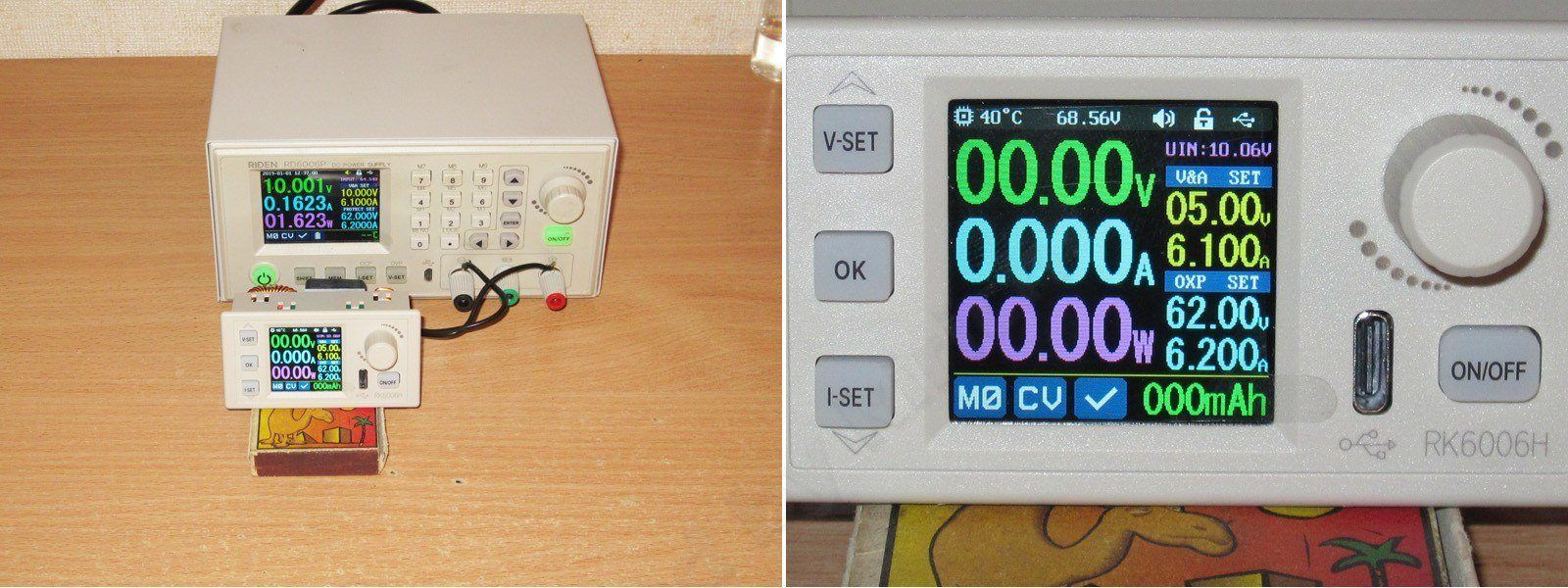
For the initial tests, I powered the new unit from my old RD6006P, since it’s more accurate.
The screen is almost the same as on the 6012 and 6006, but there’s one difference: another voltmeter at the top shows the intermediate voltage, i.e. after the boost converter and before the buck converter. That was handy during testing.
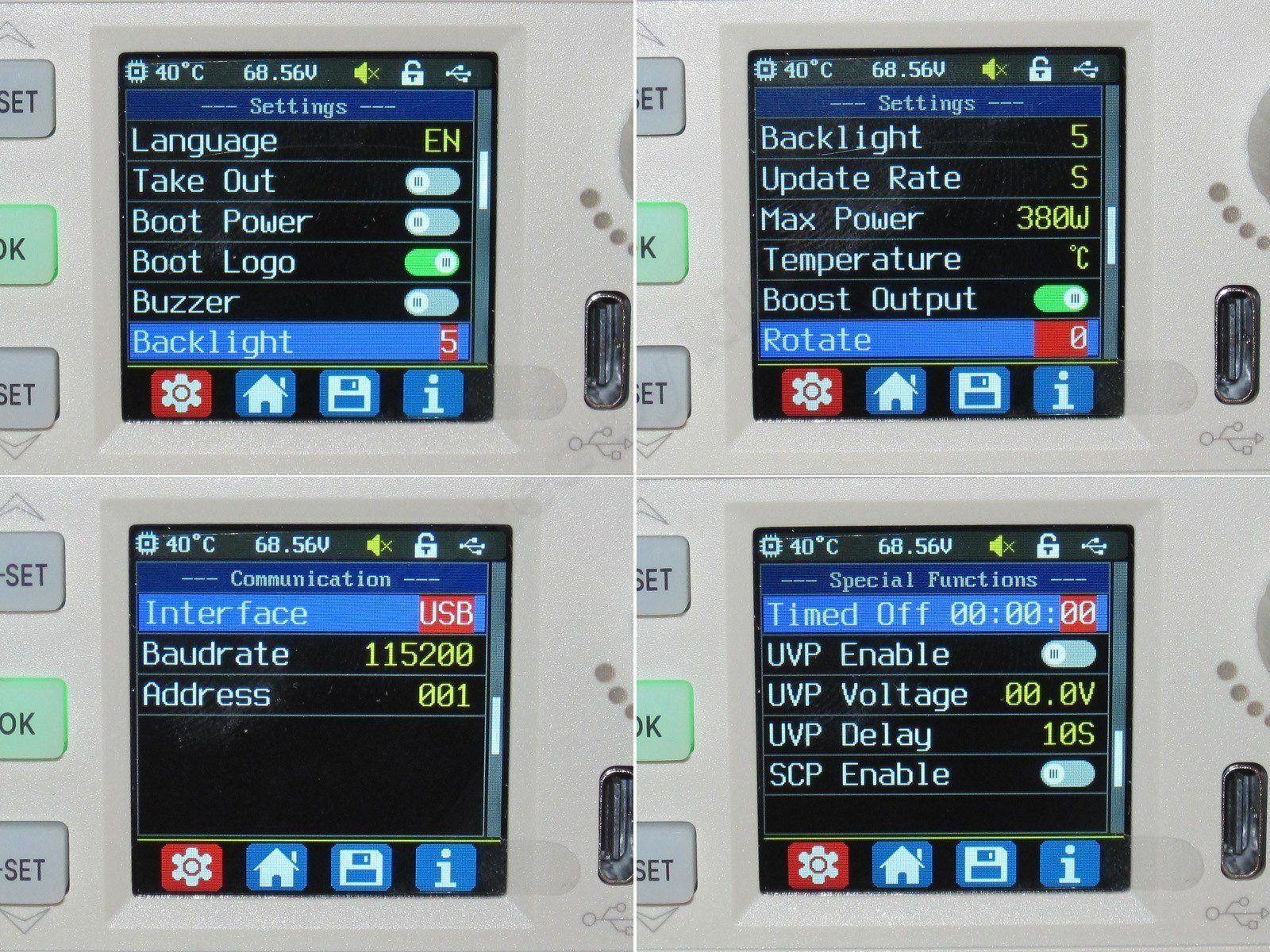
The first three menu screens don’t have anything new, except perhaps an option to enable the boost converter, which is only to be expected.
The fourth screen is more interesting. First, it has settings for protection against operating at low voltage, which is very useful, especially when running from batteries.
There’s another option hidden at the bottom: SCP. I haven’t tested it (I’ll do that with the 6018), but I was curious what it actually was. It stands for Short Circuit Protection.
The point is that the unit usually just switches to CC mode, but sometimes you need it to shut down when the current exceeds a set limit. That’s exactly what this function does. The manufacturer also mentions somewhere in the description that this mode uses an op-amp circuit that isn’t tied to software-based measurement. So this protection should respond very quickly.
Well, should I set up the oscilloscope and so on again now? Honestly, I couldn't be bothered, but I'll try to check the response time in the next review.
Now, on to the tests.
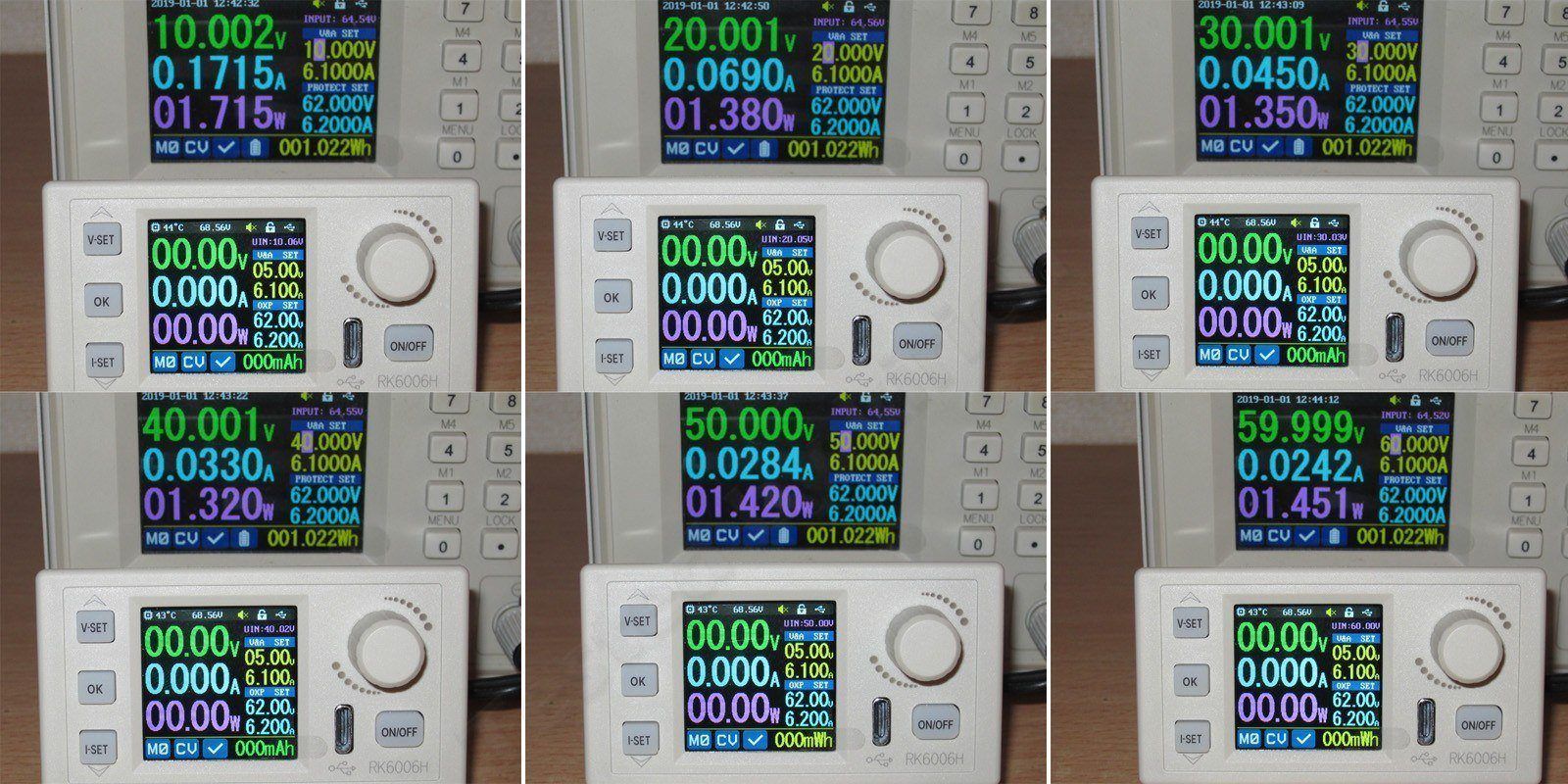
Test 1: checking the accuracy of the input voltage measurement.
I checked input voltages of 10-20-30-40-50-60 V. On the 6006, this is the VIN item.
The accuracy is acceptable overall: sometimes spot on, sometimes +\-0.05 V. You can also check the current draw here, and I have to say it's relatively high—though the boost converter was enabled.
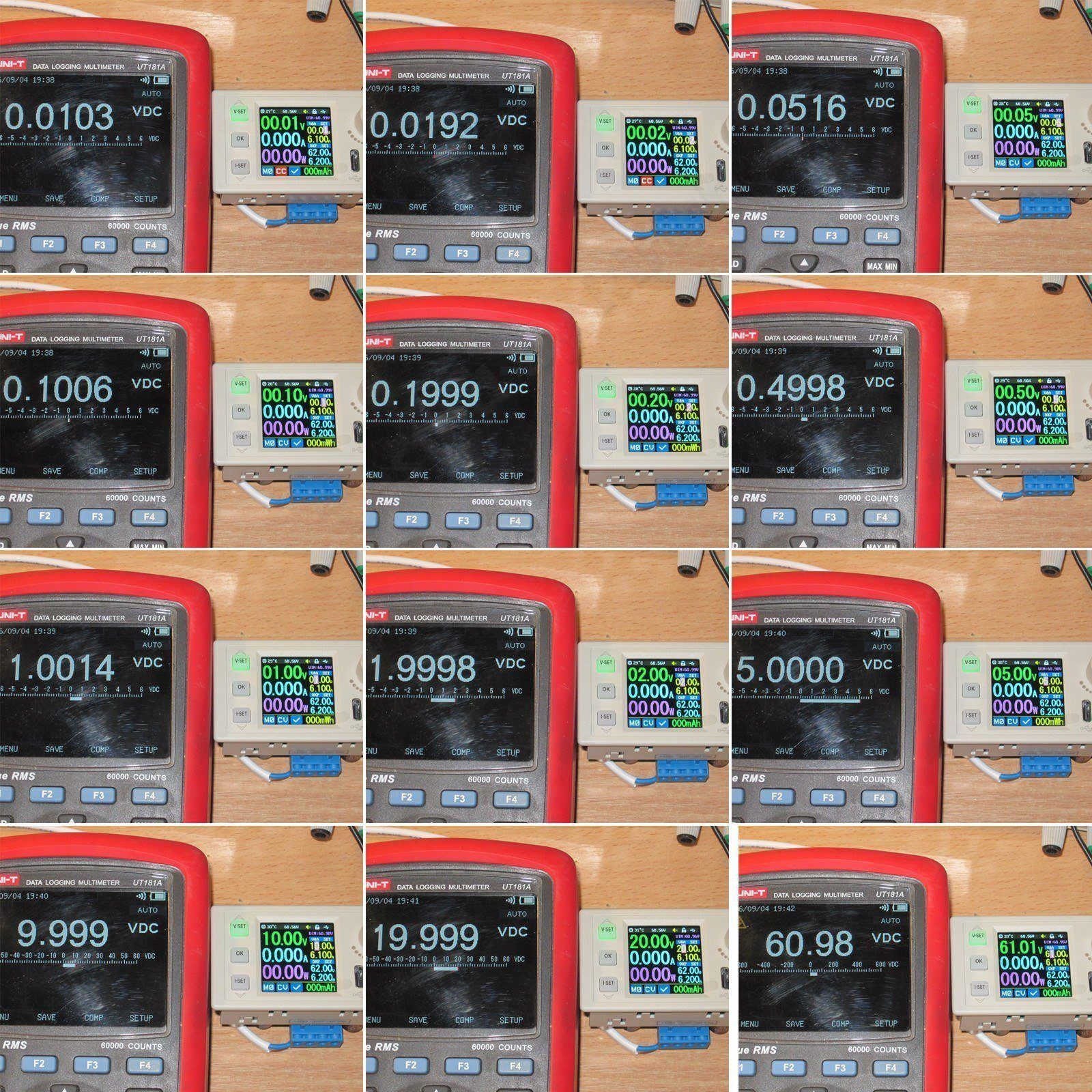
Test 2: voltage setting and measurement accuracy with no load.
I checked using the standard 1-2-5 sequence over a range of 0.01-61 V. For the last point, I simply set it to the maximum rather than 50 V.
I'd say that's very respectable. There's a small deviation, but I don't think you'd even notice it on an inexpensive multimeter :)
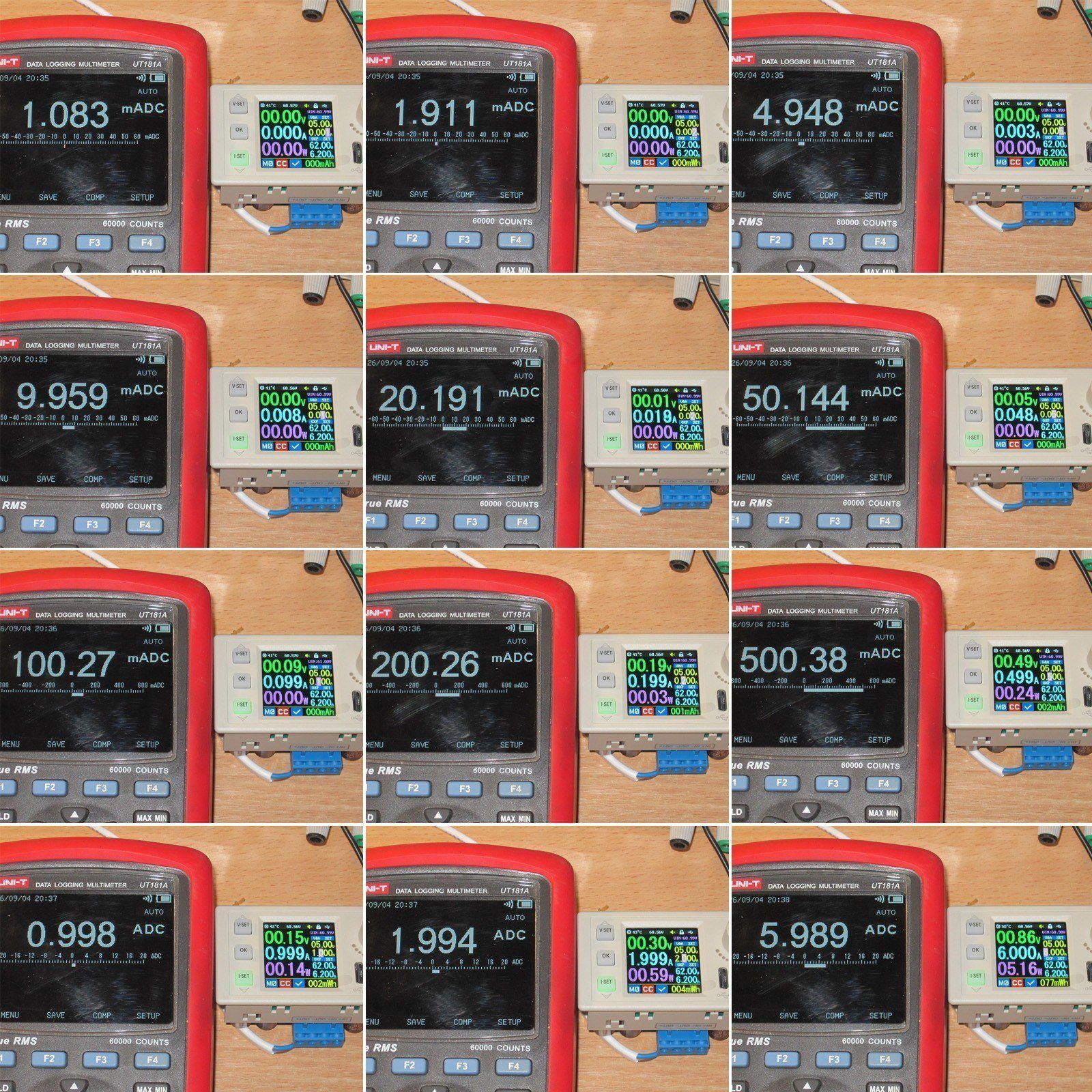
Test 3: current setting and measurement accuracy.
I checked using the same 1-2-5 sequence over a range of 0.001-6 A.
Accuracy is naturally worse at low currents, but that's to be expected. For a converter in this price range, though, I think it's excellent.
My only real complaint is the accuracy of the converter's own current measurement: it doesn't register 1-2 mA at all, and reads 5 mA as 3 mA. It gradually gets more accurate as the current increases.
Test 4: output voltage variation under load.
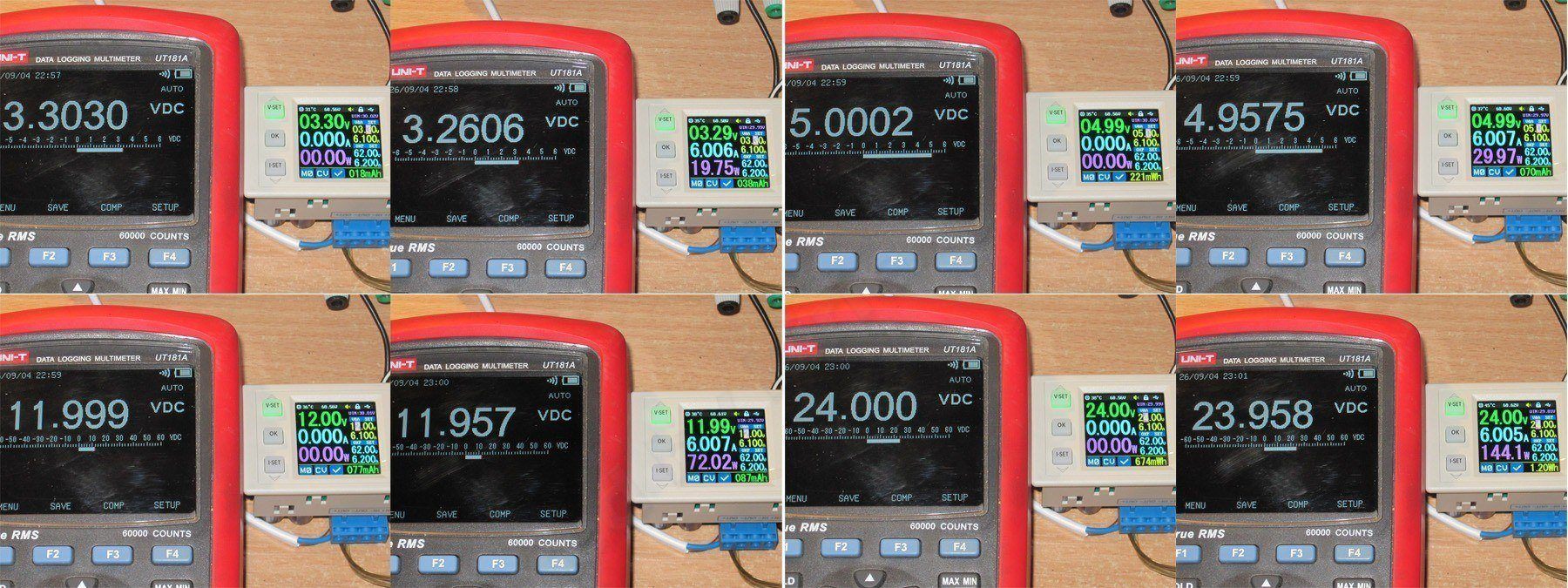
This test is also pretty standard. I checked at 3.3, 5, 12 and 24 V, comparing the voltage with no load and at a current of 6 A.
I got a voltage drop of around 40-45 mV. I think that's due to the terminal block. The RD series uses terminals with a decent cross-section, connected directly to the power board. This one has a terminal block, so the small voltage drop is more noticeable.
Test 5: minimum input-to-output voltage difference.
For this test, you need to disable the built-in boost converter. But it turned out not to be that simple: to disable it, you have to change the mode in the menu and fully reboot the converter.
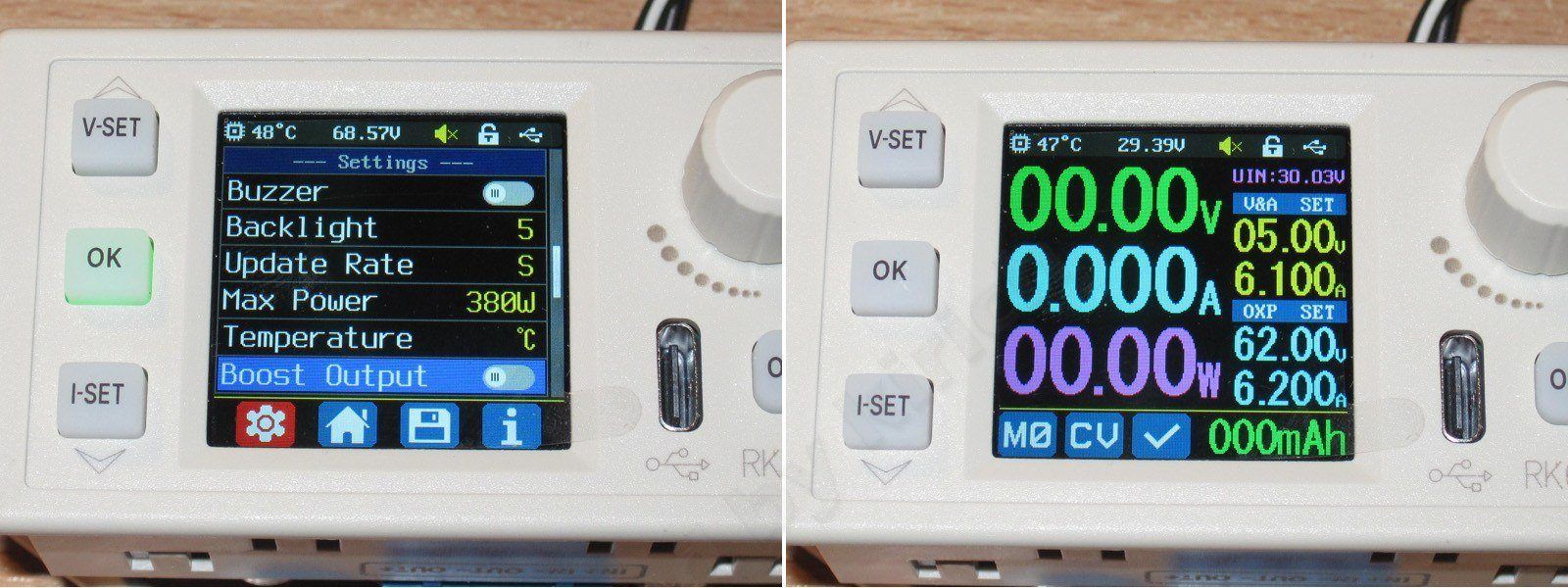
As usual, I tested at two input voltages, 24 and 48 V, and two load current levels, 3 and 6 A.
At 24 V, I got minimum drops of 2.45 and 2.7 V.
At 48 V, they were 4.5 and 4.83 V.
Note that the characteristic pattern holds: the lower the voltage, the smaller the drop.
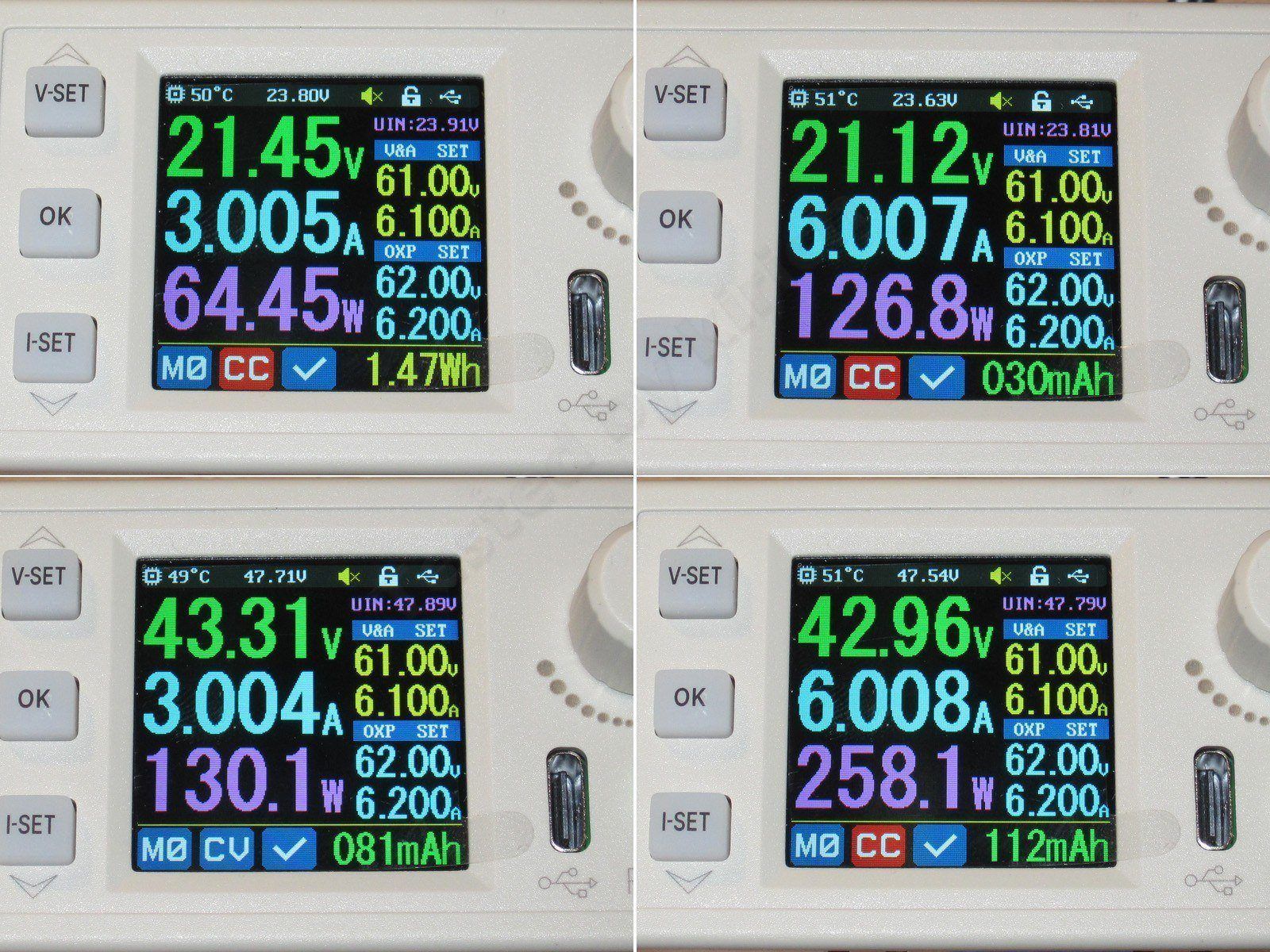
But it's more interesting to see how the converter behaves with the boost DC-DC converter enabled. I ran a lot of tests, so I'll skip some of them.
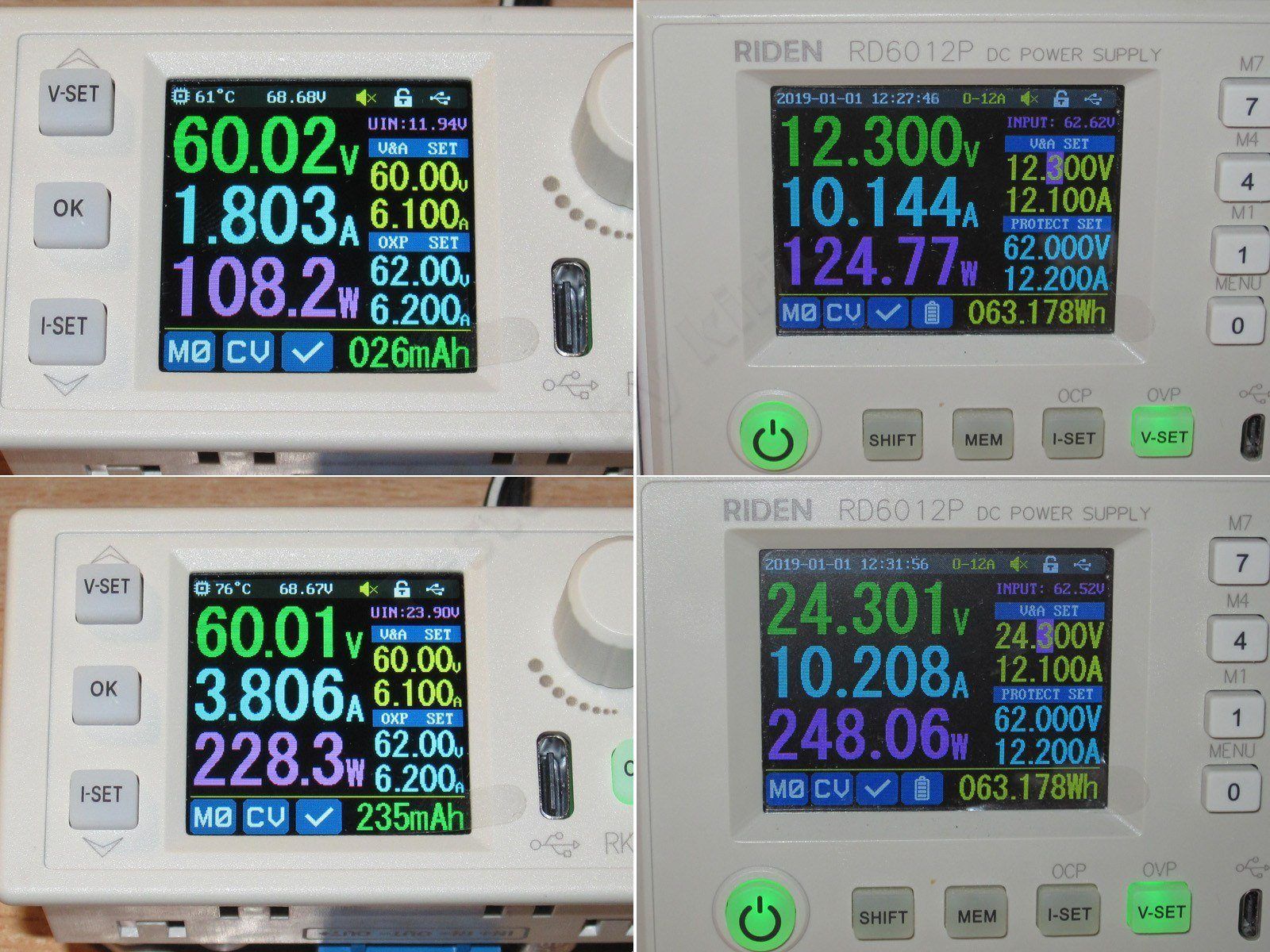
The manufacturer states in both the product description and announcements that the input current is up to 8 A. In practice, that means you'll need at least 360\8=45 V to get full power. So I started testing at 48 V and kept lowering the voltage until the converter shut down.
The photos below are grouped in pairs: the RK6006H is on the left, and the RD6012P powering it is on the right.
I ended up with 6 results at input voltages of 48, 46, 42, 39, 36 and 33 V.
As you can see, I went well below the stated 45 V, even allowing for some margin, and the input current rose to over 11 A.
I absolutely don't recommend trying this, especially since there's only a 10 A fuse on the input.
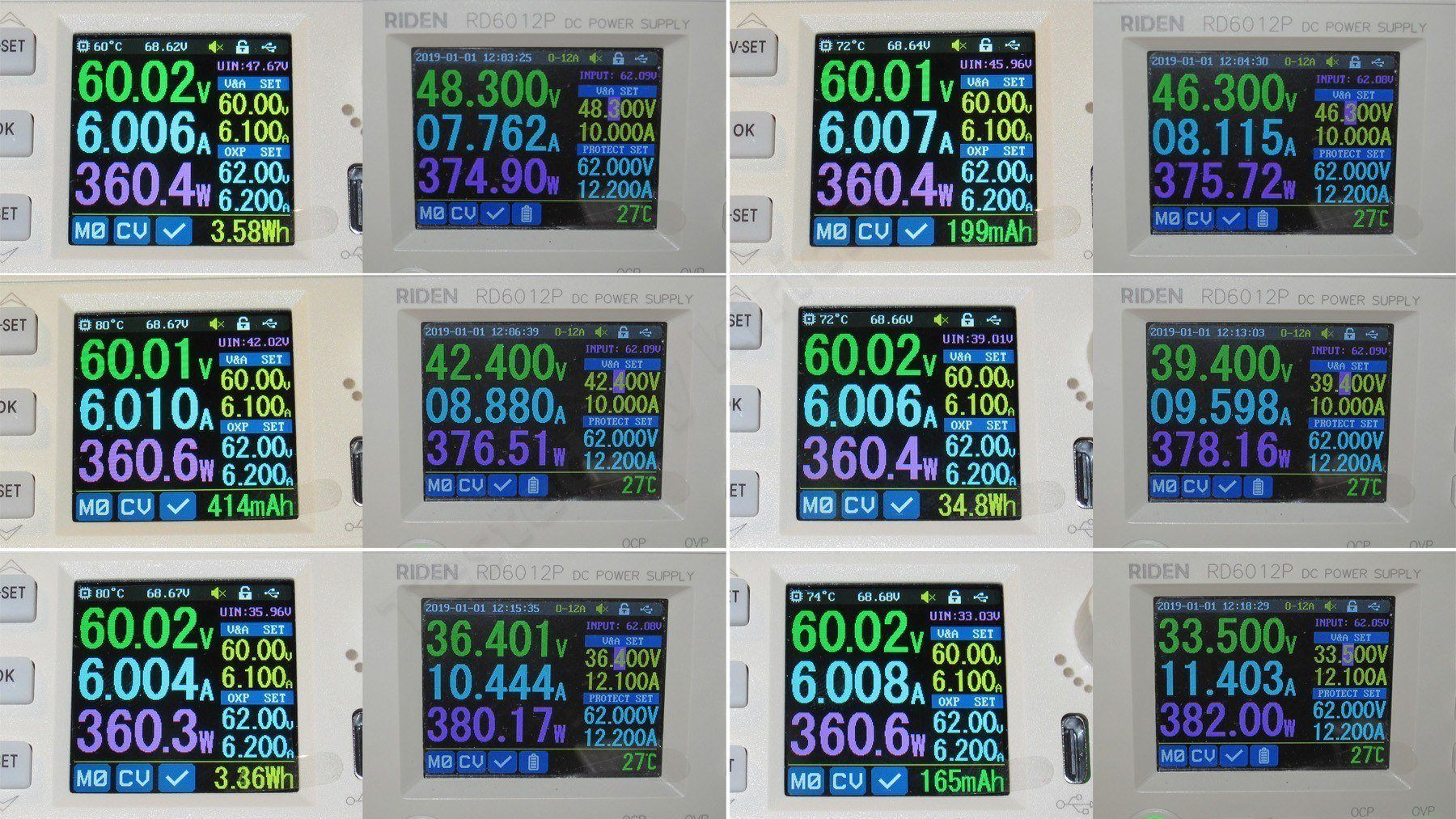
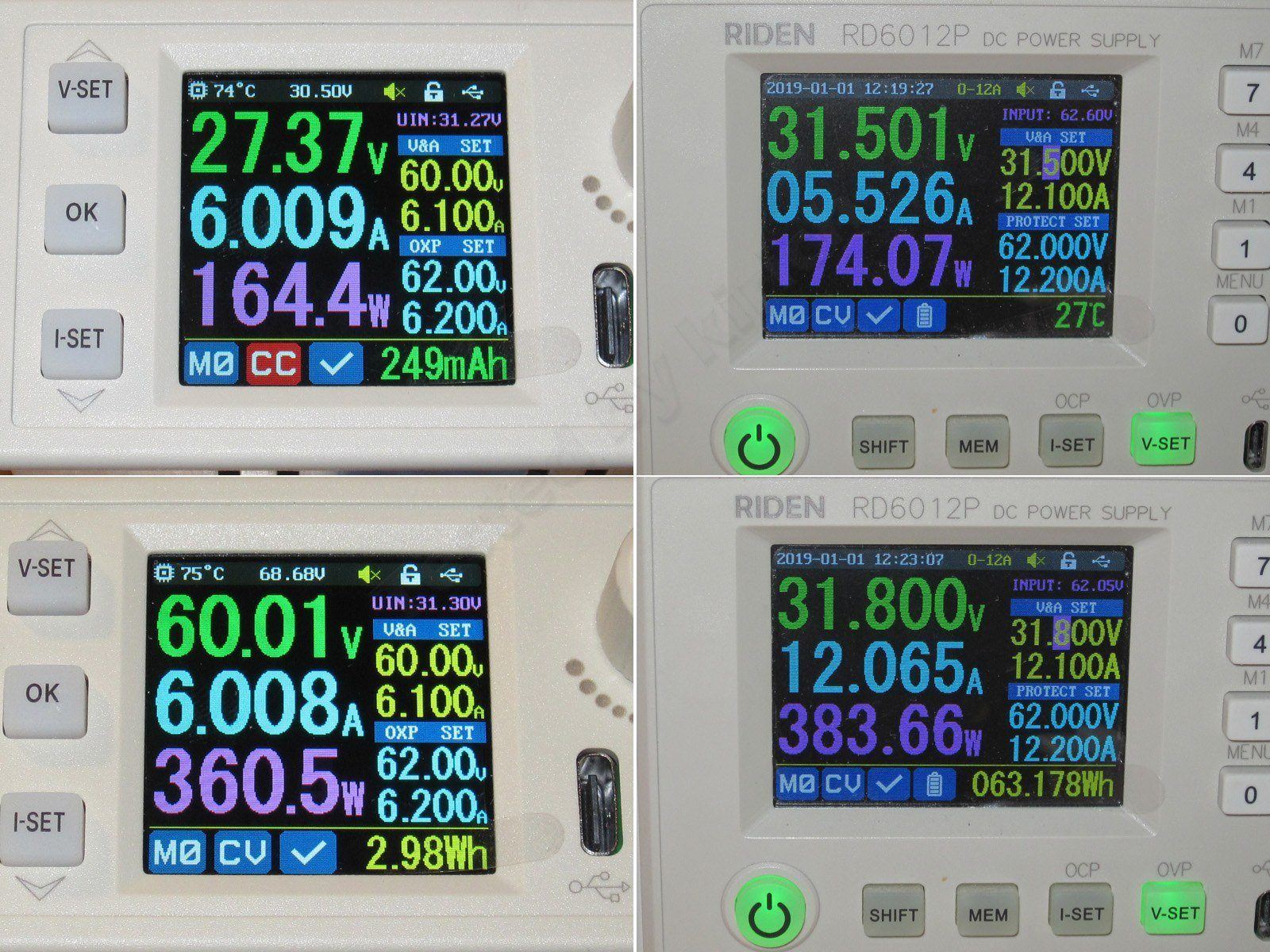
At an input voltage of 33.5-33.8 V, the converter started to give up. The boost converter kept shutting down, so both the output voltage and power fluctuated.
Raise the voltage a little, and everything starts working properly again.
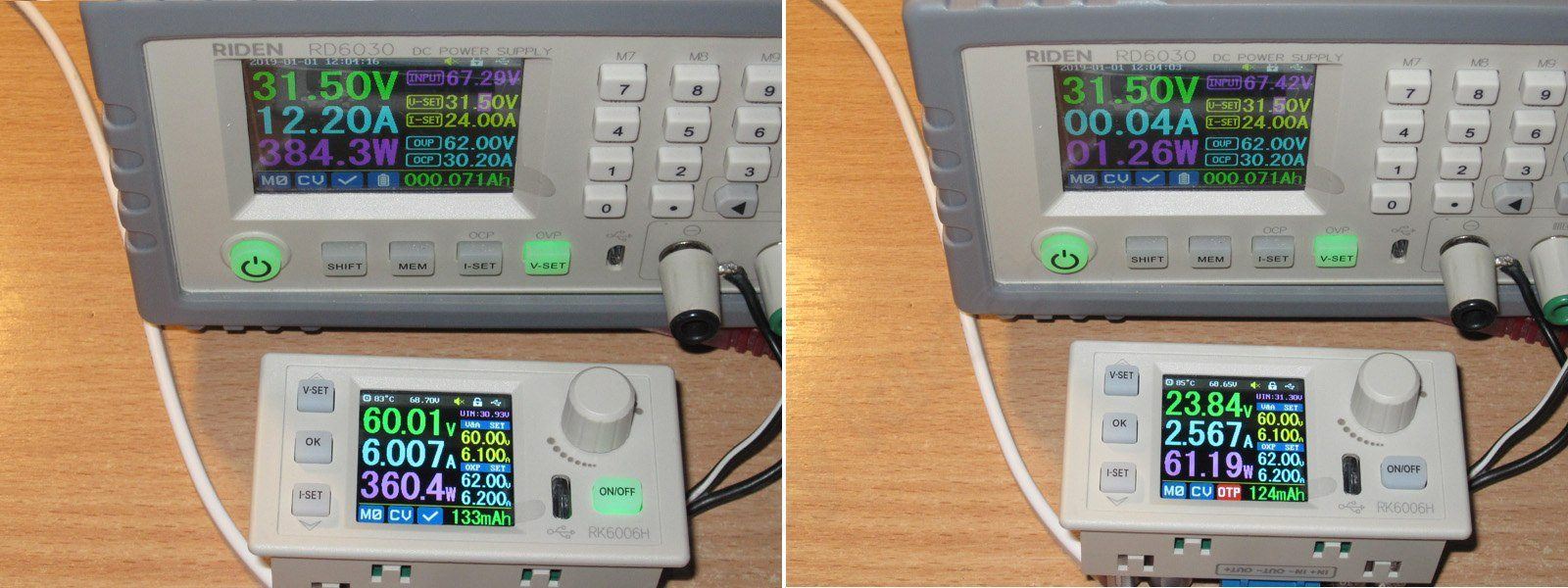
I suspected that my RD6012P's protection was kicking in, so I decided to test it with an RD6030, which definitely doesn't mind currents like these.
But in the end, I got pretty much the same results. I also triggered the overtemperature protection at least a couple of times. There is one small caveat, though: the converter was lying with its screen facing up, and the fan was blocked, so it wasn't getting proper cooling.
In any case, the converter took my abuse in stride and even tried to fight back :)
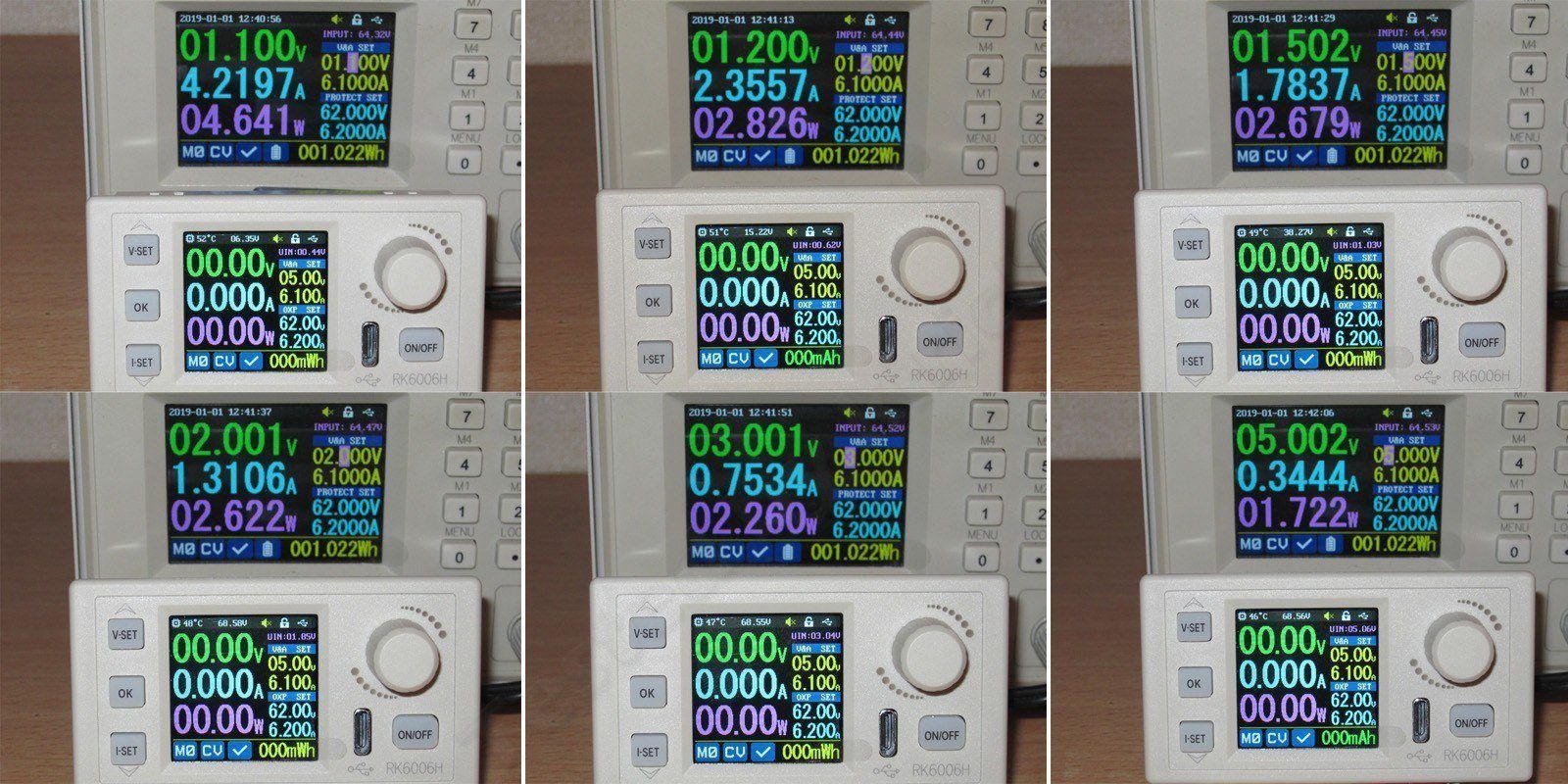
But even more interesting was the voltage at which the converter can still operate with no load.
I gradually lowered the input voltage and was very surprised when it shut down at just 1 V input. Yes, really: I raised it to 1.1 V, and it started up again. The input current was fairly high, but it was working just fine.
Results at 1.1, 1.2, 1.5, 2, 3 and 5 V. With 2 V at the input, the converter worked perfectly well; at least the boost converter started putting out the set 68 V.
Of course, I don't recommend experiments like this, and I strongly recommend setting a limit when running from batteries, but it definitely managed to surprise me.
One more quick test: how much power can you get at the output with 12 V and 24 V input?
At 12 V, I managed to load it to a maximum of 108 W, and at 24 V, to almost 230 W. Those are very good results, but a reminder: it's better not to overload it.
The input protection threshold is set rather strangely. Although 8 A is the stated limit, I can get up to 12 A. In this test, though, the converter shut down at around 10 A. There may be some dependence on the input voltage, as well as on how gradually the load power is increased.
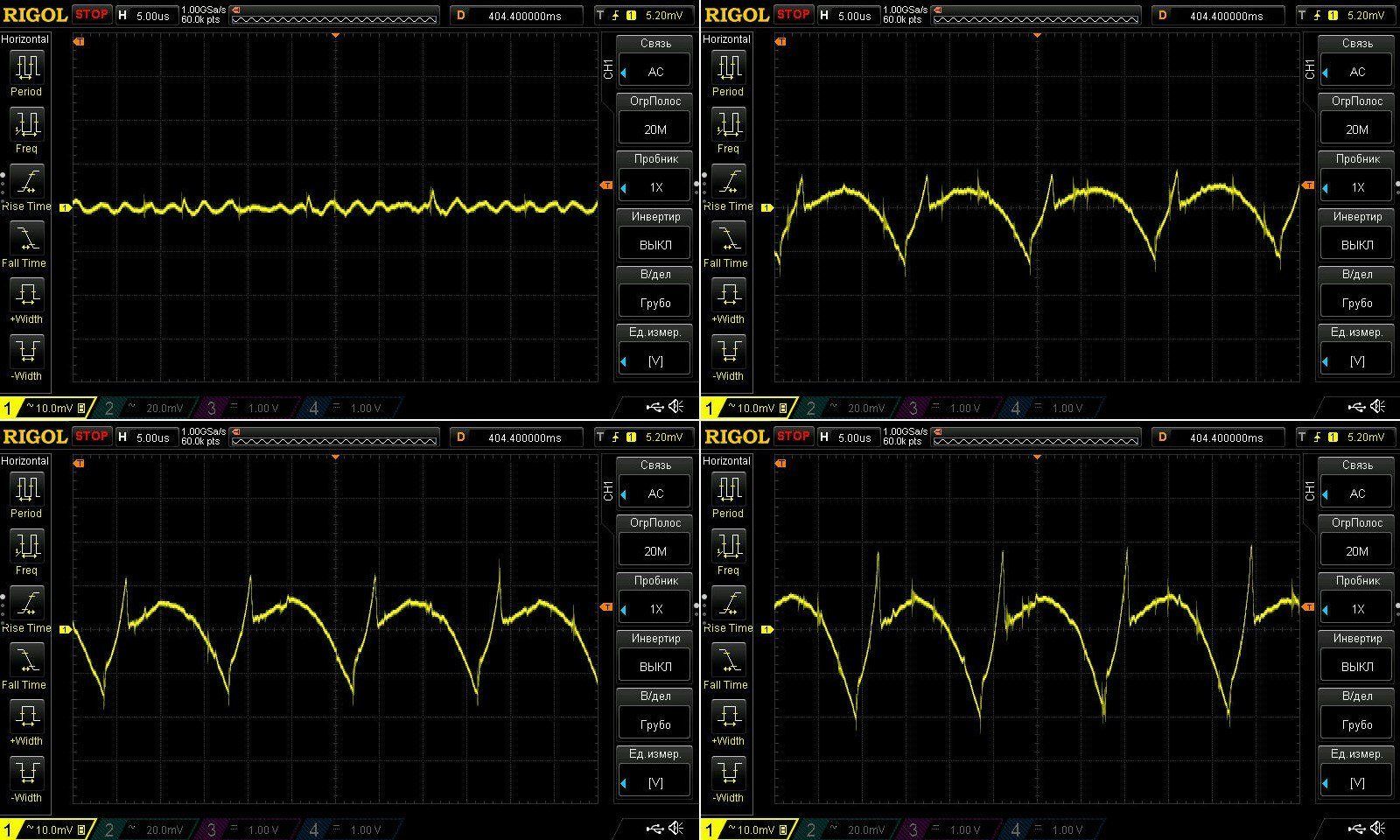
Test six: ripple measurement.
Here are the results with 48 V at the input and 12 V at the output, with no load and at currents of 2, 4, and 6 A.
The manufacturer specifies ripple of up to 100 mV peak-to-peak; I measured closer to 40 mV.
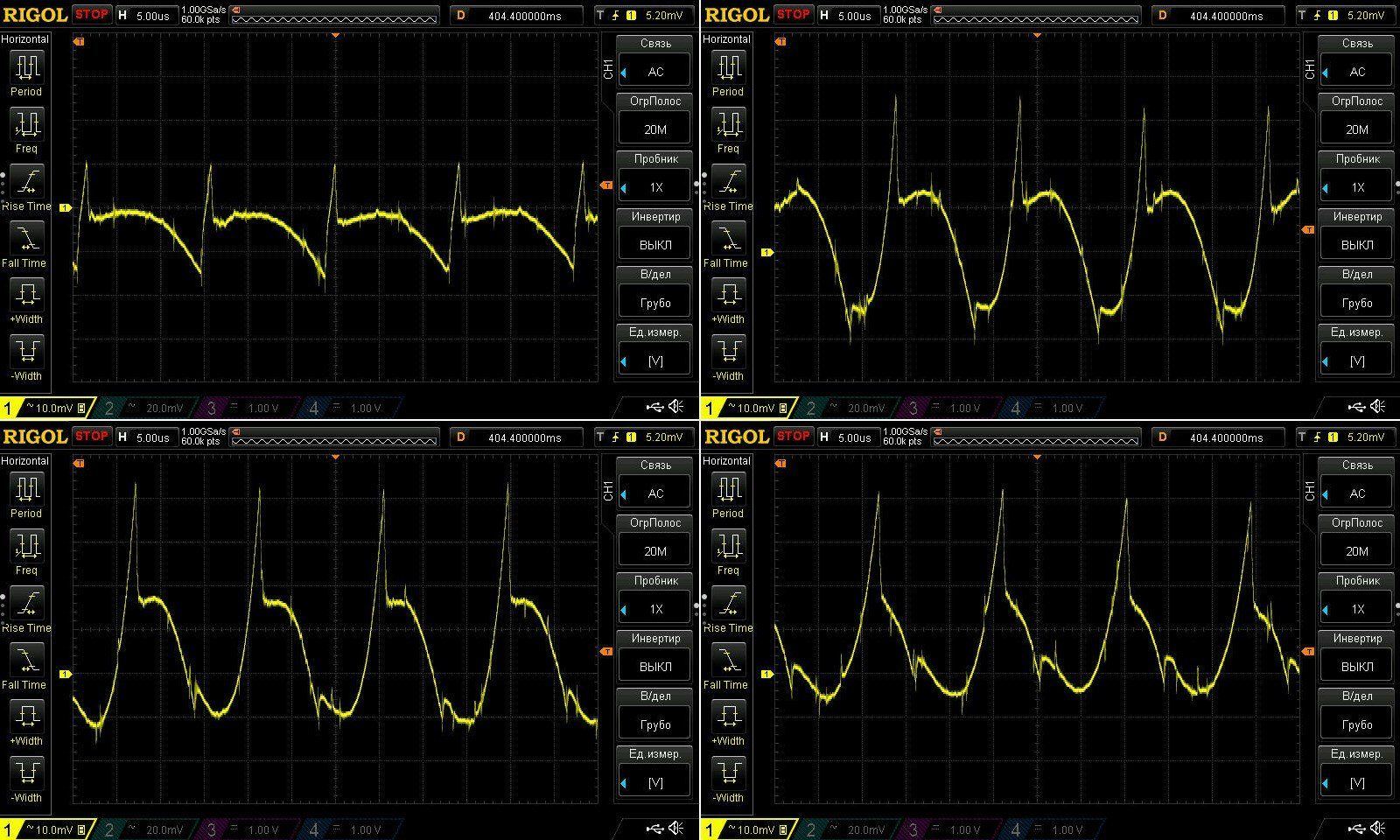
Here, the input was still 48 V, but the load current was 6 A in every case, while the output voltage was varied: 5, 25, 36, and 48 V.
The ripple amplitude increased noticeably, but even in the worst case it was no more than 55–60 mV.
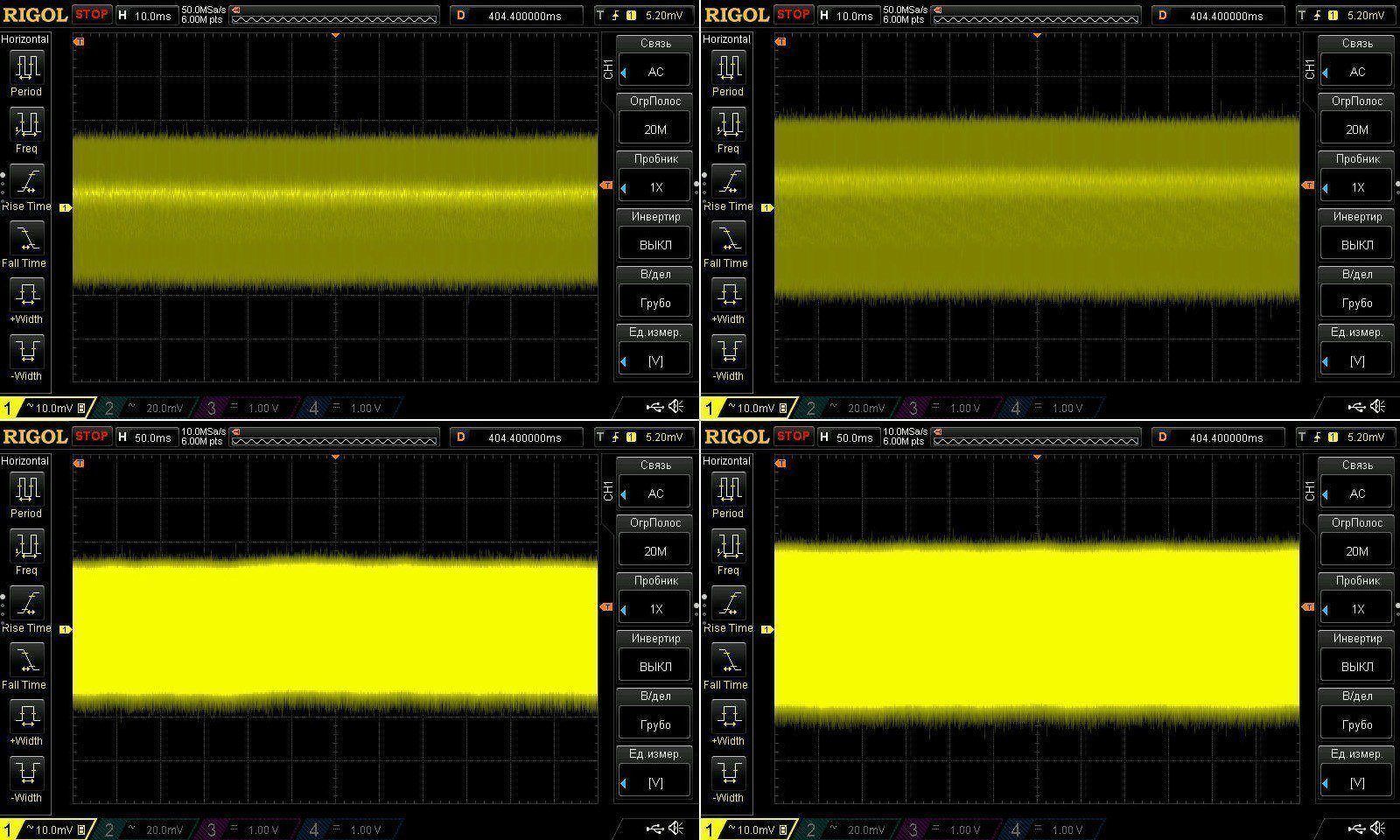
There's not much point looking at the low-frequency range. There can be quirks sometimes, but here we just see a uniform average spectrum, so I have no concerns there either.
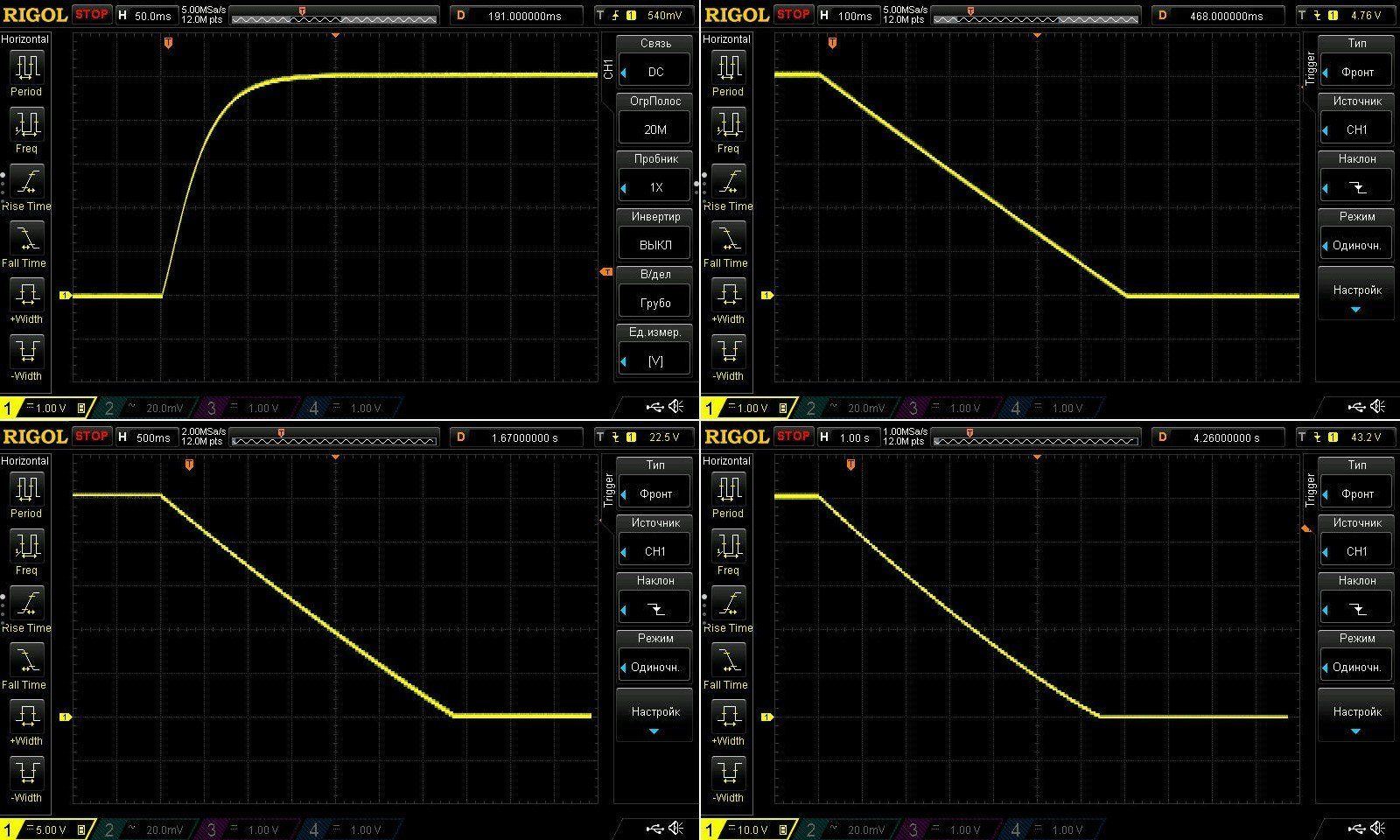
Test seven: transient response.
Power-on from 0 to 5 V and power-off from 5 to 0, 25 to 0, and 48 to 0 V.
There are no overshoots when switching on, and none when switching off either, but the time it takes for the voltage to drop completely depends strongly on the initial setting.
At 5 V, it takes 0.7 s; at 25 V, 3.2 s; and at 48 V, 6.5 s.
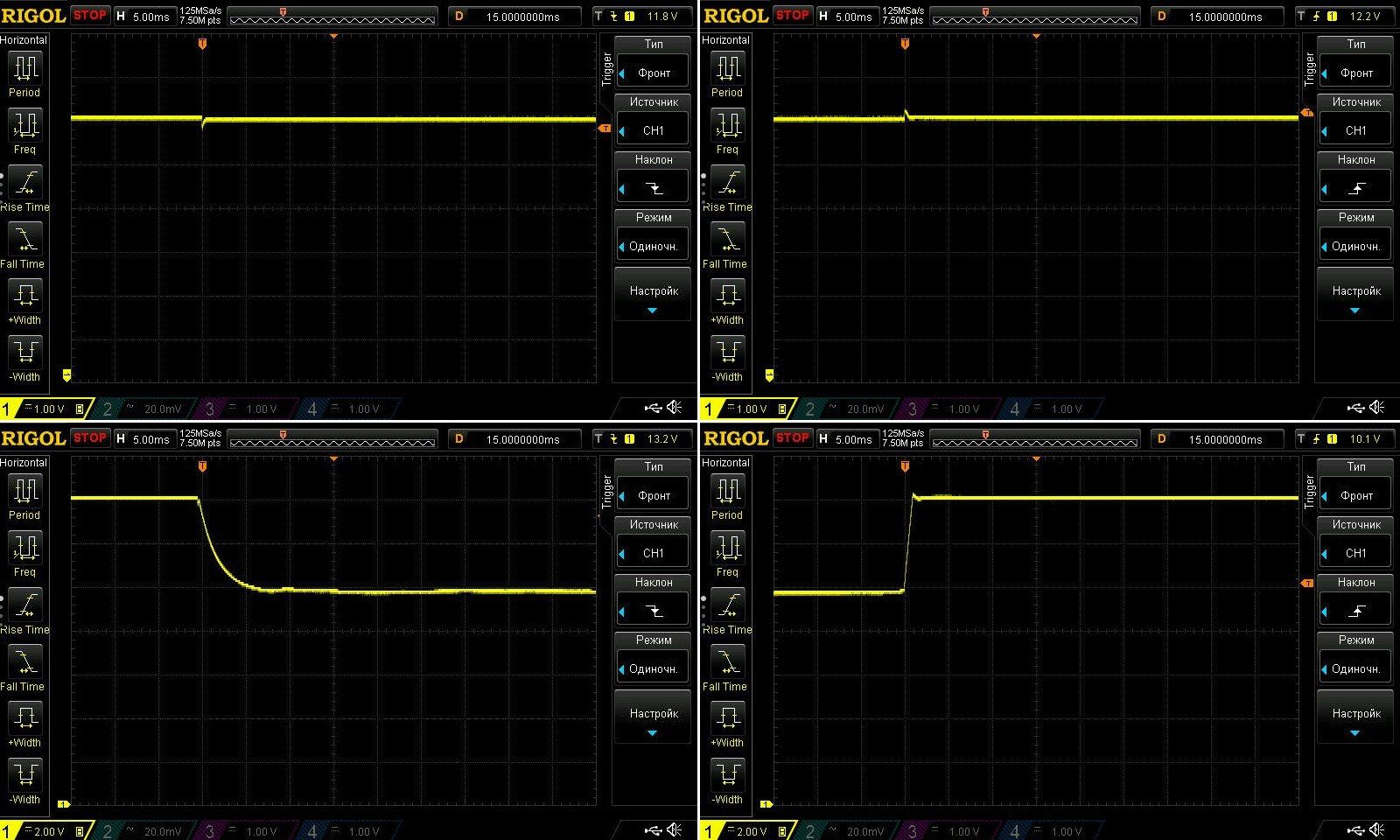
1, 2. Response to connecting/disconnecting a load. The output was set to 12 V. A 30 Ω resistor was connected continuously, and a 3.3 Ω resistor was connected in parallel with it (or disconnected), so this shows the response to a current step from 0.4 to 4 A and from 4 to 0.4 A.
3, 4. Transition from CV mode to CC mode and back. Voltage: 14 V; load current: 4.5 A; current limit set to 3 A.
There's a small overshoot during the CC-to-CV transition, but otherwise I have no complaints.
Test eight: efficiency at different operating points.
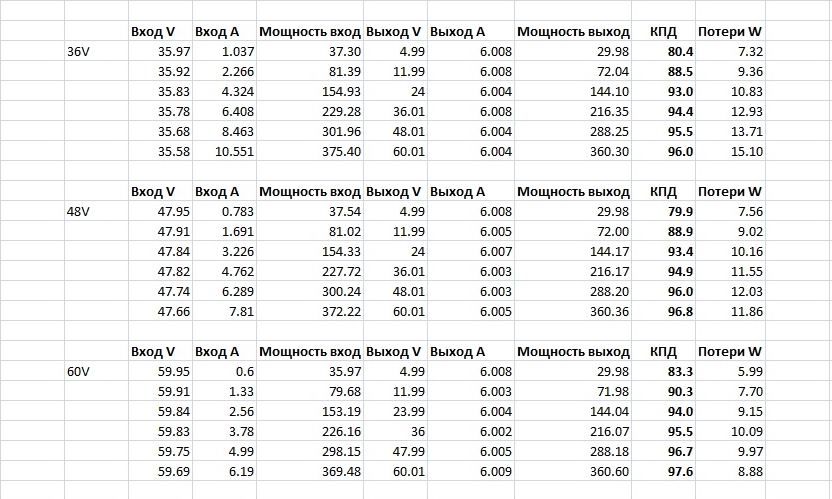
I checked efficiency with input voltages of 36, 48, and 60 V, at the maximum load current and output voltages of 5, 12, 24, 36, 48, and 60 V. The boost mode was enabled, of course.
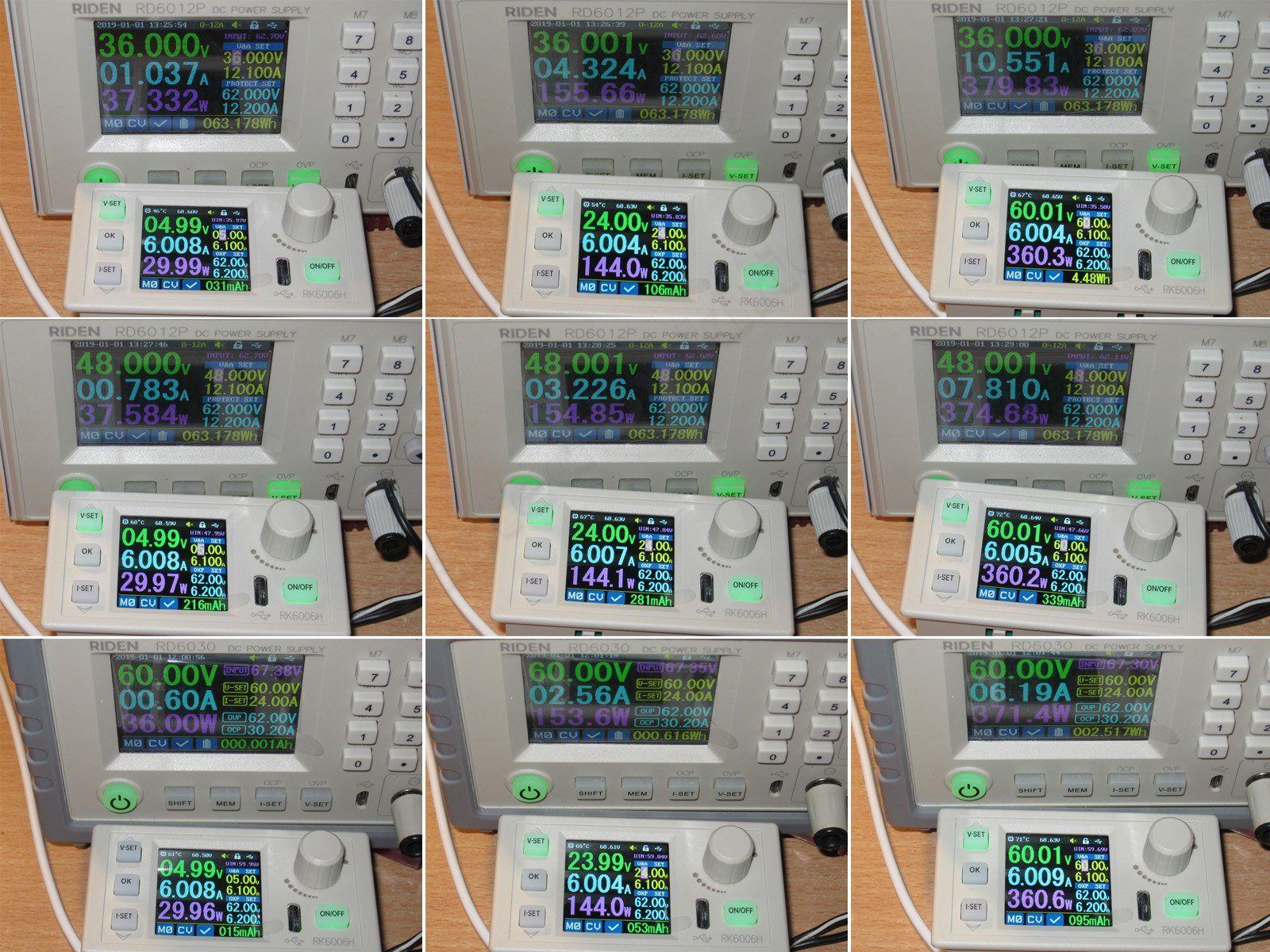
There was a lot of data, so I put it all into a table.
Test nine: thermal performance.
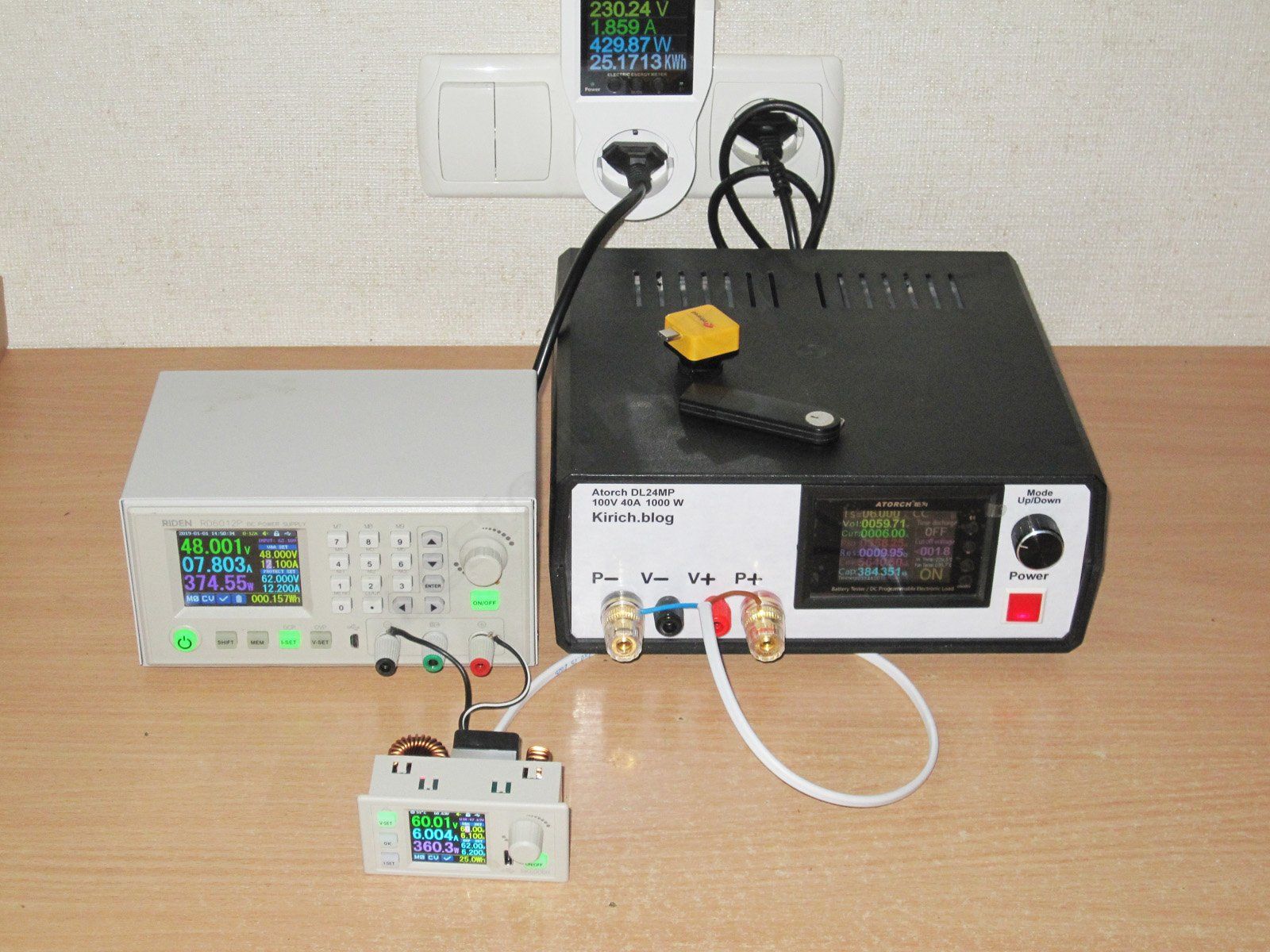
The converter was powered by an RD6012P power supply, and an electronic load was connected to its output.
The input voltage was set to 48 V, which is close to the minimum specified for full power and is also the most common voltage for branded power supplies.
While I was playing around with the converter, I also noticed that it gets noticeably warm even with no load, although I wouldn't say its no-load power consumption is particularly high—around 1.4–1.7 W. Maybe I just imagined it, or maybe something hadn't cooled down after the tests, but just to be safe, here's a thermal image from the start of the test.
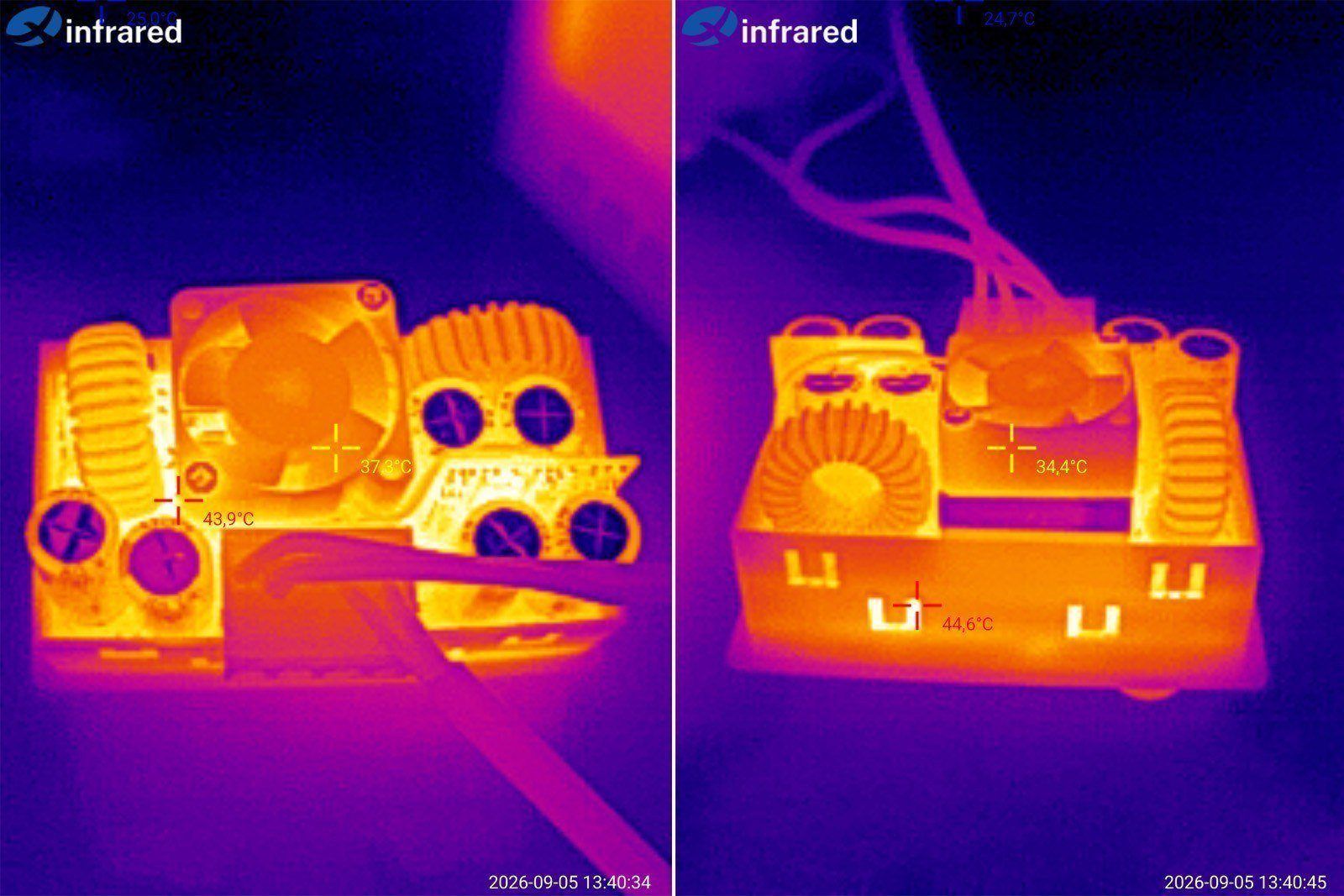
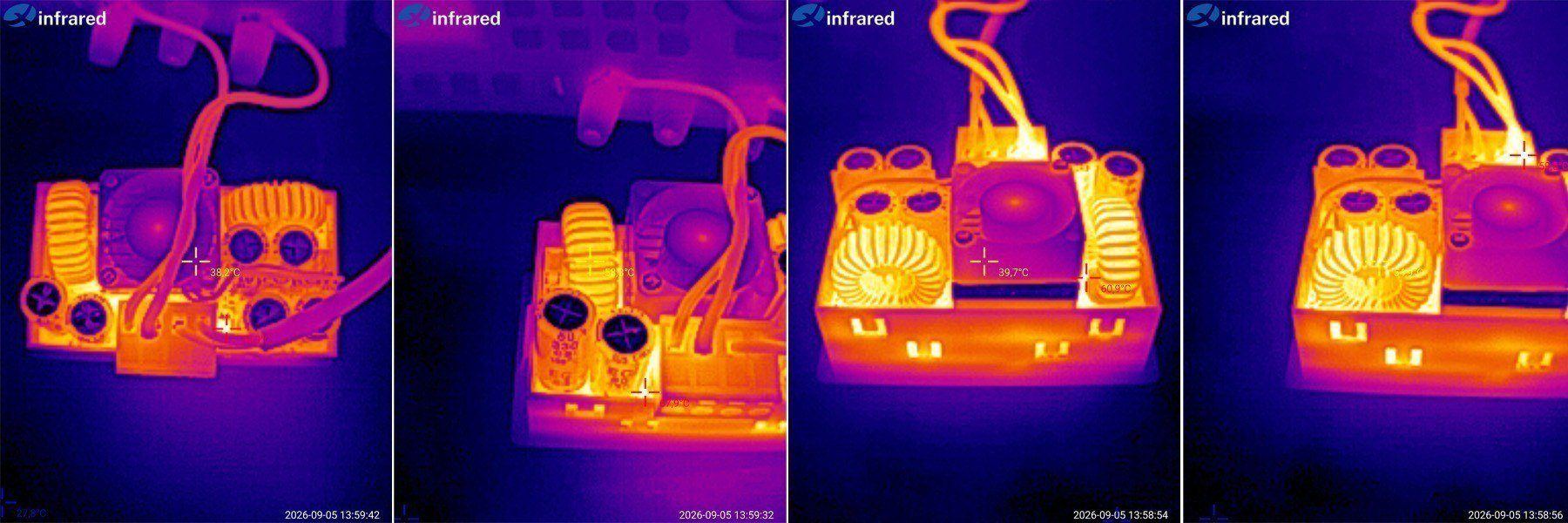
According to the internal temperature sensor, the converter warmed up to 72 degrees after 20 minutes. In my previous tests, where the fan was essentially blocked, it got above 85 degrees and worked fine, so 72 degrees should be more than safe.
Unfortunately, I couldn't get to the transistors for technical reasons, so this is all I could do.
The inductors are around 55–60 degrees. The fuse gets hottest, at about 72 degrees, and something near the input side of the terminal block reaches about 68 degrees. No other particularly high temperatures were observed.
The next logical step would be a software demo, but honestly, I don't see the point of showing the same screenshots for the hundredth time. As far as I can tell, the new versions mainly add support for new converter models, and possibly some model-specific features.
Conclusions.
I wasn't particularly worried about running into problems during testing, of course, but the Riden units have really outdone themselves here.
I have no real complaints about accuracy or ripple either: ripple is 1.5–2 times lower than specified. The same goes for the maximum input current: instead of the specified 8 A, the converter works without any problems with an input current of up to 10–10.5 A, so it can deliver full output power with an input voltage of just 36 V.
Incidentally, the input voltage range just about matches that of a 10S lithium battery, for example one from a hoverboard. Though it's still best to reduce the power toward the end of the discharge.
It has undervoltage protection, with an adjustable delay before it trips, which is genuinely useful and helps prevent false trips.
It also has output short-circuit protection. I'll test that next time.
Overall, I can say this is a neat converter. The controls are frankly not great—for example, switching from 0.01 V increments to 1 V increments—but you get used to it, and there are only so many controls you can fit on the unit.
Otherwise, it's really great for standalone adjustable power supplies, especially considering its size.
$33.75
This model is included in the summary table: Comparison of adjustable converters for a bench power supply
The figures from this review are in the measurement database: Converters
Calculate manuallyAll calculators
Discounted products
You may be interested in



Discounted products
Support the project
All the content on the site and the advice are free, but we’d be grateful for your support of the project and the channel!
Discuss on the forumHave a question or some experience to share? Discuss the article with the author and readers: the forum is a convenient place to share schematics and photos.
Go to the forumOnly registered readers can comment. It takes a minute to sign up, and you can log in with the same account you use on the forum.
Log inRegister