
Three types of 21700 cells: high-current and interesting tabless cells
I was sent some more interesting cells to test. Some are nothing particularly special, but a pair of high-current tabless cells really caught my attention. I definitely haven't tested anything like these before, so I think this will be useful.
A reminder: to keep up with new posts on the blog, I recommend following me on Instagram, where I'll post notifications about all new posts and maybe write about something interesting too - link to account
You can also subscribe to updates and new articles on the Telegram channel - https://t.me/KirichBlog Note that discussions of reviews and articles are enabled on the channel, along with general chat. I recommend it.
An acquaintance suggested testing several types of cells, and since I was interested and had the means to do it, of course I didn't turn him down. Besides, as you know, I keep a test database, so even years later you can pull up some results and compare different types of batteries side by side on a graph.
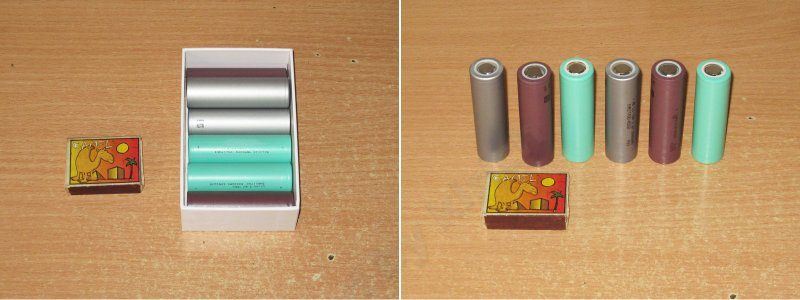
I received three types of cells, two of each type:
Tenpower INR21700-50SG
Reliance INR21700-RS50
EVE INR21700-50PL
All three types have a capacity of 5000 mAh, but I was especially interested in the so-called tabless cells, the INR21700-RS50 and INR21700-50PL, which are well suited for building batteries designed to deliver high currents.
I'll start with the Tenpower INR21700-50SG cells. They're more of an "all-rounder": they don't really qualify as high-current cells, with a maximum current of just 20 A, or as high-capacity cells, since cells with considerably higher capacity have been around for a long time. Still, they should work well in power tools.
Their color looks an awful lot like LG's "chocolate bars".
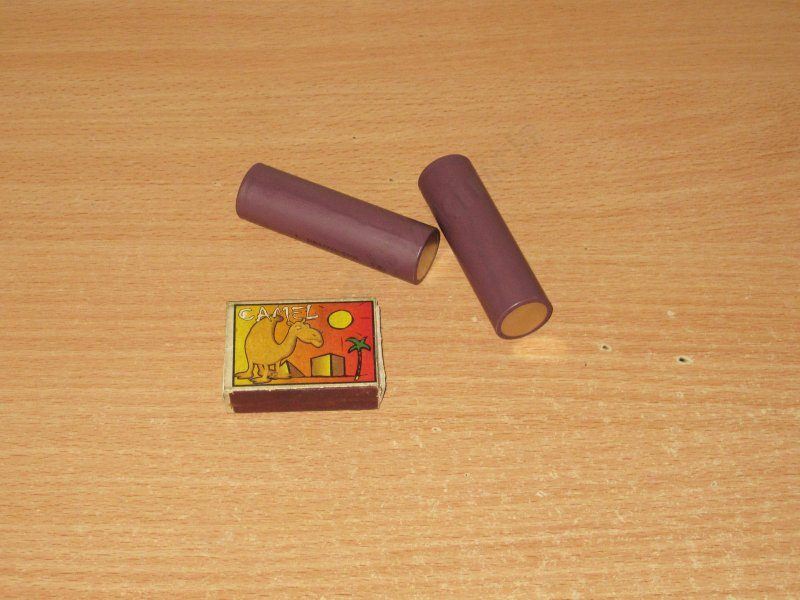
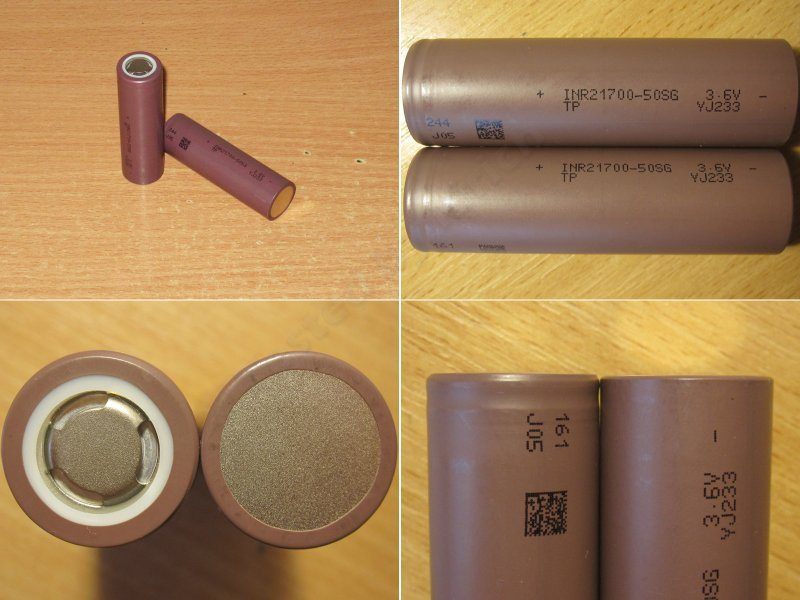
The batteries have a matrix code, which is useful for checking whether the cells are genuine.
According to the markings, they were manufactured on October 23, 2025.
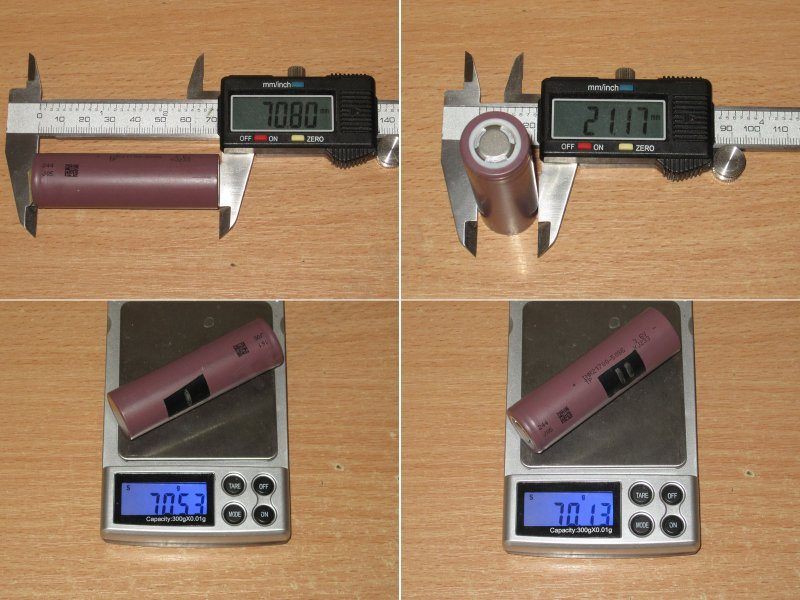
The first charge took about 3.5 Ah, so they were initially charged to roughly 30–35%. After that, at a current of 1 A, I got about 5 Ah out of them.
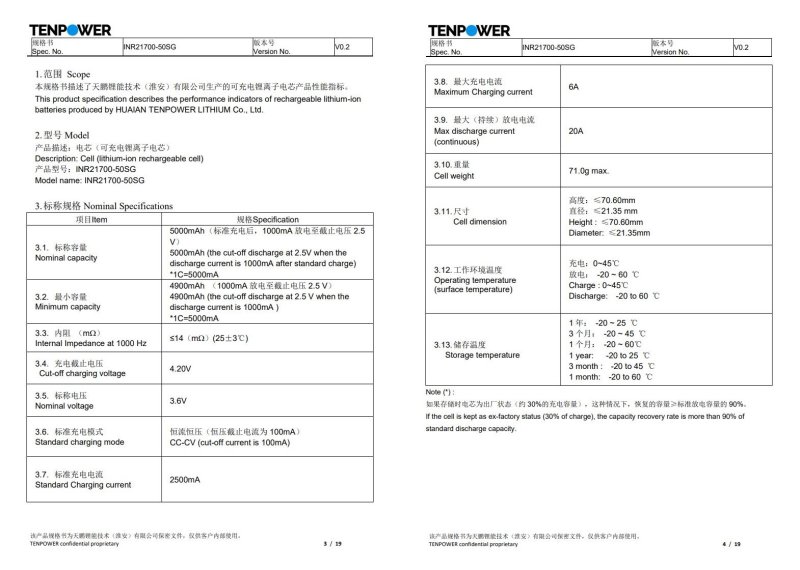
The standard charge current is 0.5C, with termination when the current drops to 100 mA; the fast-charge current is 6 A. Since the tester I started with has a maximum charge current of 5 A, that's the setting I used. The difference from the maximum 6 A isn't very large anyway, and it's also more convenient to assess things at whole-number C-rates.
I should point out that a charge current of up to 6 A seems a little unusual when the maximum discharge current is 20 A. Usually, high-current cells also have a high charge current.
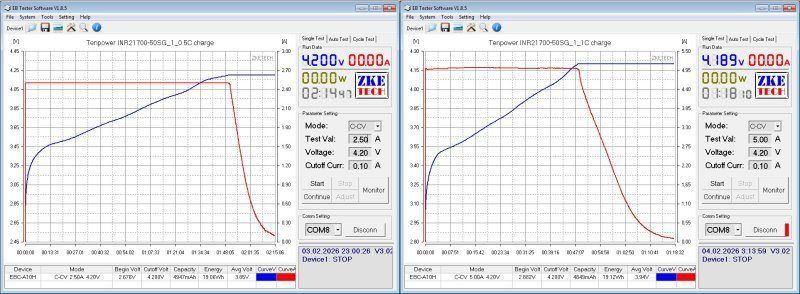
Charging at 0.5C took 2 hours 15 minutes—not bad. At 1C it took 1 hour 18 minutes, which is also pretty good for this type of cell.
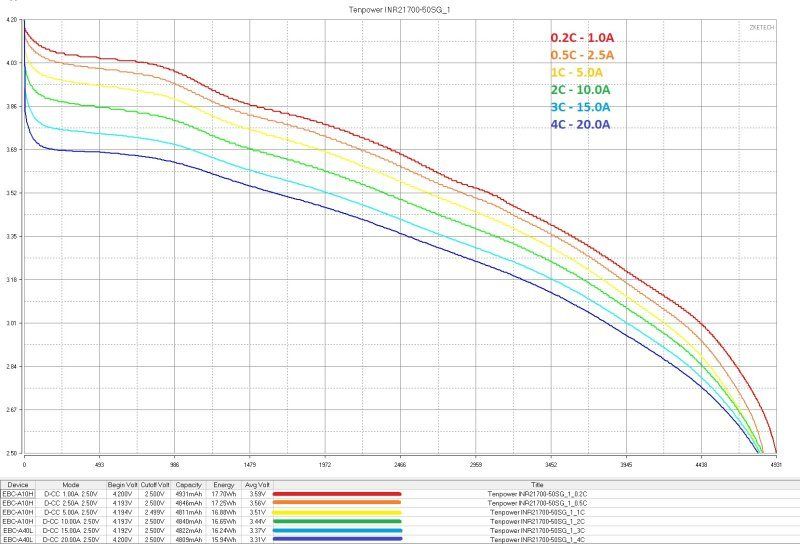
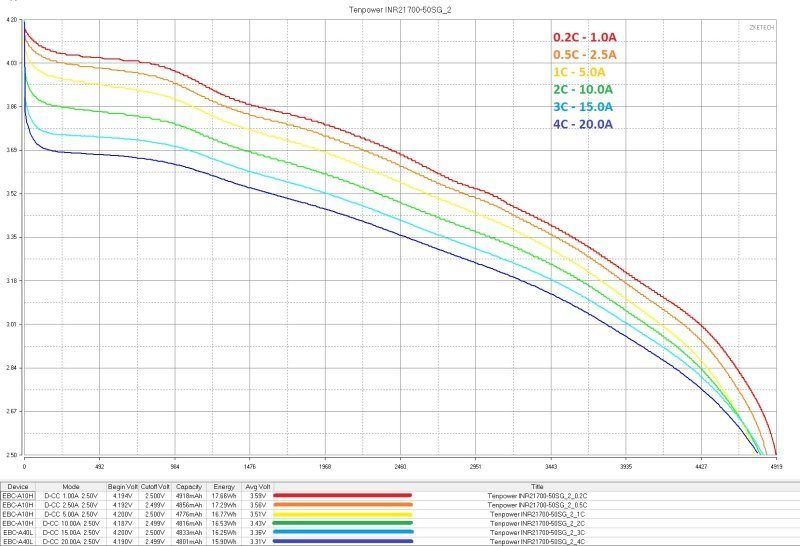
I tested discharge at 0.2, 0.5, 1, 2, 3, and 4C, i.e. across a current range of 1–20 A, for a total of 6 test conditions.
The datasheet specifies a minimum capacity of 4900 mAh against a rated capacity of 5000 mAh. At 0.2C, I got 4931 mAh, which was less than I expected. Capacity was below 4900 mAh in all the other test conditions.
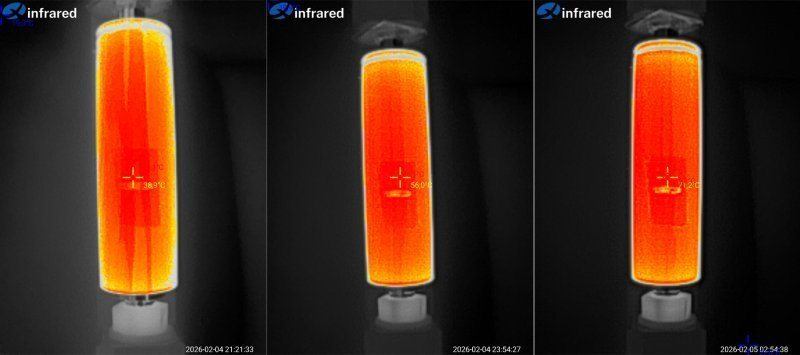
Temperatures at 2, 3, and 4C. In my opinion, around 70 degrees at 20 A is quite good for these cells, especially considering that's their maximum specified continuous current.
The second cell did even a little worse on capacity, barely managing to reach the specified minimum of 4900 mAh.
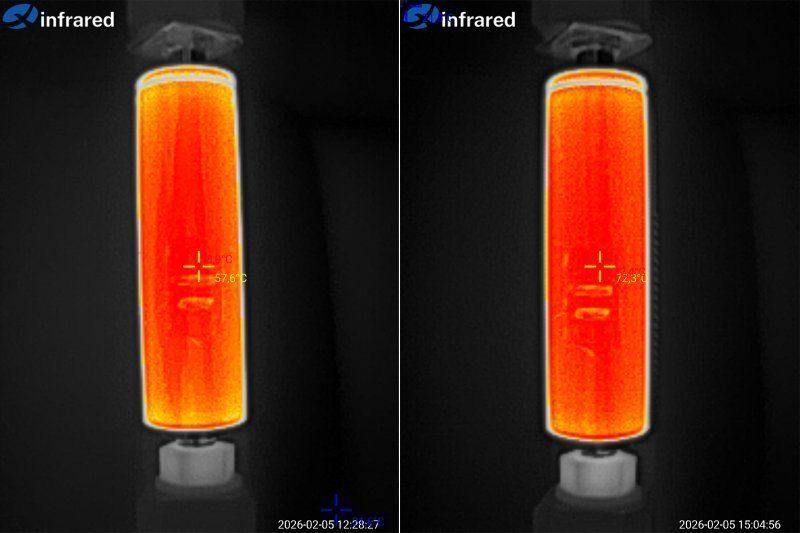
Temperatures at 3 and 4C were practically identical to those of the first cell.
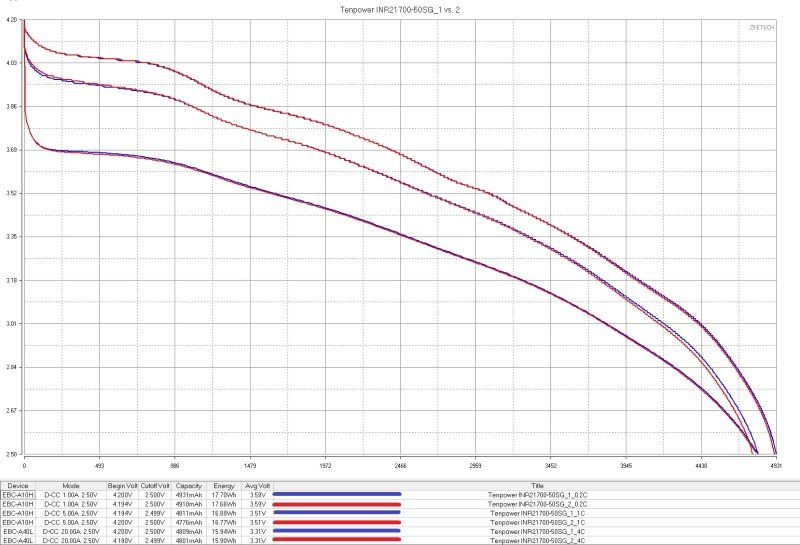
Overall, the cells match well. At 0.2 and 1C, the second cell lagged slightly, but the difference was within the margin of error.
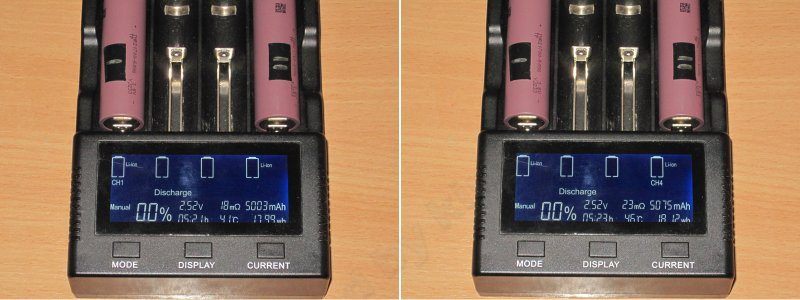
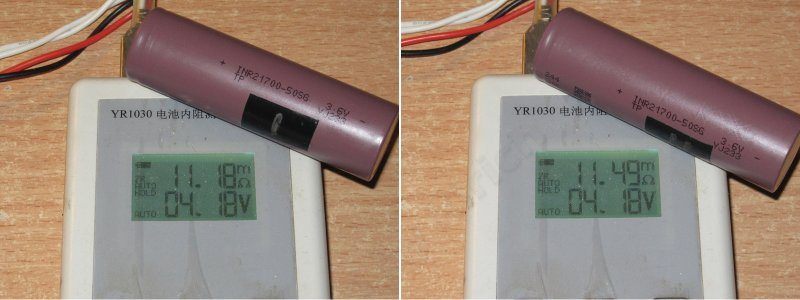
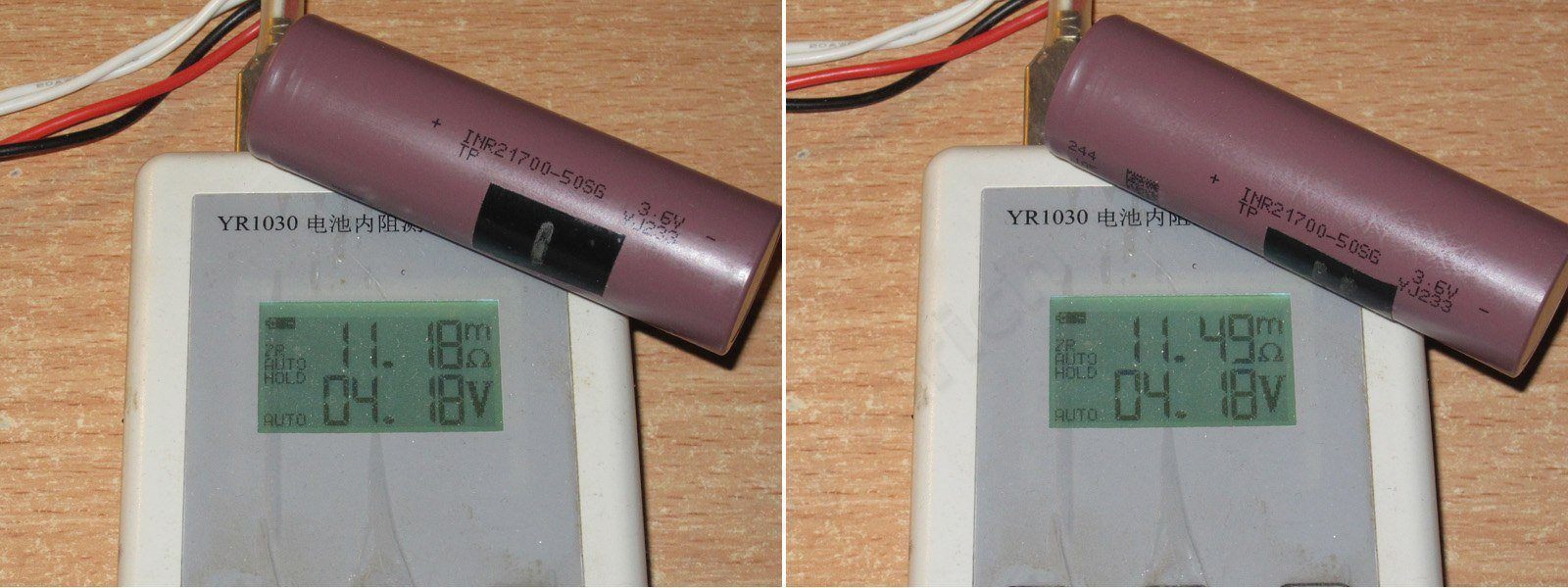
Battery impedance in the charged state, after all the tests.
The second pair: Reliance INR21700-RS50
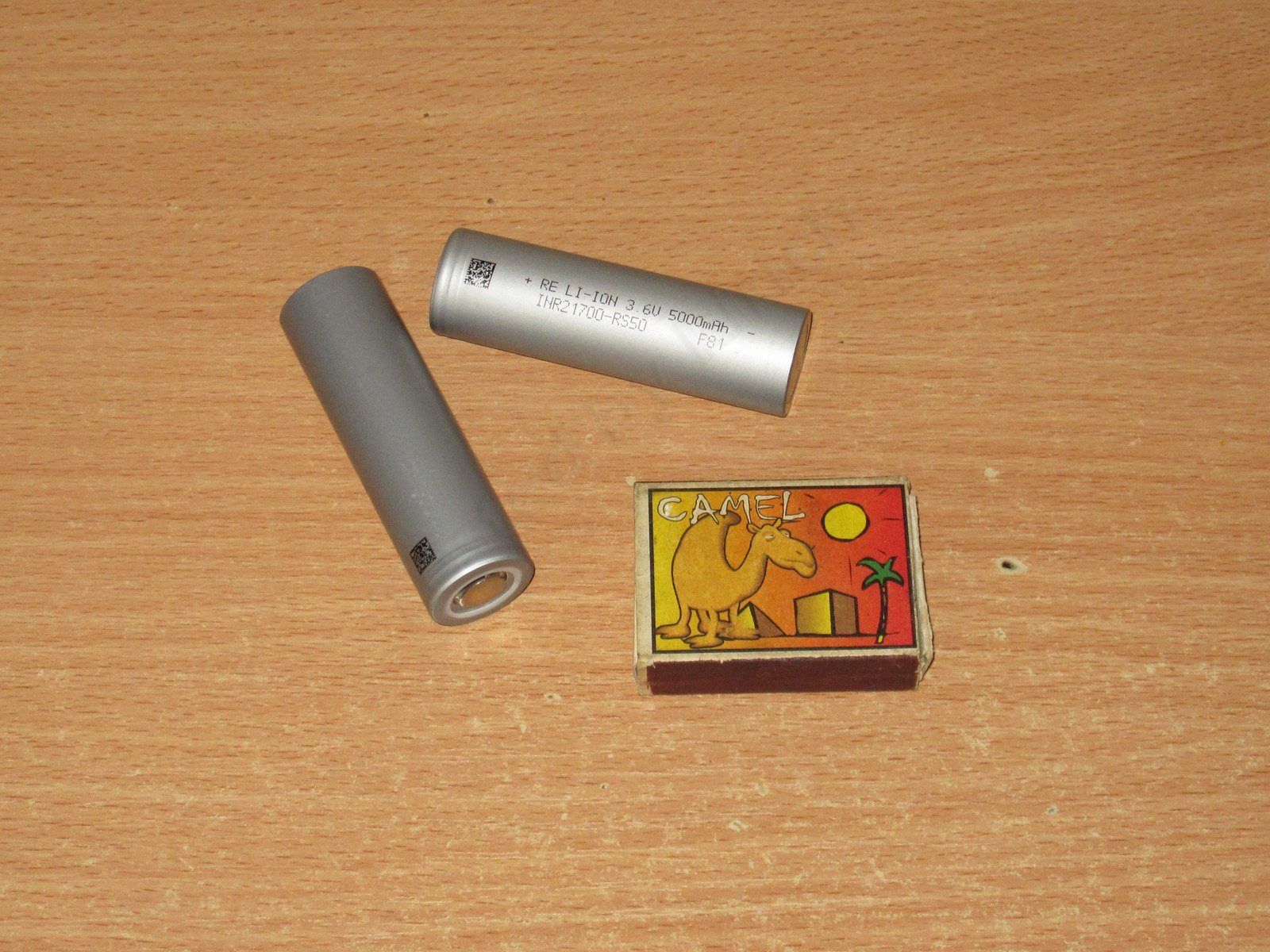
That's a very unusual color for batteries. I think this is the first time I've come across ones like these.
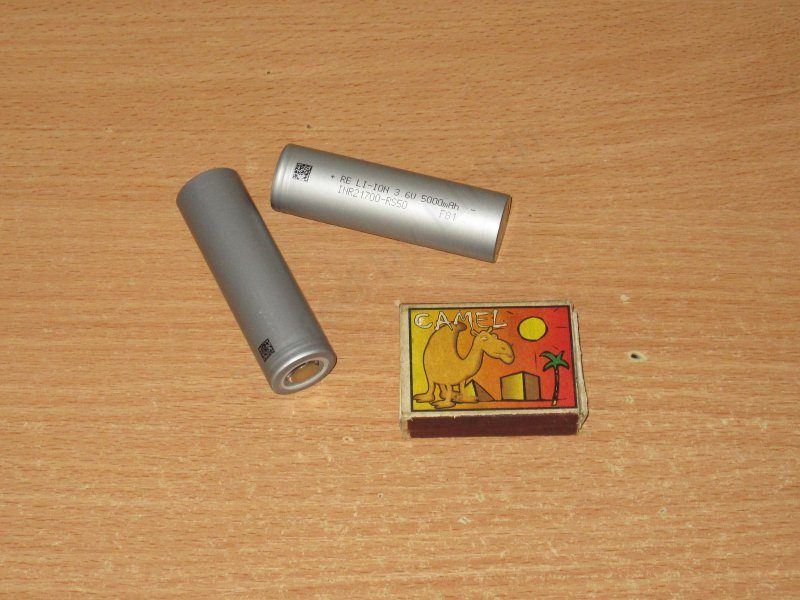
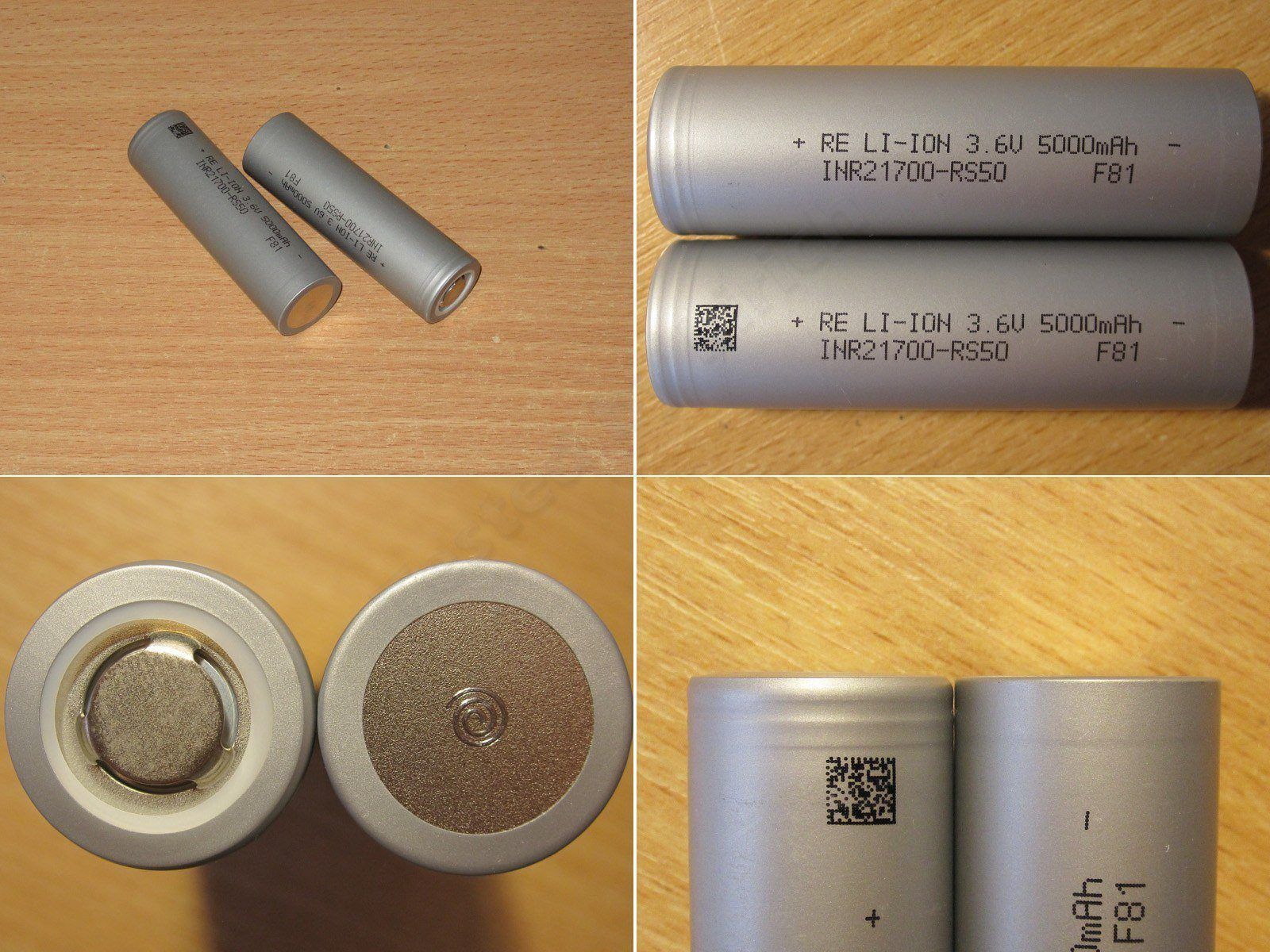
They also have a matrix code, which usually contains the cell's serial number, as well as some kind of coded marking, presumably the manufacturing date, though I'm not sure about that.
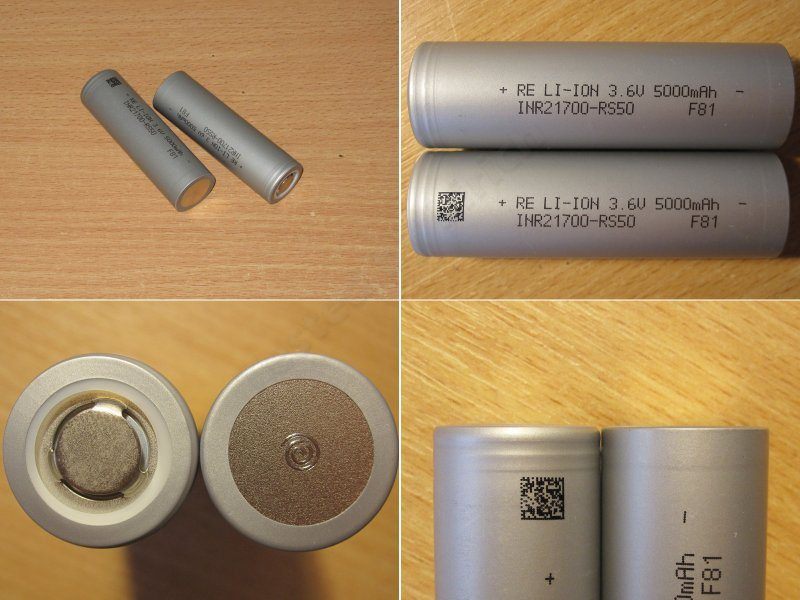
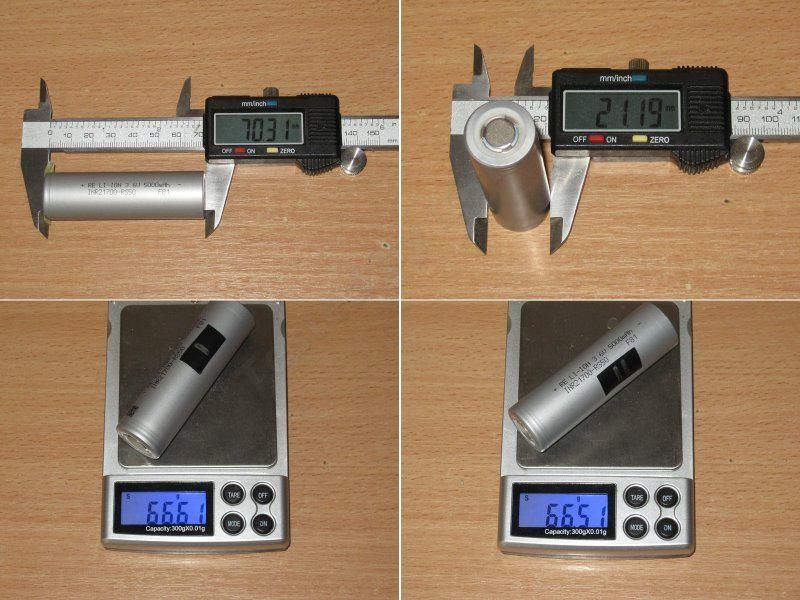
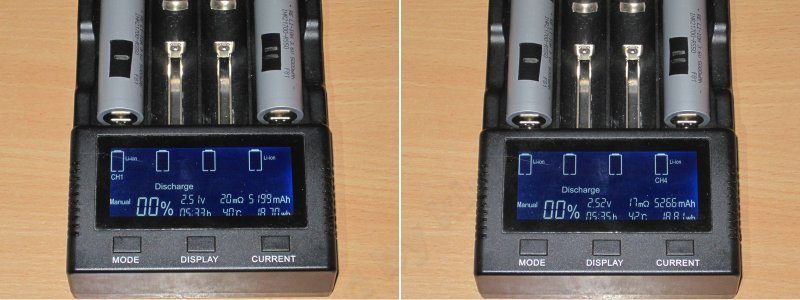
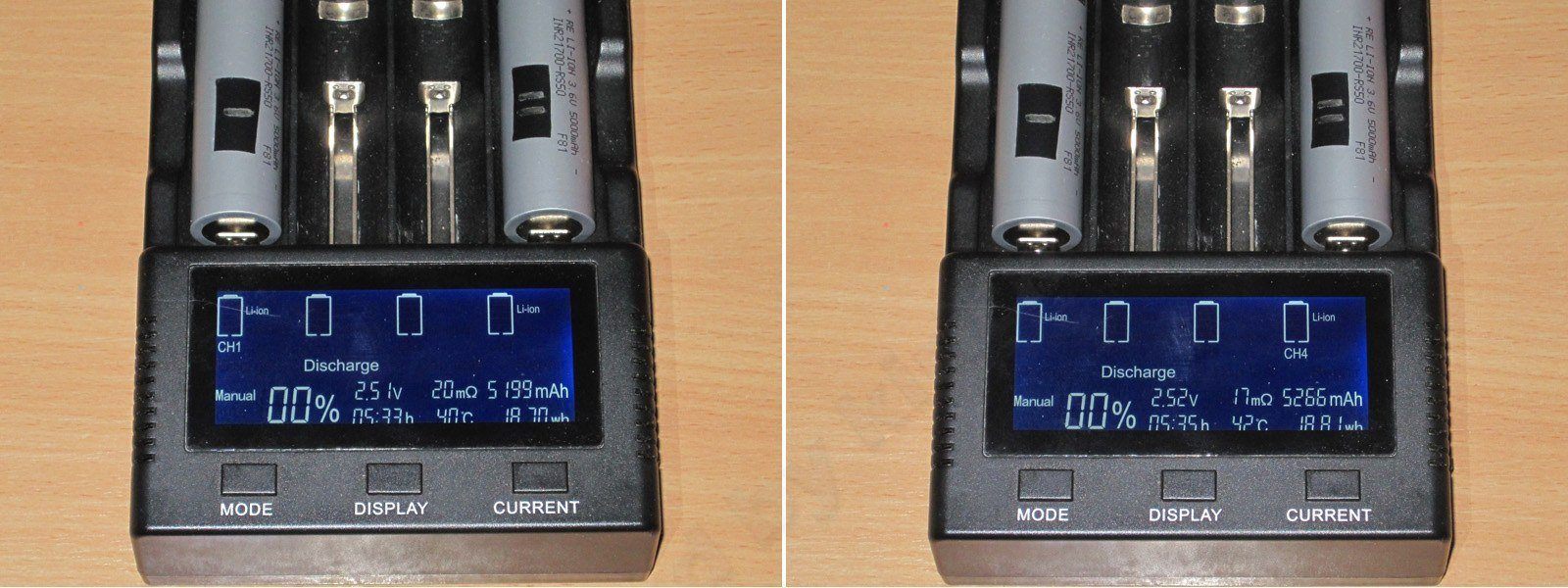
The first charge took almost 4 Ah, so... The initial charge was around 20%; the first discharge cycle showed a capacity of about 5200 mAh, which is already interesting.
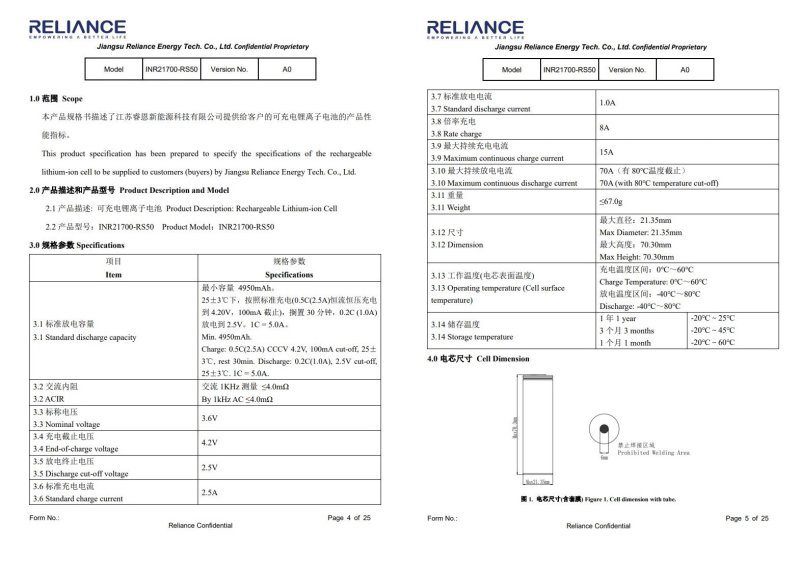
The standard charging current is 8 A, the maximum is 15 A, and the maximum discharge current is 70 A, provided the temperature is limited to 80 degrees.
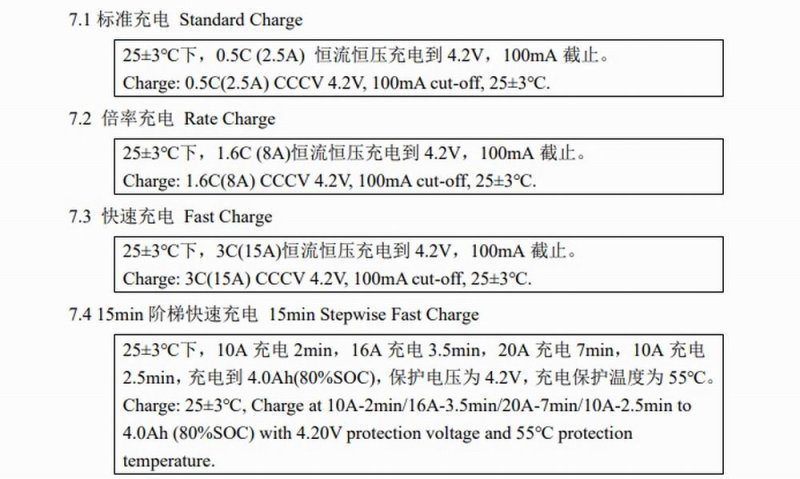
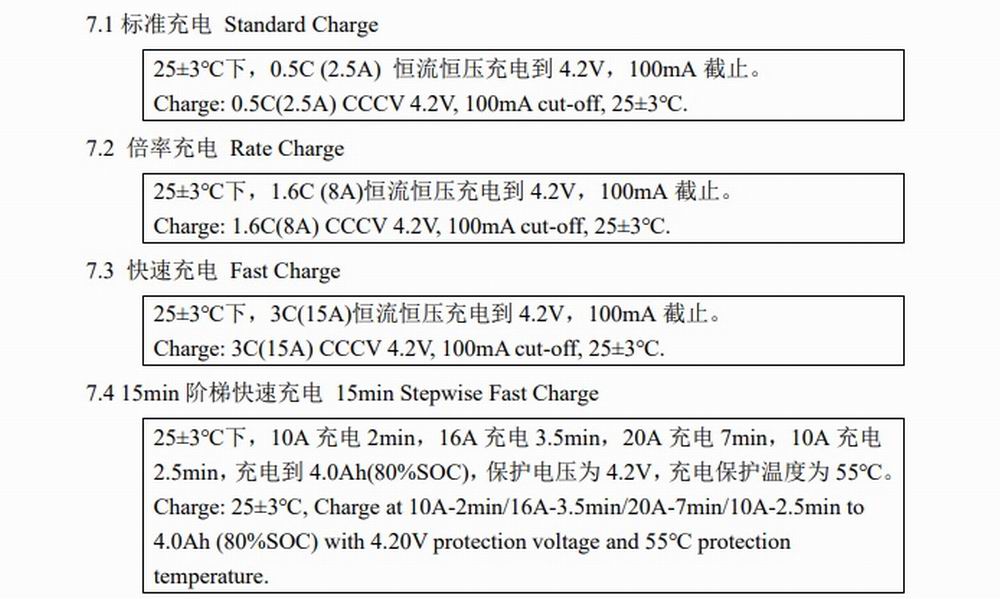
The datasheet is really comprehensive, with a lot of information. For example, it says the batteries support several charging modes: standard charging at 2.5 A, accelerated charging at 8 A, fast charging at 15 A, and a complex super-fast mode where the charging cycle is split into several stages at different currents, up to 20 A.
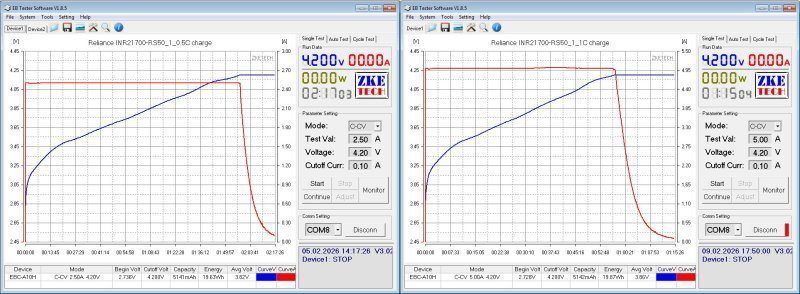
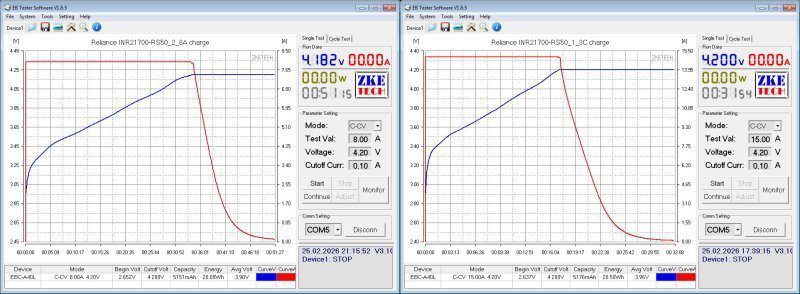
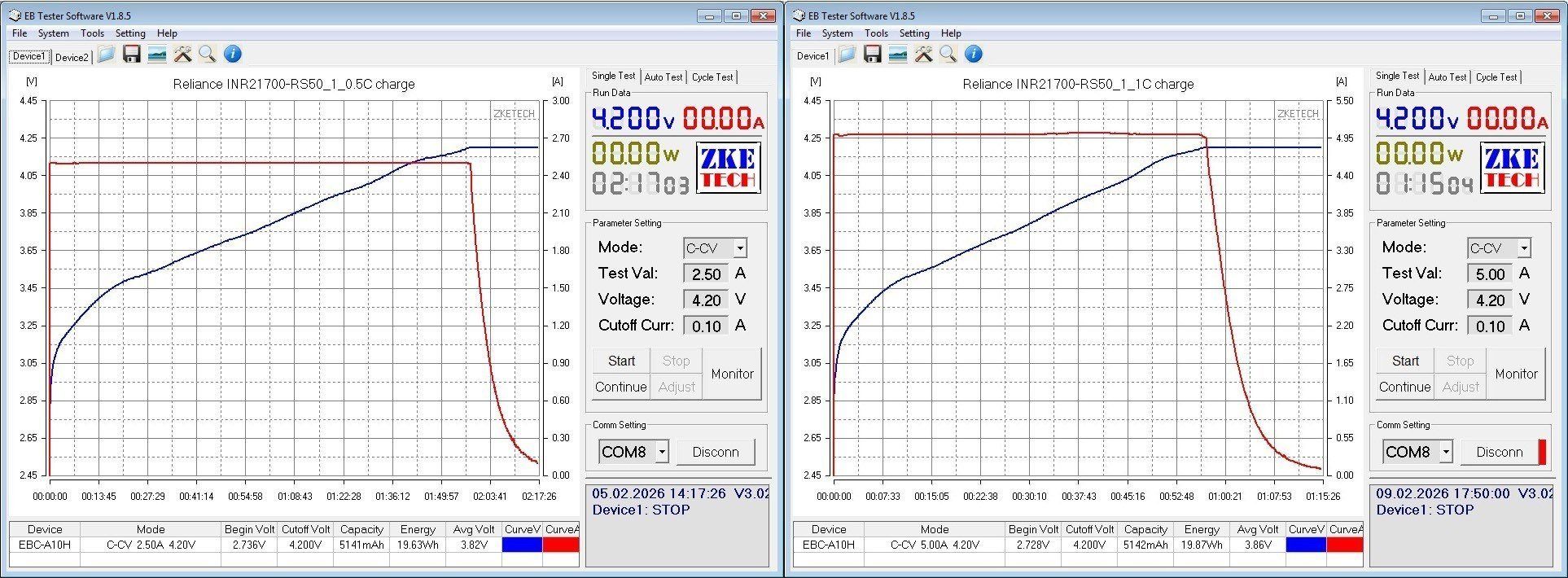
To make the results comparable, I measured charging times at 0.5C and 1C. The first took 2 hours 17 minutes, and the second 1 hour 15 minutes. To be honest, after testing the previous cells, I expected charging to be faster, although accounting for the difference in capacity, it was in fact a little faster.
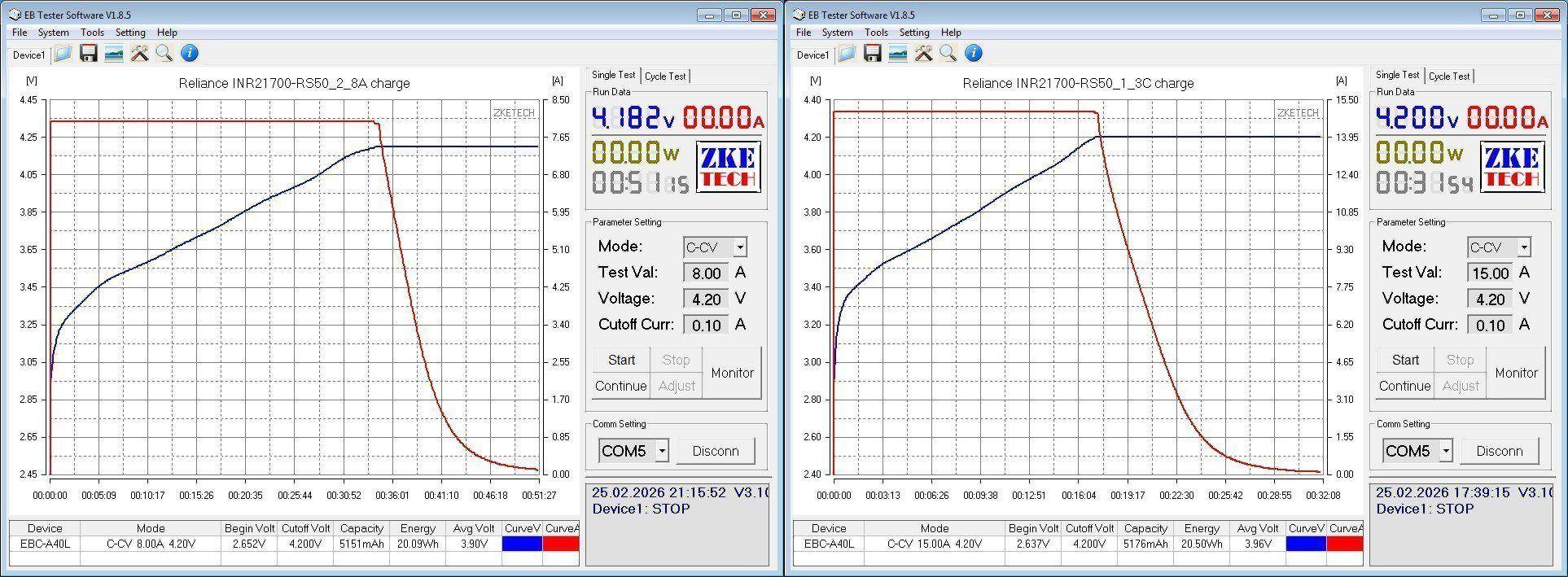
While preparing the review, I decided to also test charging at 8 A and 15 A. I wanted to try the 15-minute stepped charging mode too, but the electronic load can't do that while charging, only while discharging. By the way, the 15-minute stepped charging mode isn't quite as simple as it sounds: the manufacturer specifies that it only charges the battery to 80%, not fully.
Later I thought I could have programmed my RD6030, but honestly, I couldn't be bothered.
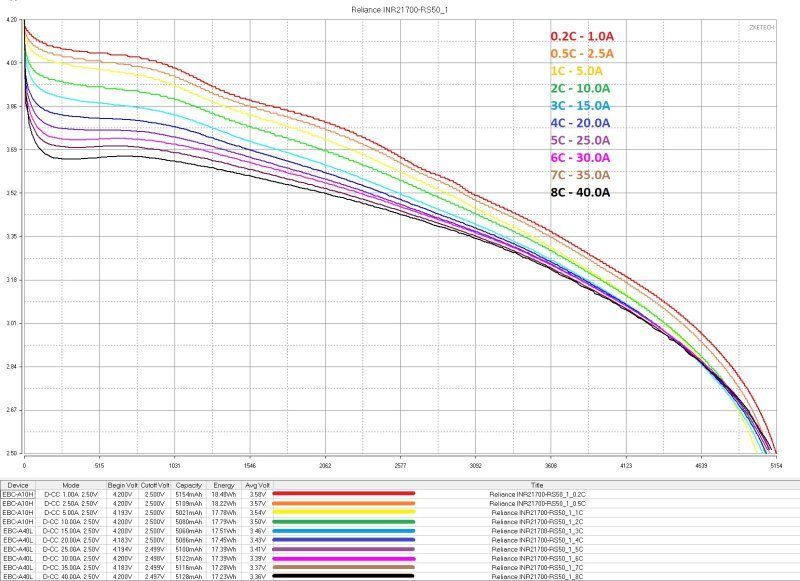
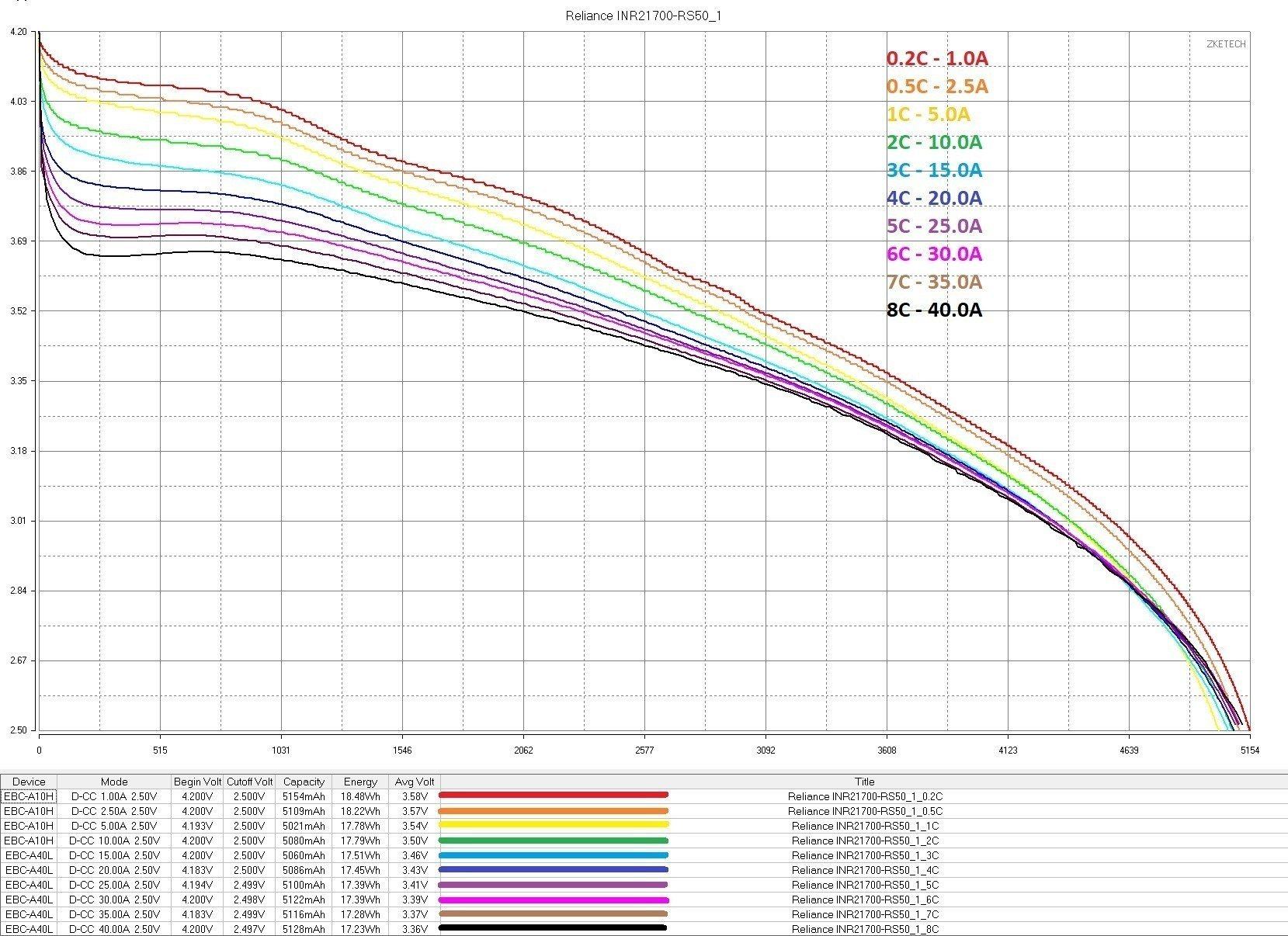
The discharge test took a long time—a very long time—and included 10 stages: 0.2, 0.5, 1, 2, 3, 4, 5, 6, 7, and 8C.
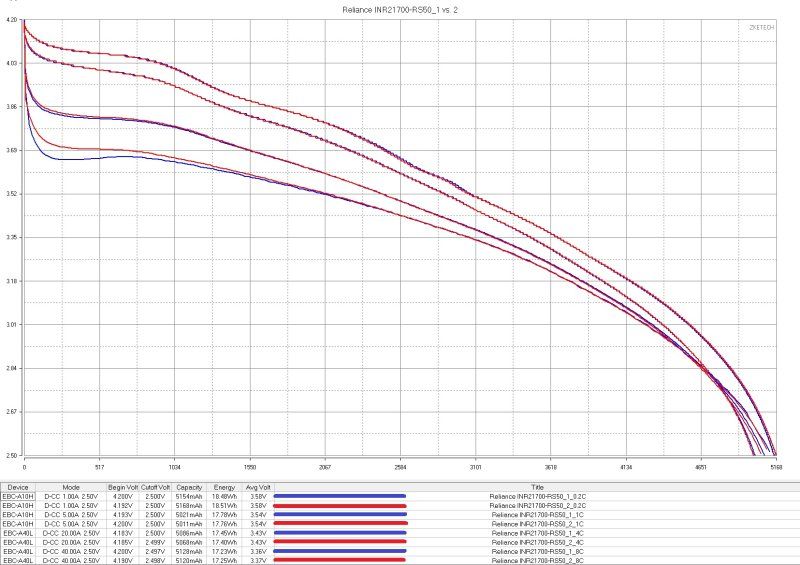
The battery delivered its rated 5 Ah in every mode. Capacity was lowest at a discharge rate of 1C and highest at 0.2C; as expected, energy in Wh was highest at the lowest discharge current. The datasheet gives figures for 40, 50, 60, and 70 A, and states that at 40 A the cell should deliver 100% of its capacity.
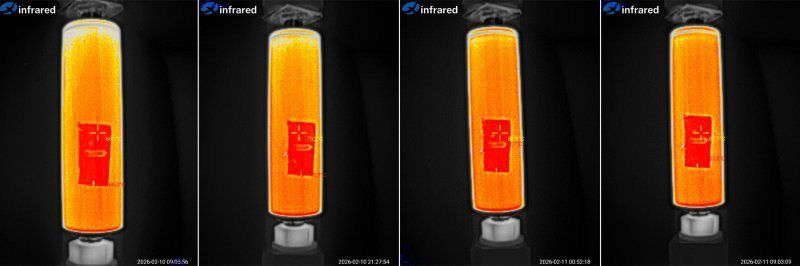
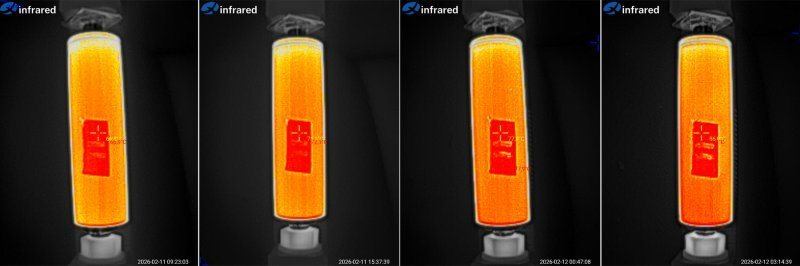
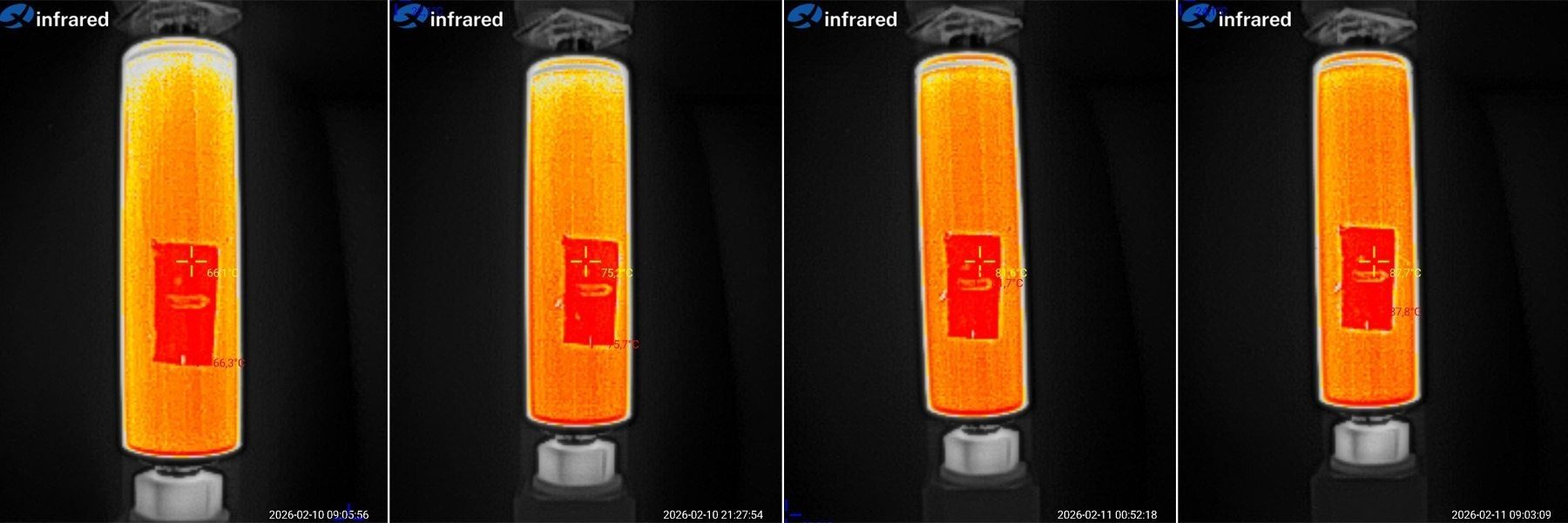
Temperature at 5, 6, 7, and 8C, although in practice I was only interested in the last mode. As I mentioned above, the specified discharge current is up to 70 A, provided the temperature is limited to 80 degrees. In reality, I reached that temperature at 35 A with a single cell.
On the one hand, you realize they're pulling a fast one on you; on the other, staying below 90 degrees at 40 A is pretty good in its own way.
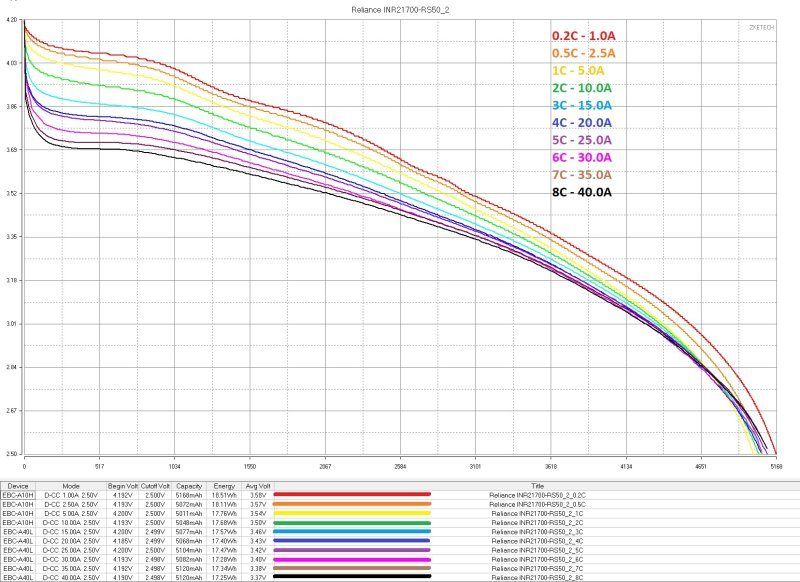
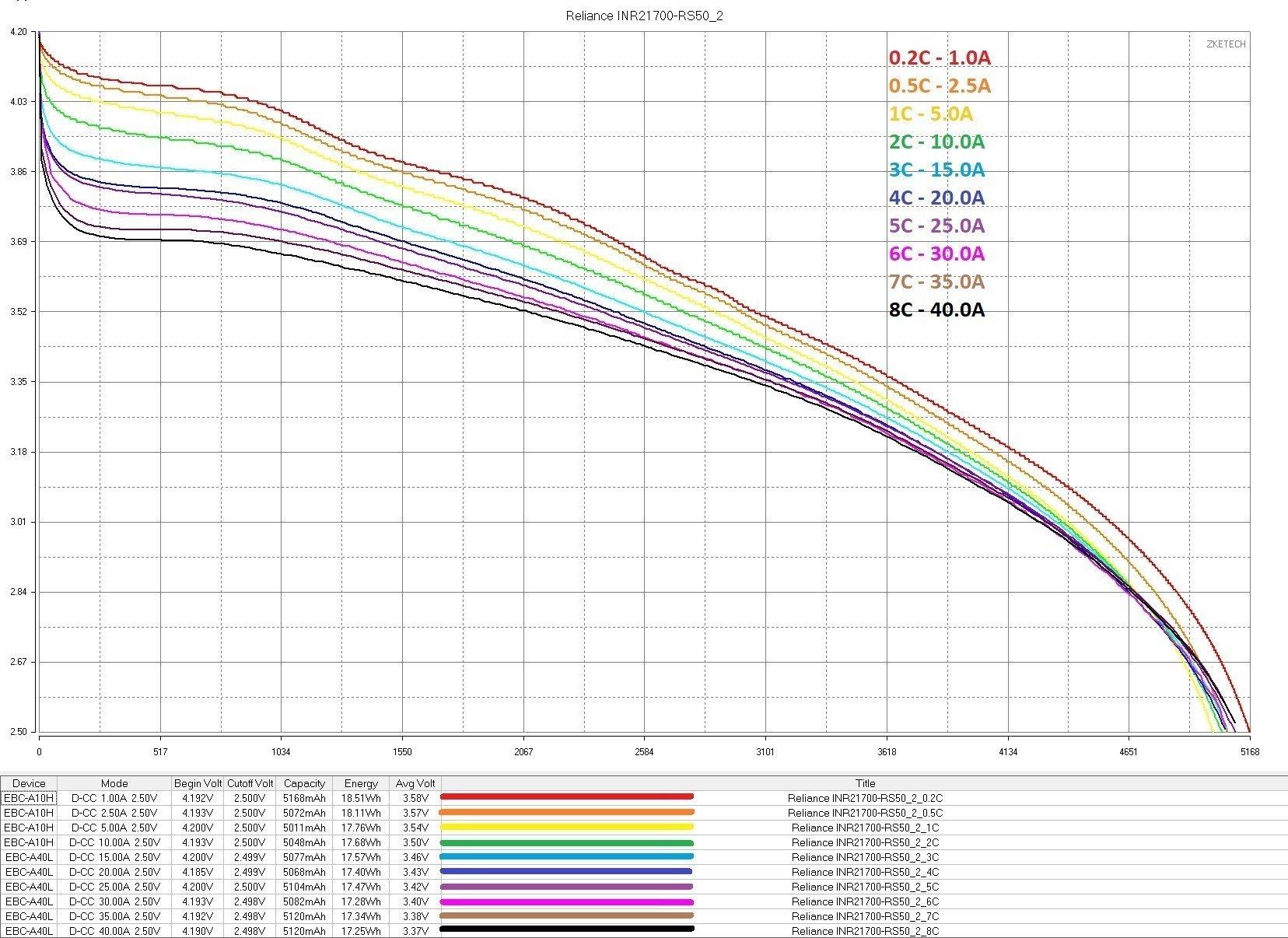
The test results for the second cell are essentially about the same.
The temperature was a little lower in some modes, but I think that's because the room was a few degrees cooler. In any case, we also get around 80 degrees at 35 A and over 85 at 40 A.
The residual capacity after discharging at 40 A was 50 and 70 mAh, which is very good—around 1–1.5% of the total.
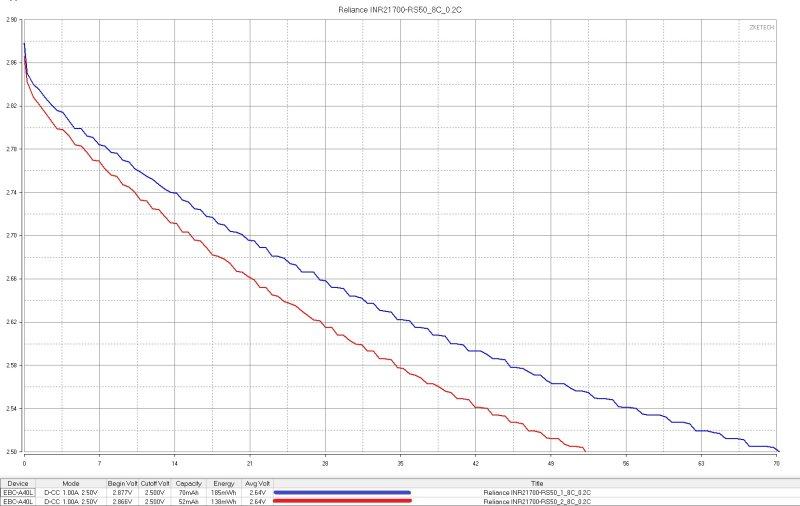
I also have no complaints about how closely the results match. The only thing is that at 40 A, one cell sagged more at the start of the test for some reason, though this didn't really affect the results.
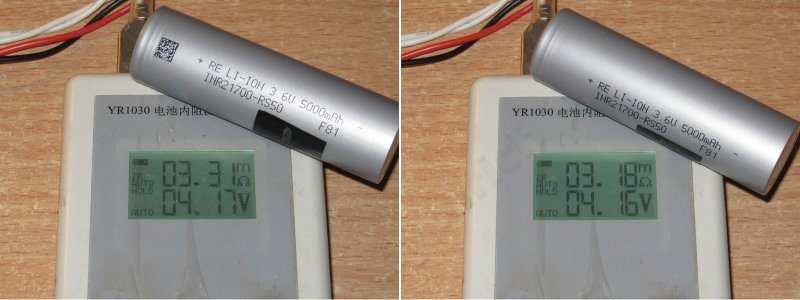
The batteries' impedance is just over 3 mΩ, which is really unusual to see in 21700 cells.
And the third cells are the EVE INR21700-50PL, which are already fairly well known online.
I think these cells have had more publicity than the previous ones, since it's hard to find anyone who hasn't heard of EVE. So I was doubly interested in comparing their results with the previous cells, especially since they're in exactly the same class.
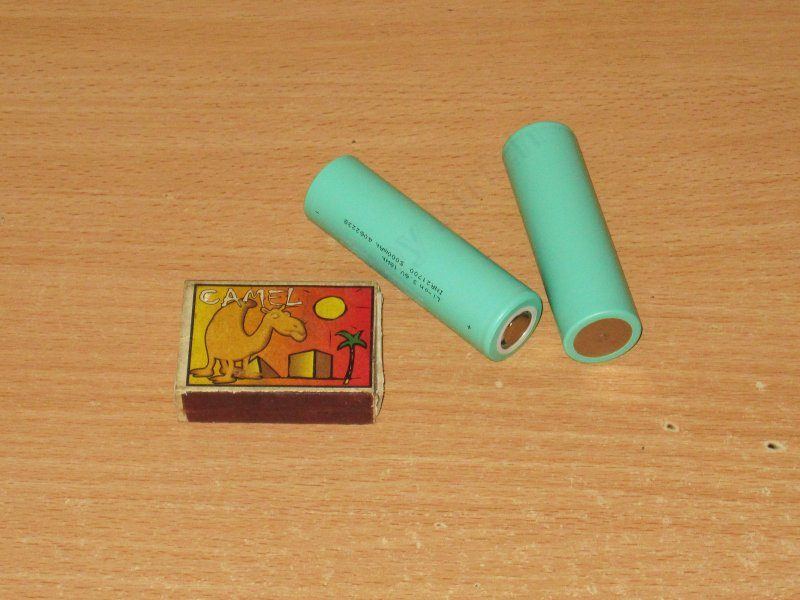
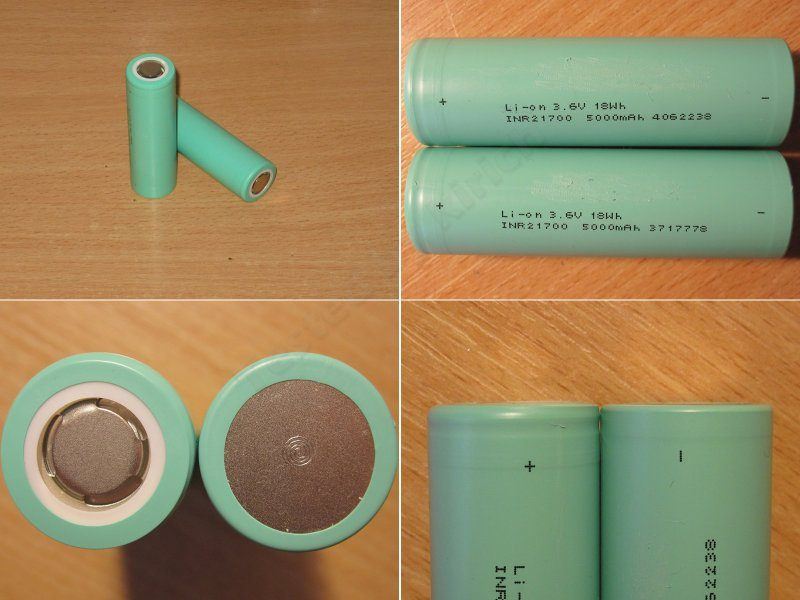
There's no matrix code on the cells, but they do have a unique number, possibly unique within a batch, which is also good.
Last time I forgot to mention the distinctive spiral on the negative terminal. It's present here too. Whether this is a distinguishing feature of tabless cells, I don't know, but it seems quite possible.
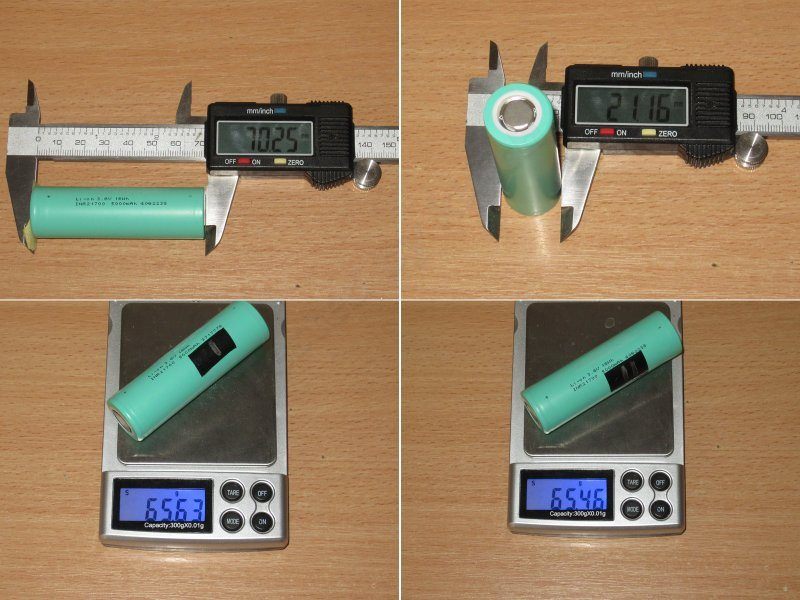
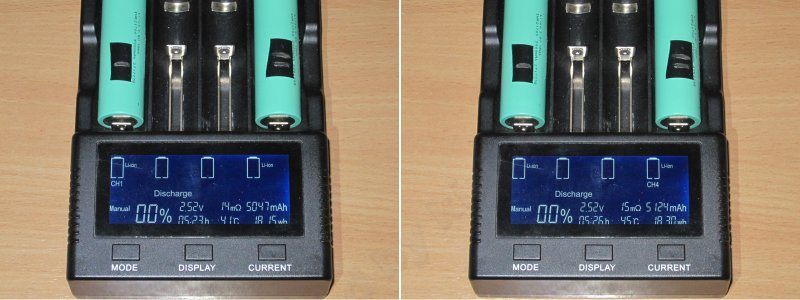
It took 4300 mAh to charge the first cell initially, while the second took about 4800 mAh, meaning it was essentially fully discharged.
The first discharge yielded around 5100 mAh.
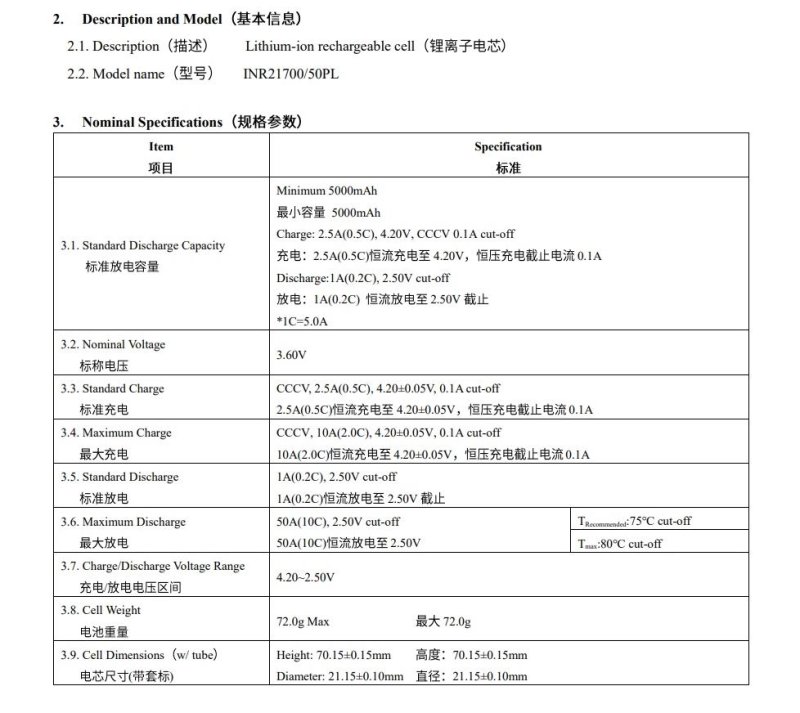
These cells are a little weaker than the previous ones. Those were rated for up to 70 A, while these top out at 50 A. The same goes for charging current: up to 15 A for the previous cells, and 10 A here, so So they’re about one and a half times less “powerful,” if that’s the right word.
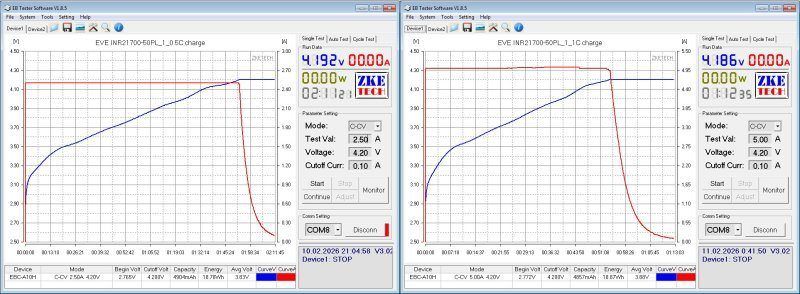
I tested charging at 0.5C and 1C, and these cells had the shortest charging time of all three samples.
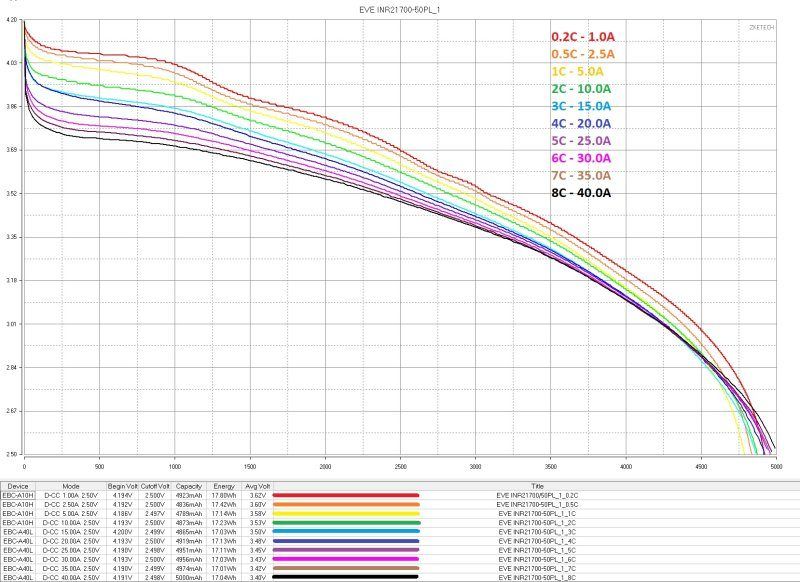
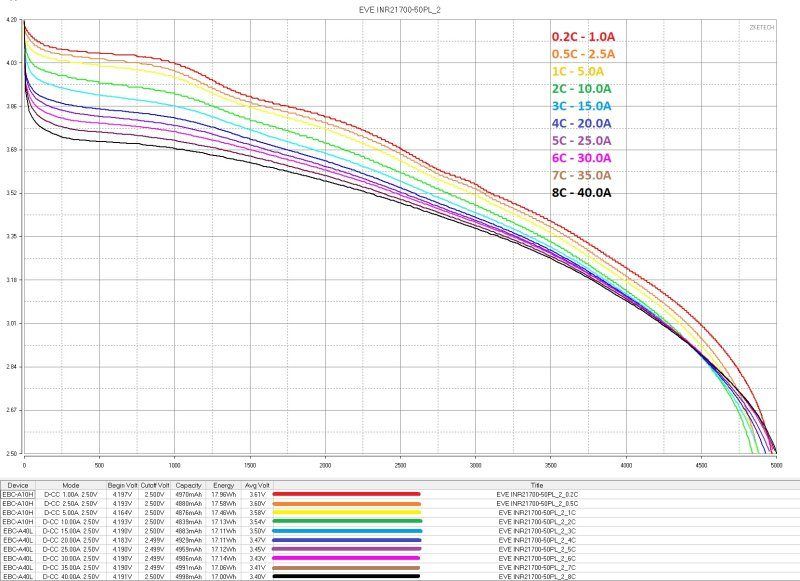
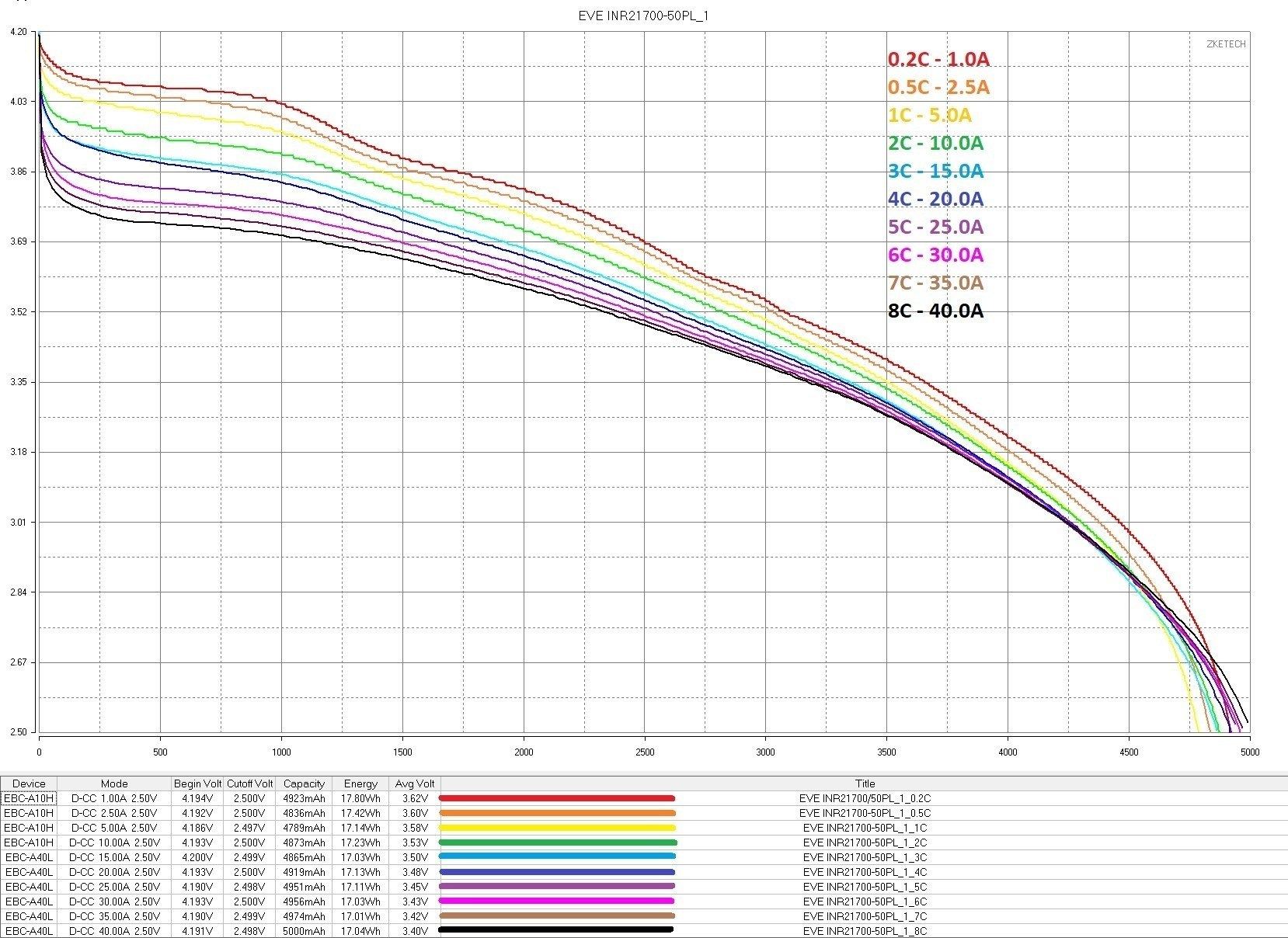
I tested discharge in the same ten modes: 0.2C, 0.5C, 1C, 2C, 3C, 4C, 5C, 6C, 7C, and 8C.
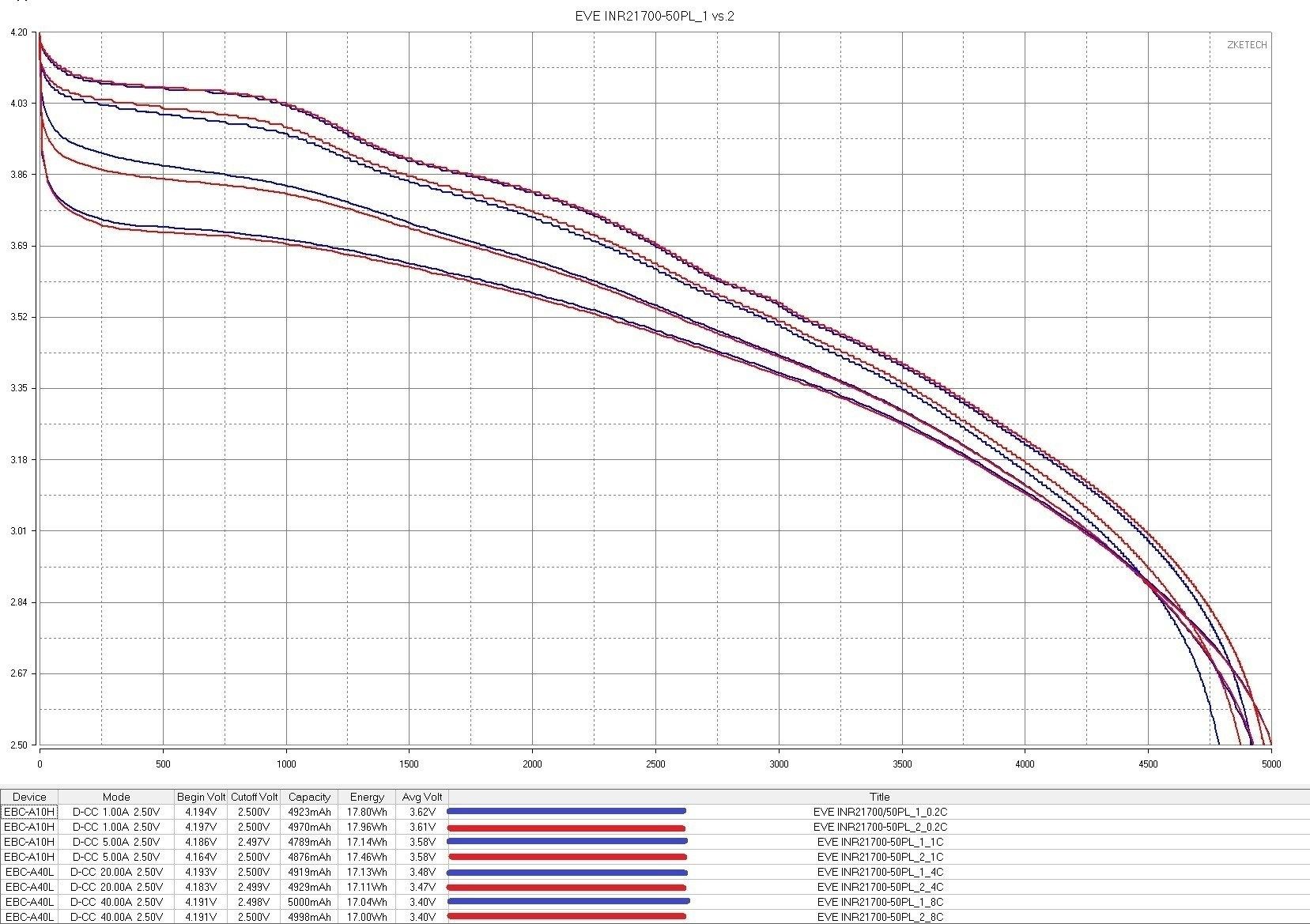
Only at the maximum current did the cell deliver exactly 5000 mAh. In all the other modes, I got slightly less, which is a little strange, since the datasheet specifies a minimum of 5000 mAh.
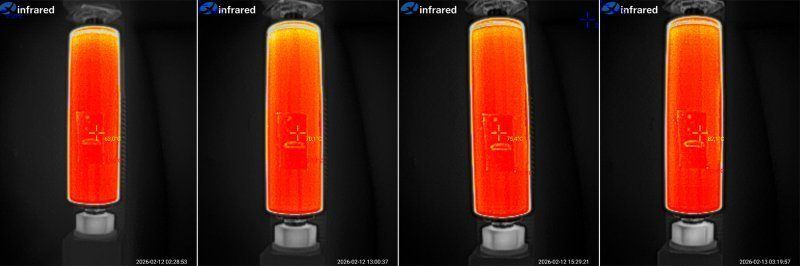
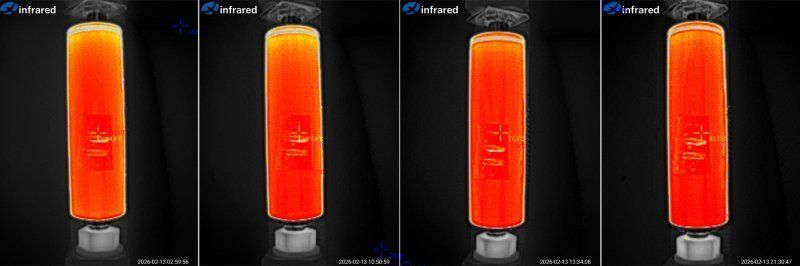
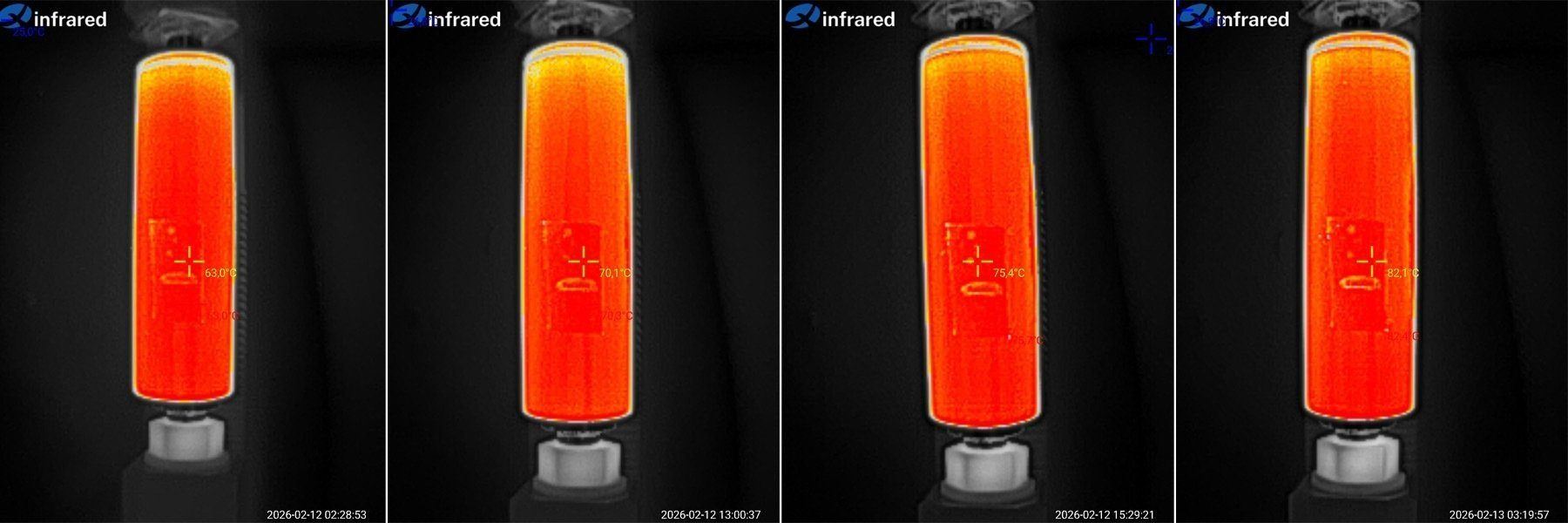
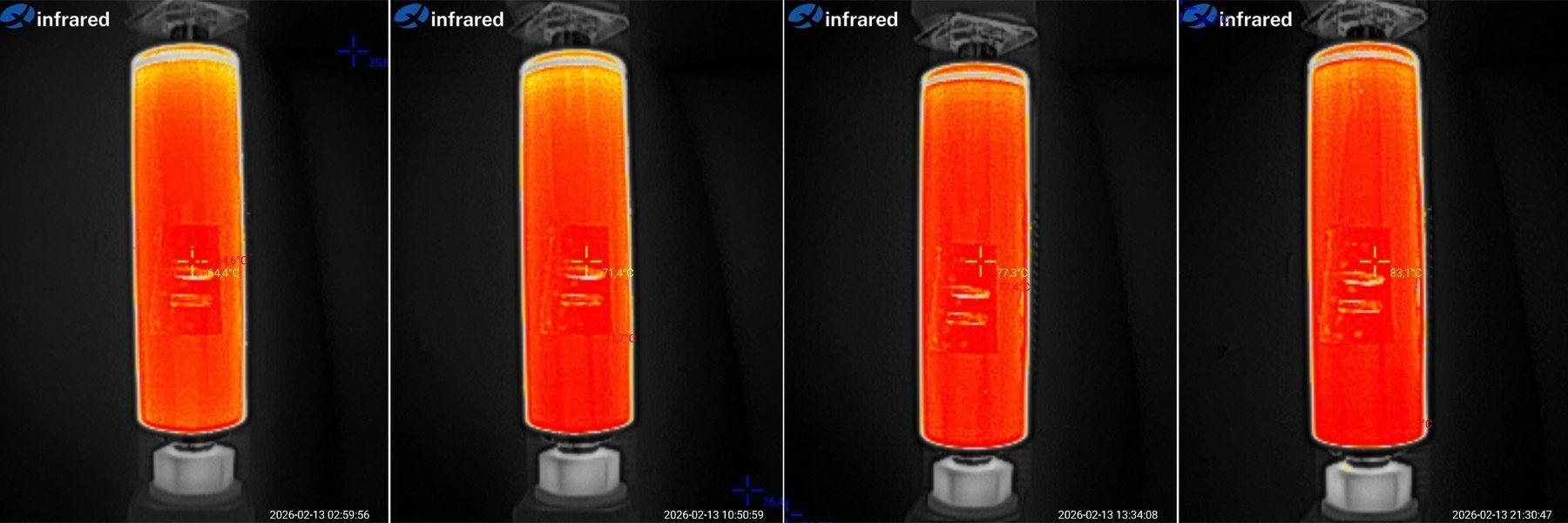
At currents of 5C, 6C, 7C, and 8C, the temperature results here were surprisingly a few degrees better too. Still, this may be due to the ambient temperature, or perhaps to the slightly lower capacity, meaning the heating lasted for less time.
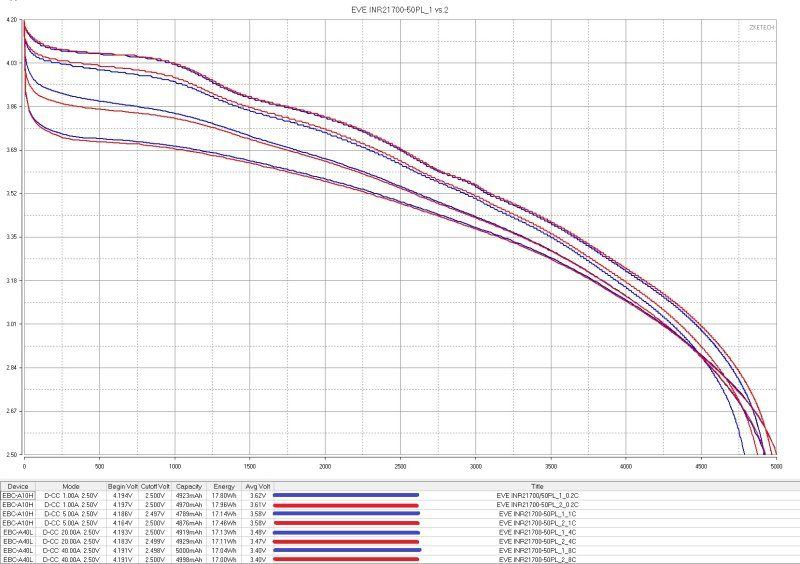
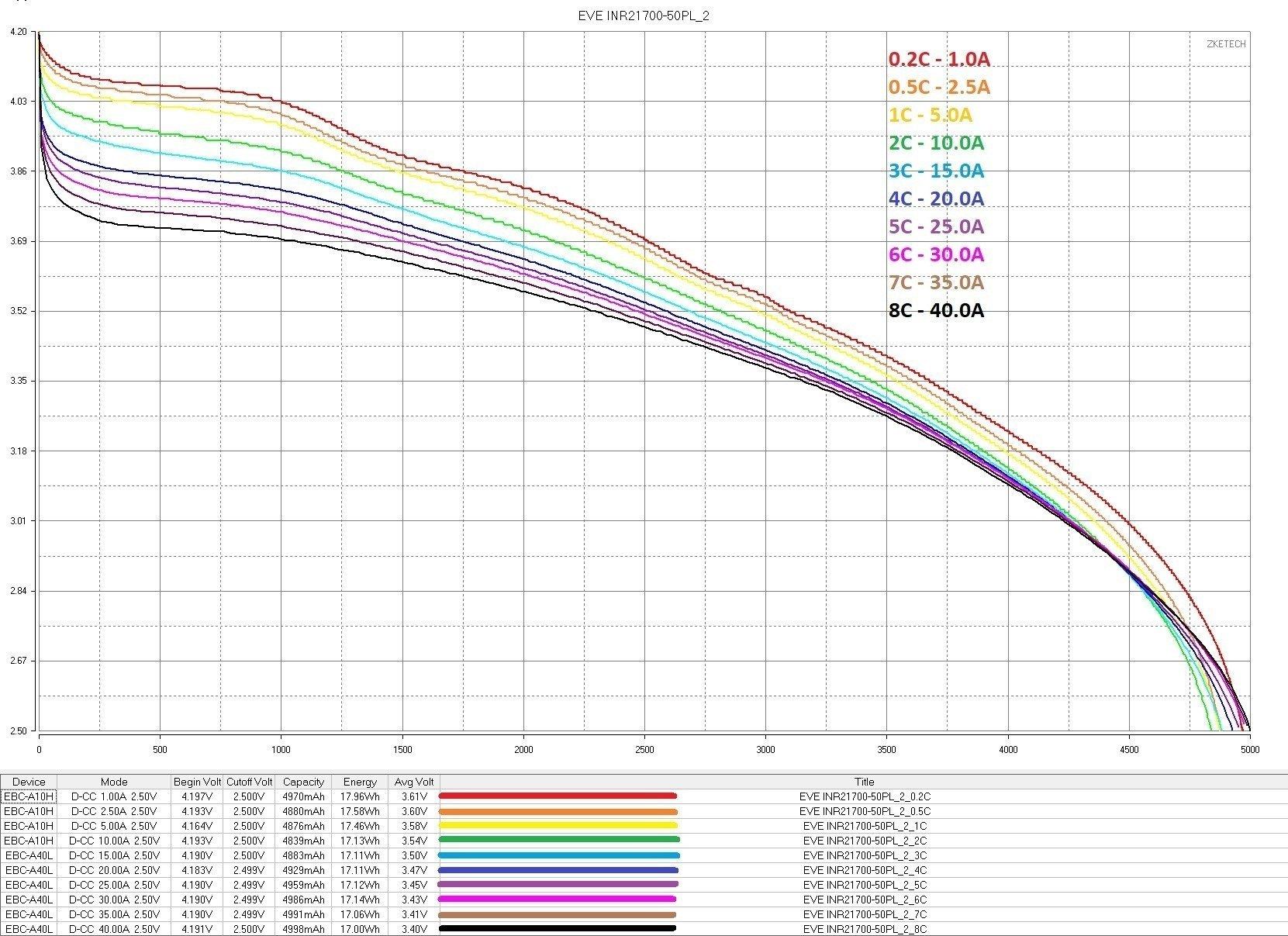
The second sample gave me practically the same results.
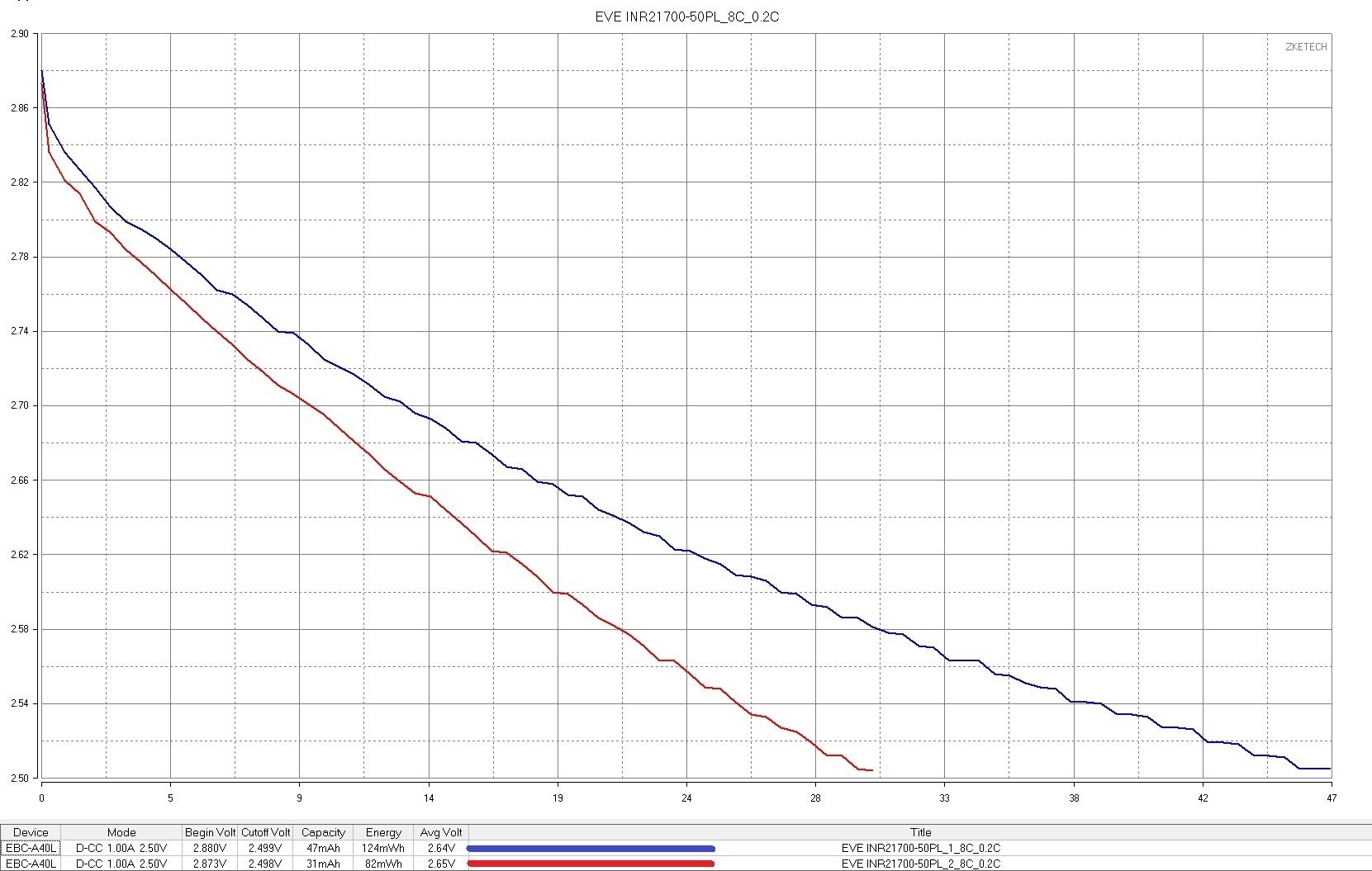
The remaining capacity is about one and a half times lower than that of the previous cells, which is good.
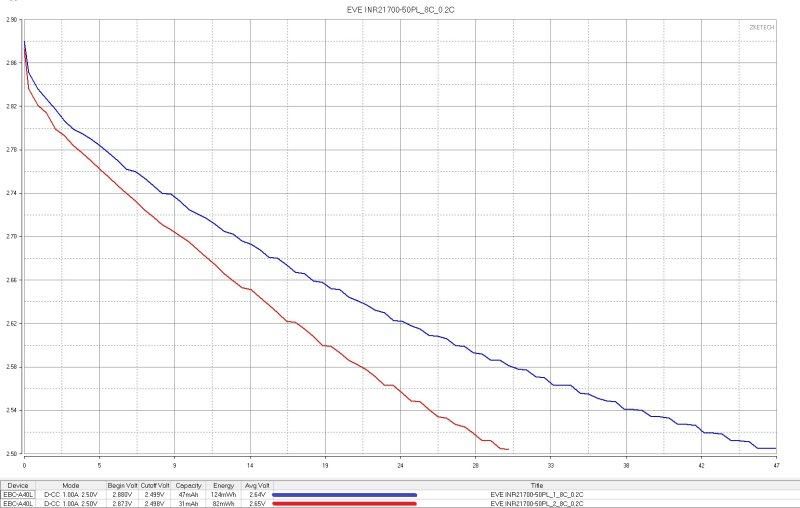
The characteristics match quite well, but what’s interesting is that while most of the graph runs practically neck and neck, right at the end they “diverge” a little.
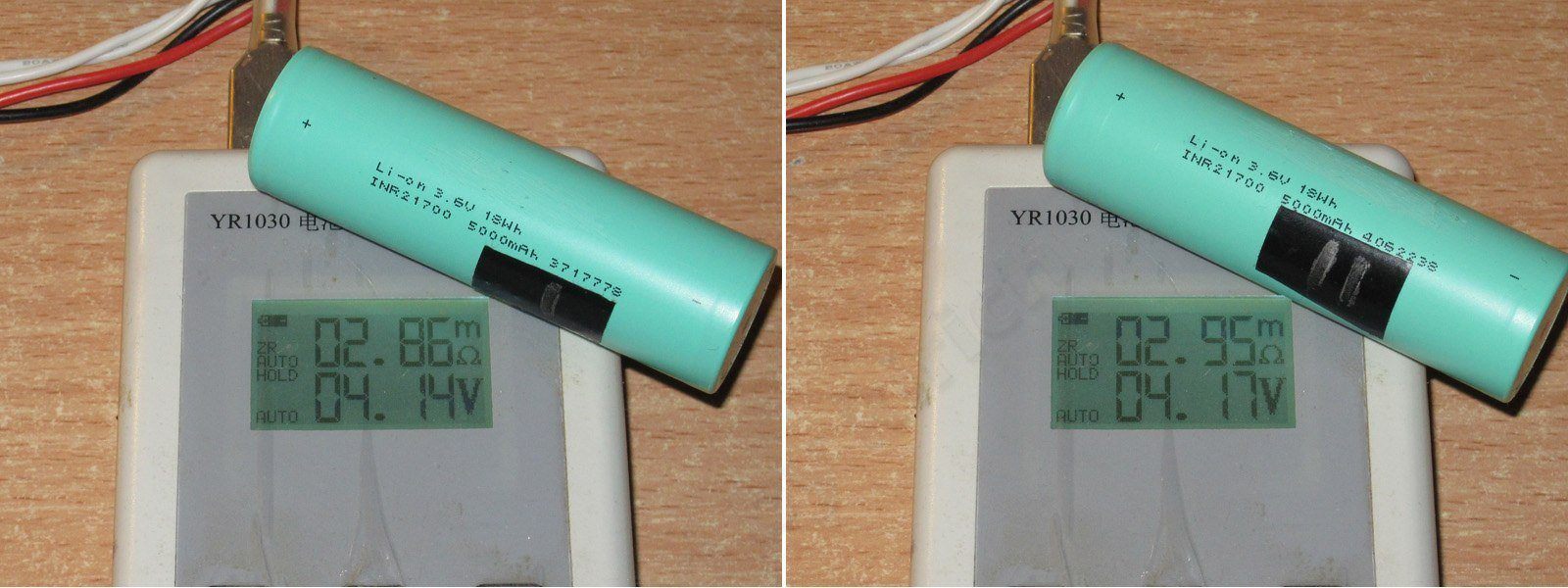
The cell impedance is even lower than that of the previous ones and doesn’t exceed 3 mΩ—really impressive.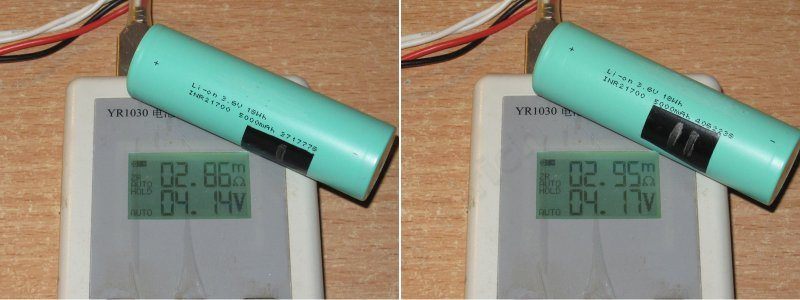
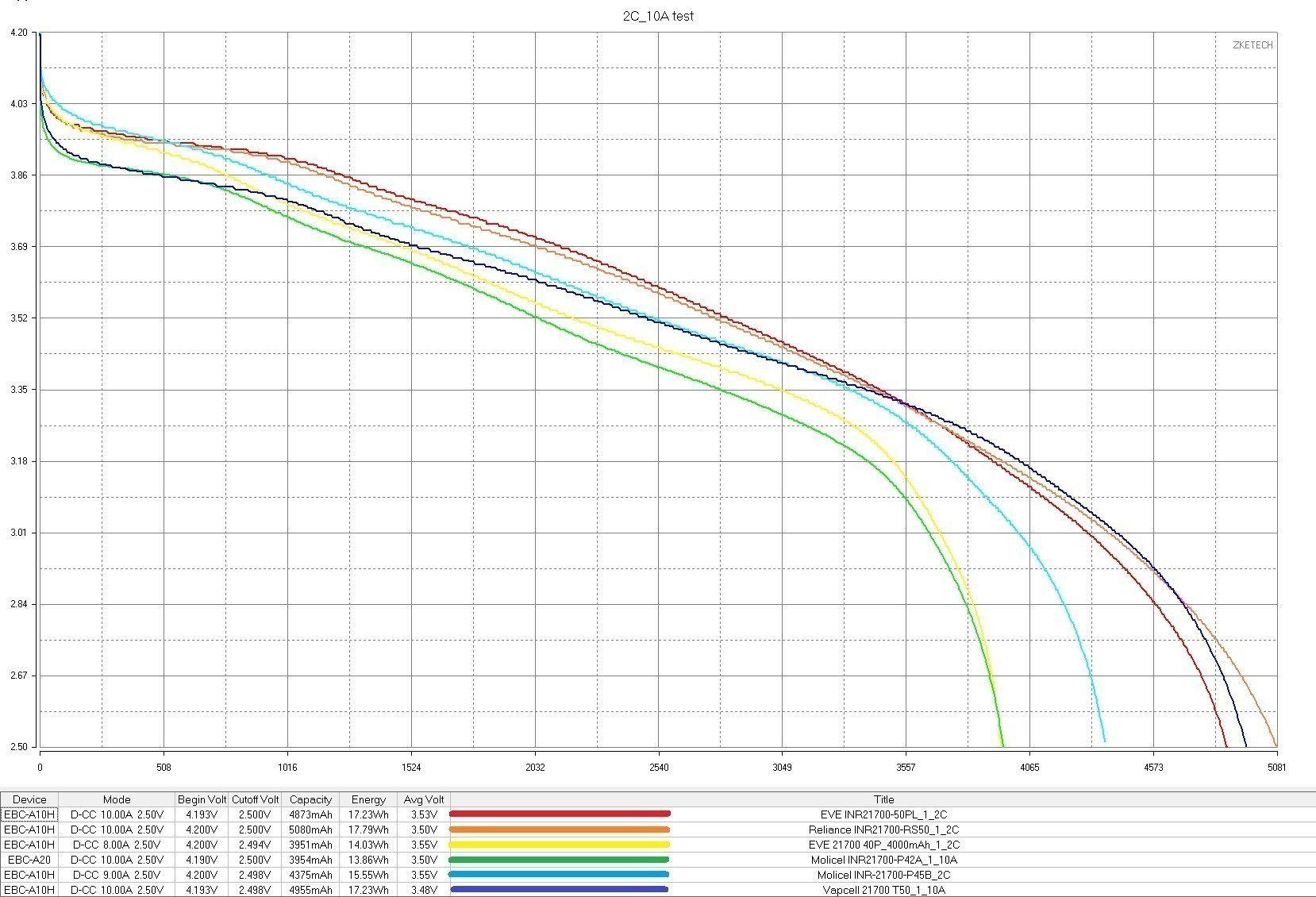
And now for the comparison tests. I didn’t have that many similar cells, so there wasn’t much to compare them with—I had to “pull it out of thin air.”
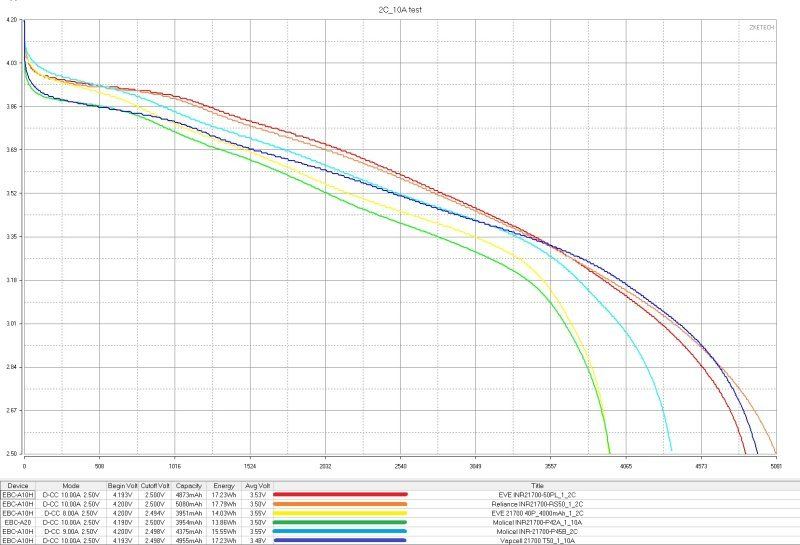
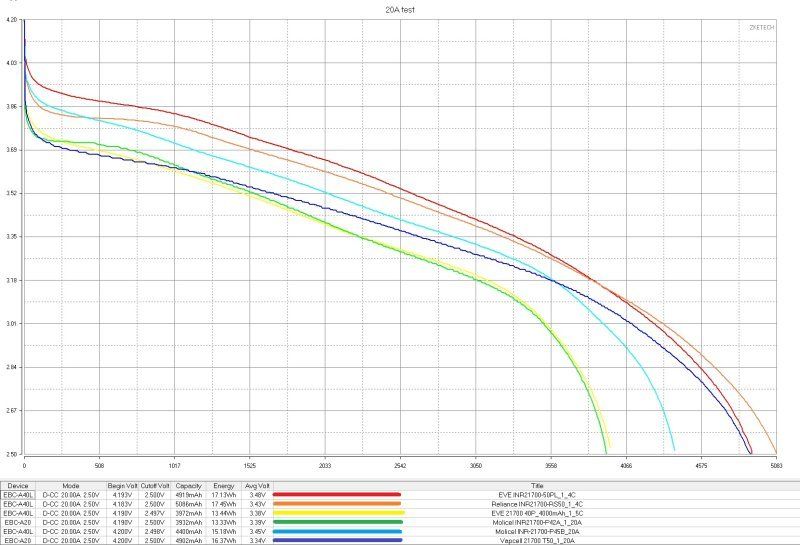
1. EVE INR21700-50PL
2. Reliance INR21700-RS50
3. EVE 21700 40P
4. Molicel INR21700-P42A
5. Molicel INR21700-P45B
6. Vapcell T50
It occurred to me later that I could have included the Tenpower INR21700-50SG too, but in my opinion, it’s somewhat similar to the Vapcell T50.
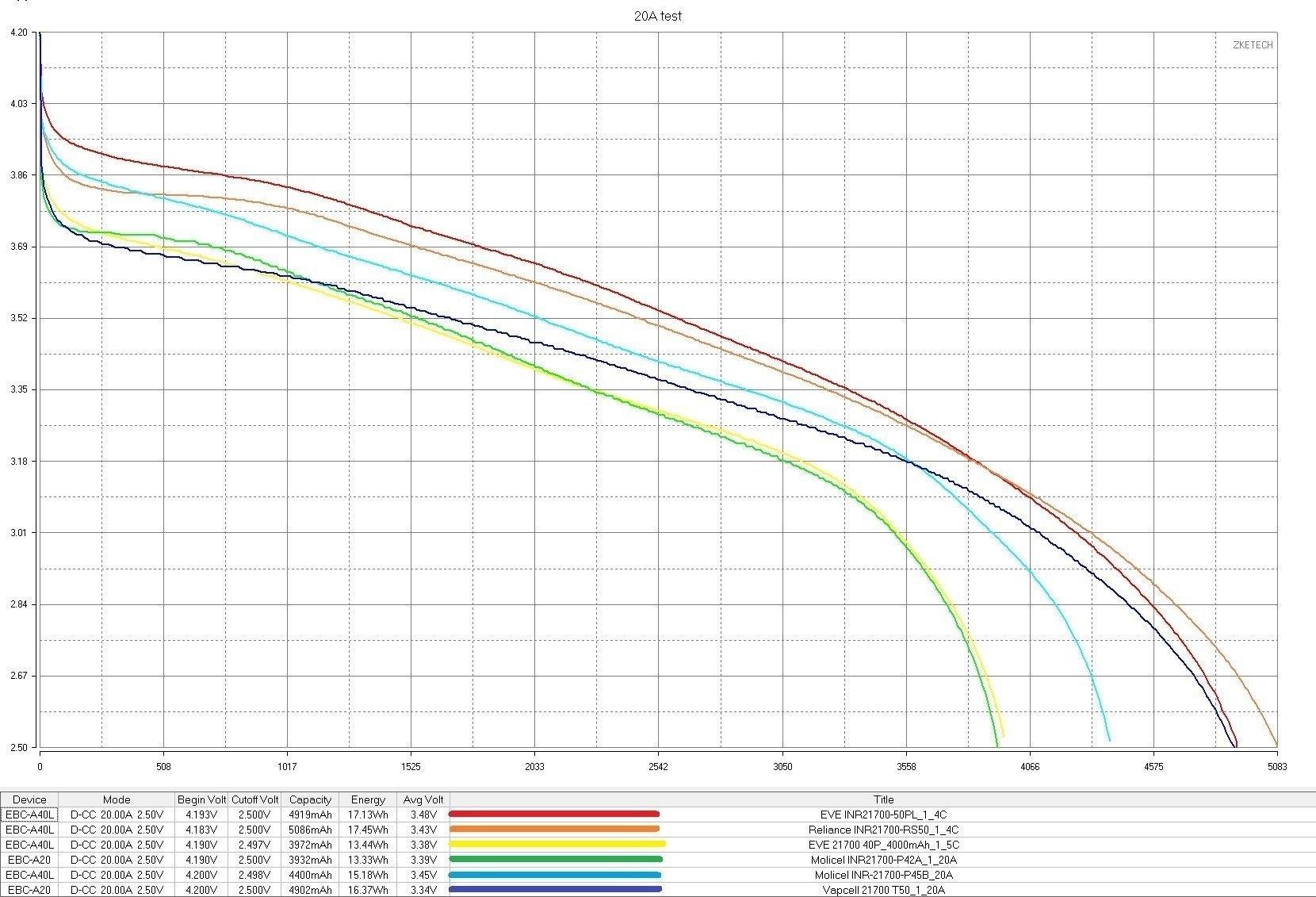
At 2C, as expected, the Reliance INR21700-RS50 takes first place, followed by the Vapcell T50, with the EVE INR21700-50PL in third.
At 20 A, the picture barely changed: the Reliance INR21700-RS50 is still in first place, while the EVE INR21700-50PL is slightly ahead in second, followed neck and neck by the Vapcell T50.
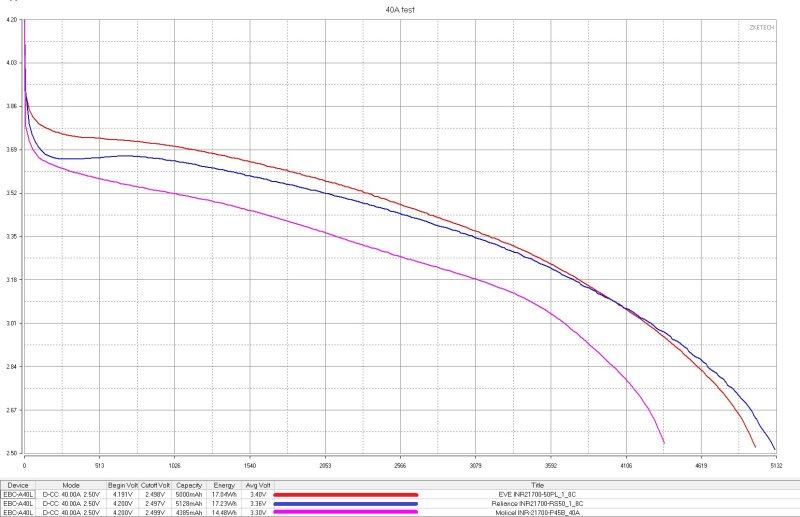
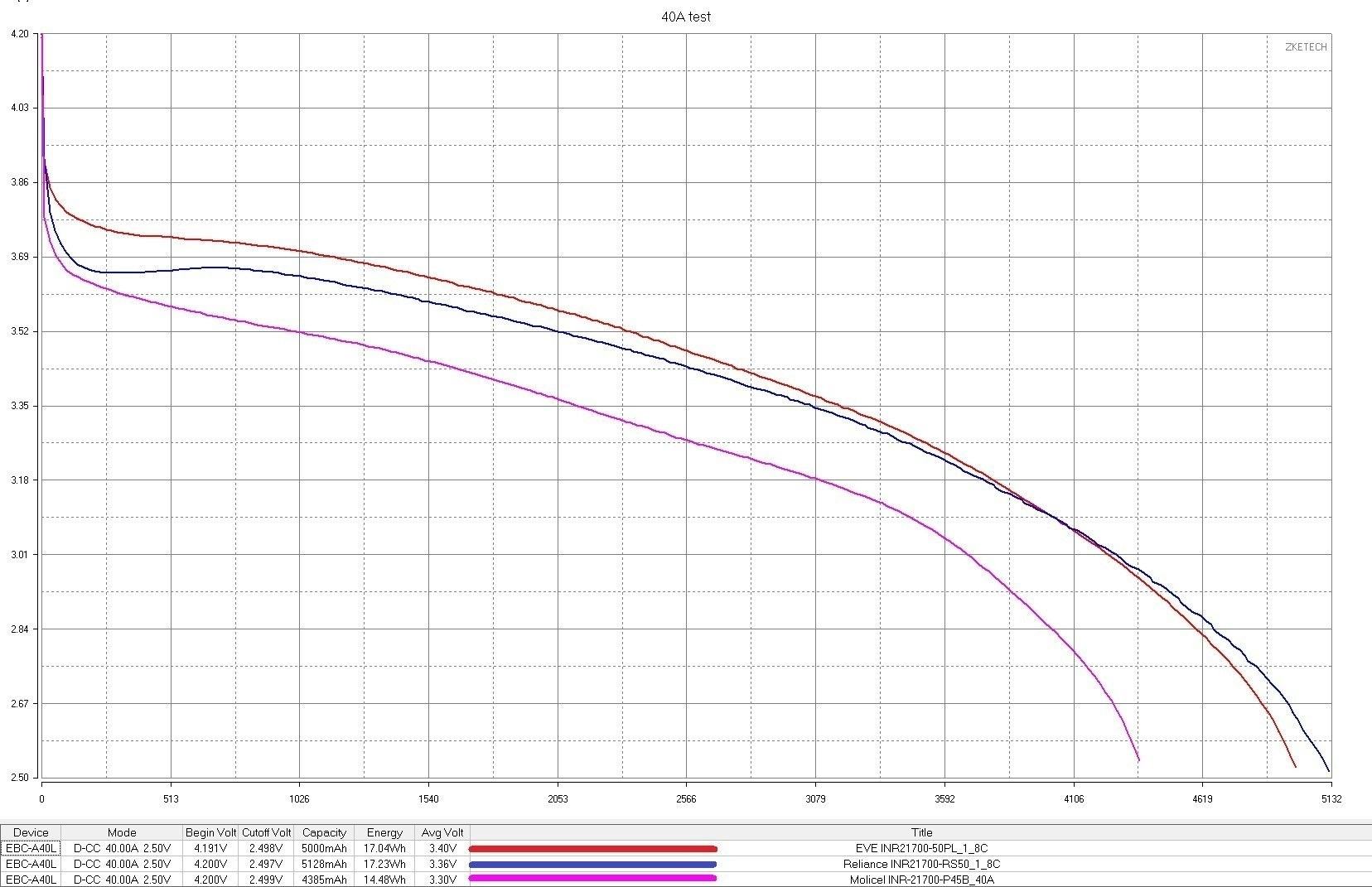
And finally, a comparison of the EVE INR21700-50PL, Reliance INR21700-RS50, and Molicel INR21700-P45B, its closest competitor, this time at 40 A. As far as I remember, Molicel also has a 5 Ah model, but I haven’t had one to test.
And here, everything is just as predictable: the Reliance INR21700-RS50 takes first place, the EVE comes second by a small margin, and the Molicel INR21700-P45B trails noticeably. That’s understandable, since its capacity is 4500 mAh to begin with.
Additional test.
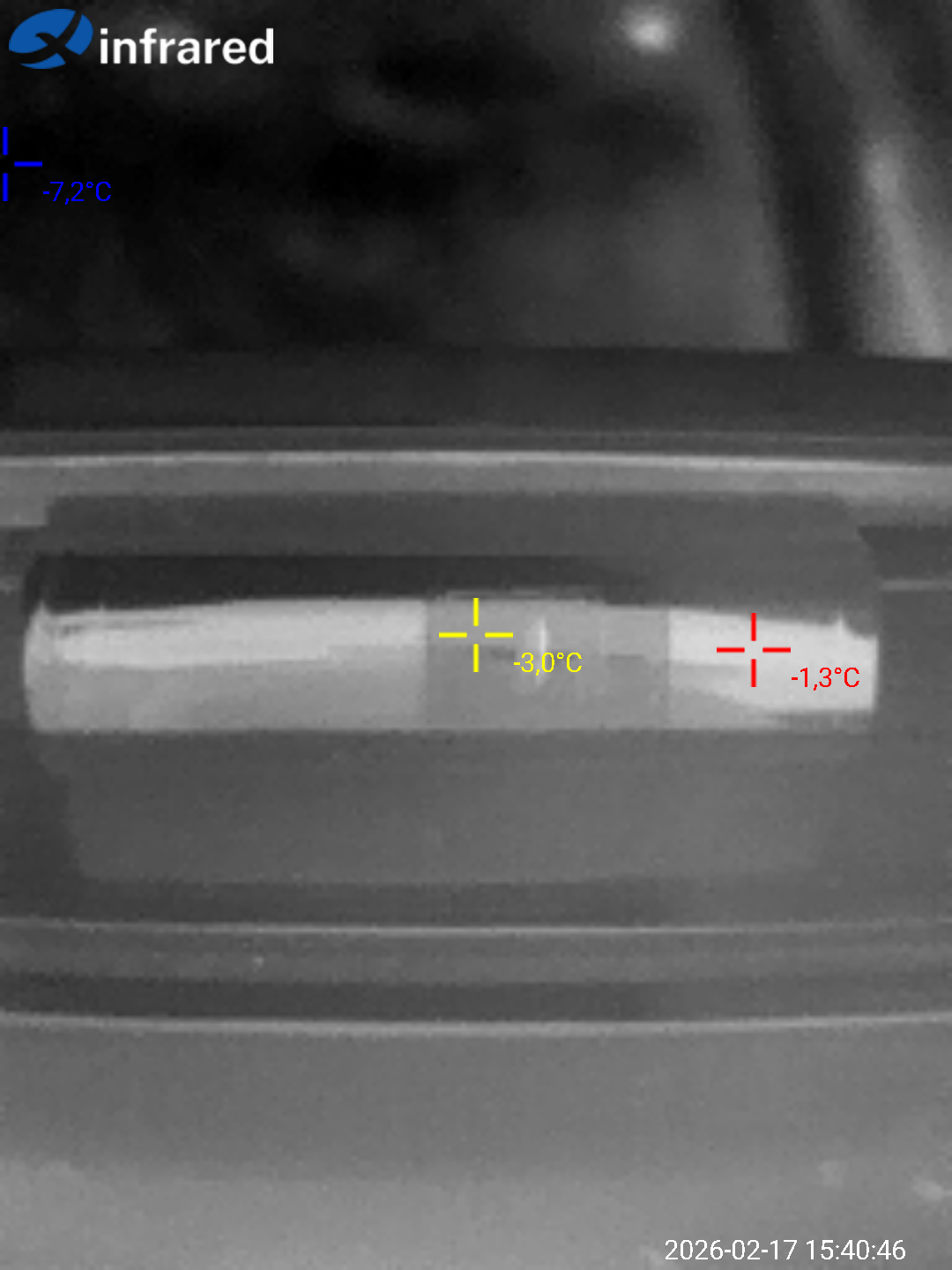
When the person who sent me these cells asked me to test them, they also immediately requested a discharge test after cooling them to 0 degrees. I didn’t aim for exactly 0 degrees; I simply left the cells on the balcony for a few hours when it was cold out. The case temperature was about -3 degrees.
In theory, I could have tested them on the balcony too, but I figured that in this case it wouldn’t make sense because the cells would heat themselves up, especially at high discharge currents.
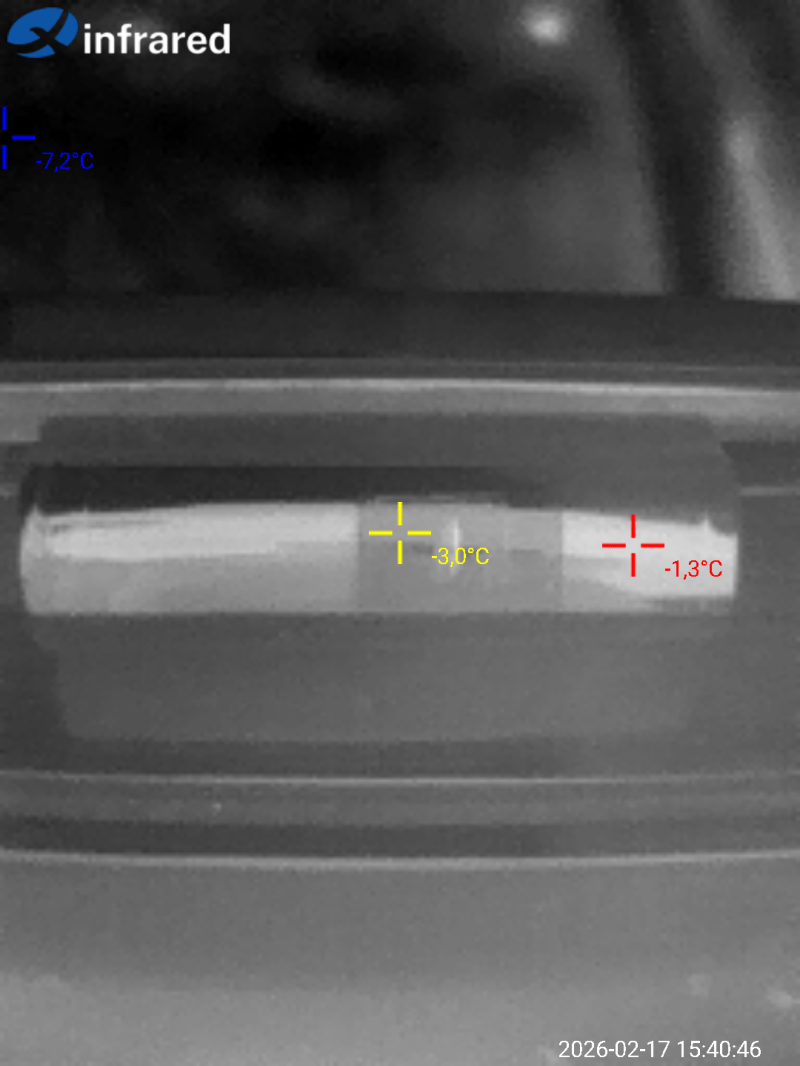
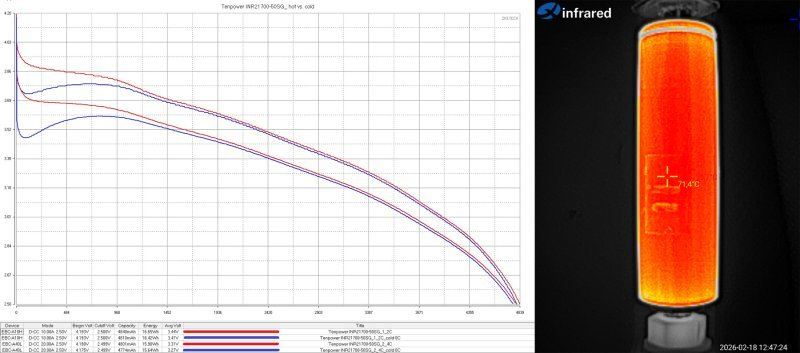
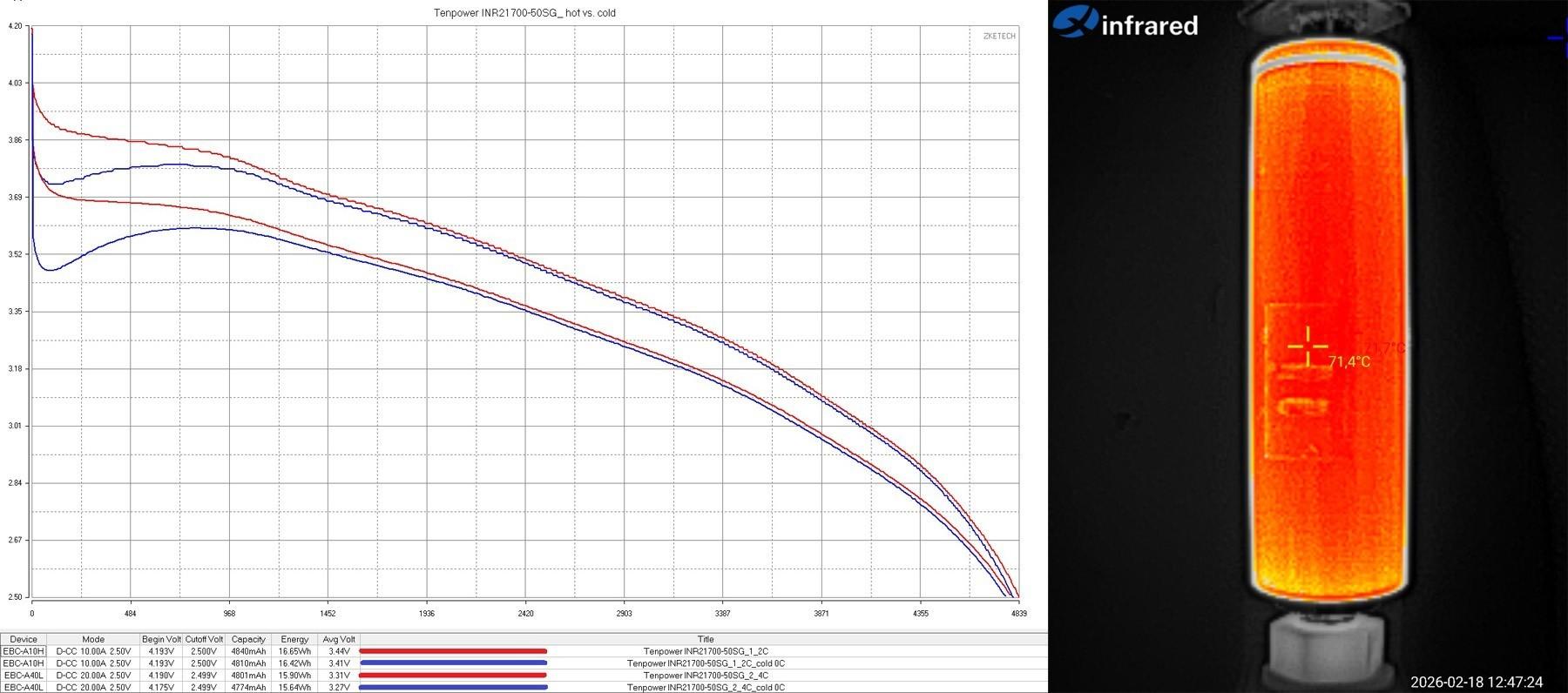
I tested the Tenpower INR21700-50SG first, although I can’t say it made much sense. I measured at 10 A and 20 A, i.e. at the maximum current and half of it.
Of course, it probably would have made sense to test them in the cold, since the cell had time to warm up in the open air during those 30 or 15 minutes. although I tried to put it under test as quickly as possible.
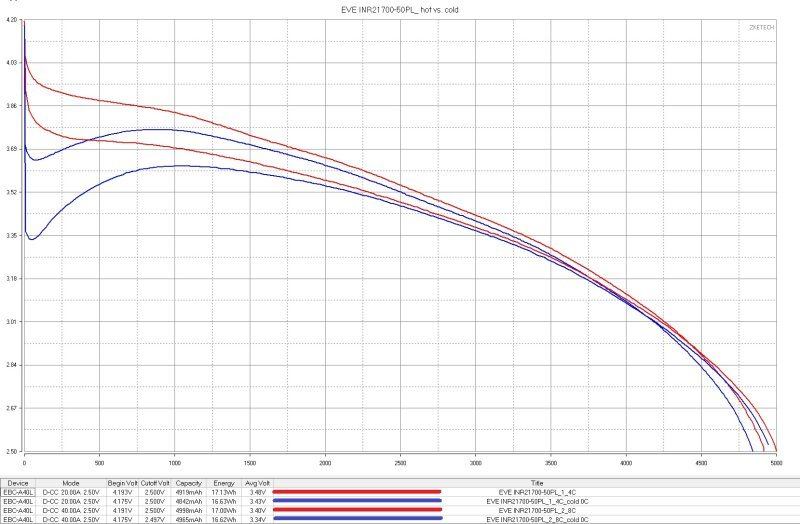
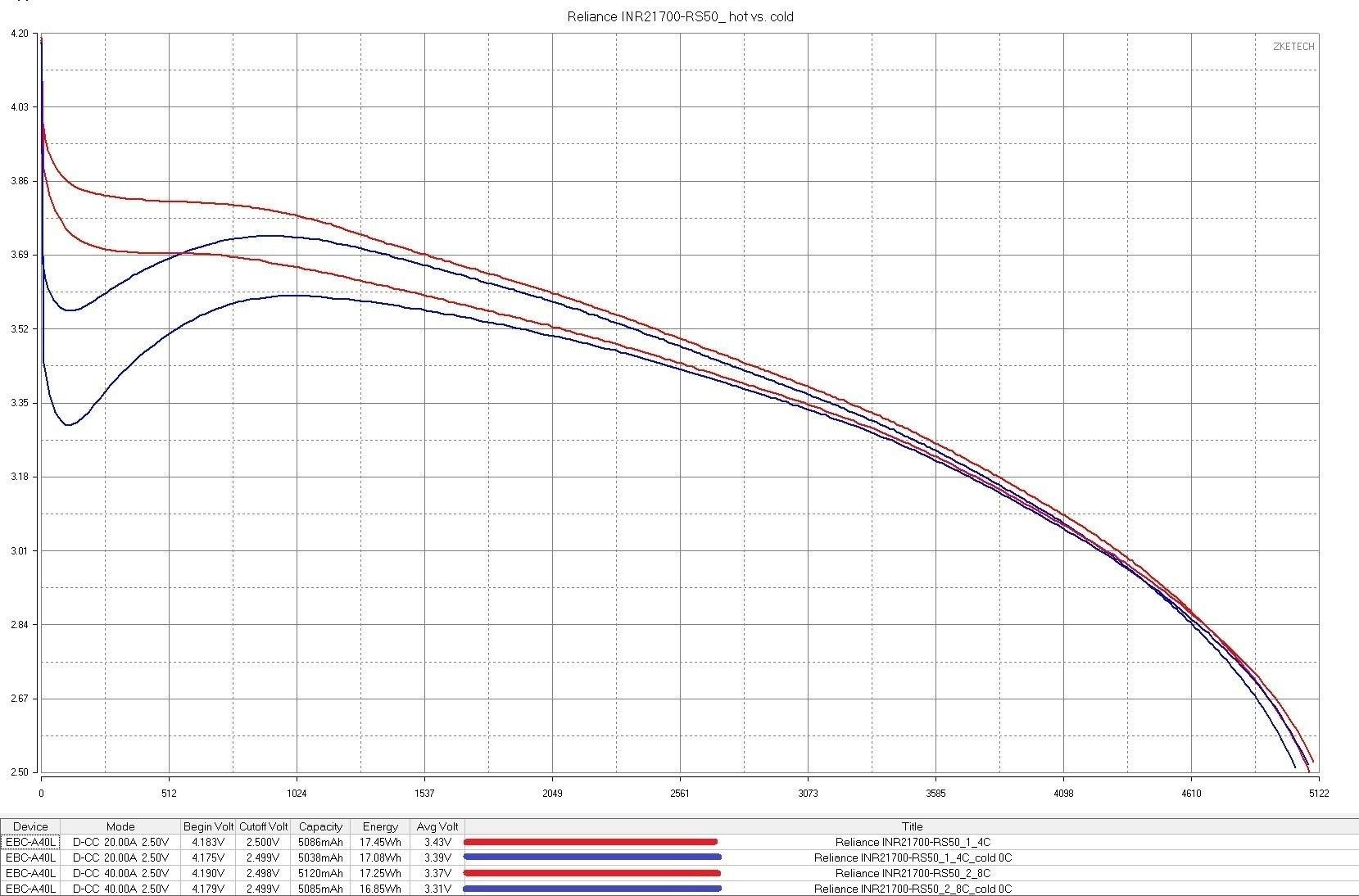
The red plots show the cell at room temperature, and the blue ones at an initial temperature of 0 degrees. Even here, you can see that the voltage initially sags, then rises to its normal level as the cell warms up.
At 20 A, the cell reached 71.4 degrees by the end of the test. In the test at room temperature and the same 20 A, the temperature was only one degree higher.
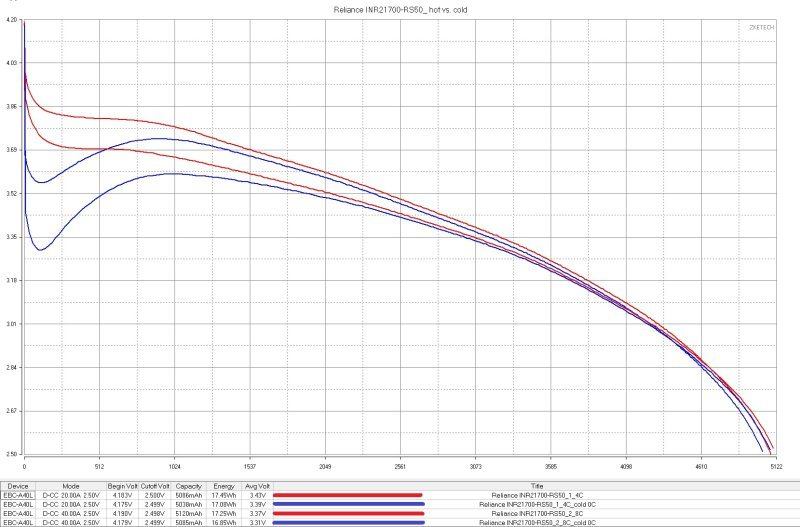
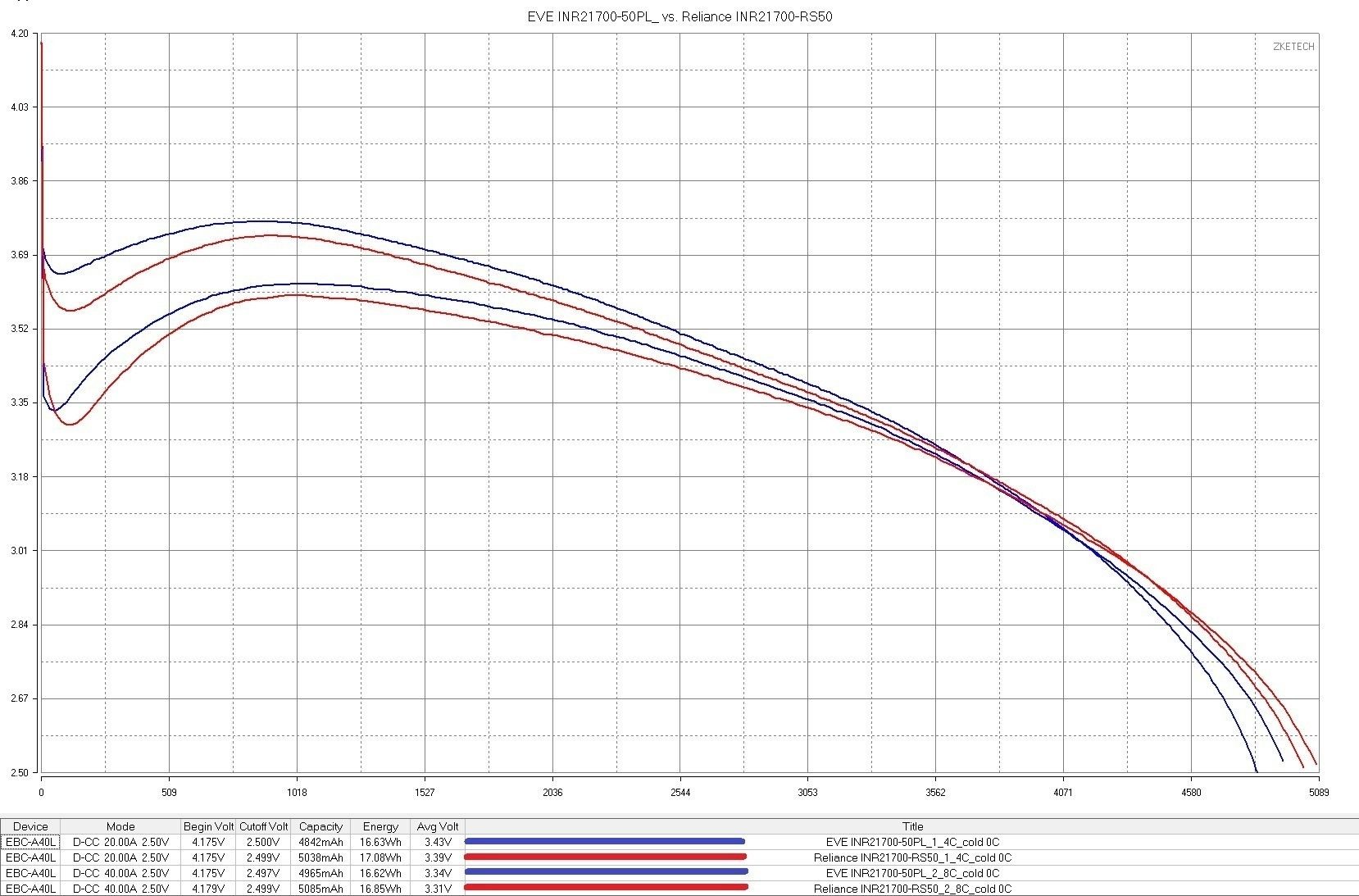
Things get more interesting from here. I tested the high-current cells at 20 and 40 A, so the tests lasted 15 and 7.5 minutes, respectively, and the air temperature had a much smaller effect.
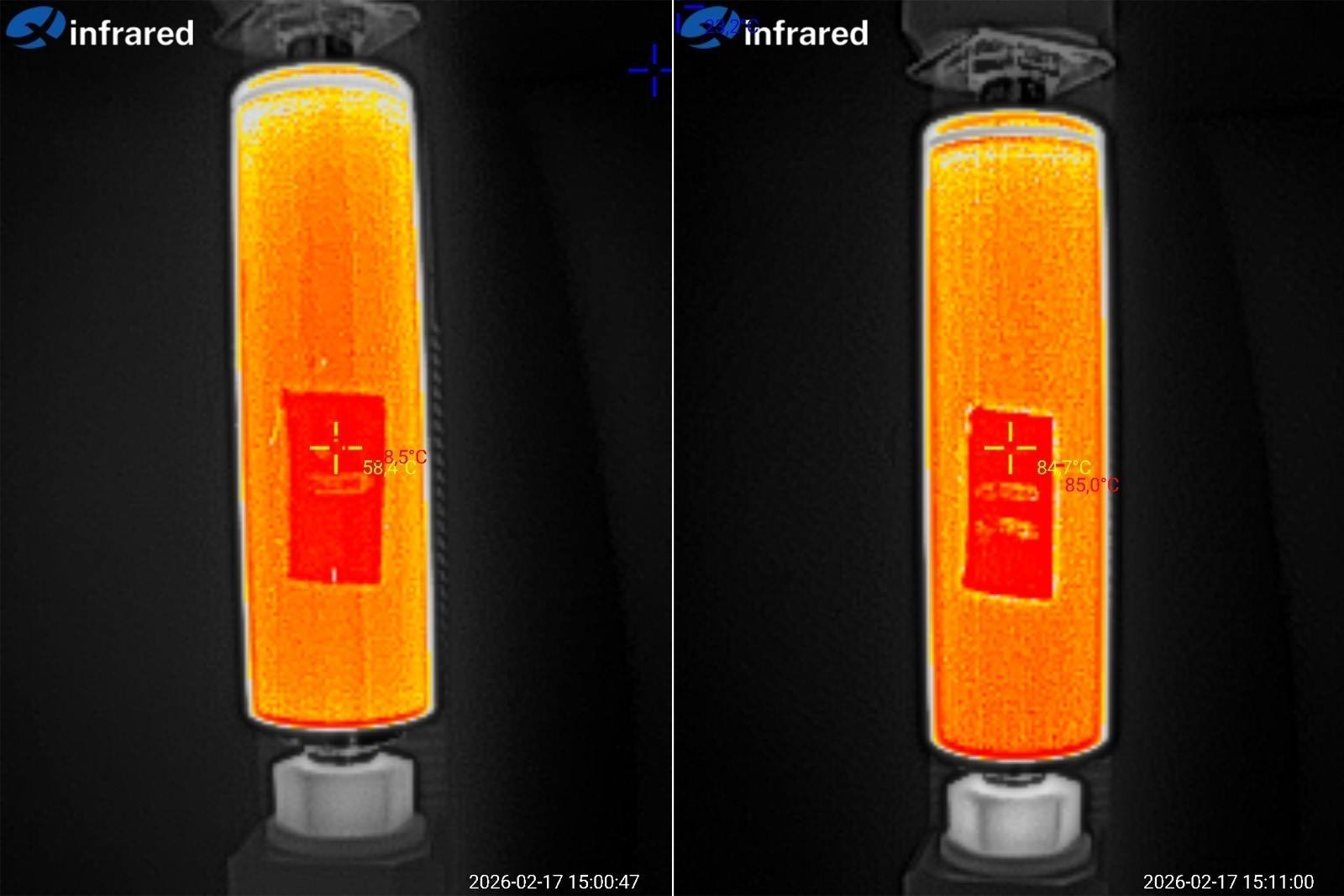
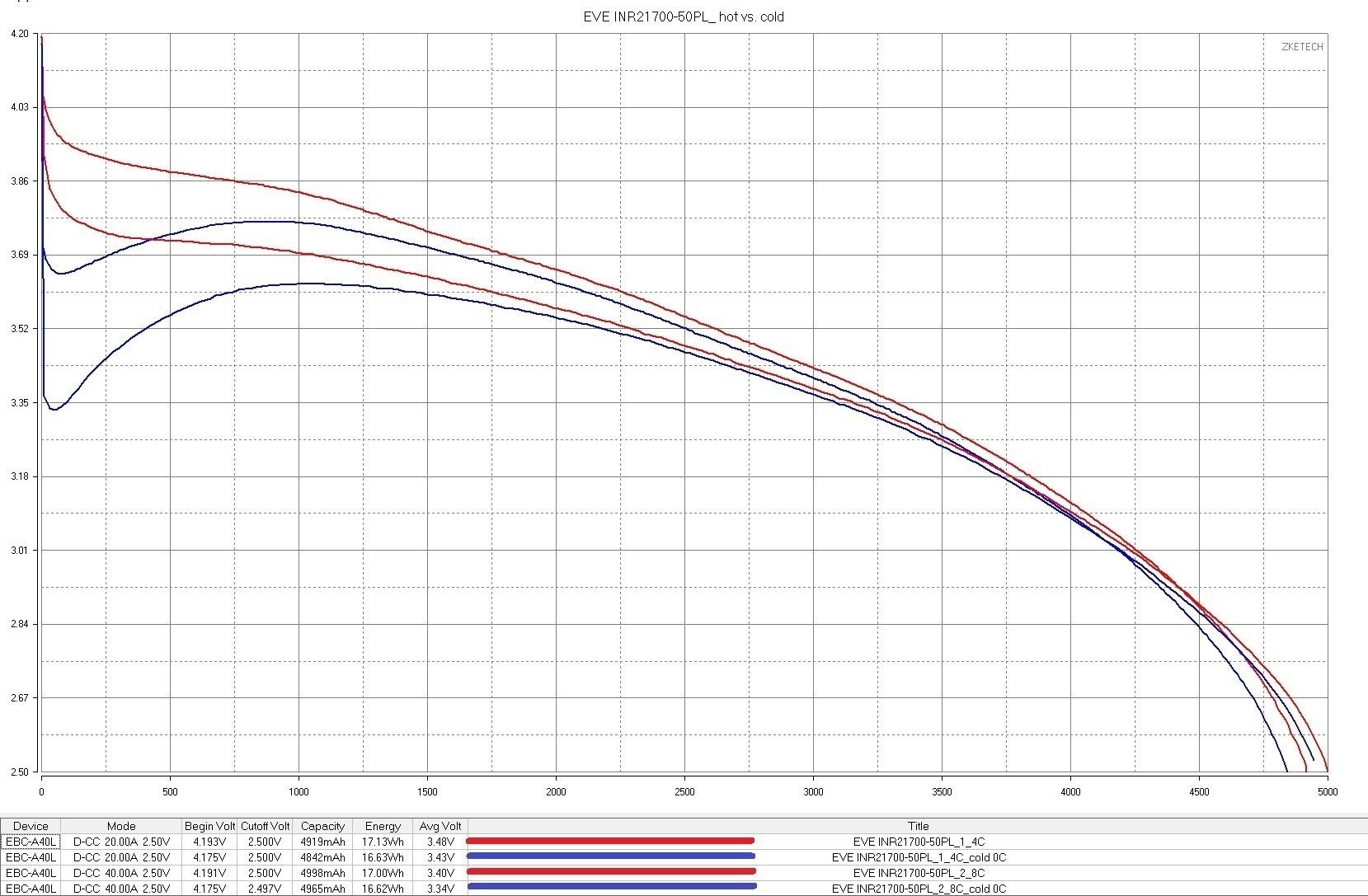
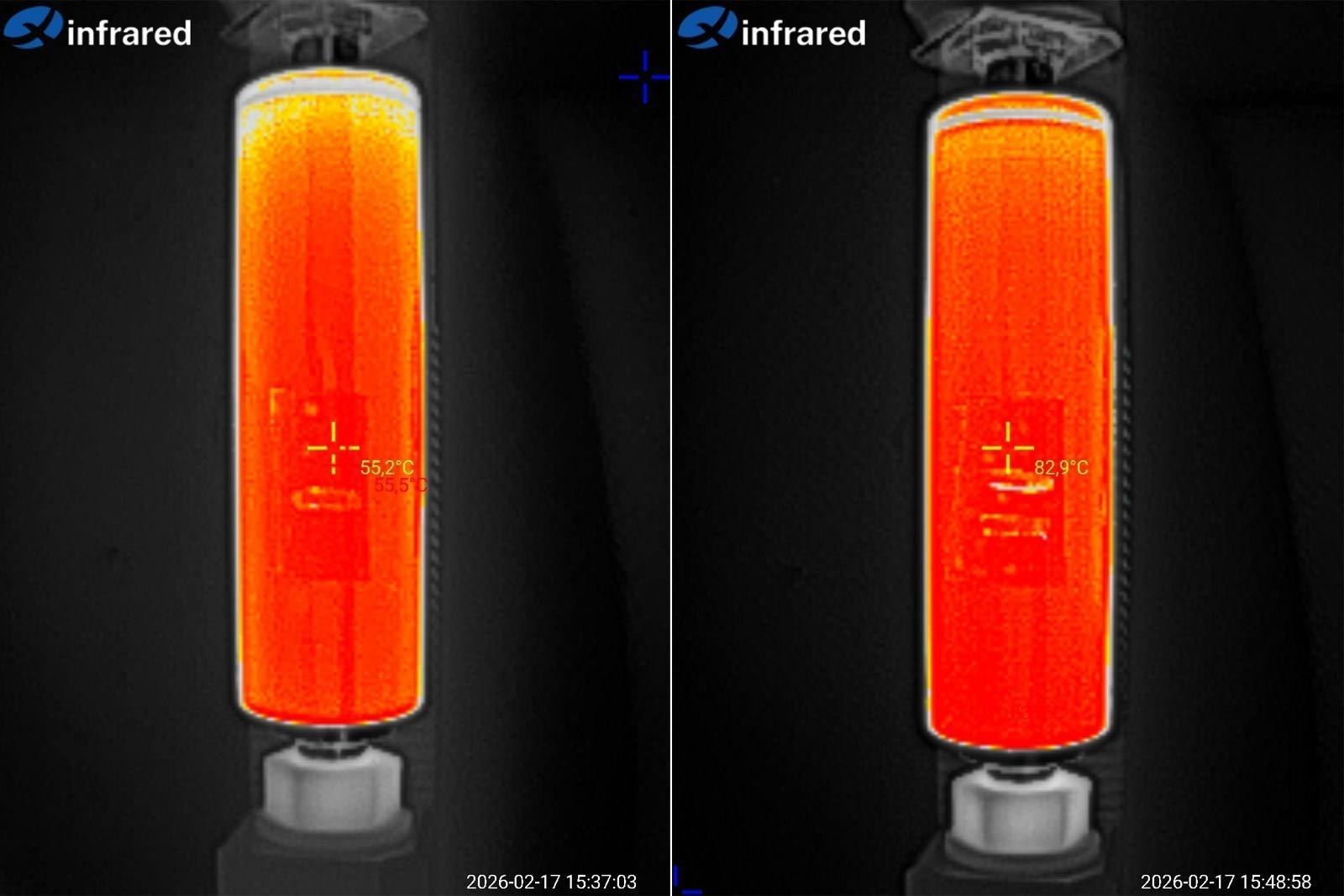
Here we also see a noticeable voltage sag, especially at 40 A. But thanks to self-heating, by around the end of the first third to halfway through the test, the cells reach their normal operating range. I wouldn't say they delivered much less energy as a result.
Yes, one thing to clarify: the higher impedance makes the battery heat up more at the start, so it delivers less in Wh than at room temperature. Capacity in Ah, however, depends less on temperature.
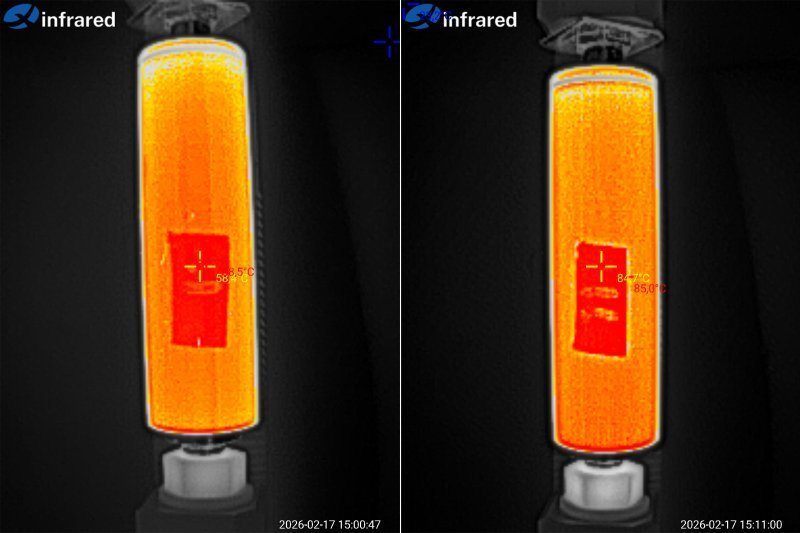
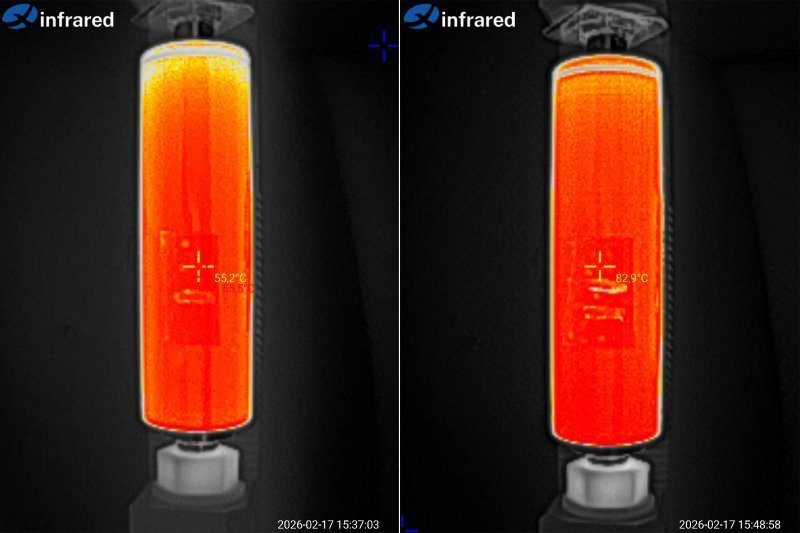
Temperature at 20 and 40 A. I don't have results for 20 A, and at 40 A it's practically the same as when starting at room temperature.
At first glance, the EVE INR21700-50PL shows roughly the same picture.
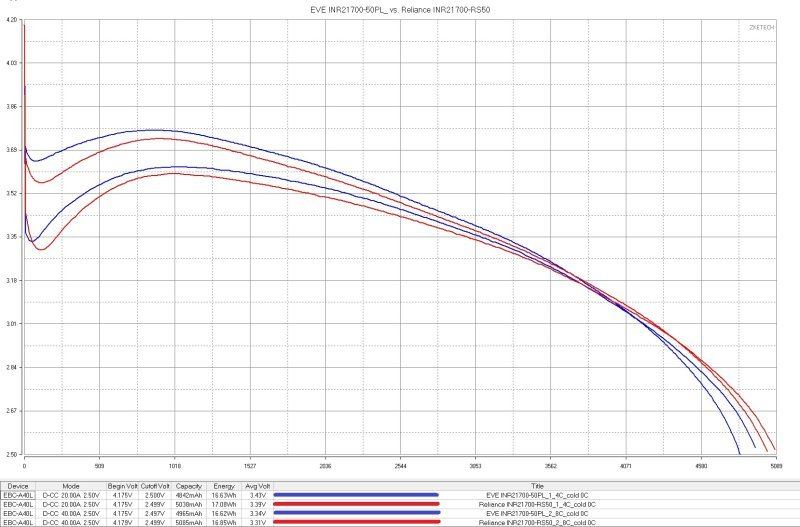
But the comparison plot for the Reliance INR21700-RS50 and EVE INR21700-50PL is much more interesting.
Here you can clearly see the effects of both the difference in impedance and the difference in initial capacity.
The Reliance INR21700-RS50 has roughly 10–15% higher impedance, so its voltage sag is noticeably greater. But since it started with more capacity, it also finished the test later and delivered more energy.
In this test, the cells are essentially equal: one makes up for its shortcomings with lower impedance, the other with greater capacity. You just need to decide what matters more to you: capacity or slightly higher voltage.
Conclusions.
This is one of those cases where there isn't much to conclude. First, all the batteries performed perfectly well. Second, I don't have anything to compare these high-current cells against, so I'll sum things up in general terms.
The Tenpower INR21700-50SG cells are decent mid-range cells: they don't stand out for either high discharge current or high capacity, but they work quite well, and I think they can deliver even more than the rated 20 A.
The Reliance INR21700-RS50 and EVE INR21700-50PL are very similar overall, but there are a few caveats and oddities. I was a little surprised that the Reliance INR21700-RS50 is rated for a maximum continuous current of 70 A, compared with 50 A for the EVE INR21700-50PL, yet it has higher impedance and handles the load worse. Capacity is the other way around: the Reliance is slightly higher. That's why they're roughly equal overall, but for heavy loads I'd probably prefer the EVE INR21700-50PL, putting the Reliance INR21700-RS50 in second place, albeit by a small margin.
One small note about the EVE INR21700-50PL: the person who sent them to me said they seemed to have high self-discharge. After sitting for about a month, their voltage had dropped to 3.8 V. I can't confirm or rule that out yet. After a week, the voltage on mine dropped from 4.2 V to 4.08 and 4.106 V, which is normal enough. I'll keep monitoring them.
That's all for now. I really hope this was useful, and thanks again to Andrey for sending the samples for testing.
A reminder: to keep up with new posts on the blog, I recommend following me on Instagram, where I'll post notifications about all new posts and maybe write about something interesting too - link to account
You can also subscribe to updates and new articles on the Telegram channel - https://t.me/KirichBlog Note that discussions of reviews and articles are enabled on the channel, along with general chat. I recommend it.
An acquaintance suggested testing several types of cells, and since I was interested and had the means to do it, of course I didn't turn him down. Besides, as you know, I keep a test database, so even years later you can pull up some results and compare different types of batteries side by side on a graph.
I received three types of cells, two of each type:
Tenpower INR21700-50SG
Reliance INR21700-RS50
EVE INR21700-50PL
All three types have a capacity of 5000 mAh, but I was especially interested in the so-called tabless cells, the INR21700-RS50 and INR21700-50PL, which are well suited for building batteries designed to deliver high currents.

I'll start with the Tenpower INR21700-50SG cells. They're more of an "all-rounder": they don't really qualify as high-current cells, with a maximum current of just 20 A, or as high-capacity cells, since cells with considerably higher capacity have been around for a long time. Still, they should work well in power tools.
Their color looks an awful lot like LG's "chocolate bars".
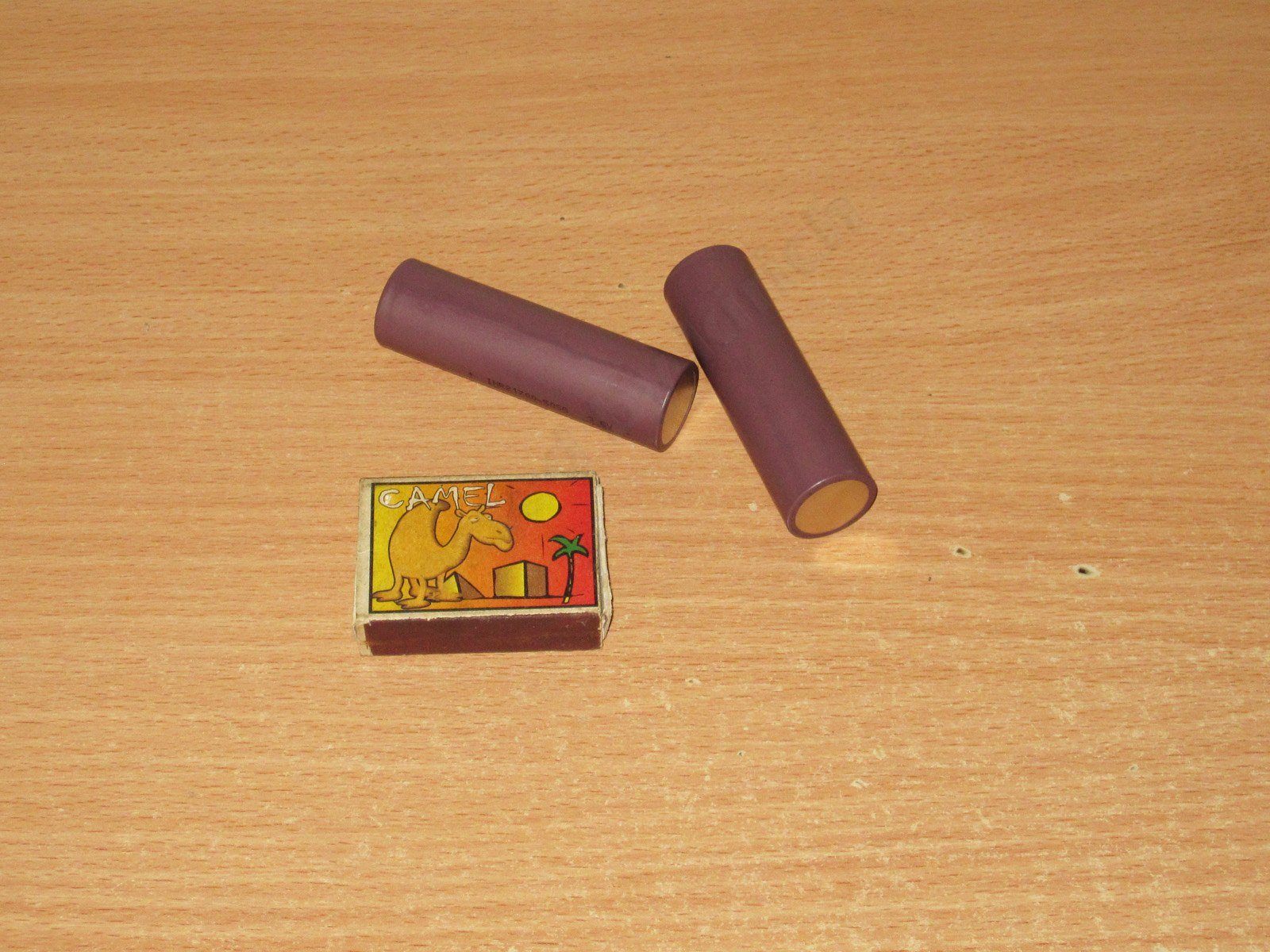
The batteries have a matrix code, which is useful for checking whether the cells are genuine.
According to the markings, they were manufactured on October 23, 2025.
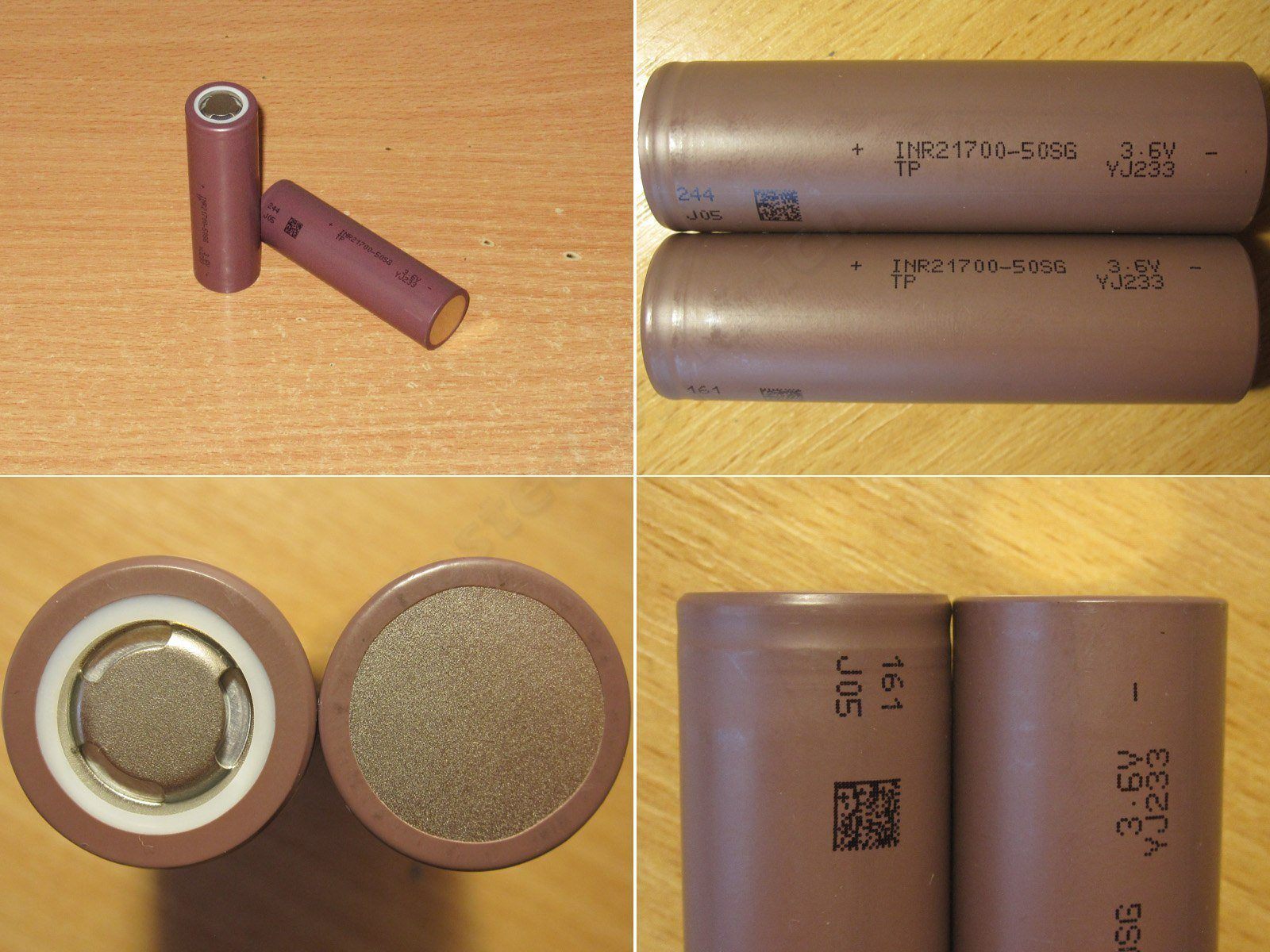
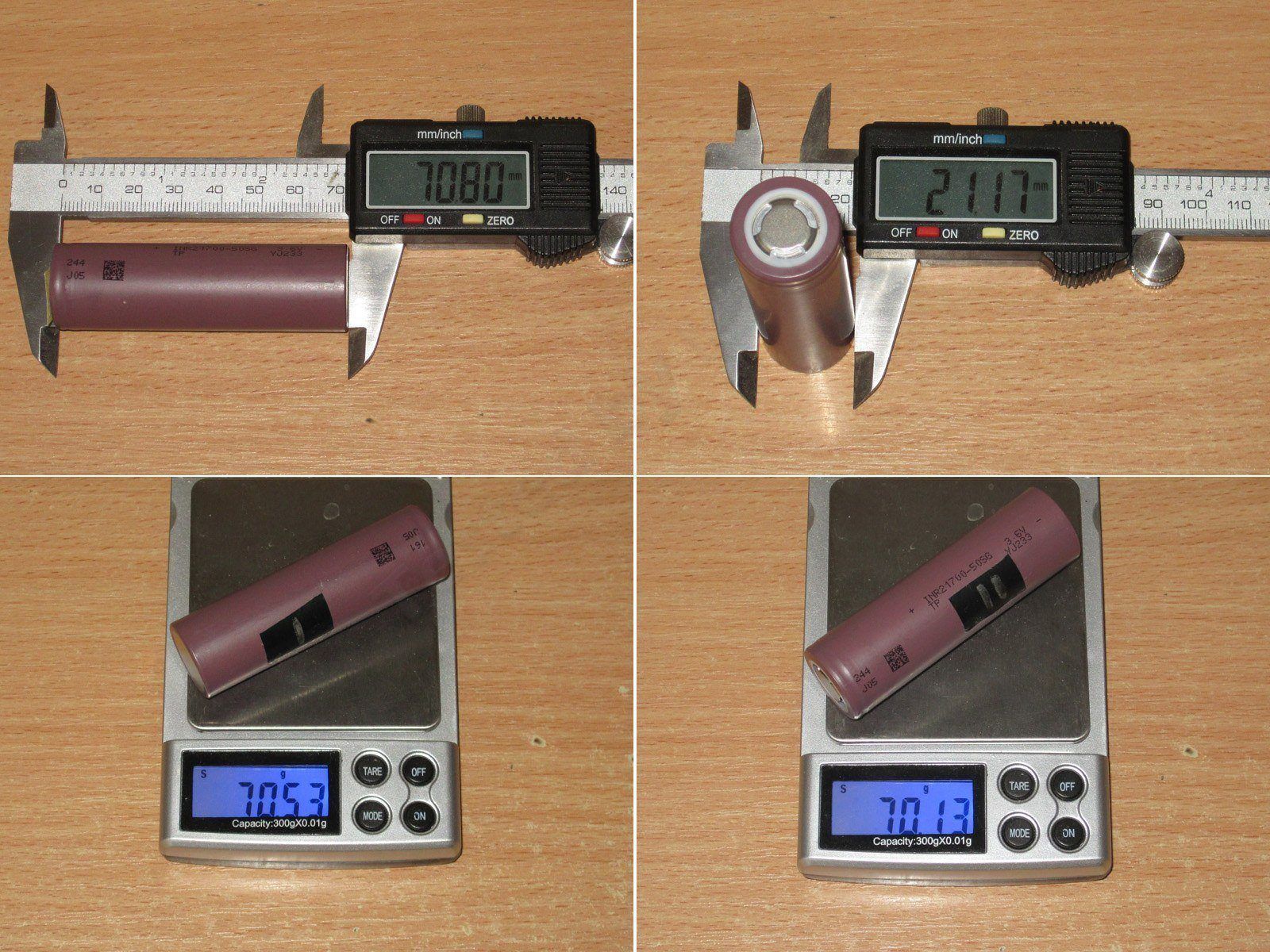
The first charge took about 3.5 Ah, so they were initially charged to roughly 30–35%. After that, at a current of 1 A, I got about 5 Ah out of them.

The standard charge current is 0.5C, with termination when the current drops to 100 mA; the fast-charge current is 6 A. Since the tester I started with has a maximum charge current of 5 A, that's the setting I used. The difference from the maximum 6 A isn't very large anyway, and it's also more convenient to assess things at whole-number C-rates.
I should point out that a charge current of up to 6 A seems a little unusual when the maximum discharge current is 20 A. Usually, high-current cells also have a high charge current.
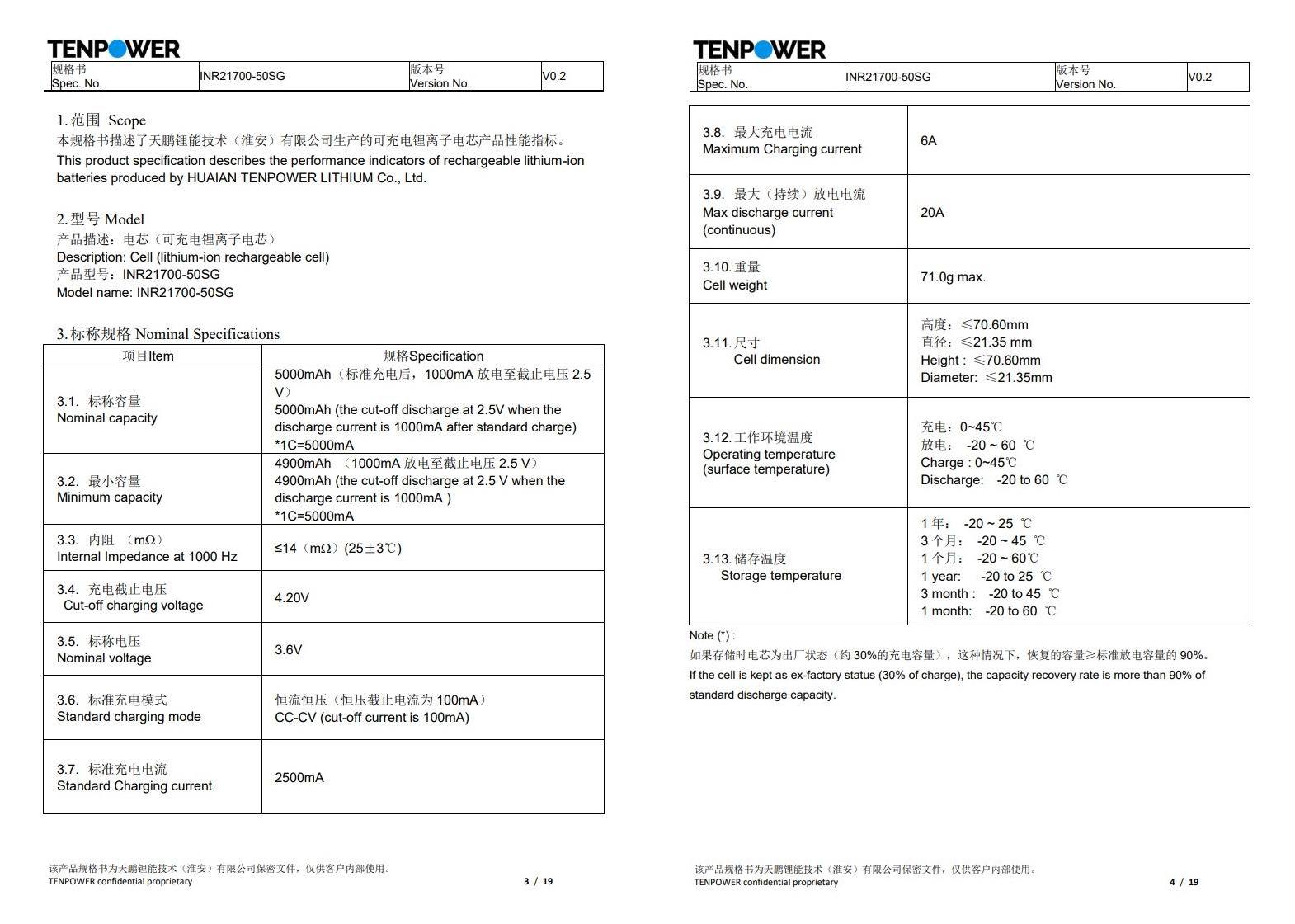
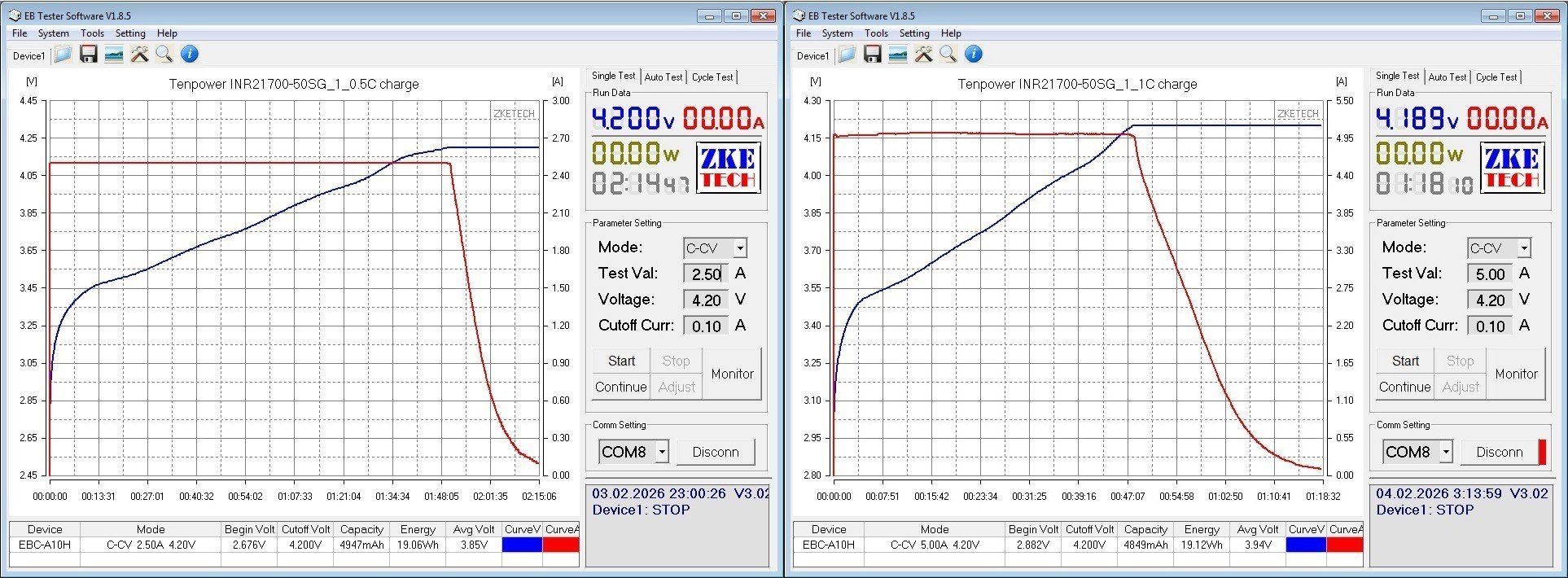
Charging at 0.5C took 2 hours 15 minutes—not bad. At 1C it took 1 hour 18 minutes, which is also pretty good for this type of cell.
I tested discharge at 0.2, 0.5, 1, 2, 3, and 4C, i.e. across a current range of 1–20 A, for a total of 6 test conditions.
The datasheet specifies a minimum capacity of 4900 mAh against a rated capacity of 5000 mAh. At 0.2C, I got 4931 mAh, which was less than I expected. Capacity was below 4900 mAh in all the other test conditions.
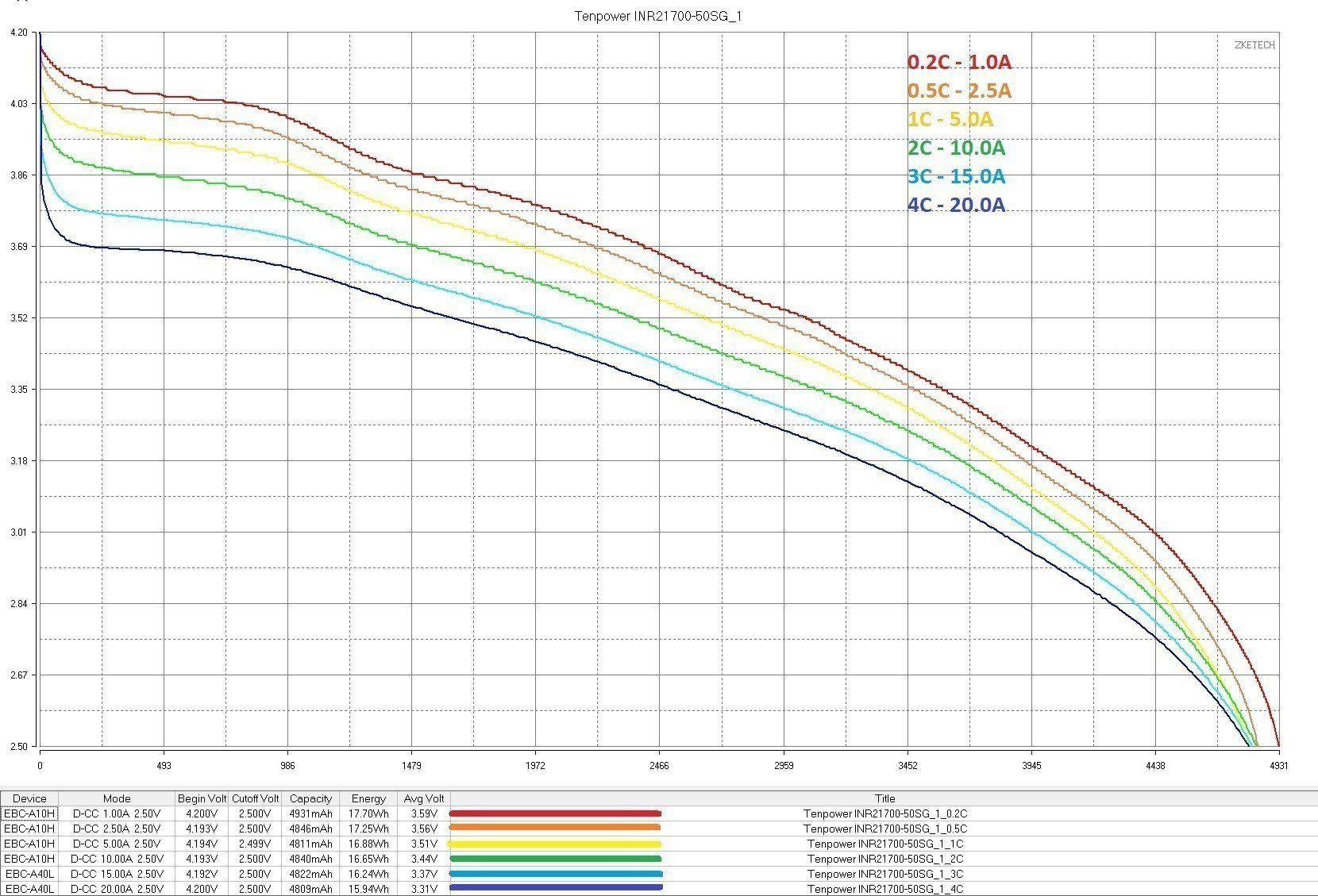
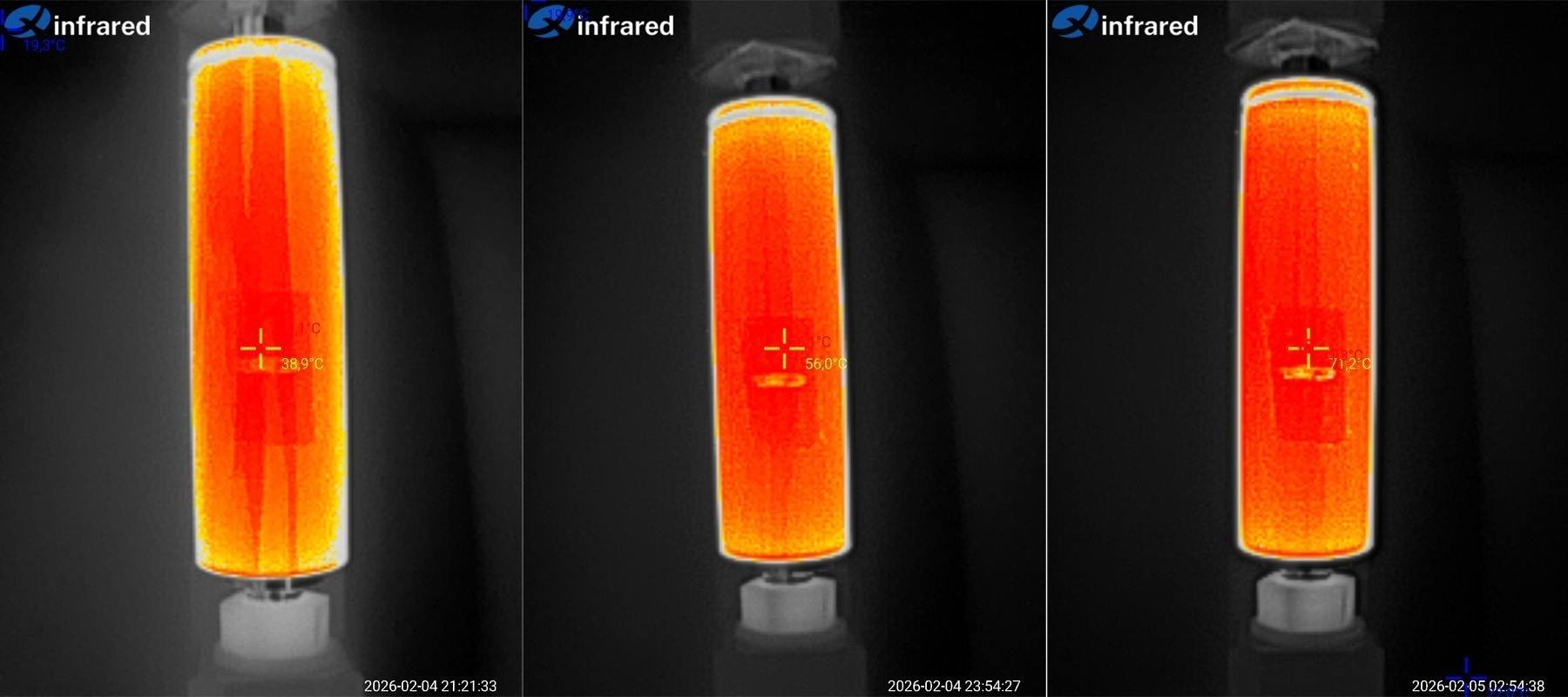
Temperatures at 2, 3, and 4C. In my opinion, around 70 degrees at 20 A is quite good for these cells, especially considering that's their maximum specified continuous current.
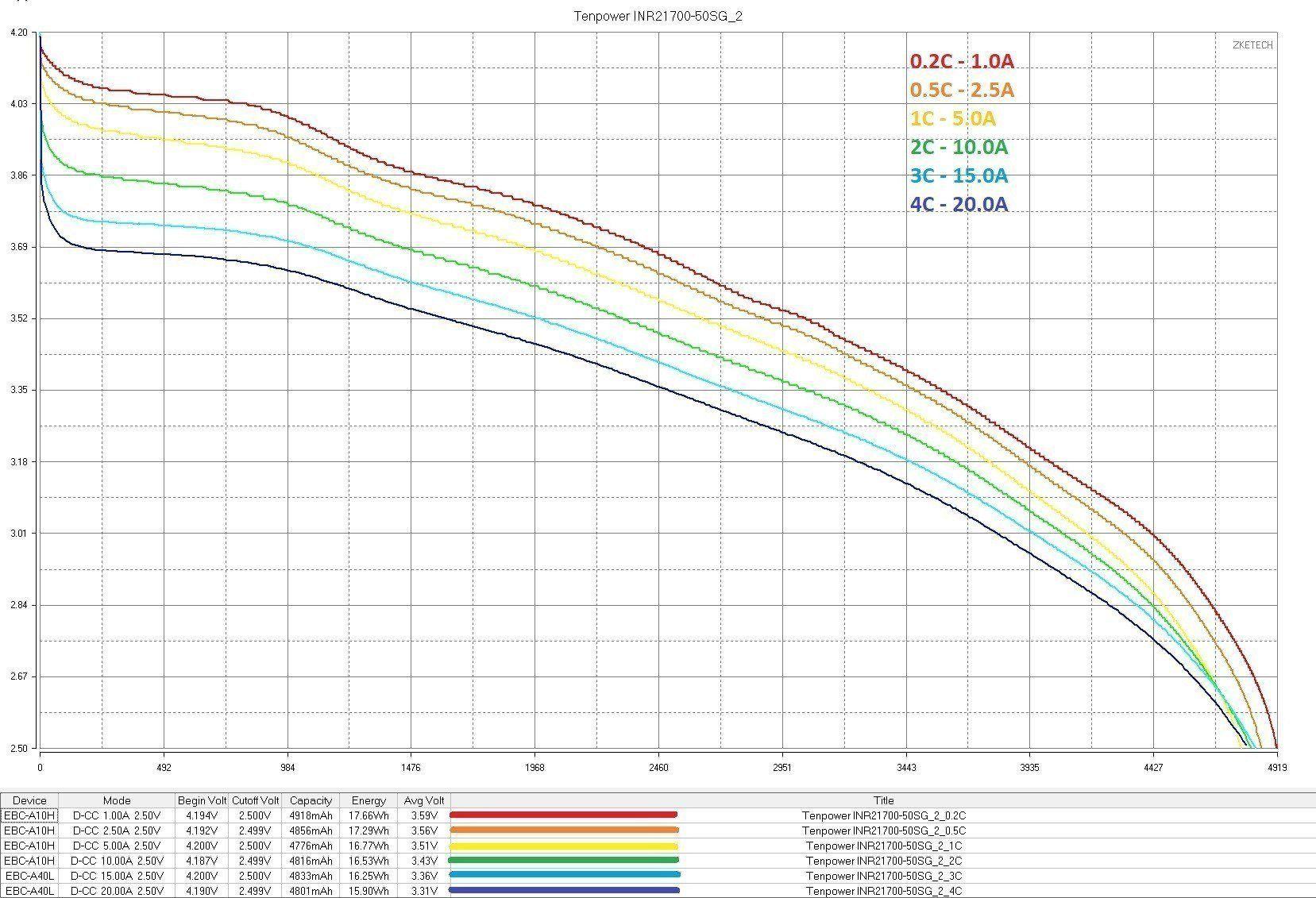
The second cell did even a little worse on capacity, barely managing to reach the specified minimum of 4900 mAh.
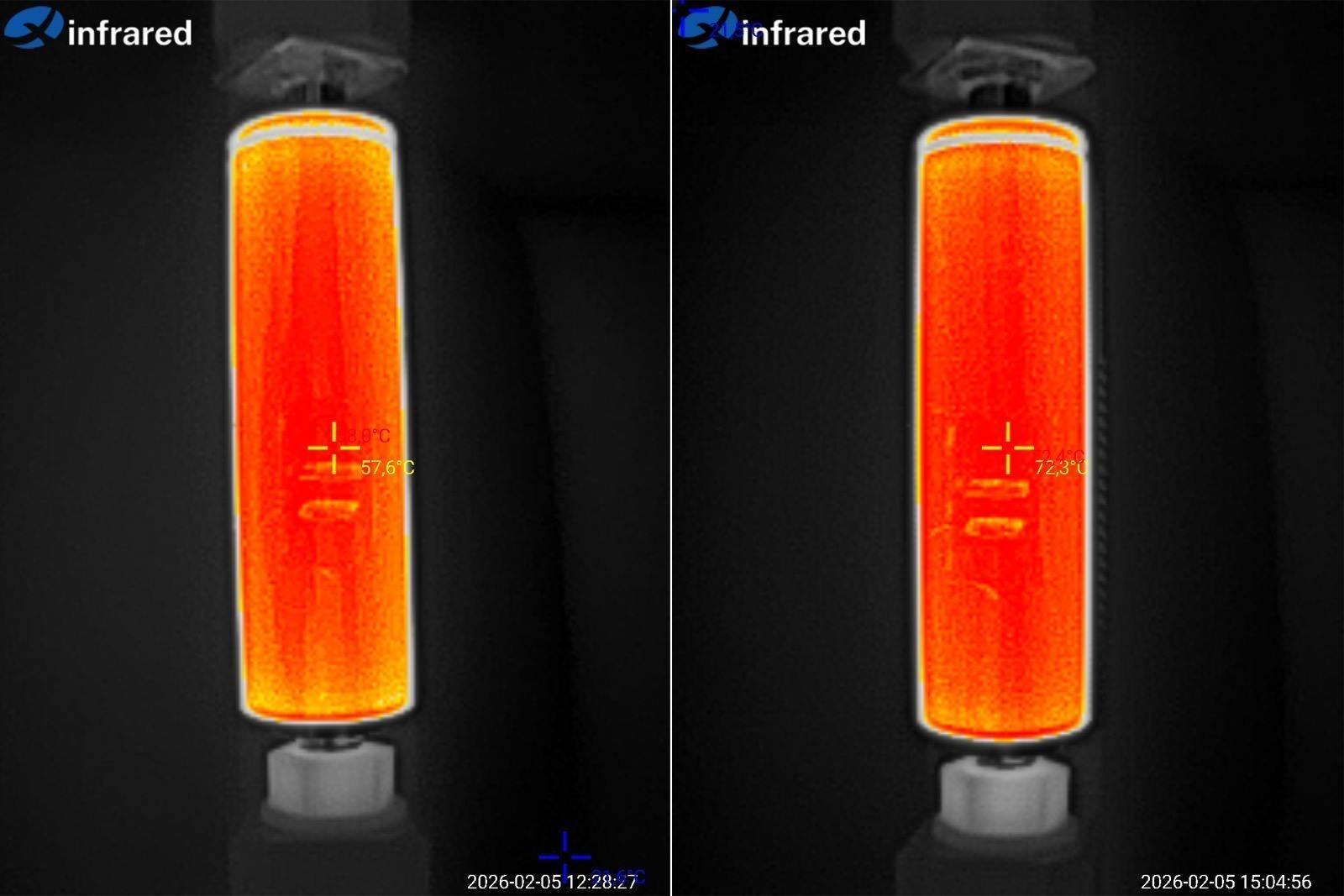
Temperatures at 3 and 4C were practically identical to those of the first cell.
Overall, the cells match well. At 0.2 and 1C, the second cell lagged slightly, but the difference was within the margin of error.

Battery impedance in the charged state, after all the tests.
The second pair: Reliance INR21700-RS50
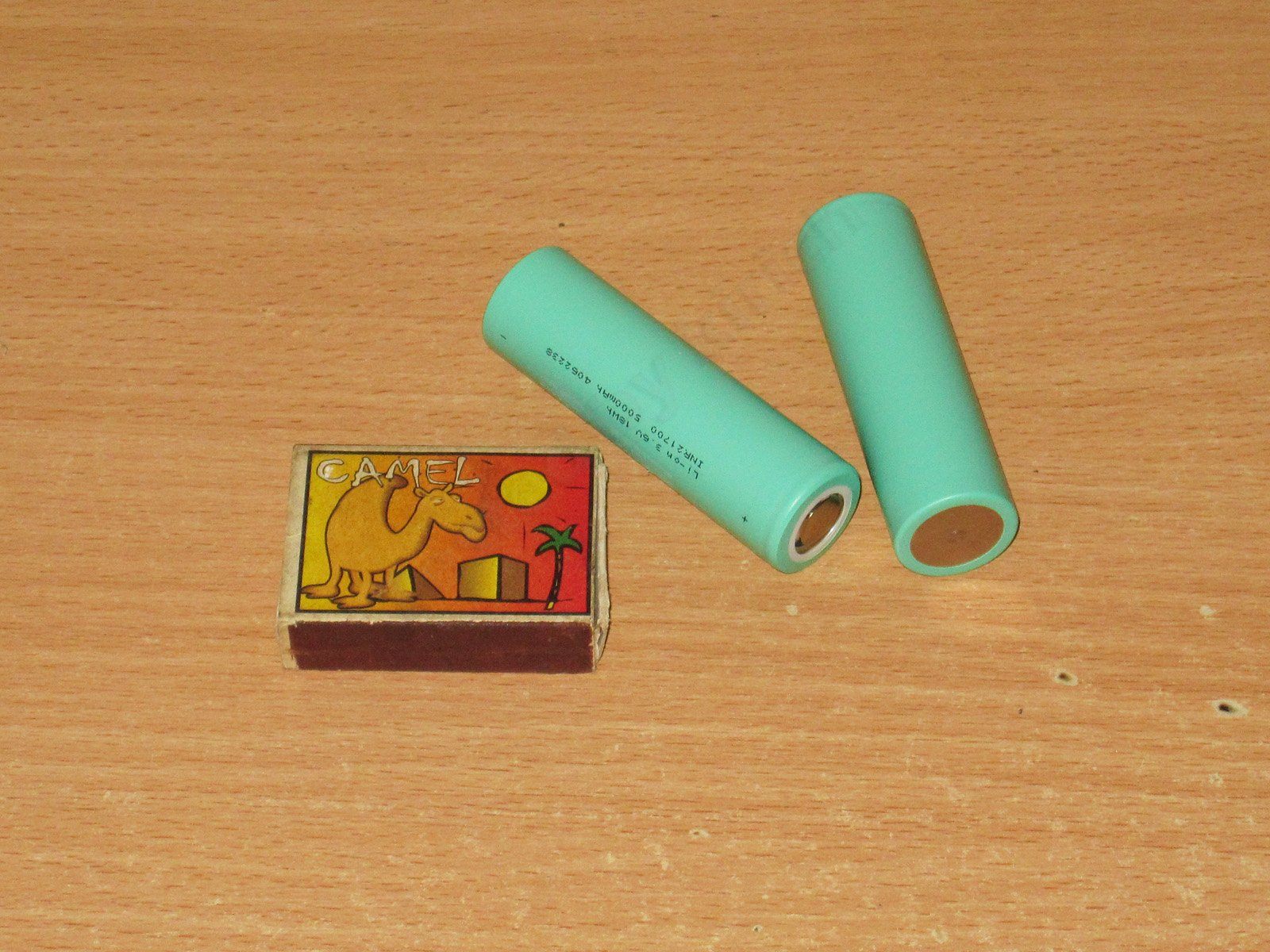
That's a very unusual color for batteries. I think this is the first time I've come across ones like these.
They also have a matrix code, which usually contains the cell's serial number, as well as some kind of coded marking, presumably the manufacturing date, though I'm not sure about that.

The first charge took almost 4 Ah, so... The initial charge was around 20%; the first discharge cycle showed a capacity of about 5200 mAh, which is already interesting.
The standard charging current is 8 A, the maximum is 15 A, and the maximum discharge current is 70 A, provided the temperature is limited to 80 degrees.
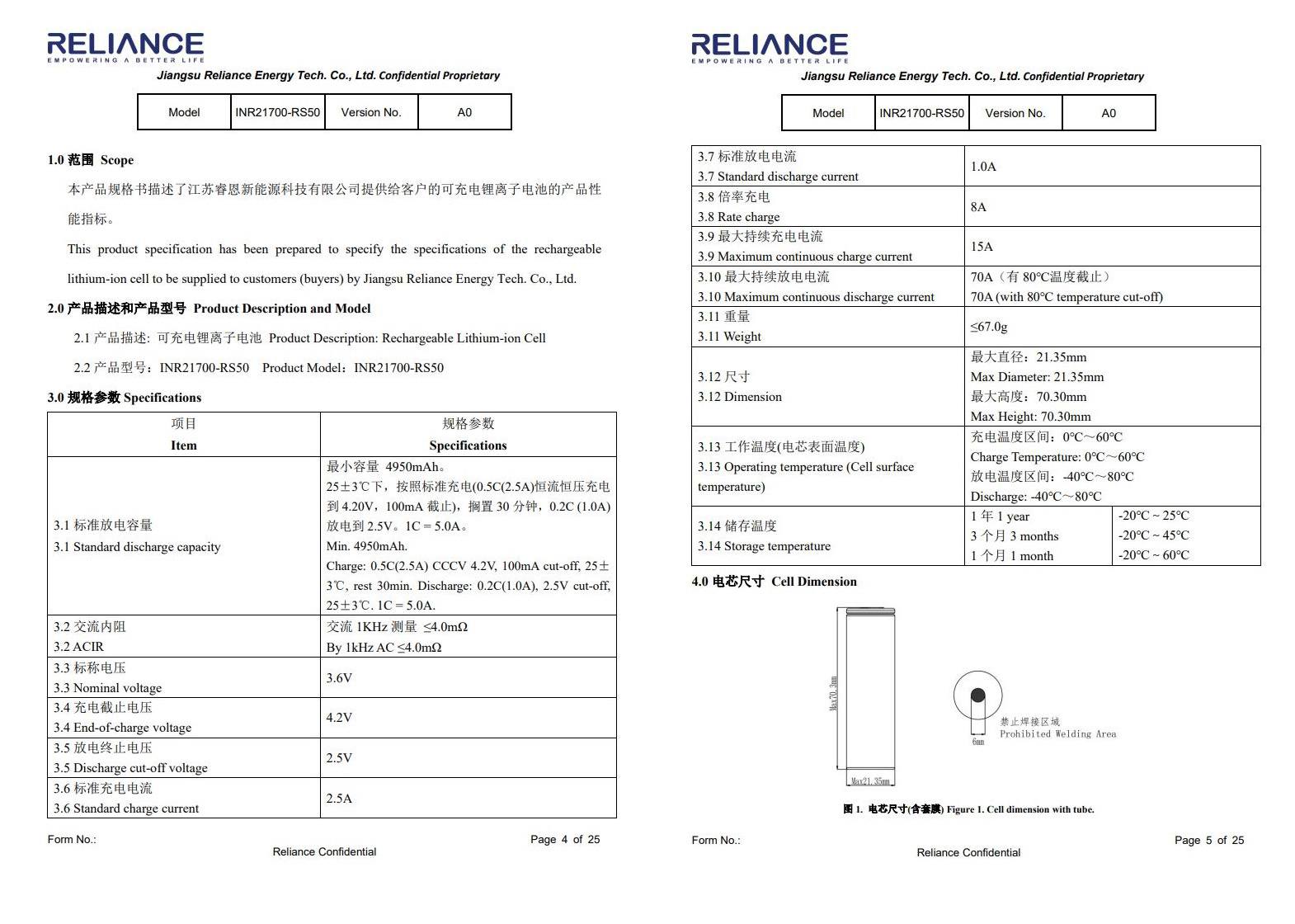
The datasheet is really comprehensive, with a lot of information. For example, it says the batteries support several charging modes: standard charging at 2.5 A, accelerated charging at 8 A, fast charging at 15 A, and a complex super-fast mode where the charging cycle is split into several stages at different currents, up to 20 A.
To make the results comparable, I measured charging times at 0.5C and 1C. The first took 2 hours 17 minutes, and the second 1 hour 15 minutes. To be honest, after testing the previous cells, I expected charging to be faster, although accounting for the difference in capacity, it was in fact a little faster.
While preparing the review, I decided to also test charging at 8 A and 15 A. I wanted to try the 15-minute stepped charging mode too, but the electronic load can't do that while charging, only while discharging. By the way, the 15-minute stepped charging mode isn't quite as simple as it sounds: the manufacturer specifies that it only charges the battery to 80%, not fully.
Later I thought I could have programmed my RD6030, but honestly, I couldn't be bothered.
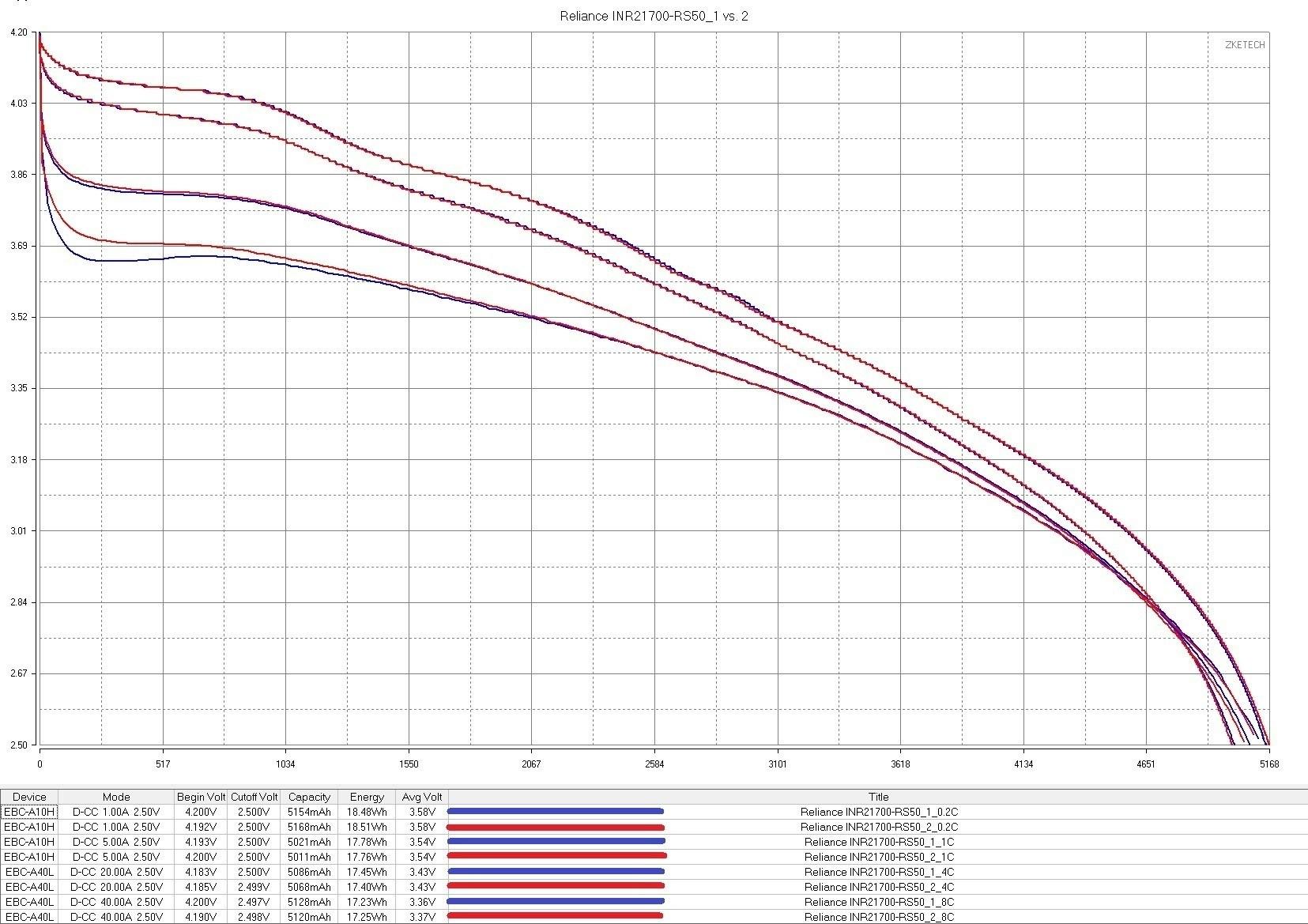
The discharge test took a long time—a very long time—and included 10 stages: 0.2, 0.5, 1, 2, 3, 4, 5, 6, 7, and 8C.
The battery delivered its rated 5 Ah in every mode. Capacity was lowest at a discharge rate of 1C and highest at 0.2C; as expected, energy in Wh was highest at the lowest discharge current. The datasheet gives figures for 40, 50, 60, and 70 A, and states that at 40 A the cell should deliver 100% of its capacity.
Temperature at 5, 6, 7, and 8C, although in practice I was only interested in the last mode. As I mentioned above, the specified discharge current is up to 70 A, provided the temperature is limited to 80 degrees. In reality, I reached that temperature at 35 A with a single cell.
On the one hand, you realize they're pulling a fast one on you; on the other, staying below 90 degrees at 40 A is pretty good in its own way.
The test results for the second cell are essentially about the same.
The temperature was a little lower in some modes, but I think that's because the room was a few degrees cooler. In any case, we also get around 80 degrees at 35 A and over 85 at 40 A.
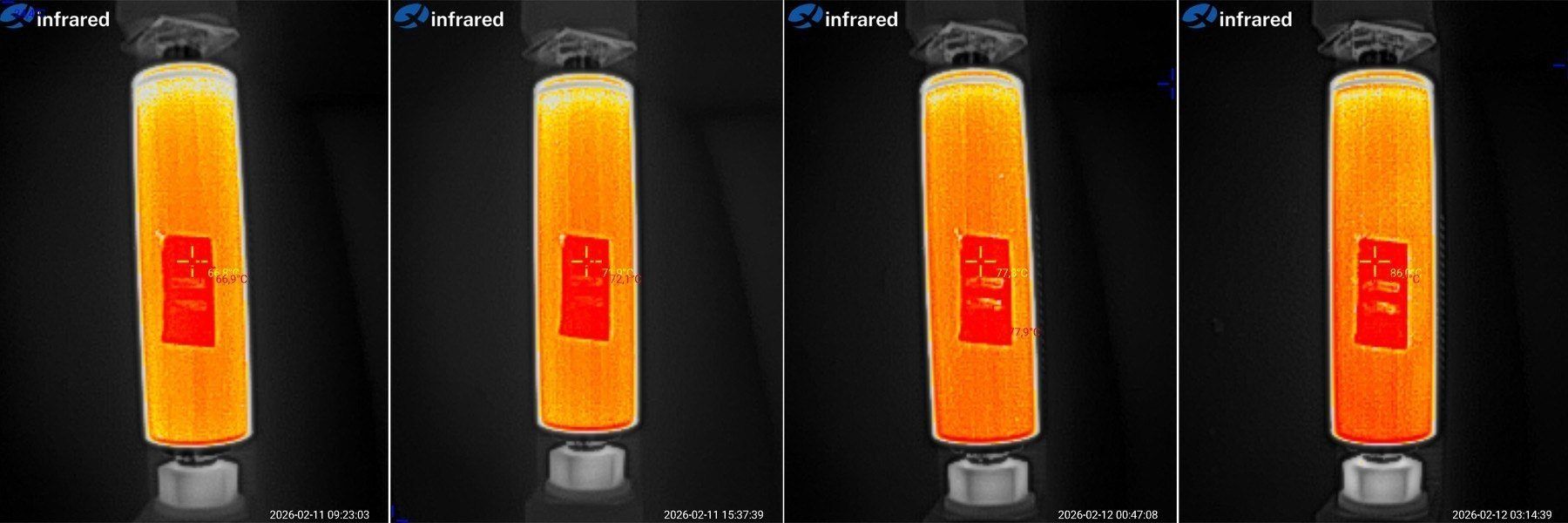
The residual capacity after discharging at 40 A was 50 and 70 mAh, which is very good—around 1–1.5% of the total.
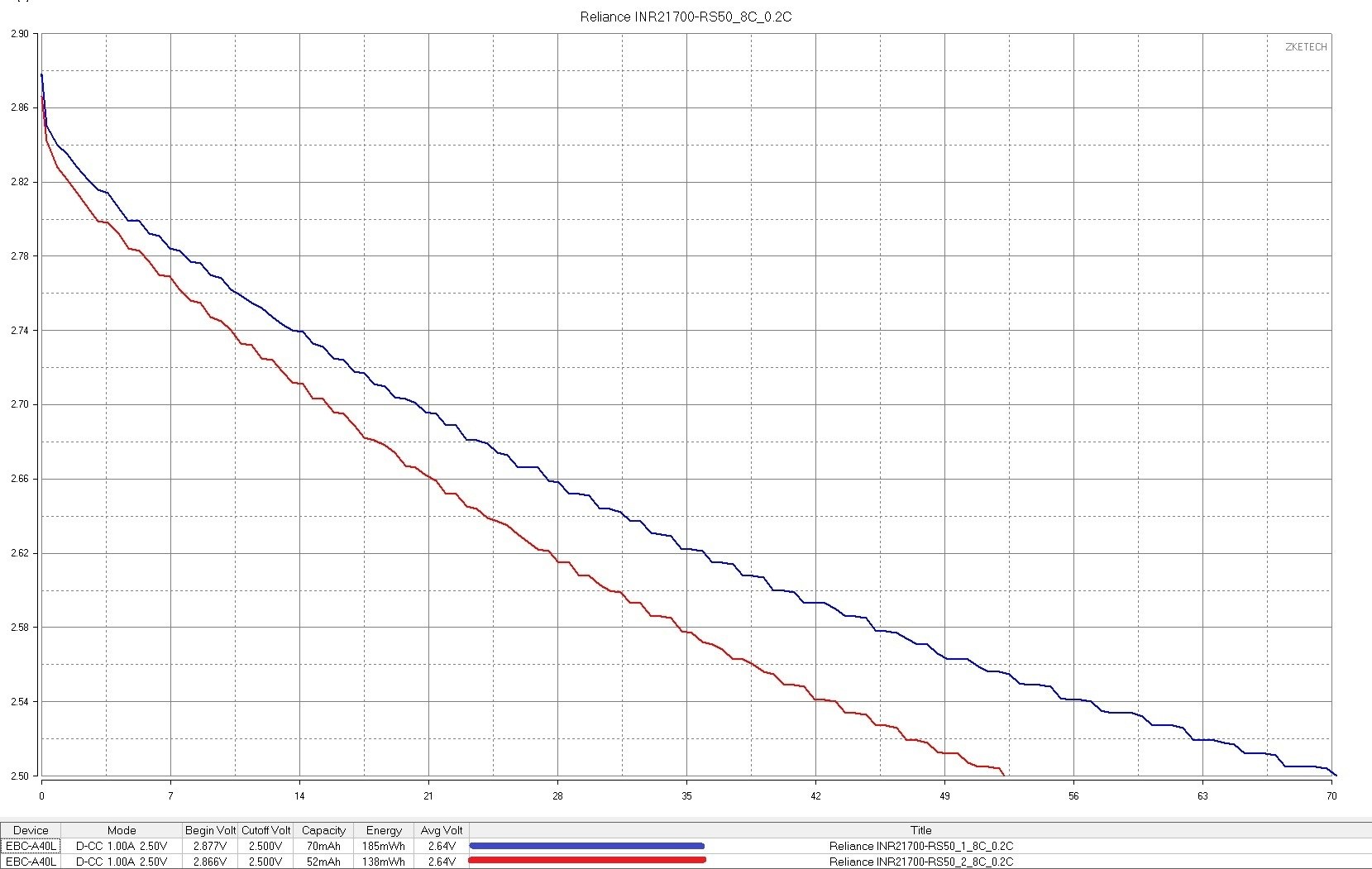
I also have no complaints about how closely the results match. The only thing is that at 40 A, one cell sagged more at the start of the test for some reason, though this didn't really affect the results.
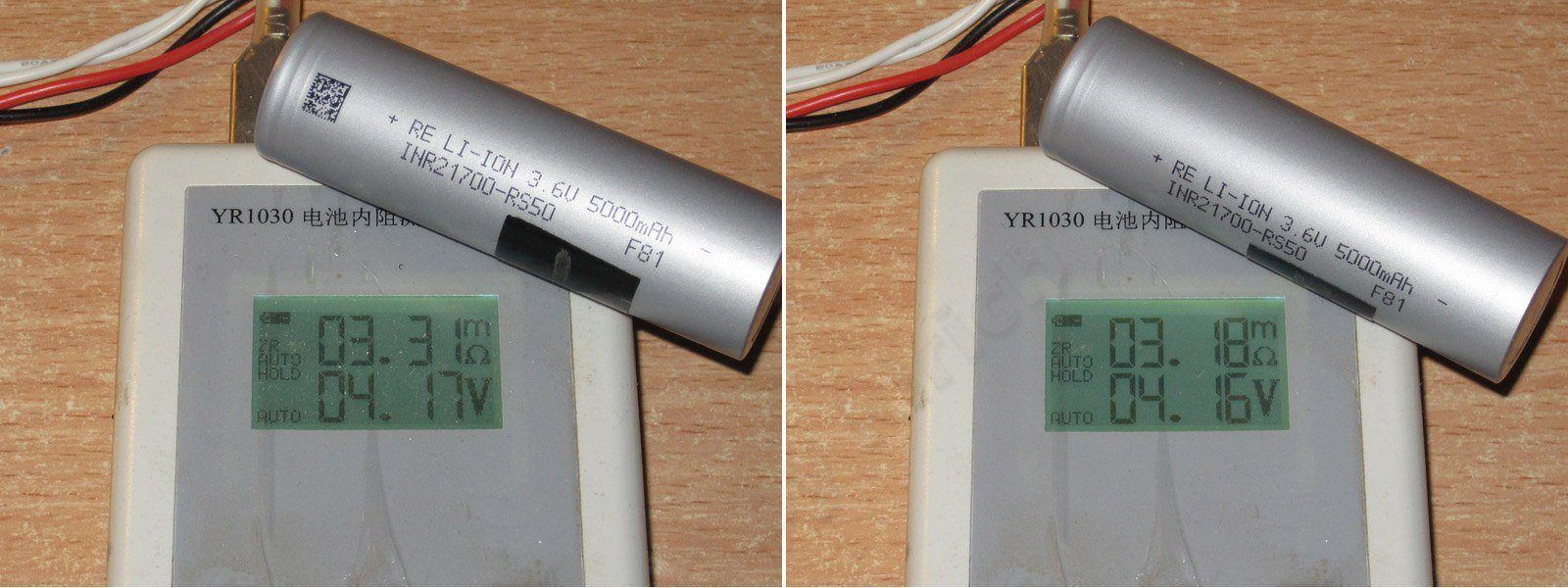
The batteries' impedance is just over 3 mΩ, which is really unusual to see in 21700 cells.
And the third cells are the EVE INR21700-50PL, which are already fairly well known online.
I think these cells have had more publicity than the previous ones, since it's hard to find anyone who hasn't heard of EVE. So I was doubly interested in comparing their results with the previous cells, especially since they're in exactly the same class.
There's no matrix code on the cells, but they do have a unique number, possibly unique within a batch, which is also good.
Last time I forgot to mention the distinctive spiral on the negative terminal. It's present here too. Whether this is a distinguishing feature of tabless cells, I don't know, but it seems quite possible.
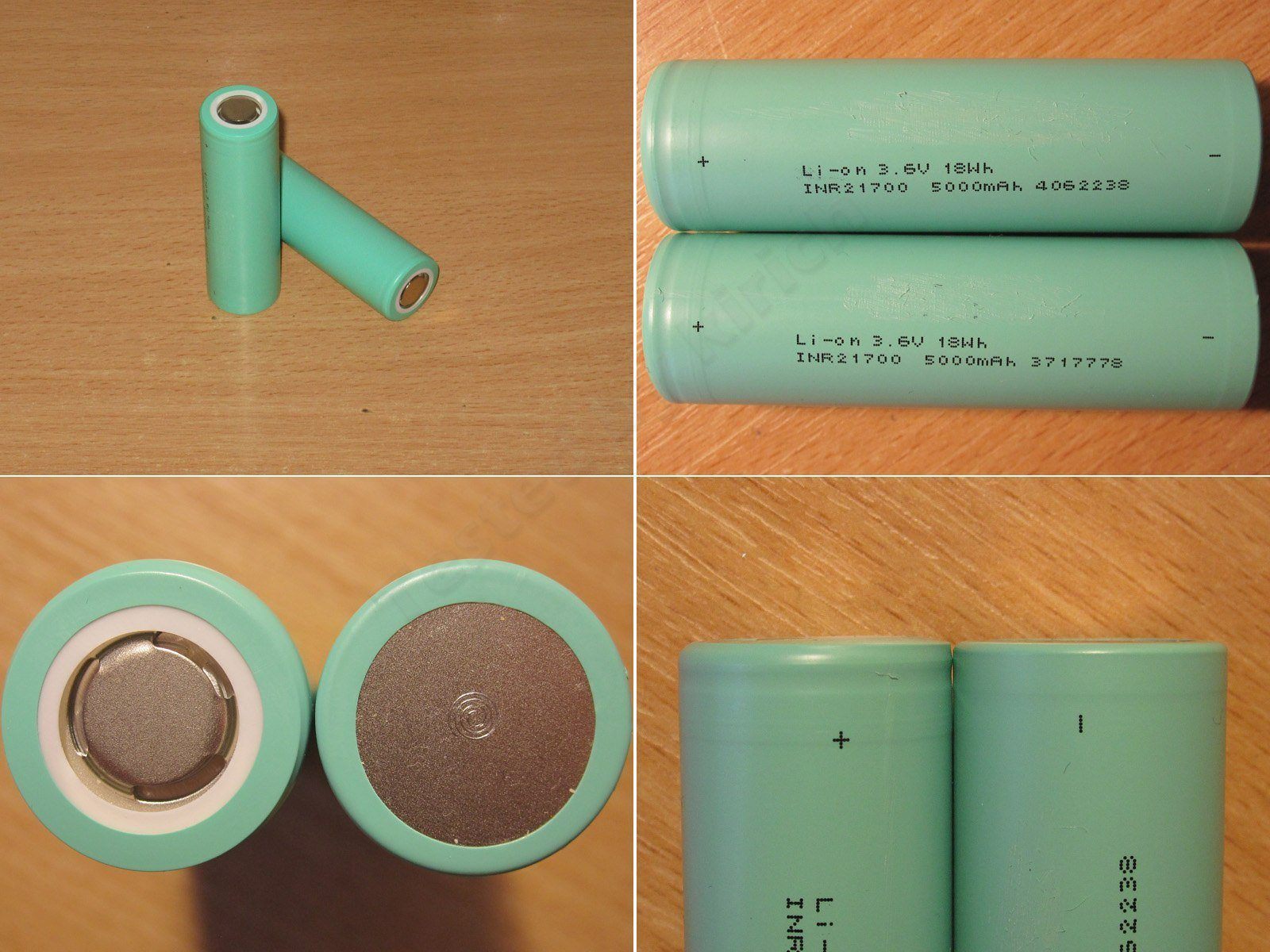
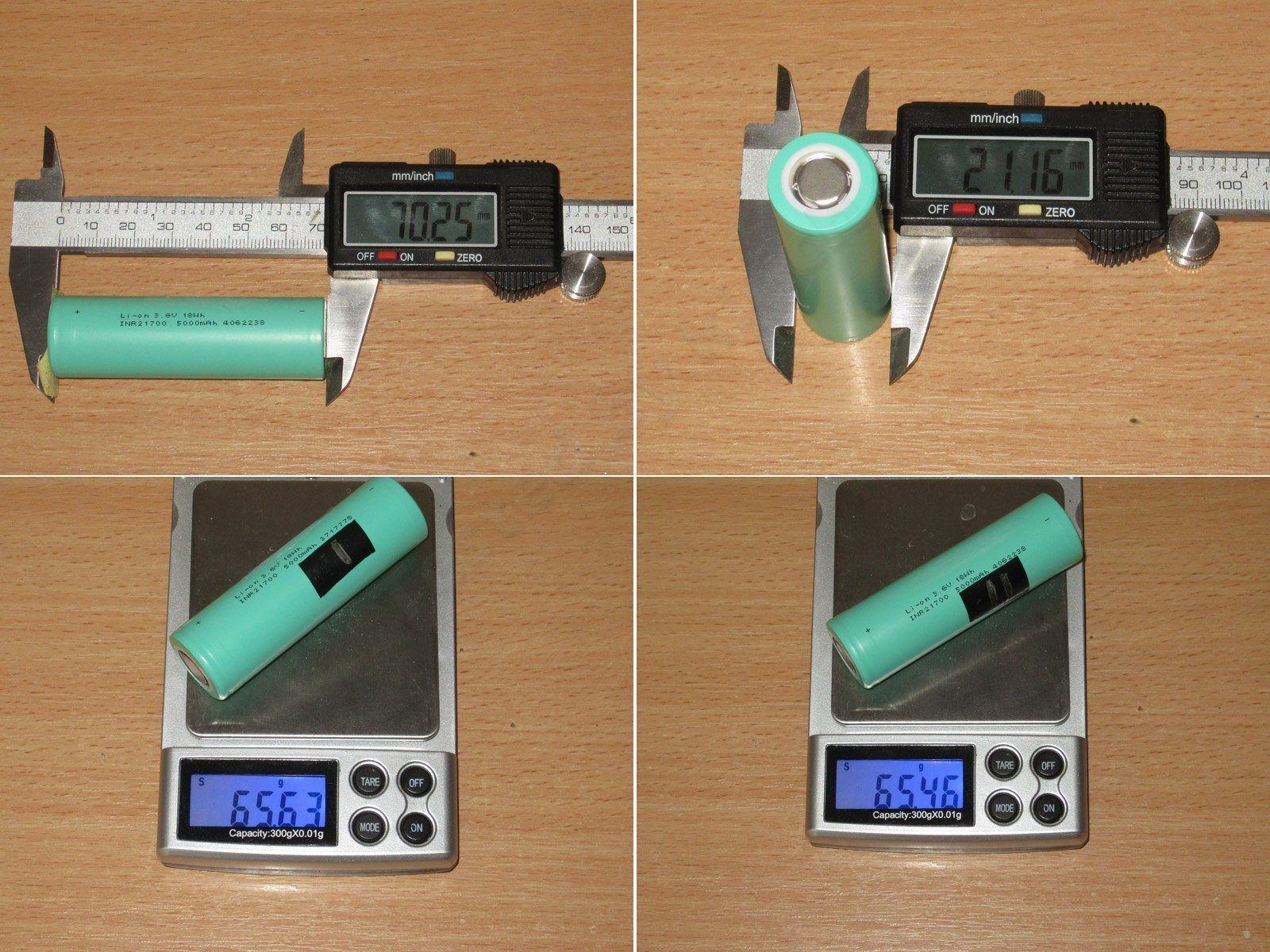
It took 4300 mAh to charge the first cell initially, while the second took about 4800 mAh, meaning it was essentially fully discharged.
The first discharge yielded around 5100 mAh.

These cells are a little weaker than the previous ones. Those were rated for up to 70 A, while these top out at 50 A. The same goes for charging current: up to 15 A for the previous cells, and 10 A here, so So they’re about one and a half times less “powerful,” if that’s the right word.
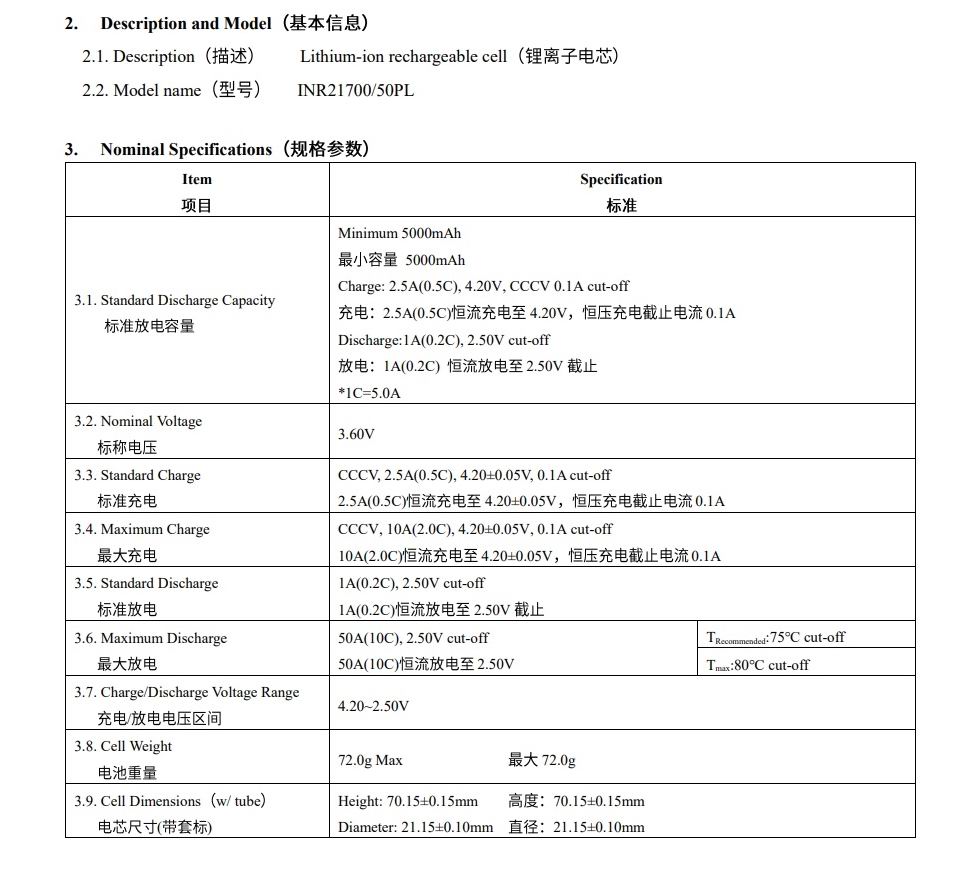
I tested charging at 0.5C and 1C, and these cells had the shortest charging time of all three samples.
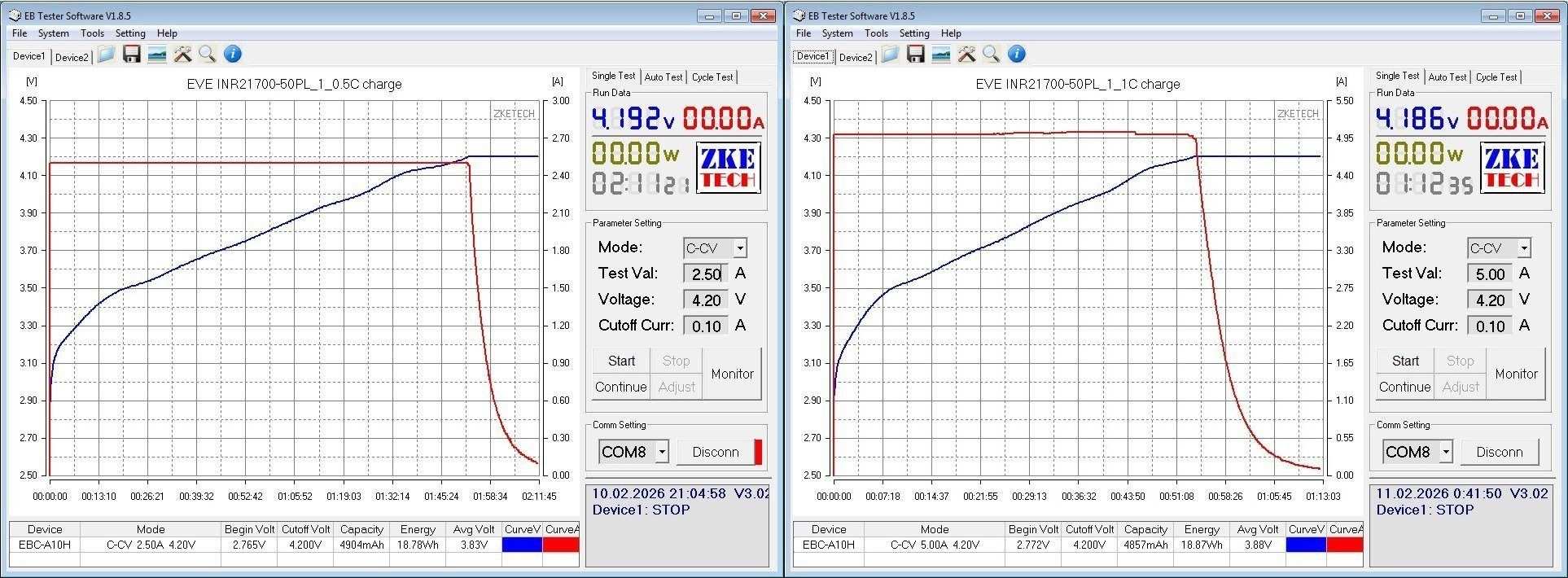
I tested discharge in the same ten modes: 0.2C, 0.5C, 1C, 2C, 3C, 4C, 5C, 6C, 7C, and 8C.
Only at the maximum current did the cell deliver exactly 5000 mAh. In all the other modes, I got slightly less, which is a little strange, since the datasheet specifies a minimum of 5000 mAh.
At currents of 5C, 6C, 7C, and 8C, the temperature results here were surprisingly a few degrees better too. Still, this may be due to the ambient temperature, or perhaps to the slightly lower capacity, meaning the heating lasted for less time.
The second sample gave me practically the same results.
The remaining capacity is about one and a half times lower than that of the previous cells, which is good.
The characteristics match quite well, but what’s interesting is that while most of the graph runs practically neck and neck, right at the end they “diverge” a little.
The cell impedance is even lower than that of the previous ones and doesn’t exceed 3 mΩ—really impressive.
And now for the comparison tests. I didn’t have that many similar cells, so there wasn’t much to compare them with—I had to “pull it out of thin air.”
1. EVE INR21700-50PL
2. Reliance INR21700-RS50
3. EVE 21700 40P
4. Molicel INR21700-P42A
5. Molicel INR21700-P45B
6. Vapcell T50
It occurred to me later that I could have included the Tenpower INR21700-50SG too, but in my opinion, it’s somewhat similar to the Vapcell T50.
At 2C, as expected, the Reliance INR21700-RS50 takes first place, followed by the Vapcell T50, with the EVE INR21700-50PL in third.
At 20 A, the picture barely changed: the Reliance INR21700-RS50 is still in first place, while the EVE INR21700-50PL is slightly ahead in second, followed neck and neck by the Vapcell T50.
And finally, a comparison of the EVE INR21700-50PL, Reliance INR21700-RS50, and Molicel INR21700-P45B, its closest competitor, this time at 40 A. As far as I remember, Molicel also has a 5 Ah model, but I haven’t had one to test.
And here, everything is just as predictable: the Reliance INR21700-RS50 takes first place, the EVE comes second by a small margin, and the Molicel INR21700-P45B trails noticeably. That’s understandable, since its capacity is 4500 mAh to begin with.
Additional test.
When the person who sent me these cells asked me to test them, they also immediately requested a discharge test after cooling them to 0 degrees. I didn’t aim for exactly 0 degrees; I simply left the cells on the balcony for a few hours when it was cold out. The case temperature was about -3 degrees.
In theory, I could have tested them on the balcony too, but I figured that in this case it wouldn’t make sense because the cells would heat themselves up, especially at high discharge currents.
I tested the Tenpower INR21700-50SG first, although I can’t say it made much sense. I measured at 10 A and 20 A, i.e. at the maximum current and half of it.
Of course, it probably would have made sense to test them in the cold, since the cell had time to warm up in the open air during those 30 or 15 minutes. although I tried to put it under test as quickly as possible.
The red plots show the cell at room temperature, and the blue ones at an initial temperature of 0 degrees. Even here, you can see that the voltage initially sags, then rises to its normal level as the cell warms up.
At 20 A, the cell reached 71.4 degrees by the end of the test. In the test at room temperature and the same 20 A, the temperature was only one degree higher.
Things get more interesting from here. I tested the high-current cells at 20 and 40 A, so the tests lasted 15 and 7.5 minutes, respectively, and the air temperature had a much smaller effect.
Here we also see a noticeable voltage sag, especially at 40 A. But thanks to self-heating, by around the end of the first third to halfway through the test, the cells reach their normal operating range. I wouldn't say they delivered much less energy as a result.
Yes, one thing to clarify: the higher impedance makes the battery heat up more at the start, so it delivers less in Wh than at room temperature. Capacity in Ah, however, depends less on temperature.
Temperature at 20 and 40 A. I don't have results for 20 A, and at 40 A it's practically the same as when starting at room temperature.
At first glance, the EVE INR21700-50PL shows roughly the same picture.
But the comparison plot for the Reliance INR21700-RS50 and EVE INR21700-50PL is much more interesting.
Here you can clearly see the effects of both the difference in impedance and the difference in initial capacity.
The Reliance INR21700-RS50 has roughly 10–15% higher impedance, so its voltage sag is noticeably greater. But since it started with more capacity, it also finished the test later and delivered more energy.
In this test, the cells are essentially equal: one makes up for its shortcomings with lower impedance, the other with greater capacity. You just need to decide what matters more to you: capacity or slightly higher voltage.
Conclusions.
This is one of those cases where there isn't much to conclude. First, all the batteries performed perfectly well. Second, I don't have anything to compare these high-current cells against, so I'll sum things up in general terms.
The Tenpower INR21700-50SG cells are decent mid-range cells: they don't stand out for either high discharge current or high capacity, but they work quite well, and I think they can deliver even more than the rated 20 A.
The Reliance INR21700-RS50 and EVE INR21700-50PL are very similar overall, but there are a few caveats and oddities. I was a little surprised that the Reliance INR21700-RS50 is rated for a maximum continuous current of 70 A, compared with 50 A for the EVE INR21700-50PL, yet it has higher impedance and handles the load worse. Capacity is the other way around: the Reliance is slightly higher. That's why they're roughly equal overall, but for heavy loads I'd probably prefer the EVE INR21700-50PL, putting the Reliance INR21700-RS50 in second place, albeit by a small margin.
One small note about the EVE INR21700-50PL: the person who sent them to me said they seemed to have high self-discharge. After sitting for about a month, their voltage had dropped to 3.8 V. I can't confirm or rule that out yet. After a week, the voltage on mine dropped from 4.2 V to 4.08 and 4.106 V, which is normal enough. I'll keep monitoring them.
That's all for now. I really hope this was useful, and thanks again to Andrey for sending the samples for testing.
This page was found when searching for:
как маркируются tabless аккумуляторы, https://www.kirich.blog/obzory/akkumulyatory/1298-tri-tipa-21700-yacheek-vysokotokvye-interesnye-tabless, tabless inr-21700, tabless батареи, tabless ячейки
как маркируются tabless аккумуляторы, https://www.kirich.blog/obzory/akkumulyatory/1298-tri-tipa-21700-yacheek-vysokotokvye-interesnye-tabless, tabless inr-21700, tabless батареи, tabless ячейки
This model is included in the summary table: Battery comparison: measured capacity and resistance
The figures from this review are in the measurement database: Batteries
Calculate manuallyAll calculators
Discounted products
You may be interested in


Discounted products
Support the project
All the content on the site and the advice are free, but we’d be grateful for your support of the project and the channel!
Discuss on the forumHave a question or some experience to share? Discuss the article with the author and readers: the forum is a convenient place to share schematics and photos.
Go to the forumOnly registered readers can comment. It takes a minute to sign up, and you can log in with the same account you use on the forum.
Log inRegister