
Test protocol
Comparison of adjustable converters for a bench power supply
Modules used to build a bench power supply: connect a regular power supply to one and get adjustable voltage and current with a display. This page brings together all the models reviewed on the blog, along with their measurement results.
- 24models
- 14review recommends
- 2014–2026review years
In brief: In the table 24 models: review recommends 14, with reservations 7, does not recommend 3. Lowest ripple in the test: RD6006P, 5 mV. Highest efficiency: RK8009, 98.9 %. Highest current: RD6030, 30 A.
Quick guide: what to choose
 Cleanest powerRD6006PJust 4–5 mV of ripple and a fast response to load changes. The trade-off is up to 20 W of heat in the linear regulator.
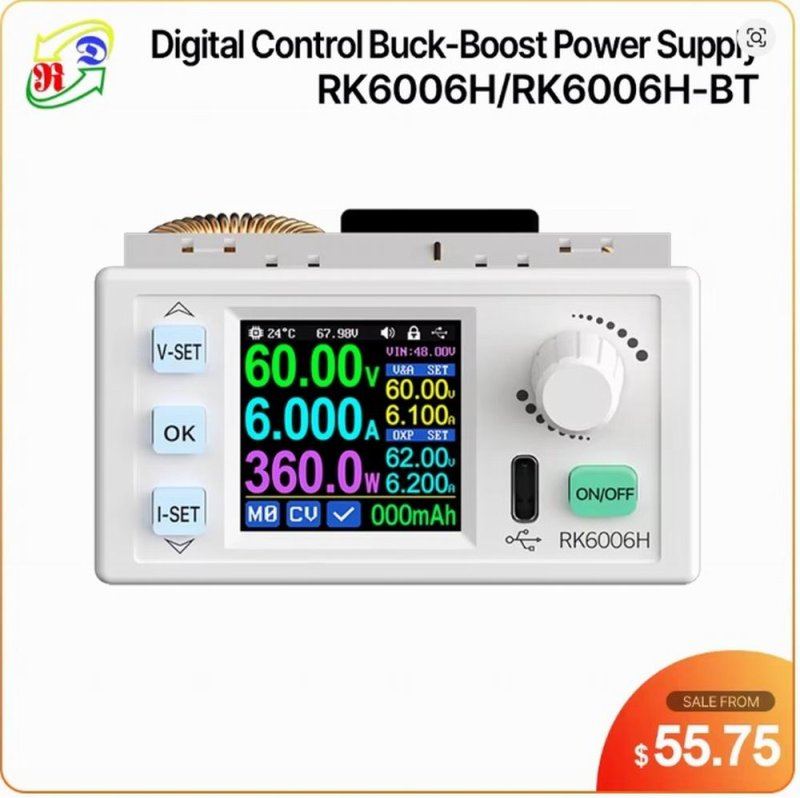 Compact and affordableRK6006Ripple is lower than specified, losses are up to 7.2 W, and the review recommends it. No battery charging mode.
 With battery charging modeRD6006, RD6018Dedicated charging output, computer control. Choose between 6 A and 18 A.
 High currentRD6024, RD6030Up to 24 and 30 A at 60 V; the RD6030 delivers up to 1800 W. Requires a suitable primary power supply. The RD6030-Max comes with its own power supply: 68 V, 28 A.
 Charging and less demanding loadsXY6020L20 A for a modest price. Fine for motors and batteries; for sensitive electronics, the RD60xx is a better choice.
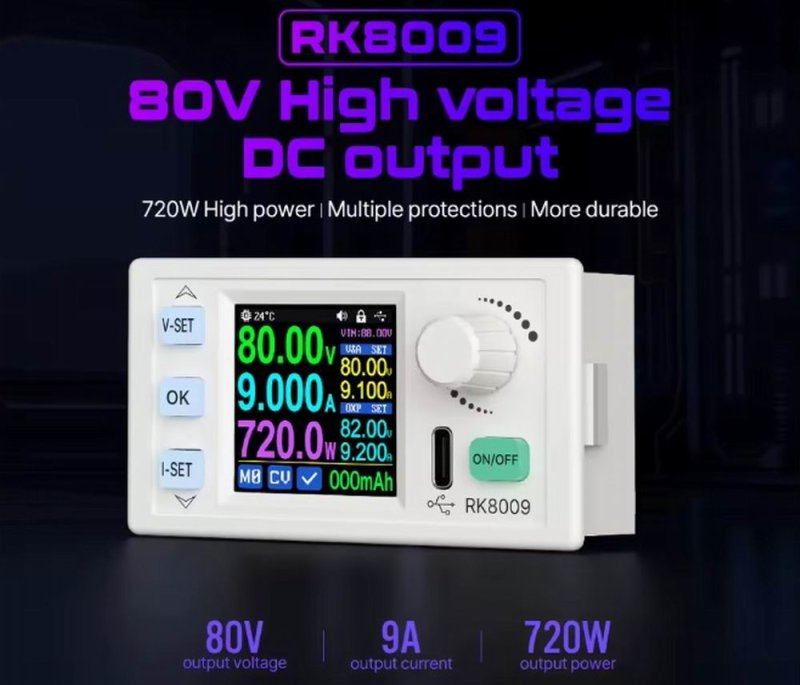 High voltageRK8009Up to 80 V and 9 A, with efficiency up to 98.9%. The margin for minimum voltage drop is small, which the review specifically points out.
All models
| Model | Output | Ripple, test | Max. efficiency | Review conclusion | ||
|---|---|---|---|---|---|---|
| RK8009RuiDeng · 2026 | 80 V / 9 A | — | 98.9 %98.9% at 80 V | Recommended | Low ripple, high efficiency, and little heat. The author notes that it simply works. The margin for minimum voltage drop is small. Typestep-downRead review |
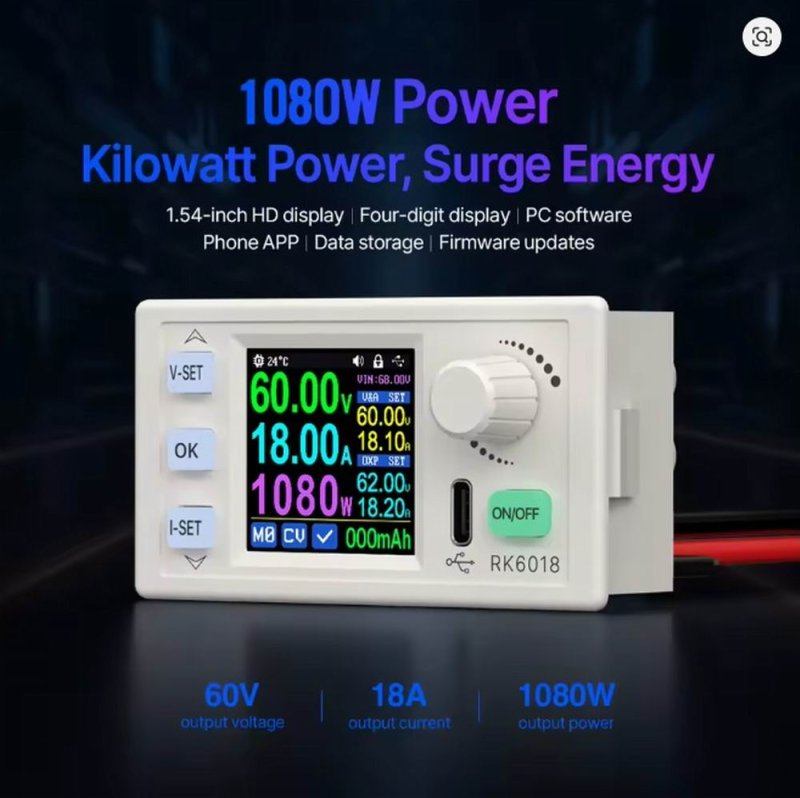 | RK6018RuiDeng · $57 · 2026 | 60 V / 18 A | 35 mV35 mV | 98.6 %98.6% at 54 V | Recommended | About 940 W output in the test, with temperatures around 70 degrees. No complaints about the converter itself, though the author notes that the SCP protection behaves strangely. Typestep-downRead review |
| RK6006HRuiDeng · 2026 | 60 V / 6 A | 60 mVno more than 55–60 mV under the worst conditions | — | Recommended | A compact option with universal input: good accuracy and low ripple. The author considers it an excellent choice for off-grid power. Typestep-up/step-downRead review |
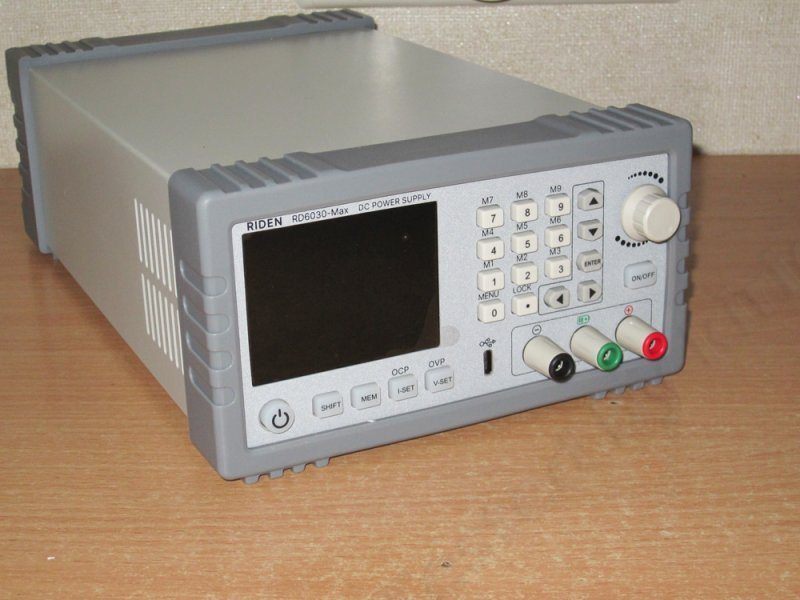 | RD6030-MaxRuiDeng · 2026 | 68 V / 28 A | — | 88 %about 88% including the power supply | Recommended | Large display and 1831 W output in the test. The fan is noisy, and the system draws about 20 W with no load, but the author liked the model. Inputwith built-in power supplyRead review |
 | RK6012RuiDeng · 2026 | 60 V / 12 A | 100 mVmeets the specified 100 mV limit | 98.8 %98.8% at 54 V and 12 A | Recommended | Compact converter: nearly 648 W output in the test, with a maximum temperature of 77 degrees. The voltage sags noticeably under load. |
 | RD6012HRuiDeng · 2025 | 60 V / 12 A | 20 mVabout 20 mV | — | Recommended | Universal input and a specified 720 W output, about 20 mV ripple, and a hottest component temperature of 82 degrees. The author really liked the model. |
 | RD6018PRuiDeng · 2025 | 60 V / 18 A | — | 94.9 %94.9% at 36 V | Recommended | Hybrid version of the RD6018: 927 W output in the test, with efficiency up to 94.9%. Losses are higher than with the standard model; the hottest component reaches about 108 degrees. Typehybrid (DC-DC + linear)Read review |
 | RK6006RuiDeng · $36 · 2023 | 60 V / 6 A | 65 mV60–65 mV (100 specified) | 97.9 %83.4–97.9% at 6 A | Recommended | It exceeded expectations: compact, accurate, and with good dynamic test results. No charging mode; input-to-output voltage drop is about 5 V. Typestep-downInputup to 58 V specified; 66–68 V needed for full outputConnectionUSB on the front panel, smartphoneRead review |
| RD6006 (W)RuiDeng · $53.50–57.50 · 2019 | 60 V / 6 A | 95 mV95 mV, spikes over 160 mV | 96.4 %73.7–96.4% at 6 A | Recommended | I liked it and would buy it myself. 1 mA steps, battery charging mode. The input voltage must be 3–4 V higher than the output. |
| RD6006PRuiDeng · $75.47–80.16 · 2021 | 60 V / 6 A | 5 mV4–5 mV, spikes of 15–20 mV | 94.6 %60–94.6% at 6 A | Recommended | Best ripple and load response in the lineup, with an order-of-magnitude finer resolution. Lower efficiency: around 20 W is lost as heat. Typehybrid (DC-DC + linear)Inputup to 70 V, for full output from 66 VConnectionUSB, Wi-FiRead review |
 | RD6018 (W)RuiDeng · $73.50–77.50 · 2020 | 60 V / 18 A | 200 mVup to 200 mV at 18 A | 97.2 %83,3–97,2 % | Recommended | If you're choosing the RD6012 and are willing to pay extra, the review recommends this one: 1.5 times the current with no drawbacks. There is a power limit. |
| RD6024RuiDeng · $98–103 · 2022 | 60 V / 24 A | —rated at up to 150 mV, with spikes getting in the way | 97.1 %80,8–97,1 % | Recommended | A decent alternative to the RD6012 and RD6018, with current up to 24 A and excellent stability. No four-wire load connection. |
 | RD6030RuiDeng · $108 · 2024 | 60 V / 30 A | 80 mVaround 80 mV at 30 A | 95.7 %83,6–95,7 % | Recommended | A higher-power RD6024 rated for up to 1800 W, which the author liked. At full current, the voltage sags by 45–50 mV. |
 | ZXY6005SZXY · $55.99 · 2014 | 60 V / 5 A | — | — | Recommended | A complete, ready-to-use device; the author would recommend it and buy it again. The input capacitor has little headroom. This is already an old model. |
 | RD6012 (W)RuiDeng · $67.50 · 2020 | 60 V / 12 A | 200 mV200 mV at 12 A | 98.4 %80.6–98.4% at 12 A | With reservations | Twice the power of the RD6006, higher efficiency, and good calibration. But ripple is noticeably higher, and the current step is coarser: 10 mA versus 1 mA. |
 | DPS8005RuiDeng · $33.50–39.50 · 2018 | 80 V / 5 A | — | 98 %around 97–98% | With reservations | Good specs, a wide voltage range, and convenient PC software. Ergonomics without a computer are lacking, and the board is difficult to repair. |
 | DPS5020RuiDeng · $48.99 · 2018 | 50 V / 20 A | 160 mVaround 160 mV, sawtooth waveform | —“really high” | With reservations | An interesting design with high efficiency and good software, at half the price of the ZXY. Drawbacks: considerable ripple and a single input fuse. |
 | DPH5005RuiDeng · $36.94–42.94 · 2018 | 50 V / 5.1 A | 100 mVup to 100 mV | —noticeably lower at low voltages | With reservations | Universal input: suitable if 250 W is enough and you have a 24–36 V power supply on hand. For a 48 V power supply, the review recommends DPS boards. |
 | ZXY6020SZXY · $71.56 · 2016 | 60 V / 20 A | — | — | With reservations | The author is pleased: it really delivers up to 62 V and 22 A. Not recommended for sustained full-power loads; the temperature sensor design is poor. |
| XY6020LXY · $21.29 · 2024 | 60 V / 20 A | 150 mV100 mV at 14 A, around 150 mV at 20 A | 97.3 %76,3–97,3 % | With reservations | Fine for charging batteries and powering non-critical loads; the price is low. The review does not recommend using it to power sensitive electronics. |
 | DC-6006LFnirsi · $36 · 2020 | 60 V / 6 A | 150 mVup to 150 mV (100 mV claimed), much higher in CC mode | 97 %87,9–97 % | With reservations | Good display and enclosure, but problems in CC mode and with assembly. Usable for non-critical loads. |
 | WZ5005$25.07 · 2020 | 50 V / 5 A | 80 mV75–80 mV at full current | 97.4 %86,8–97,4 % | Not recommended | Very rough around the edges: spikes when switching between CC/CV, voltage drifts under load, poor assembly, though efficiency and ripple are good. |
 | XYS3580XY · $19.39 · 2020 | 36 V / 5 A | —high; the review includes oscilloscope traces | —low | Not recommended | More drawbacks than advantages: overheating, high ripple, low efficiency, “white screen.” The only convenient feature is the adjustment range. |
 | XH-M403$14.54 · 2020 | 32 V / 5 A | — | — | Not recommended | Based on the XL4016, 5 A continuous and 8 A peak, with no current adjustment. The review concludes it isn't worth the money. |
Conclusion — a brief summary of the review’s findings. See the review itself for details and measurement conditions. Prices are as of the review date and may have changed since then. A dash means this value isn’t mentioned in the review; it’s often shown in the specs photo. The scales show how each model compares with the others on this page: green — good, yellow — average, red — poor.
Frequently asked questions
Which adjustable converter should I choose for a bench power supply?
For the cleanest output, choose the RD6006P; for a compact, inexpensive build, the RK6006; for battery charging, the RD6006 or RD6018; for high current, the RD6024 or RD6030; and for voltages up to 80 V, the RK8009. This recommendation is based on the results of reviews on the blog.
Which model has the lowest ripple?
The RD6006P: 4–5 mV, with spikes of 15–20 mV. The trade-off is lower efficiency: about 20 W is dissipated as heat in the linear regulator.
What power supply do I need for the RD6006 and RK6006?
The input voltage must be higher than the output: by 3–4 V for the RD6006, and by about 5 V for the RK6006. To get the full 60 V output from the RK6006, you need 66–68 V at the input.
Which models do the reviews advise against?
WZ5005 (spikes when switching between CC/CV and drifting voltage), XYS3580 (overheating, high ripple, low efficiency), and XH-M403 (no current adjustment).
Can the XY6020L power sensitive electronics?
The review advises against it: this model is well suited to charging batteries and powering less demanding loads. At 20 A, ripple is about 150 mV; for sensitive electronics, the RD60xx series is a better choice.
